On January 10, 2025, autonomous-driving company Pony.ai and BAIC BJEV said their partnership has entered a "Cooperation 2.0" phase, and launched a five-in-one program centered on "product co-creation, joint market development, supply-chain linkage, ecosystem co-building and capital alignment" to deepen collaboration.
It's more than a routine upgrade. For China's autonomous-driving industry, it marks a pivot from proving out the tech to scaling it — commercially and globally.
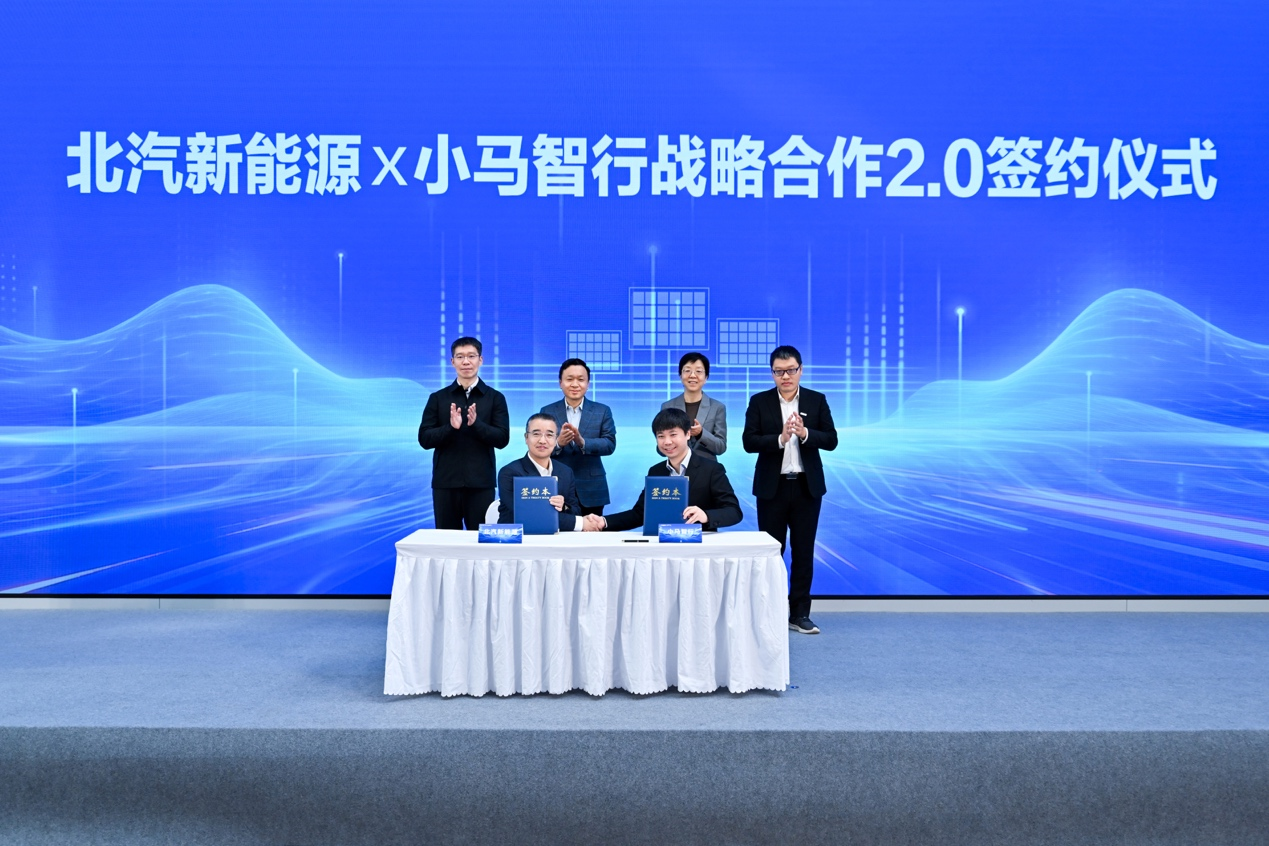
Image source: Pony.ai
From project deals to ecosystem building: a five-in-one remake of industry collaboration
For years, most collaborations in autonomy stopped at a "tech + vehicle" project model: tech firms supplied algorithms and systems, automakers offered vehicle platforms, and the two sides ran tests and small pilot operations.
That setup can validate feasibility quickly, yet it rarely solves the core challenges of scaled production, cost control, sustained operations and a closed business loop.
Pony.ai and BAIC BJEV's "five-in-one" is essentially a systemic upgrade of that model — aiming to build a sustainable, scalable, deeply integrated industrial community.
First, "supply-chain linkage" tackles the pain point of mass production. Moving autonomous driving from factory-fit to ongoing operations involves sensor integration, reworking E/E architecture, supply-chain cost management, and adapting maintenance systems — a complex set of engineering tasks.
To that end, the two will launch actions to "fill, build, stabilize and upgrade" the supply chain, pushing China's L4 mass-production forward. Pony.ai will work closely with BAIC BJEV's OEM supply-chain system, optimizing performance requirements, maintenance costs and full life-cycle costs for L4 models — continually cutting the robotaxi BOM and operating costs. Meanwhile, by setting new standards and stimulating new demand, they aim to nurture domestic high-end intelligent-driving supply clusters, injecting fresh momentum into local advanced manufacturing.
In short, the collaboration is shifting from aftermarket retrofits to factory definitions — and from joint development to supply-chain coordination.
Next, "ecosystem co-building" and "capital alignment" focus on forging a commercial loop and long-term trust. BAIC BJEV will bring in group mobility platforms (such as Huaxia Mobility) and aftermarket resources, integrating them with Pony.ai's fleet to connect the full value chain — R&D, manufacturing, customer acquisition, operations, maintenance and finance. That integration should lower marginal operating costs for robotaxis and accelerate scale-up and the path to profitability.
On capital, the partners will deepen ties beyond their existing mutual investments, co-investing around tech R&D, supply-chain assets and global expansion — creating tight alignment across "co-developing technology, co-expanding business and co-investing capital."
Capital is not just a financial bond; it underpins strategic coordination and shared risk, aligning interests and making the partnership more durable.
The deeper meaning of this five-in-one model is that it tries to answer autonomy's central commercialization question: how to cross the gap from demo to product to commodity through systemic collaboration.
As the industry moves beyond counting test miles and disengagement rates, manufacturing scalability, cost control, operating efficiency and ecosystem synergies have become the new battlegrounds.
This tie-up blends each side's strengths in tech iteration, vehicle manufacturing, supply-chain management, mobility ecosystems and capital — exploring a path to scaled deployment powered by industry coordination.
Taking the "China solution" global: exporting both technical standards and business ecosystems
Another clear theme is globalization.
The partners plan to bring the ARCFOX Alpha T5 robotaxi — their benchmark model — and its full operating system to strategic markets in the Middle East and Europe. They emphasize this is not just "vehicle export," but a global export of technical standards, operating models and business ecosystems.
It signals a shift in Chinese autonomous-driving firms' overseas strategies: moving from one-off tech licensing or vehicle shipments to systemized exports of "product + operations + ecosystem."
Complex traffic in China's tier-one cities provides a demanding training and validation ground. Robotaxis already running routinely in Beijing and Shenzhen have amassed data, iteration experience, and decision models for "China-style traffic," forming a distinctive "China solution."
That solution spans perception, prediction and planning — and includes operating strategies for dense mixed traffic, safety redundancy designs, and user-facing HMI. Pushing it overseas, especially to parts of the Middle East and Europe with similarly compact urban patterns, should offer strong scenario fit and competitiveness.
Pony.ai has already built a presence in 8 countries, including Luxembourg, Qatar and the UAE — local experience that will be key to this push. Globalizing autonomy is no copy-paste: it demands regulatory adaptation, data compliance, infrastructure integration, user-habit cultivation and local partnerships. Pony.ai's early footprint paves the way for a joint go-to-market with BAIC BJEV. Their approach — Pony.ai providing the autonomous-driving stack and operations platform, BAIC BJEV delivering customized mass-production vehicles, and the two jointly plugging into local mobility ecosystems and regulators — forms a replicable "tech + product + operations" template for going abroad.
Conclusion
Pony.ai and BAIC BJEV's five-in-one deepening comes as China's autonomous-driving sector works through a capital boom and a more sober reset — striving to push past the "pre-dawn of commercialization."
It reflects the ambition to build a new paradigm spanning tech R&D, mass manufacturing, commercial operations and global expansion. The outcome matters not only to these two companies; it could become a key case study in how China — and the world — move from technical leadership to commercial success in autonomy.
Amid a sweeping industrialization wave, an ecosystem-first, long-term approach — grounded in system capabilities — may be the rudder that helps players ride out cycles and reach the other shore.