



Gasgoo Munich- If 100-million-yuan funding rounds were the norm for embodied AI last year, that bar has been raised significantly this year. Now, 1 billion yuan is becoming the new entry ticket for top-tier players vying for a spot in the race.
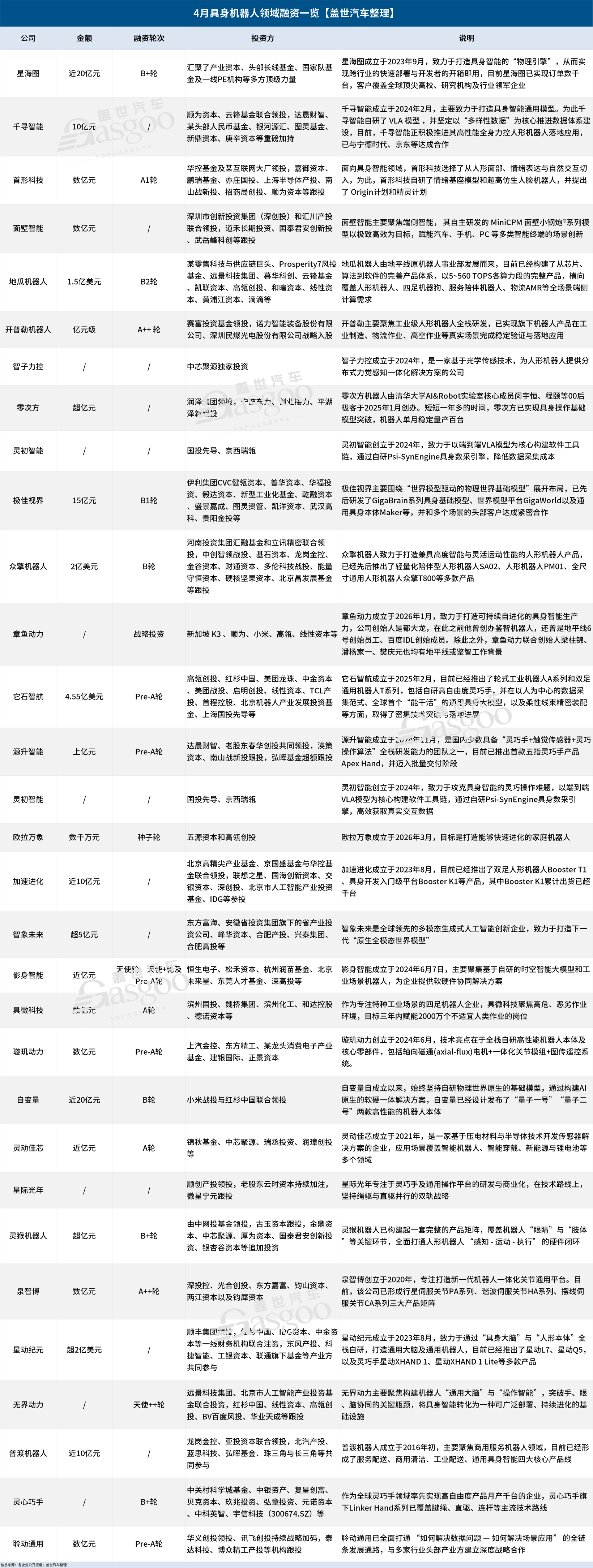
According to statistics from Gasgoo, April alone saw 32 disclosed funding rounds in the embodied robotics and core components sector. Of these, 10 rounds hit the 1-billion-yuan mark—including two at 2 billion yuan and one at 3 billion yuan—marking a further climb in the density of mega-deals compared to previous months.
That brings the total for the first four months of 2026 to 26 funding rounds of at least 1 billion yuan in the embodied intelligence and core components space, involving 21 companies and totaling nearly 40 billion yuan. Nine of those rounds exceeded 2 billion yuan, with several companies securing more than one 1-billion-yuan deal in recent months.
Where capital flows, certainty follows. As funding continues to concentrate on a handful of leading projects, the embodied intelligence sector is entering a new phase defined by "oligopoly preparation."
Billion-Yuan Rounds Become the New Normal
In April, the largest funding round in the embodied intelligence space went to TARS—roughly $455 million, or about 3.1 billion yuan. It stands as the largest single-round fundraising record on record in China's embodied AI sector.
Even more notable is that this round was at the Pre-A stage. In other words, as a startup just one year old, TARS secured a capital haul that many established companies fail to raise even by their Series C or IPO—before it had even completed its Series A.
Behind this lies a shift in the capital market's valuation logic: it is no longer merely about betting on the sector's direction, but a full endorsement of TARS's core team and technological path.
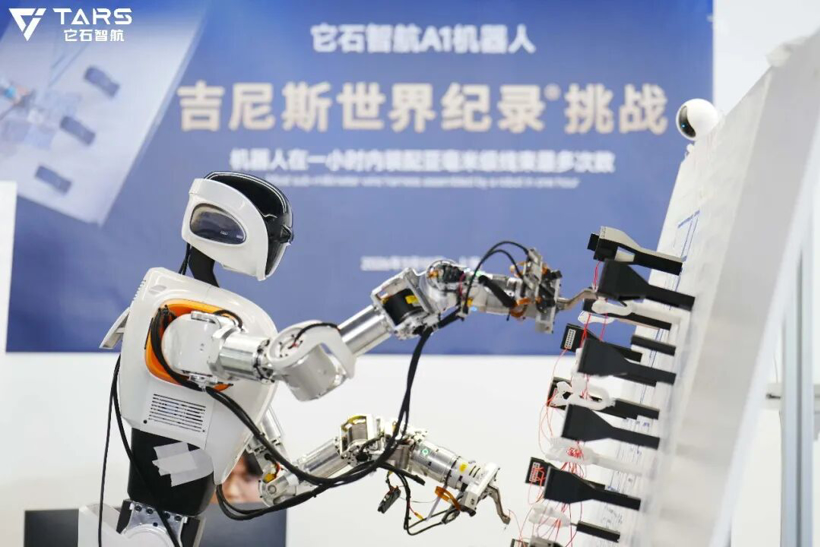
Image Source: TARS
TARS's core team is a veritable "all-star team" of autonomous driving veterans. Founder and CEO Chen Yilun formerly served as CTO of Huawei's autonomous driving unit and chief scientist at its Intelligent Automotive Solutions BU. Chairman Li Zhenyu, previously president of Baidu's Intelligent Driving Group, spearheaded the creation of the Apollo open platform and the Apollo Go robotaxi service. Co-founder and Chief Scientist Ding Wenchao, one of Huawei's first "Genius Youth" recruits, not only led Huawei's autonomous driving decision-making networks but also spearheaded the development of the first humanoid robot at Fudan University.
This means TARS is not merely a "promising startup," but a battle-hardened "army" that has won the grueling fight for autonomous driving mass production and possesses mature deployment experience.
Against this backdrop, capital investment in TARS is not a bet on a concept or hypothesis, but a recognition of its proven capabilities and track record.
Given that autonomous driving and embodied intelligence share a deep commonality in underlying logic and technical architecture, Tashi's core team can systematically transfer the perception, planning, and control capabilities accumulated in autonomous driving to the embodied intelligence arena, creating a natural competitive edge.
Chen Yilun has noted on multiple occasions that autonomous driving and embodied intelligence are technologically of the same lineage. Autonomous driving is essentially a key sub-task of embodied intelligence, handling the movement and navigation of agents in complex, dynamic physical environments. The mature end-to-end systems in autonomous driving unify perception, decision-making, and planning within spatiotemporal coordinates—a paradigm that provides the fundamental underlying framework for robots to understand and act in the physical world.
The other two 2-billion-yuan rounds in April were secured by X Square Robot and Xinghai Tu (Beijing) Artificial Intelligence Technology. Prior to this, both companies had already closed 1-billion-yuan rounds in January and February, respectively. This means that in 2026 alone, X Square Robot and Xinghai Tu (Beijing) Artificial Intelligence Technology have each raised approximately 3 billion yuan.
Additionally, Spirit AI, D-Robotics, Gigaai, ENGINEAI, Booster Robotics, ROBOTERA, and Pudu Robotics all successfully secured new 1-billion-yuan funding rounds in April. Among them, Spirit AI, Gigaai, and ROBOTERA each landed their second mega-round of the year.
This intensive, large-scale capital deployment underscores continued confidence in these companies, while also serving as indirect confirmation that they are collectively crossing a critical watershed: the ability to convert technology into real-world productivity.
In other words, the high-value follow-on investments are not merely a repetitive expression of confidence, but a continued bet on the developmental certainty that these top players are progressively delivering.
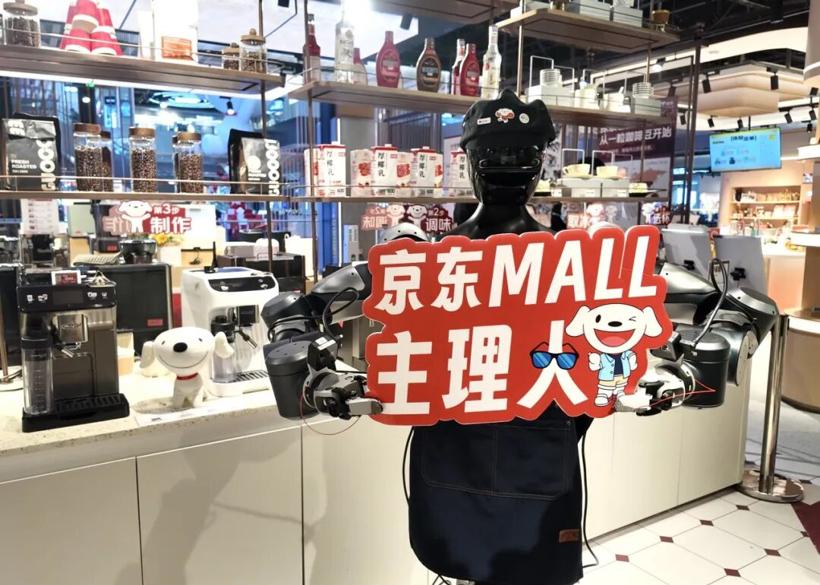
Image Source: Spirit AI
Take Spirit AI's Moz robot, for instance. It has already officially "gone on duty" at JD MALL offline stores, handling high-precision coffee preparation and service tasks. Future plans include expanding into retail scenarios such as JD pharmacies, inspection and guidance, and automated cleaning.
Gigaai's general-purpose robot, the Maker H01, partnered with FAW Die & Mold and Alibaba Cloud to implement a full-process solution for embodied intelligence robots in real-world industrial manufacturing settings, with plans to sprint toward 1,000 unit deliveries this year.
Viewed from this angle, the intense funding secured by leading companies reflects a fundamental shift in the competitive logic of the embodied intelligence track. It has evolved from "storytelling and concept battles" into a ruthless contest of "execution and tangible results."
Looking at the composition of investors, April's financing market sent another clear signal: Super-industry giants are entering the fray, shifting from "bystanders" to "heavy-weight backers."
For example, Spirit AI's latest round was co-led by Shunwei Capital (backed by Lei Jun) and Yunfeng Capital (backed by Jack Ma). ROBOTERA's latest round was led by SF Group. X Square Robot's new funding was co-led by Xiaomi's strategic investment arm and Sequoia China. TARS is backed by Meituan and TCL, while Gigaai counts the Yili Group among its supporters.
It is clear that cross-sector forces—from tech giants and logistics leaders to consumer industry capital—are rushing in, pouring significant resources into staking their claims in the embodied intelligence sector.
Behind this phenomenon lies both a definitive bet by industrial giants on the vast prospects of embodied intelligence and an inevitable strategic move to bolster their own business ecosystems and seize the future high ground.
However, the higher the resource density of top players, the narrower the window becomes for those chasing behind.
With competitive barriers raised significantly, these companies must comprehensively catch up across every dimension—from financial reserves and talent density to data accumulation, production ramp-up, and client relations—just to remain at the "table."
Ability to Work Is the "Real Ticket"
From the perspective of industry development, while 1-billion-yuan funding rounds can rapidly help top players build competitive barriers in technology, production capacity, and deployment scenarios, they ultimately represent only a "mid-race refuel" in a long marathon.
What truly creates a gap between companies is the efficiency with which they convert capital into actual delivery capabilities—and the intense wave of commercialization signals since April is making that efficiency measurable.
At APC 2026, AgiBot founder, chairman, and CEO Deng Taihua outlined a clear framework for the stages of the embodied intelligence industry: 2022-2025 is the "development and trial period," where robots move from prototype to mass production and learn to "move"; 2026-2030 is the "deployment and growth period," where robots begin to "work" and become true productive forces in the physical AI world; and post-2030 marks the "deployment and ubiquity period," where the "GPT moment" for embodied intelligence arrives, creating reliable productivity units capable of cross-industry scaling and full-scenario deployment.
Deng defines 2026 specifically as the "first year of deployment." Notably, this aligns with a broad industry consensus on the pace of embodied intelligence adoption.
Previously, the industry competed on prototype capabilities and technology narratives. Starting in 2026, the market's core metrics will shift toward scaled deployment and real-world scenario delivery. The ability to produce mature products that "can work," create quantifiable value in specific scenarios, and even secure stable repeat orders from customers will become the core standard for remaining in the game.
Behind this judgment lies AgiBot's initially closed commercialization loop.
According to data disclosed by AgiBot, revenue was a mere 300,000 yuan in 2023, but surged to exceed 60 million yuan in 2024, and in 2025, it vaulted past the 1 billion yuan mark. Correspondingly, shipments of its humanoid robots alone exceeded 5,100 units in 2025.
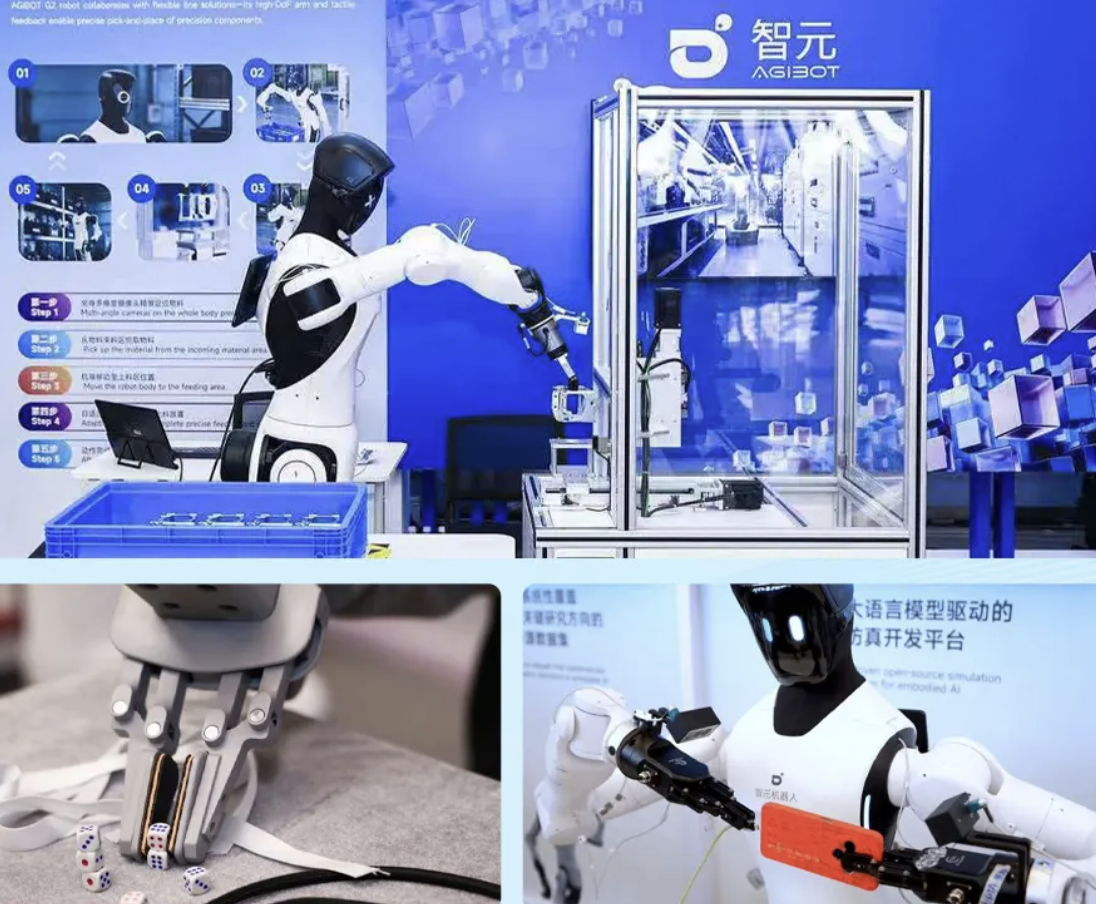
Image Source: AgiBot
In March of this year, AgiBot'ss 10,000th general-purpose embodied robot officially rolled off the production line, just one quarter after the 5,000-unit milestone. At this growth rate, the company's overall revenue and production scale are set to hit new highs this year.
Particularly in recent months, while cultivating the domestic market, AgiBot has also accelerated its overseas expansion, which is expected to further speed up its commercialization. Currently, 30% of AgiBot'ss revenue comes from overseas, a figure it plans to lift to 50%. To that end, the company will begin building local manufacturing facilities in the U.S., Europe, and other regions this year.
For this reason, AgiBot co-founder, president, and CTO Peng Zhihui stated bluntly in a media interview, "We are not short of money right now." That confidence stems from the company's rapid commercialization progress. "Our commercialization pace allows us to achieve self-sufficiency, so we are not as desperate for external primary market capital," he explained.
Even so, it is undeniable that even AgiBot remains a long way from the true "GPT moment" for embodied intelligence.
In Peng's view, the inflection point for embodied intelligence will not come from a breakthrough in a single technology, but rather requires the simultaneous maturation of multiple key conditions within the same time window. These include large models significantly improving their understanding of the world, robot hardware crossing the threshold of reliable execution, and the continuous generation of high-quality data feedback through real-world deployment. Only through the convergence of these three can AI truly possess the capability to enter real production systems.
To this end, AgiBot is strengthening its systemic capabilities across multiple dimensions.
On the model front, AgiBot plans to release six AI models this year, including a whole-body motion control foundation model supporting sensory-control fusion, a generative motion control foundation model, the end-to-end embodied multimodal interaction large model WITA Omni 1.0, and the GO-3 model.
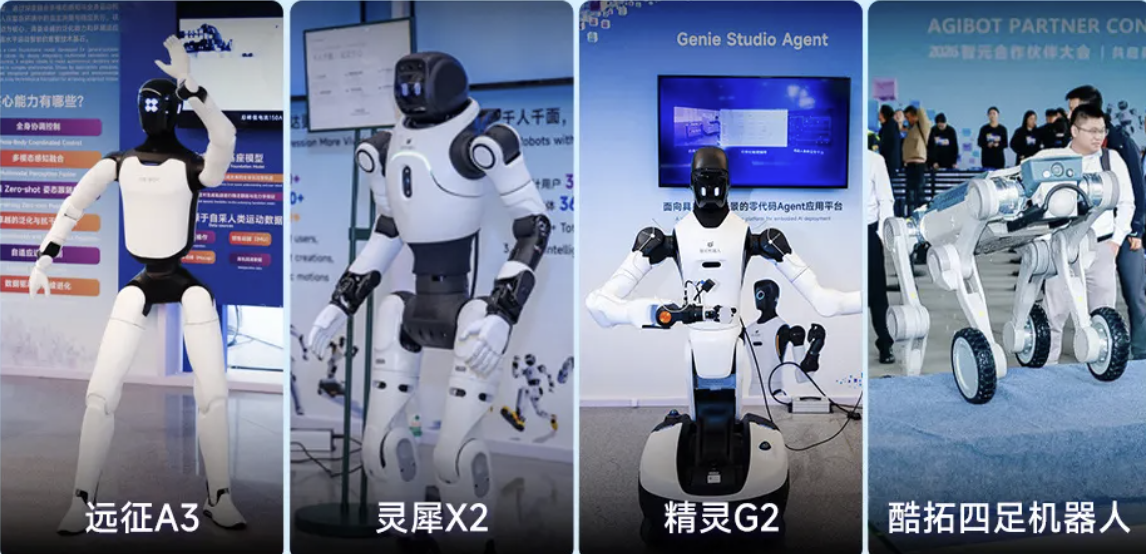
Image Source: AgiBot
On the hardware front, in addition to the flagship Yuanzheng A3 released in April, AgiBot will launch two new product lines this year: the Lingxi X3 and the Kutuo D2 series.
On the data front, AgiBot has launched the "Honeycomb Data Co-creation Initiative," a physical AI data network. Built on three pillars—systematic collection, standardized pipelines, and scalable supply—it aims to construct a multi-dimensional, extensible data ecosystem, with a target capacity of tens of millions of data hours within the year.
Furthermore, AgiBot plans to invest over 2 billion yuan over the next five years to build the embodied intelligence ecosystem, with the goal of helping thousands of partners grow.
Around the same time, Chery's AiMOGA held a global launch event in Wuhu, unveiling a series of major initiatives aimed at aggressively driving the scaled deployment of robots.
According to Zhang Guibing, general manager of Chery AiMOGA, the company plans to advance industrial implementation in three stages: the first involves creating price-friendly robots for child companionship; the second focuses on scenario-based robots for public and enterprise services; and the third aims to bring robots into households as intelligent assistants for daily life.
However, he also noted that true commercialization in the robotics industry cannot rely solely on single-product capabilities. It requires forming a complete closed loop that includes clear application scenarios, talent teams familiar with both robots and scenario requirements, sufficient technological reserves, a competitive supply chain, stable sales channels, financial leasing platforms, after-sales service systems, and data collection and feedback centers. Only by connecting the entire chain—from R&D and manufacturing to delivery, operations, service, and data feedback—can robots continuously evolve in real-world scenarios.
Notably, these happen to be Chery's core strengths. During the event, the AiMOGA Smart Police Robot successfully secured contracts for 1,000 units and completed a centralized delivery of 100 units—a feat backed by Chery's accumulated expertise in manufacturing systems, supply chain capabilities, global layout, and intelligent technology.
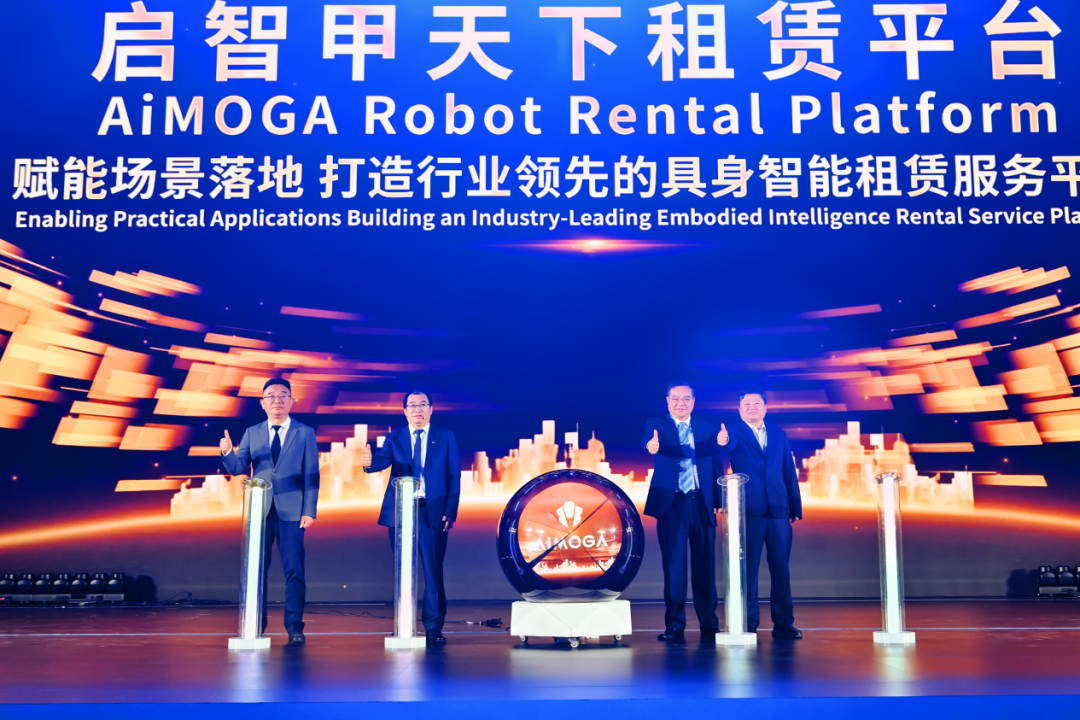
Image Source: AiMOGA
To further advance the scaled mass production of embodied intelligence, AiMOGA also established the "Qizhi Jiatianxia Robot Leasing Platform." It aims to accelerate the promotion and application of robots across more industries and scenarios through innovative models such as leasing, financial services, and operational support.
Additionally, AiMOGA is actively promoting the overseas expansion of its products. In early April, it signed a cooperation agreement with Vietnam's Geleximco Group, confirming plans to use a joint venture model to comprehensively advance robot R&D, manufacturing, and application deployment in Vietnam.
From this, it is evident that competition in the current embodied intelligence track has long since moved beyond comparing single technologies or products. It has officially entered a stage of systemic competition involving full-industry-chain layout and the construction of end-to-end capabilities. In particular, the data loop—drawing lessons from the autonomous driving sector—is becoming a long-term moat for players in embodied intelligence and a core advantage that other companies cannot quickly replicate or catch up to.
This also explains, from another dimension, why large-scale financing in the embodied intelligence sector is becoming increasingly dense: it is not that capital has become more generous, but rather that the arena has expanded and the entry tickets have become more expensive.
Some industry insiders even believe that the table for embodied intelligence is set at a minimum buy-in of $1 billion in funding. Viewed from this perspective, even the current top players have not yet reached a truly safe position.
Conclusion
Looking back from May, the embodied intelligence industry stands at a juncture where two tracks are advancing in parallel.
On the financing front, 1-billion-yuan rounds are no longer news; the real suspense lies in who will be the first to successfully close the loop on the data flywheel and scaled delivery. On the industry front, "deployment" is no longer a conceptual plan, but a reality that is unfolding.


