



Gasgoo Munich- Spring 2026 brought a rare "reverse maneuver" to China's auto market. Since March, Chery's EXEED ET5 high-spec version officially raised prices by 5,000 yuan; FAW Bestune's 2026 Yueyi 03 mid-to-high trims quietly climbed in price; and Zeekr 007GT and the new Xiaomi SU7 have both signaled upcoming hikes. These scattered adjustments point to a single culprit: memory chips.
As surging AI computing power collides with the proliferation of smart vehicles, two seemingly unrelated tracks are converging on chip supply. Cost pressures triggered by memory chips are rippling down the supply chain, finally breaking on the shores of retail prices.
This isn't the first raw material cost wave for NEV makers. Between 2020 and 2022, material costs rose significantly, culminating in 2022 price hikes of 5,000 to 30,000 yuan driven by subsidy cuts and material inflation. But this round is different: the scope is broader, transmission faster, and the market has shifted from a rapid expansion phase to a new era of stock competition.
AI Seizes the Lion's Share: Automotive Memory Enters a Seller's Market
"Foreign capacity has pivoted to the AI industry; the industrial storage sector is just too small," a mid-stream practitioner in automotive memory told Gasgoo. Since November, his company has issued three price increase notices—and a fourth is imminent.
Even so, they are struggling to maintain ties with foreign upstream chipmakers. "Chasing them for stock" has become the daily routine.
This is no isolated case but a snapshot of a global upheaval. Just three months into 2026, the global memory market has fully entered a "seller's market." Samsung and SK hynix notified clients in early March that Q2 DDR5 chip prices would rise uniformly by about 40%, with some products jumping as much as 100%. SK hynix was blunt on a February earnings call: "No single client's demand will be fully met this year."
The core engine driving this round of hikes is artificial intelligence.
HBM (High Bandwidth Memory) is the heart of this storm. Designed for AI large models or supercomputing chips, it stacks multiple DRAM chips using TSV technology, offering throughput far beyond traditional DRAM. But performance comes at the cost of capacity. Manufacturing one HBM chip consumes several times the 12-inch wafer capacity of standard DDR5, rapidly squeezing already tight advanced process capacity.
According to SEMI, global memory output will top $550 billion in 2026, overtaking foundries as the semiconductor industry's primary growth engine for the first time. HBM market size is expected to grow 58% to $54.6 billion, accounting for nearly 40% of the DRAM market, with an annual capacity shortage of 50% to 60%. Sigmaintell predicts global AI server-related chip sales will reach $169 billion in 2026, up 55% year-on-year.
For chipmakers, the calculation is cold and simple. According to SemiAnalysis, HBM prices are roughly five times that of standard DRAM. More importantly, margins on AI-specific HBM far exceed those of automotive-grade memory.
Automotive chips, by contrast, face a natural barrier in their "long-tail certification." Entering the supply chain requires years of costly validation—from AEC-Q100 reliability testing and ISO 26262 functional safety certification to final road testing and OEM designation. The cycle often takes 3 to 5 years.
This means once an automotive chip is finalized, its specs and supply chain are "locked" for the next 5 to 10 years.
For manufacturers, allocating precious advanced capacity to auto products means sacrificing higher profits today and shouldering "sunk cost risks" from slower tech iteration and high maintenance costs for years to come. This stands in stark contrast to the AI sector's fast pace: "one generation lasts two years; a new iteration replaces the old."
In this resource war, the auto industry is clearly on the back foot. AI firms often lock in capacity one to two years out through massive, long-term agreements. Auto chips offer lower margins and their long certification cycles give chipmakers pause. Meng Qingpeng, Li Auto's supply chain vice president, warned that the supply fulfillment rate for automotive memory chips could fall below 50% in 2026.
This isn't alarmism. For giants selling millions of units, it might mean config tweaks or delayed deliveries for high-end models. For smaller players with weaker risk resistance, it could mean production halts due to core component shortages.
Suppliers' "Extreme Survival": Inventory Drops from Monthly to Weekly
Mid-stream suppliers are absorbing the most direct shock along the cost transmission chain.
"We're trying hard to stockpile, but we still can't cover this seemingly endless price hike cycle," the insider revealed. Orders are booked through October, but they're hesitant to take more. "We're afraid memory chip prices will rise too high, making it impossible to balance costs."
By the time this reaches Tier 1 suppliers and OEMs, safety inventory duration is being further compressed. "It's not that we don't want to stockpile; we can't afford to, and we can't get the stock anyway," an anonymous supply chain director told Gasgoo.
UBS data shows automotive DRAM prices surged 180% over the past three months. TrendForce forecasts that in Q1 2026, general-purpose DRAM prices will rise 55% to 60%, and NAND flash by 33% to 38%. Spot prices for high-end automotive DDR5 have jumped as much as 300%.
UBS estimates that for a typical mid-sized smart EV, memory chip price hikes alone have added 4,000 to 7,000 yuan per vehicle, severely squeezing automaker margins. HSBC calculates that memory costs could add 1,000 to 3,000 yuan per NEV. While models vary, "significant cost increases" are the industry consensus—with high-end models bearing the brunt.
More troubling, it isn't just memory chips. Metal costs are climbing too. Since the conflict erupted on February 28, LME three-month aluminum prices jumped as much as 10%. As of Wednesday afternoon in London, they settled around $3,370 per ton—up roughly 8% since before the conflict. Supply tensions worsened after Alba, the world's largest smelter, announced production cuts, fueling fears of a global shortage.
CRU Group warns that if inventory levels keep falling and Middle East supply disruptions persist, aluminum prices could climb to $4,000 per tonne.
Specialty engineering plastics used in connectors and sensors are also caught in the geopolitical crossfire, relying heavily on imported raw materials. "Foreign clients mandate specific imported suppliers; now they're raising prices, and we just have to swallow it," a parts supplier said resignedly.
Adding to the chill, while raw material costs soar, downstream OEMs are still enforcing annual "price-down" policies. "We're being chased for hikes by upstream, while clients demand cuts from us—our margins are being squeezed to the thickness of paper," the supplier said. Facing new orders, the company has started tentatively adjusting quotes—unthinkable in recent years.
If memory chips are the "heart condition," then the rebound in power battery costs is the "Sword of Damocles" hanging over the 2026 NEV market.
Battery-grade lithium carbonate, a core material, has surged from around 75,000 yuan per ton in early 2025 to 155,000 yuan in March 2026—a jump of over 100%. Analysts estimate that for every 10,000 yuan increase in lithium carbonate per ton, the cost of an EV with a 50 kWh battery rises by roughly 3,000 to 5,000 yuan.
Yang Hongxin, chairman of battery supplier SVOLT, admits that the biggest uncertainty for hitting 2026 profit targets is upstream raw material inflation. "Suppliers often can't pass new costs on quickly or fully to downstream clients, meaning we must absorb a large chunk of the pressure." This "sandwich" trap is the reality for mid-stream firms: absorbing upstream hikes while struggling to pass them downstream.
Automakers' Dilemma: Raise Prices to Survive or Bleed to Compete?
As upstream pressure hits the retail level, automakers stand at a crossroads.
On March 10, Chery's EXEED broke the deadlock, announcing a 5,000 yuan price hike for the ET5 high-spec version to 164,900 yuan. Previously free advanced driving packages became paid options, effectively raising the actual purchase cost by 10,000 yuan. FAW Bestune also raised prices on mid-to-high trims of its 2026 Yueyi 03 by 2,000 to 5,000 yuan. Dealers revealed that beyond spec upgrades, rising raw material costs were a key driver.
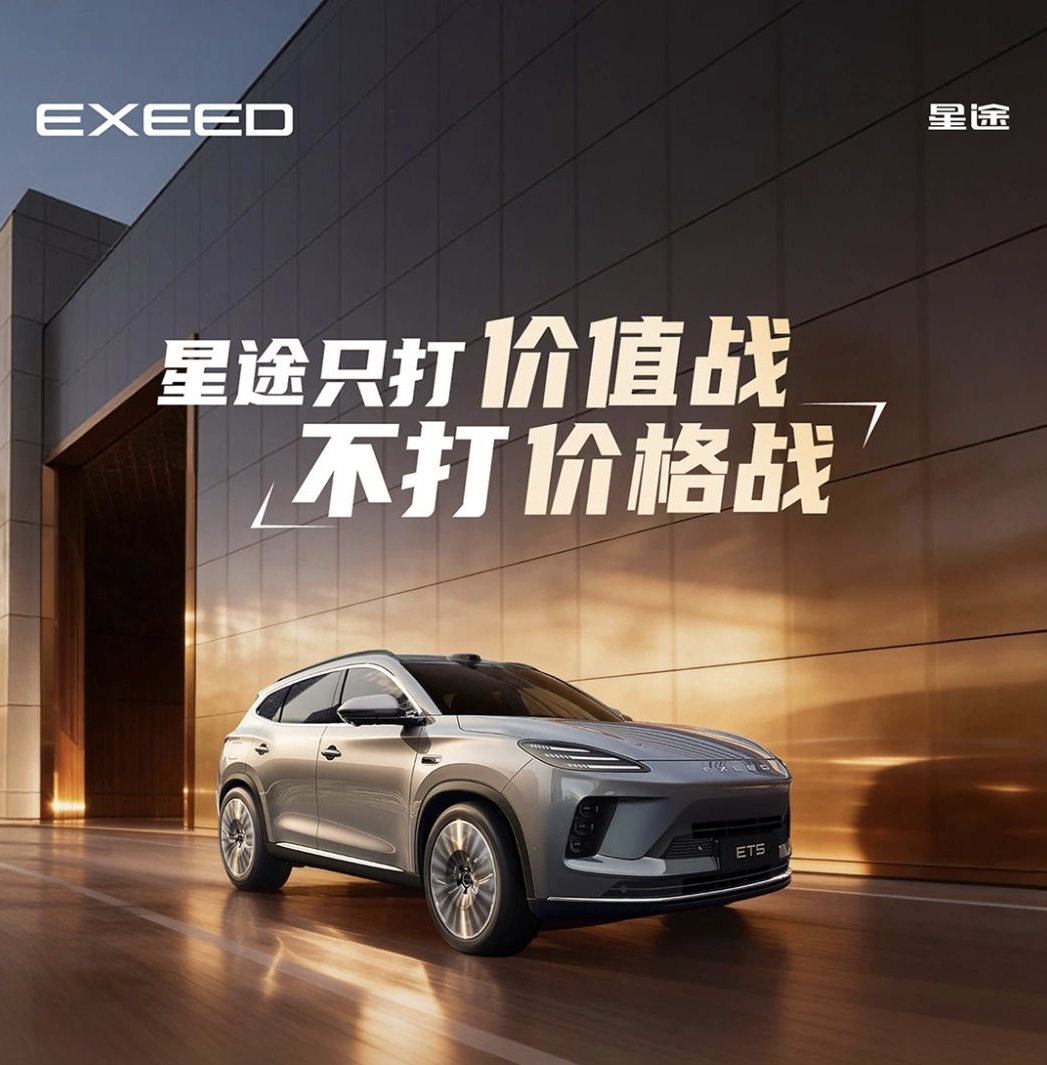
Image Source: EXEED
EXEED attributes the counter-cyclical hike to "factors including chip price increases." Incoming models won't escape either. The new Xiaomi SU7's pre-sale price is already 10,000 to 14,000 yuan higher than the previous generation. CEO Lei Jun admitted prices "will definitely rise," noting memory costs jumped 40% to 50% last quarter alone.
Meanwhile, reports suggest the new Zeekr 007GT will see price adjustments of 5,000 to 8,000 yuan due to rising upstream costs.
NIO Chairman William Li was blunt: "The biggest cost pressure for companies in 2026 comes from rising memory chip prices." He noted the difficulty of automakers competing with AI and computing centers for chips. Deng Chenghua, head of Shenlan, acknowledged in a livestream that production costs have risen by thousands, driven mainly by batteries and storage. VOYAH's Lu Fang offered direct advice to consumers: "If you want to buy a car, I suggest doing it sooner rather than later."
Yet, not all automakers have the confidence to raise prices. Some brands "dare not," fearing share loss in a fierce market. Others considered it but backed down after failing to reach agreements with stakeholders.
Market segmentation is clear: high-end models see small hikes, mid-range models absorb costs, and low-end cars face pressure to adjust. Luxury EV buyers are less price-sensitive and value tech specs. Since these cars pack more memory and batteries, they face sharper cost shocks but have room to maneuver.
The mid-range market is the core battleground. Automakers are mostly absorbing costs through long-term contracts, spec optimization, and cutting non-core features. Low-end models are trapped in a dilemma: "Raise prices and lose the market; don't raise them and lose money." Some have even halted production.
Notably, the 2026 NEV purchase tax incentive shifted from exemption to a 50% reduction—effectively a 5% rate, capped at a 15,000 yuan discount per vehicle. For a NEV priced at 100,000 yuan, buyers paid no tax in 2025 but will owe roughly 4,425 yuan in 2026. This raises the barrier to entry.
To ease pressure, automakers are rolling out promotions. Xiaomi offers "three-year 0% interest plus config upgrades" for the YU7. NIO is providing 10 years of free NOP for Firefly, along with tax subsidies and delivery points. Local governments have also introduced specific NEV subsidies. Additionally, the 2026 "trade-in" policy continues, offering proportional subsidies for the 150,000 to 200,000 yuan price band, likely boosting the mid-to-high-end market.
Conclusion
Looking back from the spring of 2026, the two-year price war may be reaching a turning point. But this time, the shift isn't a strategic choice—it's a passive transmission of upstream cost pressures.
As AI and auto industries collide over chip supply, and memory chips evolve from standard parts to strategic resources, the cost logic of the auto sector is being rewritten. For automakers, the test is no longer just supply chain management, but a test of resolve across technology, product definition, and brand value.
The price surge will pass, but the lessons will linger. In an era where intelligence is the core competitiveness, holding sway over the core supply chain may determine the future more than any price war. As experts note: "Cost pressures are squeezing profits, making the 'price war' unsustainable. Long term, competition will return to product and technical strength."
Yet, a cruel reality is taking shape: for the auto industry, "supply freedom" and "cost autonomy" over core memory chips are becoming more distant than ever.


