Gasgoo Munich- "Life is tough for automakers" has evolved from a sigh at the start of the year into the dominant theme running through all of 2025. The price war has spread from localized skirmishes to a full-blown conflict, moving from new energy vehicles to internal combustion engines, and finally transmitting to every corner of the supply chain. As automakers battle to "survive" or "protect market share," the upstream parts suppliers are naturally feeling the squeeze.
Yet for all the complaints, a counter-intuitive fact emerges from the 2025 financial reports: many parts suppliers are quietly raking in cash. CATL is making nearly 200 million yuan a day; Fuyao Glass's net profit hit a record high; Enjie and Asia Pacific Mechanical & Electronic doubled their profits. Of course, some companies are indeed stuck in the mud of rising revenue but falling profits.
Everyone says it's tough, so who is actually making the money? Breaking down these scorecards, the direction of the electrification and intelligence waves, combined with globalization, cost control, and technical iteration, holds the key answer.
Who's Counting Cash, and Who's Just Holding On?
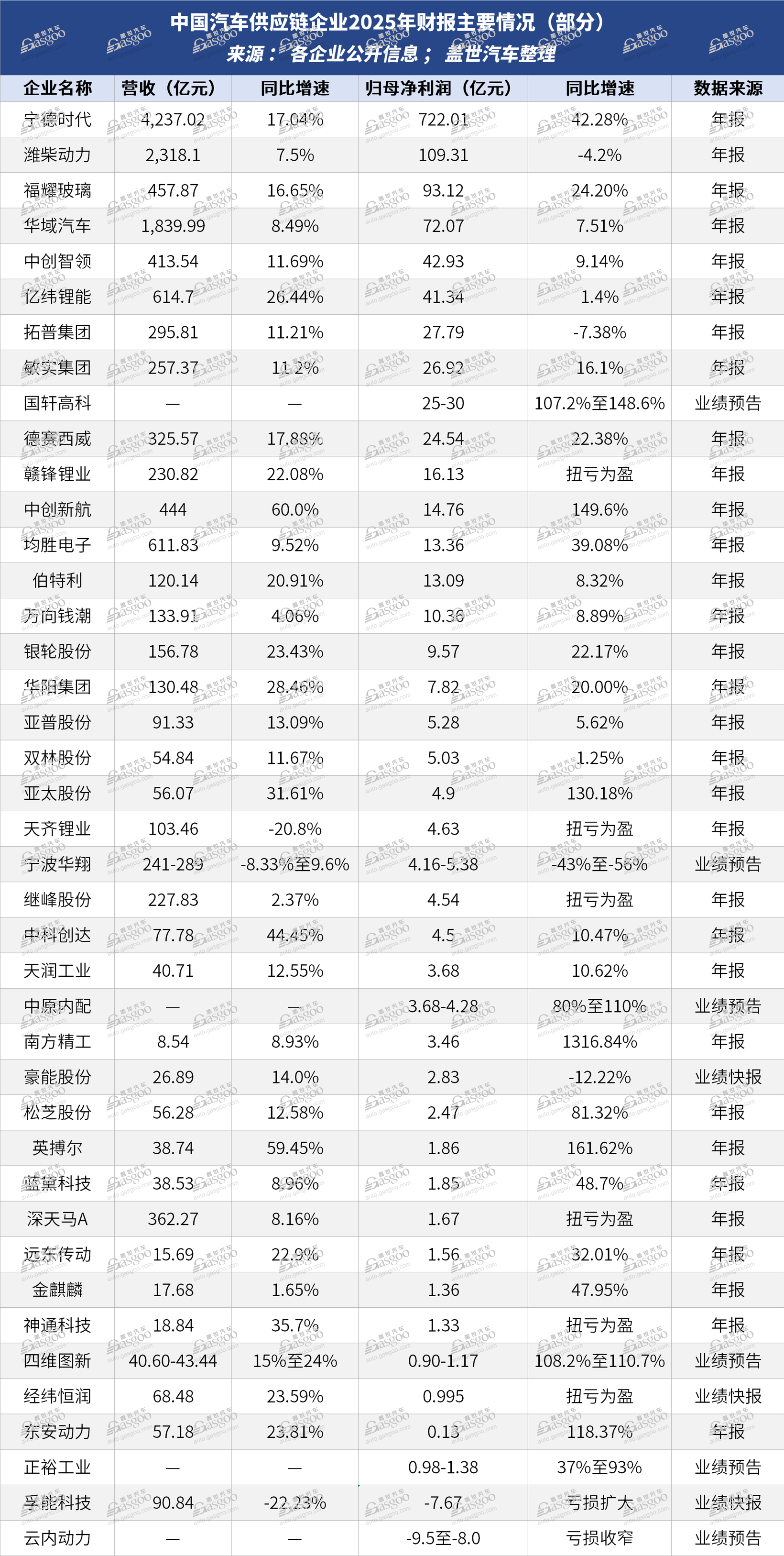
In 2025, the performance of listed Chinese auto parts companies showed a stark divergence.
At the top of the pyramid remains CATL. In 2025, the company generated 423.7 billion yuan in revenue, up 17.04% year-on-year, with a net profit of 72.2 billion yuan, a 42.28% jump—averaging nearly 200 million yuan per day. Net operating cash flow reached 133.2 billion yuan, while cash and tradable financial assets totaled 392.5 billion yuan at year-end, a war chest that is nothing short of staggering.
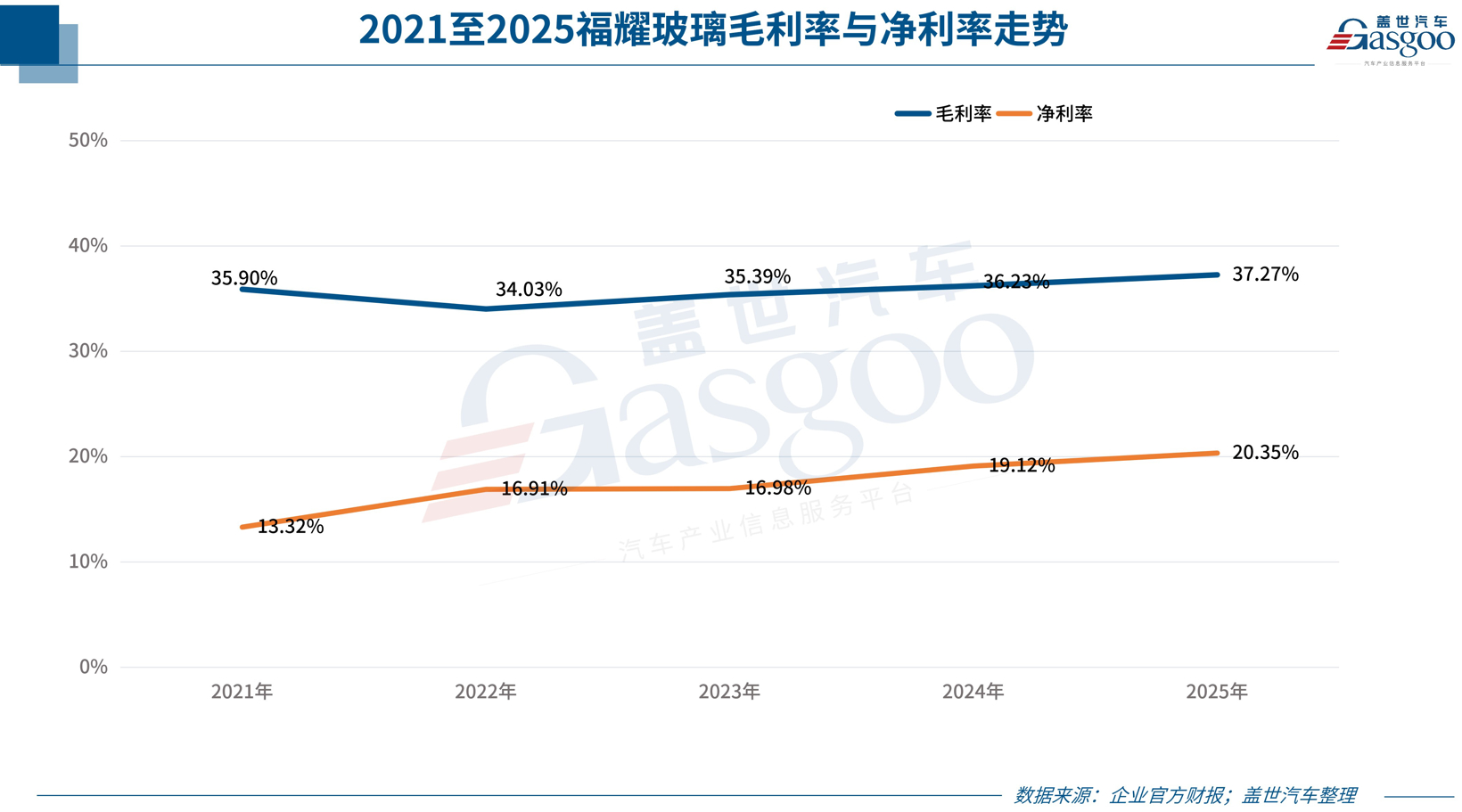
Fuyao Glass continues to write the legend of "a single piece of glass." Revenue hit 45.79 billion yuan, up 16.65%, maintaining growth above 16% for two consecutive years. Auto glass revenue reached 41.89 billion yuan, up 17.3%, with gross margins rising 1.17 percentage points to 31.32%. Float glass revenue came in at 6.48 billion yuan, up 8.71%, with gross margins surging 3.60 percentage points to 39.64%. Thanks to ongoing product optimization, full-year net profit hit 9.31 billion yuan, up 24.2%, with profit growth significantly outpacing revenue growth.
As a representative of comprehensive giants, Huayu Automotive achieved revenue of 183.99 billion yuan, up 8.49%, and net profit of 7.21 billion yuan, up 7.51%. On the business front, interior and exterior component revenue grew 12.22%, and functional parts rose 9.3%, providing the core support for its growth.
A group of companies deep in niche tracks also showed strong momentum in their core businesses. Enjie, riding the wave of electric drive and power system products, posted revenue of 3.87 billion yuan, up 59.45%, and net profit of 186 million yuan, a 161.62% surge. Asia Pacific Mechanical & Electronic also delivered impressive results: revenue of 5.61 billion yuan, up 31.61%, and net profit of 490 million yuan, up 130.18%.
On the other side, some firms have fallen into the trap of "growing revenue but not profit." Weichai Power generated 231.8 billion yuan in revenue, up 7.47%, but net profit fell 4.15% to 10.93 billion yuan. Behind this slump lies the cyclical downturn in the heavy truck industry and a 1.28 billion yuan impairment charge by subsidiary KION Group, which dragged down net profit by about 393 million yuan. However, sales of data center power generation products jumped 259% to roughly 1,400 units, while revenue for M-series large-bore engines hit 5.81 billion yuan, up 65%—new growth points are taking shape.
Tuopu Group saw revenue rise 11.2% to 29.58 billion yuan, but net profit dropped 7.4% to 2.78 billion yuan, breaking a streak of high growth since 2020. The main culprit: a surge in capital expenditure due to capacity expansion. New facilities in Mexico and Poland are still ramping up, putting short-term pressure on depreciation and amortization.
Ningbo Huaxiang expects full-year net profit to fall between 43.5% and 56.34% to 416–538 million yuan, largely due to a one-time impact of about 1.03 billion yuan from stripping assets in Europe and North America. However, adjusted net profit is expected to grow between 43.72% and 72.57% to 1.32–1.59 billion yuan, showing that core business profitability actually improved. This "amputation" hurt the short-term report but cleared years of baggage.
A red flag: some high profit growth isn't coming from core operations. Nanfang Precision reported a 2025 net profit of 346 million yuan, a staggering 1,316.84% surge. But the bulk of that—about 310 million yuan—came from fair value gains on investments, a non-recurring item. Strip that out, and the actual profitability of its main business remains under pressure.
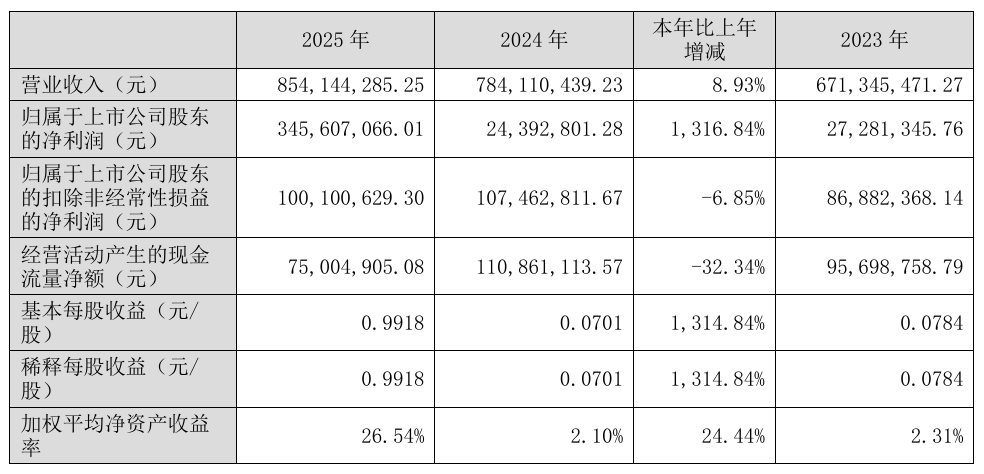
Image source: Nanfang Precision official financial report screenshot
This divergence shows that the 2025 earnings season is no longer a simple judgment of "profit or loss." Whether profit is sustainable and whether growth is driven by the core business are becoming the core yardsticks for corporate value.
Speed of Transition Decides Life or Death
Behind the numbers, the pace of transformation is widening the gap between companies. The 2025 data serves as a report card on strategic choices made in recent years, rewarding the visionary and punishing the hesitant.
CATL's performance myth stems from its absolute focus on the power battery track and continuous deep cultivation, maintaining steady profit growth through technology premiums and customer stickiness. In 2025, high-end batteries like Shenxing and Qilin accounted for about 60% of shipments, commanding significant premiums for higher energy density and safety. On the customer side, CATL works closely with new forces like Li Auto, Xiaomi, and Seres, while maintaining long-term strategic partnerships with global giants like Tesla, BMW, Mercedes-Benz, and Volkswagen.
Fuyao Glass's growth against the trend comes from the continuous high-end shift of its product mix. High value-added products like smart panoramic roofs, dimmable glass, and HUD glass increased their share by 5.44 percentage points year-on-year, directly pushing auto glass gross margins to 31.32%. From a simple pane to a smart interface, the leap in technical content has triggered a qualitative change in profit margins.
Huayu Automotive's transformation path is reflected in its customer structure and order quality. In 2025, revenue from customers outside SAIC Motor rose to 64.6%. Seres, Tesla Shanghai, BYD, Geely, and Xiaomi all entered the top ten for non-SAIC revenue. Among new orders, NEV-related supporting amounts hit 80%, and domestic independent brands accounted for over 65%. This means the bulk of its future revenue is firmly locked to the two fastest-growing tracks: NEVs and domestic brands.
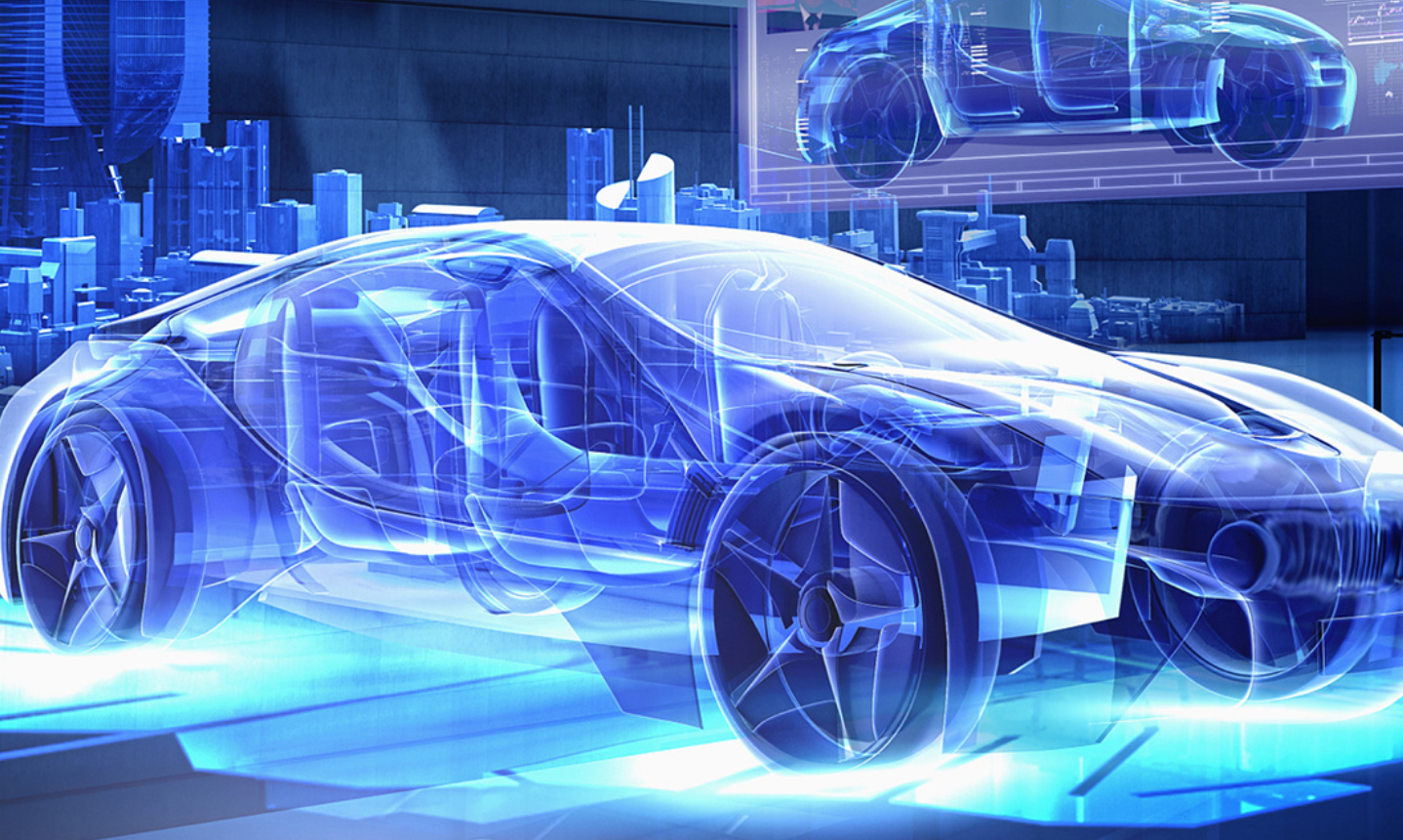
Image source: Huayu Automotive official website screenshot
Weichai Power's case is intriguing: traditional business under pressure, but a "second growth curve" quietly taking shape. Its data center power products have completed a full power layout from 1,250 kWe to 5,000 kWe, breaking foreign monopolies in backup power. Benefiting from the global acceleration of AI computing infrastructure, this sector is becoming a new pillar alongside traditional power. The pressure and hope of transformation coexist in the same report.
In the intelligent sector, Desay SV and Joyson Electronics are typical examples of betting on the right track. Desay SV posted revenue of 32.56 billion yuan, up 17.88%, and net profit of 2.45 billion yuan, up 22.38%. The growth engine is the continued volume of smart driving domain controllers, securing multiple new project orders from mainstream OEMs like Li Auto, XPENG, and Geely. It also launched an autonomous vehicle brand and secured robot domain controller projects, aiming for mass production in 2026.
Joyson Electronics reported 2025 revenue of 61.18 billion yuan, up 9.52%, and net profit of 1.34 billion yuan, a 39.08% jump. During the year, it added about 97 billion yuan in global orders, with the automotive electronics business contributing roughly 46.1 billion yuan, becoming the core block pulling overall order growth.
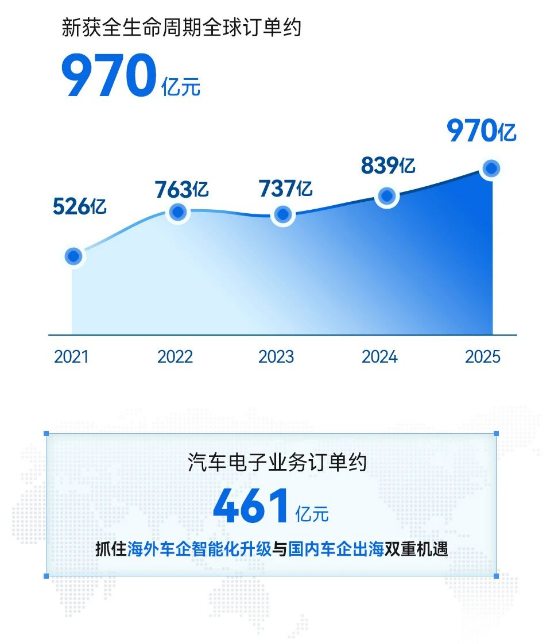
Image source: Joyson Electronics official image screenshot
Also benefiting from the intelligent track, ThunderSoft delivered a standout 2025: revenue of 7.78 billion yuan, up 44.45%, and net profit of 450 million yuan, up 10.47%. Centered on AIOS, it built a full-stack tech system of "Chip-AIOS-Middleware-Upper Application." Notably, its Smart IoT business revenue hit 3.61 billion yuan, surging 133.26%, with its AIoT platform covering diverse scenarios like smart vision, robotics, and AI PCs.
A notable new trend: some parts suppliers are extending their reach into "new tracks" with more imagination—humanoid robots. This isn't a crossover, but a natural spillover of precision manufacturing capabilities.
Tuopu Group disclosed "robot actuators" as a separate business segment for the first time, with 2025 revenue of 10 million yuan, but rapid progress in customer collaboration. Sanhua and Shuanghuan Transmission are also laying out robot joint modules and reducers. Head players are expanding competition from autos to smart hardware, building growth poles that can weather cycles.
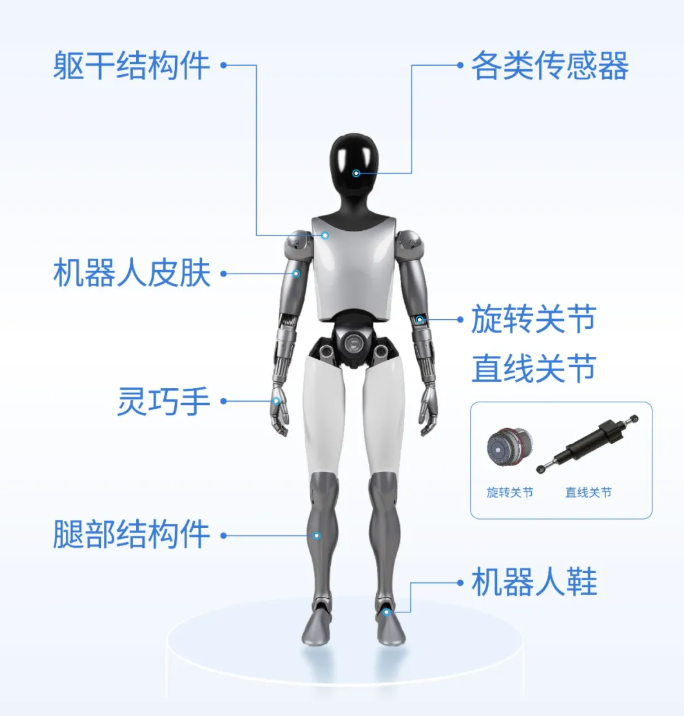
Image source: Tuopu Group
By contrast, companies still "spinning their wheels" in traditional businesses feel mounting pressure daily. Independent engine makers are facing a fierce shock from commercial vehicle electrification. Despite launching NEV products, breaking out is extremely difficult against giants like BYD and the trend of OEM in-house R&D. New businesses are still in the investment phase, and the bleeding of traditional business may outpace the growth of new business. Competition has entered a stage of "comprehensive capability" comparison: choosing the right direction is just step one; execution speed and implementation quality are the keys to pulling ahead.
Transition speed has become a key variable determining profit or loss. Companies that took the lead in completing product structure upgrades and market layout adjustments are reaping the dividends, while those lagging behind are forced to endure the dual pressure of shrinking market share and sliding profits.
Looking further, the restructuring of the industry landscape may arrive faster than imagined. An analyst at Gasgoo Automotive Research Institute noted: "Future autonomous driving should converge to a monopoly by a few local tech firms or parts companies, and this scenario will arrive relatively quickly." This means the current elimination round is just the prologue; the future points to a highly concentrated monopolistic competition, and the window for transformation is rapidly closing.
Meanwhile, the underlying logic of supply chain relationships is undergoing profound change. The analyst believes that as the industry evolves, "OEMs' future focus will be defining vehicle product architecture, user preferences, and needs—the vehicle will return to its positioning as an integrated terminal." In this context, he further points out: "Will OEMs bypass Tier 1 and contract manufacturers to cooperate directly, achieving flatter supply chain management and cost reduction? Currently, in the domestic auto industry, there has already been a massive change." For traditional parts suppliers, this means the challenge comes not only from the switch in technology roadmaps but also from the direct impact of OEMs reshaping the supply chain model.
Going Global: Cure or New Battlefield?
Facing extreme domestic competition, overseas markets have become the "second engine" for performance growth. This wave of going global features "industrial output"—not just exporting products, but moving factories, technology, and services together, deeply integrating into the global industrial chain.
At the forefront of this wave are companies that have already built overseas businesses into "profit engines."
CATL's overseas revenue accounted for 30.6% in 2025, growing faster than domestic sales, with gross margins 7.44 percentage points higher. Its overseas power battery market share jumped to 30%. The first phase of its Hungary plant is near production, the Spain JV with Stellantis is proceeding smoothly, and the Indonesian nickel and battery chain projects are gradually landing. These bases allow CATL to serve European clients close by while avoiding geopolitical and trade tariff risks.
Fuyao Glass's globalization presents a different kind of solid strength. In 2025, overseas market revenue reached 20.86 billion yuan, up 18.81%, accounting for about 45.6% of total revenue, with gross margins rising in tandem to 32.64%. The brightest spot is its U.S. subsidiary, with full-year revenue of 7.92 billion yuan, up 25.43%, and net profit soaring 40.91%.
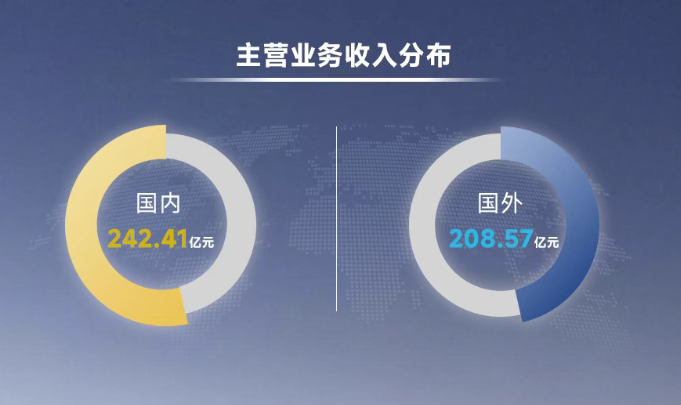
Image source: Fuyao Group official image screenshot
Tire companies also rely on overseas bases as profit cores. As the Chinese tire maker with the largest overseas production capacity, Sailun Tire has built bases in Vietnam, Cambodia, Mexico, and Indonesia. Amidst continued trade barriers in Europe and the U.S., these overseas factories have become "bridgeheads" contributing the vast majority of profits.
Another group of companies is in the quality improvement phase of globalization. Joyson Electronics' 2025 overseas revenue was 44.07 billion yuan, 72.28% of total revenue. The strategic focus has shifted from M&A expansion to "digestion and improvement," focusing on overseas profitability. The gross margin rose to 18.3%, a preliminary result. Huayu Automotive's export gross margin rose 3.5 percentage points year-on-year to 4.12%, shifting from scale expansion to profit quality.
In the intelligent sector, ThunderSoft also shows strong overseas momentum. In 2025, its overseas market revenue reached 3.56 billion yuan, a massive 81.57% increase, far outpacing its domestic market (23.23%), covering Finland, Germany, the U.S., Japan, and other regions.
Some companies show flexibility, some making subtractions, others breaking through fast in high-margin tracks.
Ningbo Huaxiang completed the stripping of its long-loss-making European business. Although it dragged net profit down by about 1.03 billion yuan in the short term, it thoroughly cleared years of baggage. Adjusted net profit is expected to grow 43.72% to 72.57%, significantly releasing core business profitability. This conveys an important insight: in globalization, timely "subtractions" and focusing on advantaged markets hold more strategic value than blind expansion.
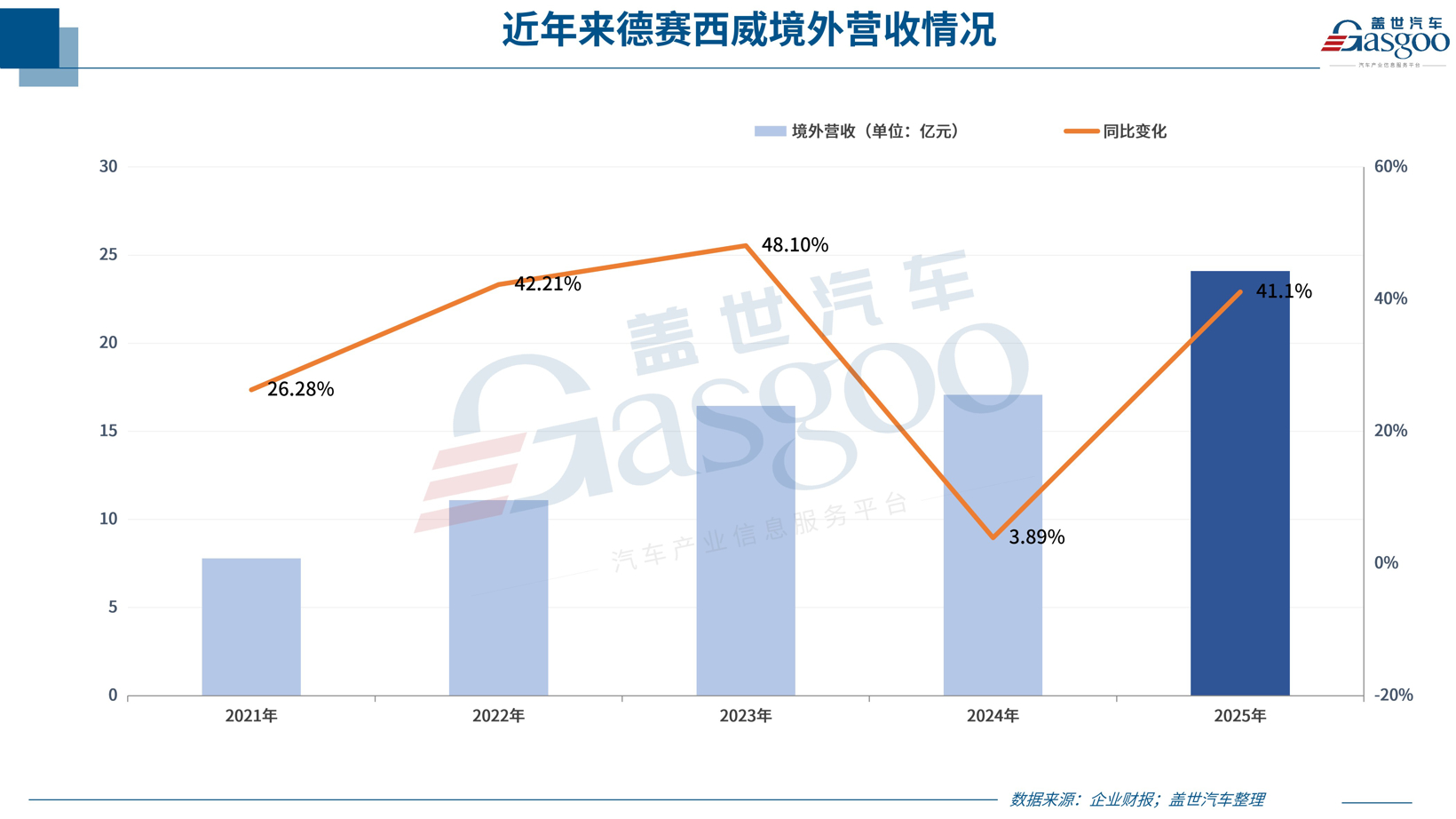
Desay SV's overseas expansion features "high growth, high margin." 2025 offshore revenue was 2.41 billion yuan, up 41.1%, with a gross margin as high as 27.3%, significantly higher than the domestic 18.4%. Though only 7.4% of the mix, its high growth potential is rapidly becoming a new growth pole.
Tuopu Group's global layout is also accelerating. The first phase of the Mexico project is fully in production, and the second phase of the Poland factory and the Thailand production base are being planned. However, new overseas capacity is still in the ramp-up phase, and fixed costs like depreciation and amortization are high—one reason the company's profit side was under pressure in 2025. It is foreseeable that as capacity utilization at overseas factories gradually rises, these early investments are expected to convert into tangible profit contributions in the future.
From product export to capacity output, from rough M&A to refined operations, from moving forward with burden to decisive subtraction, the going global of parts suppliers in 2025 has entered a deeper stage of differentiation. Overseas markets are no longer a simple incremental supplement, but a comprehensive test of global comprehensive operational capabilities.
Conclusion
Reading the 2025 financial reports of parts suppliers, the industry landscape is becoming clear. This is no longer an era where "everyone gets a share of the rain and dew" from industry prosperity, but a cruel "elite elimination match." The data declares the end of the extensive growth model oriented by scale and cost, and opens a new cycle of intensive cultivation centered on technology, efficiency, and globalization.
Looking to 2026 and beyond, industry transformation will be more thorough. The pressure of price wars and tech iteration will not fade, and industry concentration will continue to rise. In this marathon with no finish line, only by maintaining strategic resolve, continuously investing in technology and revolutionizing efficiency, and constantly expanding capability boundaries can one cross the cycle and win the future.