



As electrification and intelligence merge deeply in the auto industry, market competition is shifting from early chaos to a phase of structural realignment.
Data from Gasgoo Research Institute on 2025 installations reveals a clear trend: swept by the waves of electrification and intelligence, key sectors like power batteries, smart driving chips, lidar, and cockpit domain controllers are seeing the outlines of a dominant hierarchy take shape.
This concentration at the top signals not just rising industry maturity, but a redistribution of power within the supply chain.
Top 10 Firms Control 70% of the Market
Across critical smart vehicle technologies, market share is rapidly consolidating among a few players. Notably, domestic suppliers have established dominance in several niche tracks by leveraging deep tech iteration and rapid mass deployment.
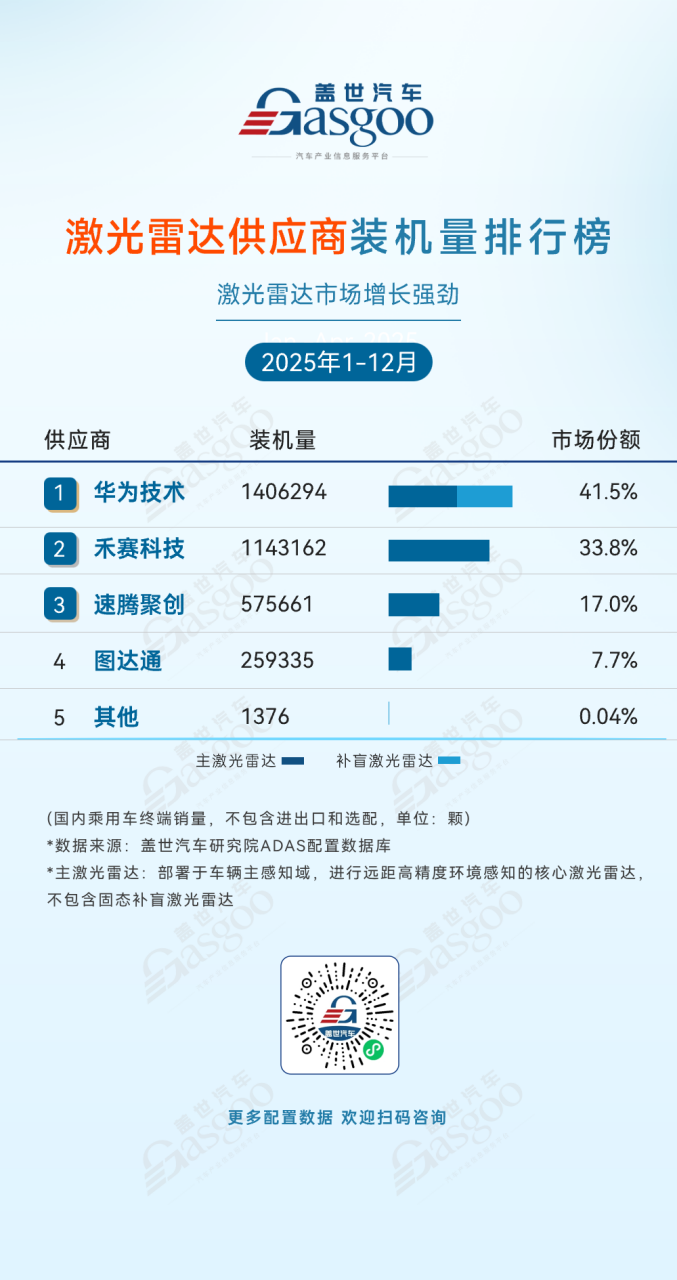
Take lidar as an example: annual installations in the domestic market surpassed 3 million units in 2025, with penetration rates breaking into double digits. Huawei Technologies led the pack with a 41.5% share and 1.41 million installations, while Hesai Technology followed closely with a 33.8% market share.
This is largely driven by top vendors self-developing core components and underlying chip technologies, striking a balance between detection reliability and cost. That shift is accelerating the product's migration from a high-end option to mass-market models.
Meanwhile, the competitive landscape for lidar is quietly upgrading — shifting from "does it work?" to "are the resolution lines high enough?" RoboSense was the first to globally mass-deliver the EM4 in 2025, equipped in the ZEEKR 9X and IM LS9, supporting customization up to 2,160 lines. By 2026, Huawei had rolled out an 896-line lidar. For companies like RoboSense, the "thousand-line era" is fast becoming a reality.
The competitive landscape in smart cockpits is equally distinct, with a clear tiered split. In the 2025 cockpit domain controller market, Desay SV took the lead with over 1.56 million installations and a 16.1% share, while Bosch ranked second with 8.4%.
Close behind, ECARX, Huawei, and Tesla's suppliers held shares in the 6% to 8% range. Notably, the gap between the 6th and 10th ranked companies was razor-thin, signaling a tight contest.
In the ADAS sector, a report by the China Automotive 100 Think Tank titled "Intelligent Driving Development Status and Trend Judgment" shows Horizon Robotics retained the top spot in market share for a second year running, reaching 47.66%. In the high-compute market for urban NOA (Navigation on Autopilot), NVIDIA, Huawei, and Horizon Robotics together command over 90% of the share, indicating extreme concentration among core players. Meanwhile, in in-vehicle voice interaction, iFlytek continues to solidify its leading position with a market share exceeding 40%.
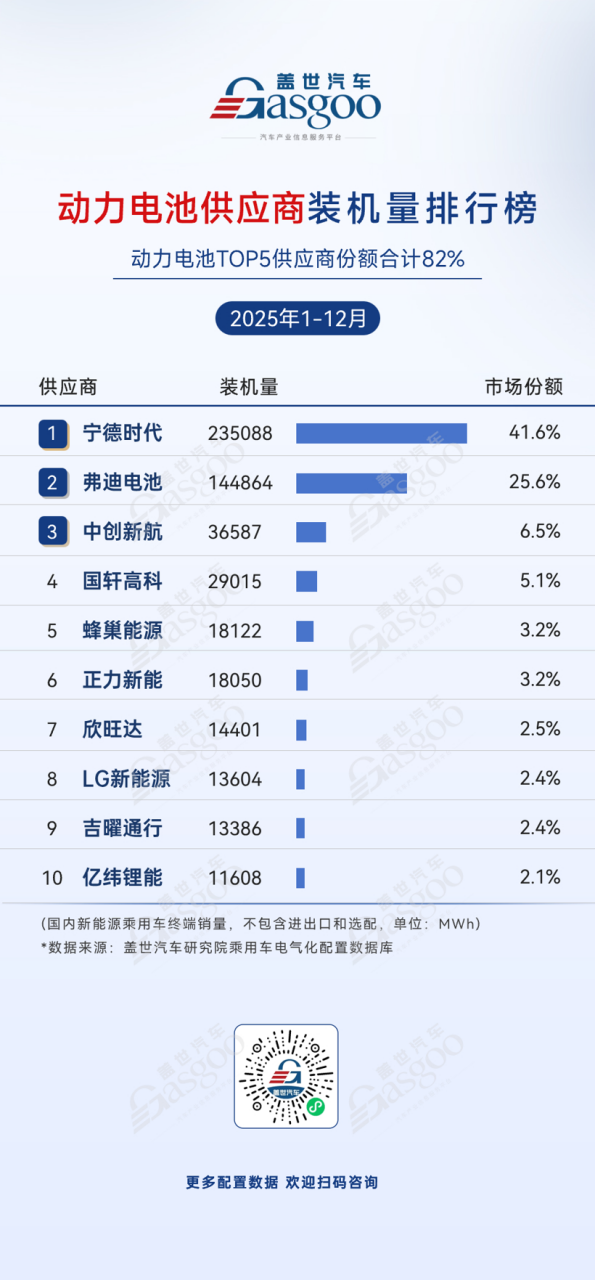
As the "heart" of the car, the power battery sector boasts an equally stable hierarchy. CATL continued to lead in 2025 with 235 GWh of installations, locking in 40% of the market through investments in materials and long-term customer contracts. FinDreams Battery followed closely, claiming roughly 25% of the share.
A similar pattern emerges in intelligent chassis areas like air suspension. As domestic suppliers such as Tuopu Group and Baolong Technology achieve breakthroughs in key components, features once reserved for high-end models are accelerating their spread into mainstream vehicles.
Behind this concentration of resources lies the ability to mass-produce, develop platforms, and deliver consistently. For OEMs, core component suppliers are no longer just single-project partners but long-term allies spanning multiple vehicle cycles. The ability to secure design wins across different price segments while maintaining compatibility and upgradeability across generations is the defining divide for top-tier suppliers.
What Did the Top Players Get Right?
The high concentration across core sectors stems from how top suppliers positioned themselves regarding policy insight, technical accumulation, and business models. While specific tactics vary, the core logic of seizing first-mover advantage shares common threads.
Top leaders often possess the foresight to "sense the spring water before the duck does." The rise of CATL and BYD in power batteries benefited from early state support for the new energy vehicle industry. Leveraging a vertically integrated layout, BYD secured its core supply chain—from raw materials to finished vehicles—on the eve of the industry's explosion. CATL, meanwhile, used the policy window to rapidly scale up and dilute costs, establishing its voice in global battery technology standards.
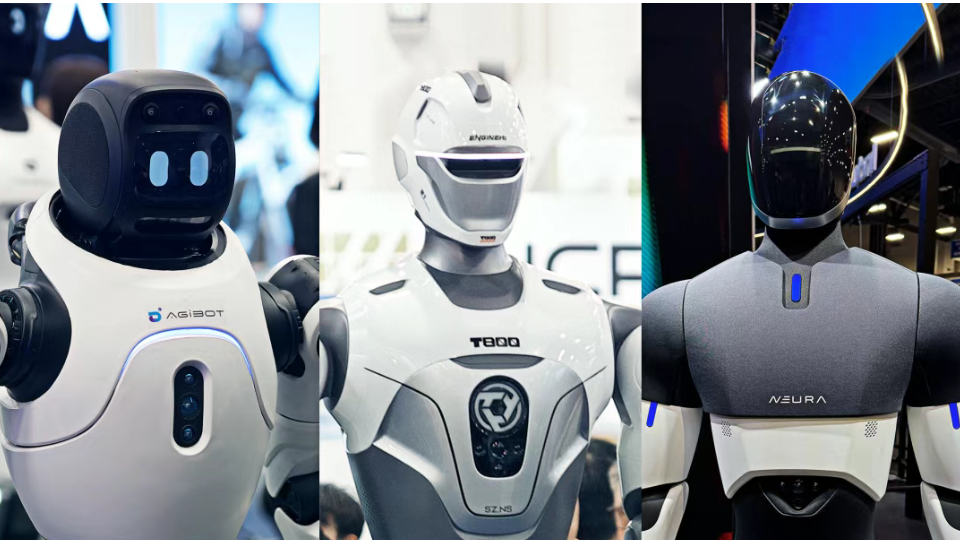
Products have expanded into the robotics sector. Image source: RoboSense
Of course, maintaining that first-mover edge depends on sustained technical investment and high entry barriers. RoboSense told Gasgoo that its lead in mass-producing thousand-line lidar stems from early deep dives into SPAD-SoC chip technology—a path that uses digital architecture to redefine perception limits, providing a fundamental guarantee of physical-level safety and reliability.
As a leader in smart driving chips, Horizon Robotics notes it was among the earliest in China to commit to a software-hardware integration path. It quickly recognized that the essence of smart driving competition lies in the synergy between chips and algorithms. By deeply binding chip design with software development, it created its Journey series chips, achieving underlying compatibility between chip architecture and driving algorithms. Currently, Horizon's flagship HSD (Horizon SuperDrive) system has been mass-produced in models like the Exeed ET5 and Deepal L06. This makes Horizon the first domestic company to bring urban assisted driving experiences to the mainstream market under 150,000 yuan.
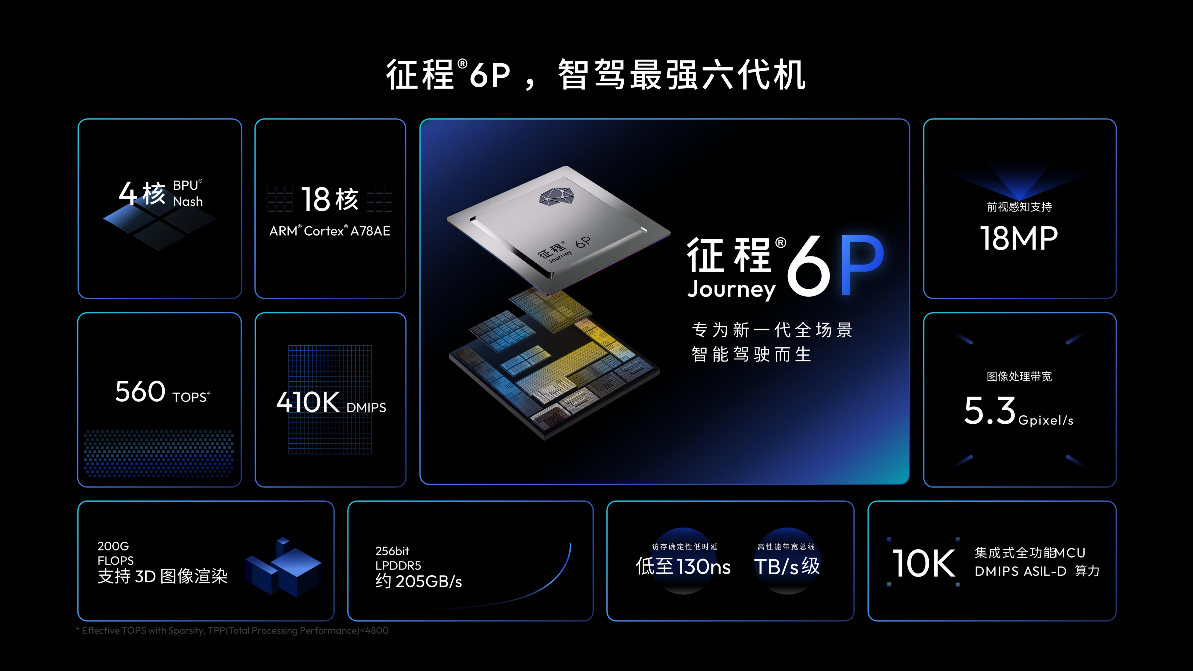
Image source: Horizon Robotics
Furthermore, cooperation has deepened, shifting from a "buyer-seller relationship" to a "symbiotic ecosystem." Top suppliers are no longer passive parts providers responding to orders; they are strategic partners deeply embedded in OEM R&D systems.
For instance, traditional Tier 1 suppliers like Baolong Technology, in their transition to smart chassis, have achieved domestic substitution for complex systems like air suspension by deeply aligning with domestic automakers.
Huawei has pioneered a multi-dimensional cooperation matrix ranging from parts supply and the HI model to Harmony Intelligent Mobility Alliance, participating directly in product definition and terminal sales.
Horizon Robotics, meanwhile, is building an ecosystem through an open strategy. It launched a classic cooperation model of "chip + toolchain + reference design," alongside the "HSD Together" service model, which doesn't compete for algorithm dominance. This significantly lowers development costs and cycles for partners, attracting top players like Bosch and QCraft, and enabling automakers to rapidly build differentiated competitiveness on its underlying platform.
From this, it is clear that specific paths vary. It is this "harmony in diversity" that is collectively driving the evolution of China's automotive supply chain toward greater intelligence and integration.
Leadership Is Far From Secure
As industry concentration rises and top players become more prominent, it doesn't mean their positions are unbreakable. "Small fish eat big fish, and there's always a bigger fish above the big fish" — this is industry standard. Hanging over their heads are the two swords of Damocles: Tier 1 suppliers and OEMs.
For OEMs, supply chain stability and cost bargaining power are core demands; they won't sit idly by while any supplier holds a long-term monopoly. To avoid being left vulnerable to shortages or price hikes from a single source, many automakers are aggressively fostering second or even third suppliers.
In the cockpit domain controller chip market, while Qualcomm holds the top spot with its first-mover advantage, domestic players like Huawei Technologies, SiEngine, and SemiDrive are achieving double-digit growth in installations and share through more flexible design-win support and rapid response times.
The lidar market tells a similar story. Although Huawei Technologies and Hesai Technology command a combined 70% share, RoboSense continues to close the gap, ranking third in 2025 installations. Currently, RoboSense has opened a window of technical differentiation by mass-producing the thousand-line EM4, securing new design wins with multiple automakers.
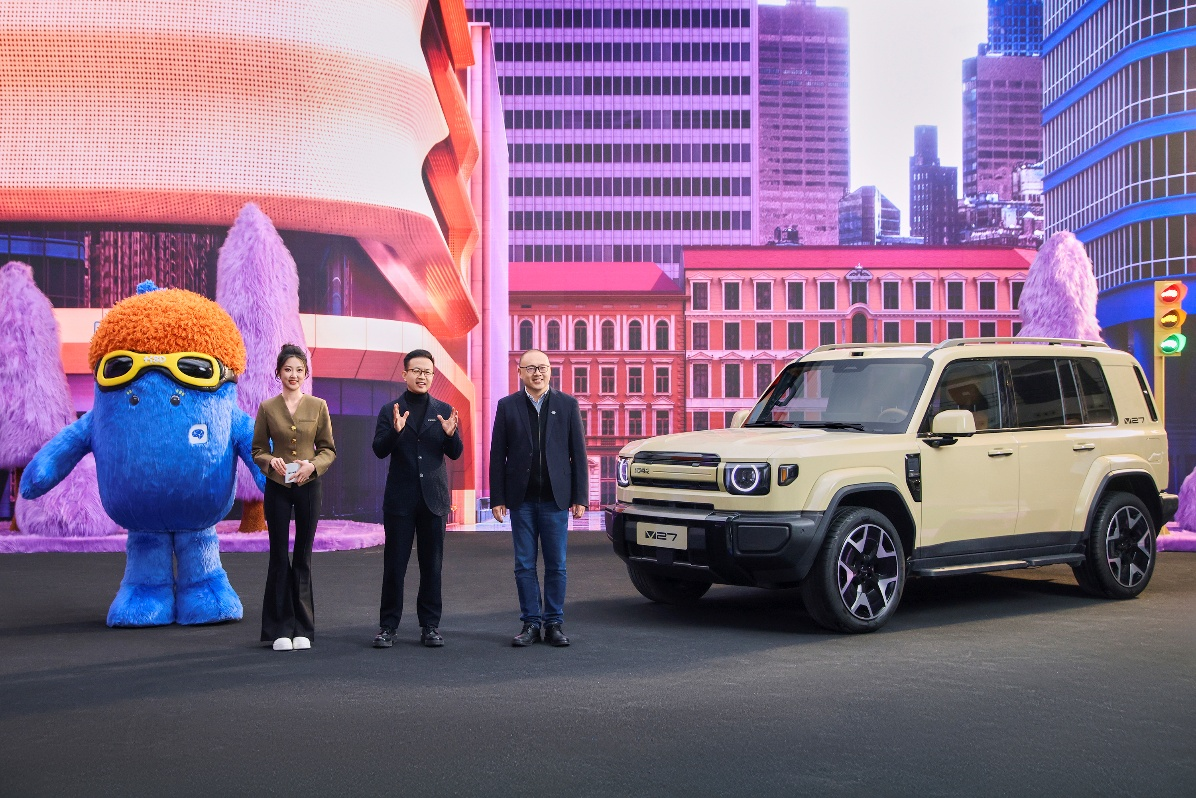
Image source: Horizon Robotics
The smart driving chip sector faces similar pressure. Even so, Horizon Robotics notes that while the technological, ecological, and scaling advantages of the leading camp are consolidating, the door is not entirely shut for new entrants.
In the power battery sector, second-tier players like CALB, Gotion High-tech, and Sunwoda are accelerating their rise. Li Auto invested hundreds of millions in Sunwoda to build a dedicated division. "Li Auto is both our strategic client and our shareholder," said Chen Hui, general manager of Sunwoda's Li Auto division. This "client-to-shareholder" model is reshaping the battery supply chain. Meanwhile, Leapmotor's batteries are largely supplied by CALB and Gotion.
Some argue that opportunities for the second tier come from deep binding, extreme cost reduction, and market expansion. The growth of Suzhou Inovance Automotive is representative; it entered a new track by producing motor drive systems for Li Auto.
"In 2016, we were still a new player. There was no range-extender technology route in China yet, but we thought it might be a direction, so we were willing to walk alongside Li Auto," said Zhang Pingjian, deputy general manager of the company's passenger vehicle sales division. Deep binding during uncertain technological phases often yields long-term returns. Today, its client base has expanded to new forces like Xiaomi and XPENG, and it achieved an IPO in 2025.
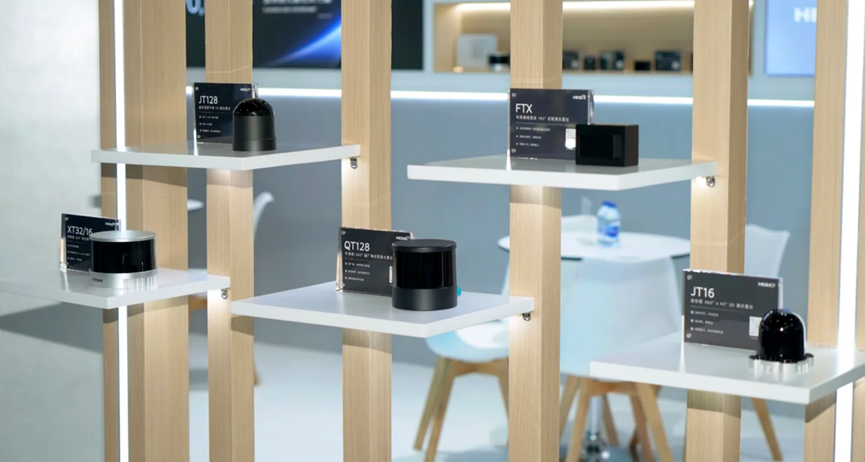
Image source: Hesai Technology
Cost control is another entry point. On the premise of guaranteed performance, introducing second and third suppliers is itself a crucial means for automakers to control costs and spread risk. As long as the second tier can achieve breakthroughs in specific technical links or master extreme cost control, they still have a shot at entering the mainstream supply chain.
Furthermore, market expansion driven by "technology democratization" creates space for the second tier. As configurations like lidar and smart driving chips migrate from high-end models priced over 300,000 yuan to mass-market vehicles in the 100,000 to 200,000 yuan range, demand for high cost-performance solutions is surging.
However, for new players entering these tracks, the difficulty has intensified. Horizon Robotics notes that for a new entrant to succeed, they must build systematic competitiveness in technology, cost, and mass delivery to find their niche in a mature sector. It favors companies that have cultivated deep expertise with software-hardware integration capabilities, working with the broader industry to drive the mass adoption of smart driving.
Others argue that the window for joining new tracks has already closed.
"Building Ecosystems" Becomes Capital
Against a backdrop of competitive pressure and uncertainty, top enterprises are embedding themselves into broader industrial networks through capital maneuvers, securing a more stable footing in the multi-party game.
Take CATL as an example; its layout extends far beyond battery manufacturing. Financial reports show that by the end of the third quarter of 2025, its external investments reached 76.87 billion yuan, spanning upstream minerals, midstream materials and equipment, and downstream automakers and applications.
For instance, its 26.7 billion yuan investment in CMOC Group in 2022 locked in copper and cobalt resources, yielding a paper profit of over 60 billion yuan by January 2026. Investments in projects like Hunan Yuneng not only delivered financial returns but also secured priority supply rights for cathode materials and nickel resources.
Downstream, CATL has solidified partnerships by signing strategic agreements or establishing battery joint ventures with automakers like GAC, SAIC, Changan, and NIO. These collaborations cover R&D, supply chain security, and market expansion.
This vertical strategy of "locking resources upstream and customers downstream" is evolving CATL's relationship with automakers from supplier-client to partners jointly managing user energy assets. As Xu Yanhua, secretary-general of the China Power Battery Alliance, put it: "Given the current intensity of industry competition, automakers and battery companies must develop collaboratively."
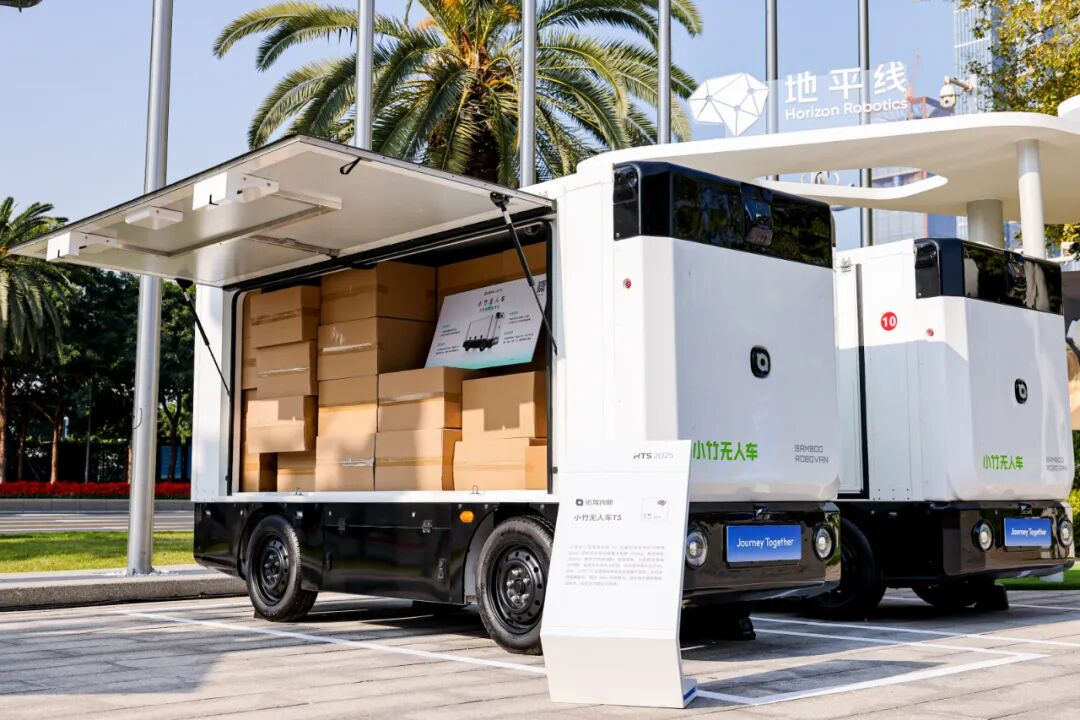
Image source: Minieye
Horizon Robotics is following a similar path. Since listing on the Hong Kong Stock Exchange in October 2024, it has raised 16.89 billion Hong Kong dollars, with funds explicitly directed toward overseas expansion, the mass deployment of high-end smart driving solutions, and emerging fields like Robotaxis.
Even more noteworthy is its capital logic: In September 2025, after signing a strategic partnership with Chery, Horizon Robotics participated as a cornerstone investor in Chery's Hong Kong IPO, subscribing to 40 million USD. This moved the relationship from project-based design wins to shared interests.
In December 2024, Horizon also acted as a cornerstone investor for Minieye's IPO and further increased its holdings in Minieye's H shares in January 2026. Currently, Minieye's domain controller products, developed on Horizon chips, cover over 40 OEMs.
"We work deeply with Horizon Robotics' engineers to squeeze every drop of computing power out of the Journey 6," said Guo Long, vice president of Minieye. Joint R&D, business symbiosis, and equity sharing have become the cornerstones of Horizon's ecosystem-building strategy.
Even further upstream in lithium mining, companies are binding with downstream clients through investment. For example, Ganfeng Lithium has successively invested in OEMs like Voyah, GAC Aion, and a Seres subsidiary, both to deepen cooperation and to seek new growth points.
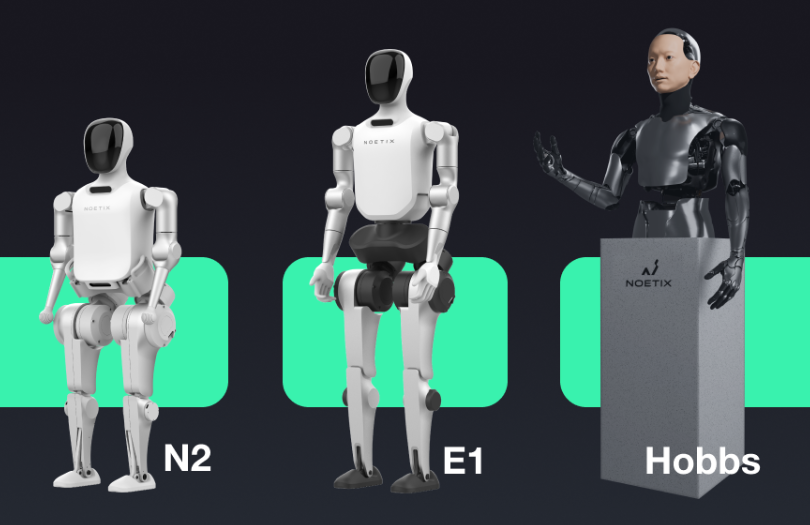
Image source: Songyan Power
At this stage, this "build ecosystem, become capital" model is radiating outward from top players. In March 2026, humanoid robot company Songyan Power completed a nearly 1 billion yuan Series B financing round led by Chendao Capital, CATL's industrial investment platform, with participation from Gotion and others. This signifies that the ecosystem tentacles of battery companies have extended from automobiles to robotics, as their industrial investment logic is replicated and migrated.
Clearly, for top suppliers, the moat now has a capital dimension. By participating in investments, joint ventures, and strategic alliances, they establish connection points across multiple nodes, thereby enhancing their presence and influence throughout the network.
For the industry as a whole, as more companies integrate into the capital ecosystem, the rules of the automotive supply chain are being rewritten. Those who can establish a stable yet flexible position within an increasingly complex industrial network are more likely to retain the initiative in the next round of change.


