



Gasgoo Munich- With embodied AI and humanoid robotics gaining traction, the industry is accelerating its shift from proof of concept to mass adoption. During this transition, achieving stable, reliable motion control and improving adaptability in complex environments have become critical factors determining the pace of commercial deployment. Consequently, technological upgrades centered on core perception and control capabilities are becoming a priority across the upstream and downstream supply chain.
At the same time, the automotive-grade technology system refined during the auto industry's intelligent transformation is cascading into the robotics sector. From high-reliability sensors to mass production capabilities, mature automotive-grade technologies are providing vital engineering support for the robotics industry. In this context, the automotive-grade Inertial Measurement Unit (IMU)—a key component for robot motion perception—is seeing its application value rise, becoming a crucial technological lever for enabling stable robot deployment.
At the 2026 4th Embodied Intelligence Development Forum, Diao Pinhao, head of Asensing's robotics business, shared insights on the application value and trends of automotive-grade IMU technology in the robotics sector. He systematically outlined the technology's core advantages, as well as the company's full-stack solutions and industrial support capabilities for the robotics industry. As the first company globally to successfully mass-produce automotive-grade MEMS combined spatiotemporal intelligent solutions for intelligent driver assistance, Asensing is accelerating its expansion into emerging scenarios like robotics and construction machinery. Currently, the company has established partnerships with over 20 robotics enterprises, with its products widely applied across bipedal humanoids, wheeled humanoids, and quadruped robot dogs.
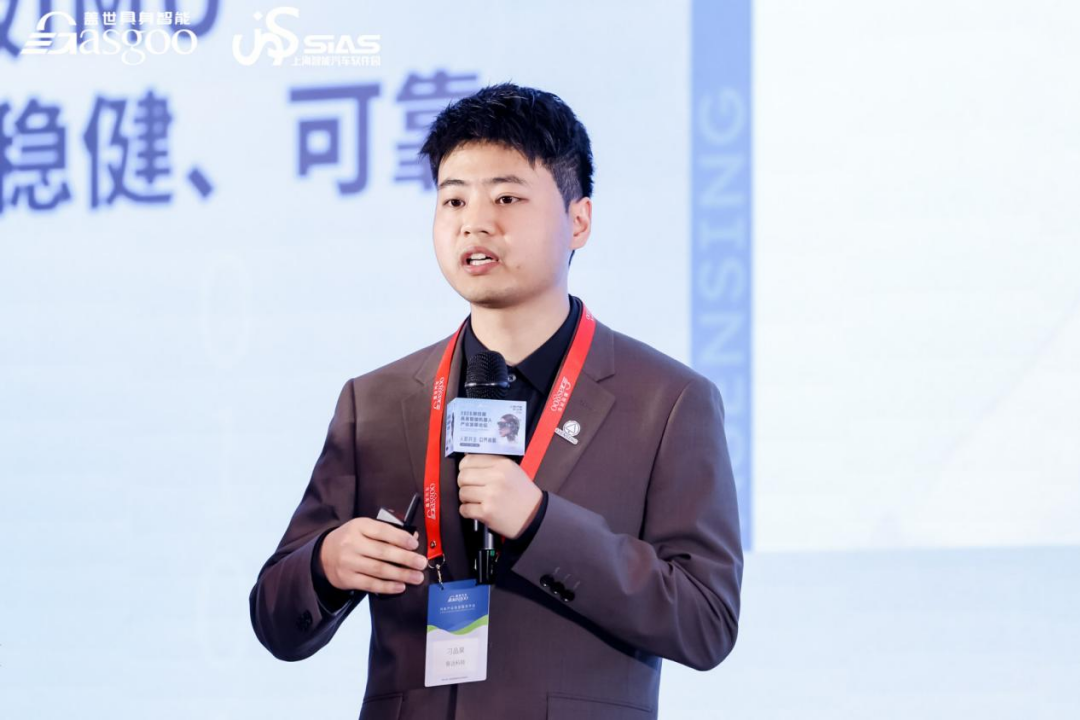
Diao Pinhao | Head of Robotics Business, Asensing
Automotive-Grade IMU: A Core Necessity for Robot Motion Perception
Currently, as embodied AI and humanoid robotics continue to evolve, the robotics industry is accelerating the shift from technical verification to scenario-based application and large-scale deployment. During this process, alongside breakthroughs in AI algorithms, large models, and autonomous decision-making, stable and reliable motion capability is becoming a crucial foundation for the actual performance of robot products. Precise perception of motion state is particularly key here; as the core component of the robot motion perception system, the IMU's performance and reliability directly impact the stability of the entire system and its ability to execute complex tasks.
In practical engineering applications, building a motion perception system for robots still faces multiple technical challenges. First, robots typically possess multi-degree-of-freedom motion characteristics, placing higher demands on attitude measurement accuracy and dynamic response capability. Second, as the industry advances from prototype development to mass production, maintaining product performance consistency across deliveries of hundreds or thousands of units has become a widespread concern. Furthermore, robot units usually integrate multiple motors and complex electronic systems; in scenarios involving strong electromagnetic interference and high-intensity movements like jumping and tumbling, higher reliability is required for the long-term stable operation of the perception system. Additionally, as human-machine interaction deepens, the importance of core perception components in ensuring operational safety is also rising.
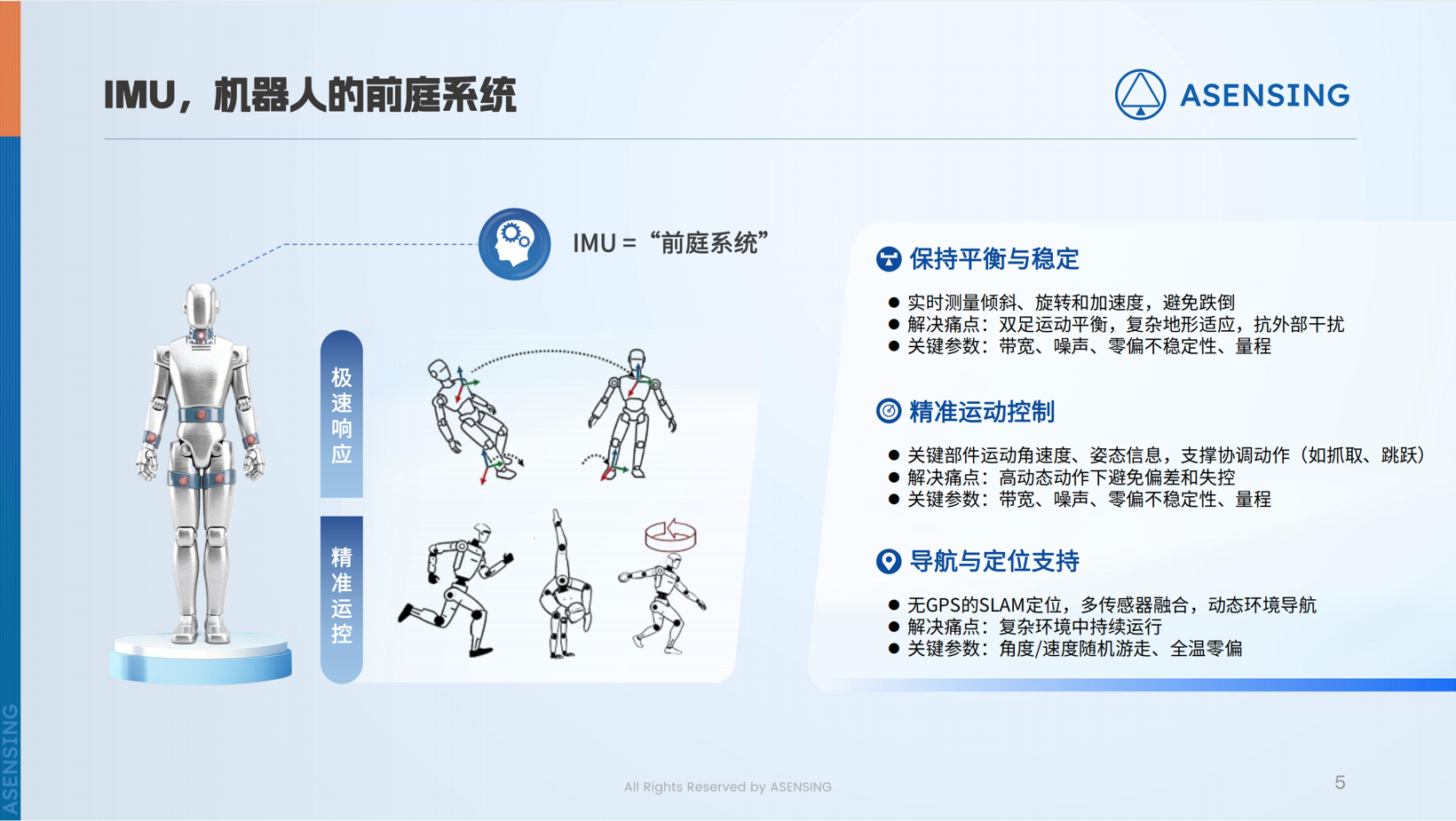
Addressing these challenges, Diao Pinhao noted that the IMU provides real-time motion attitude measurement and high-frequency data feedback in robot systems, playing a foundational supporting role in key areas such as balance stability control, precise action execution, and indoor positioning and navigation.
Based on an assessment of the industry's development stage and technical requirements, Asensing offers a clear answer: Robots require automotive-grade IMUs.
Source: Speaker Materials
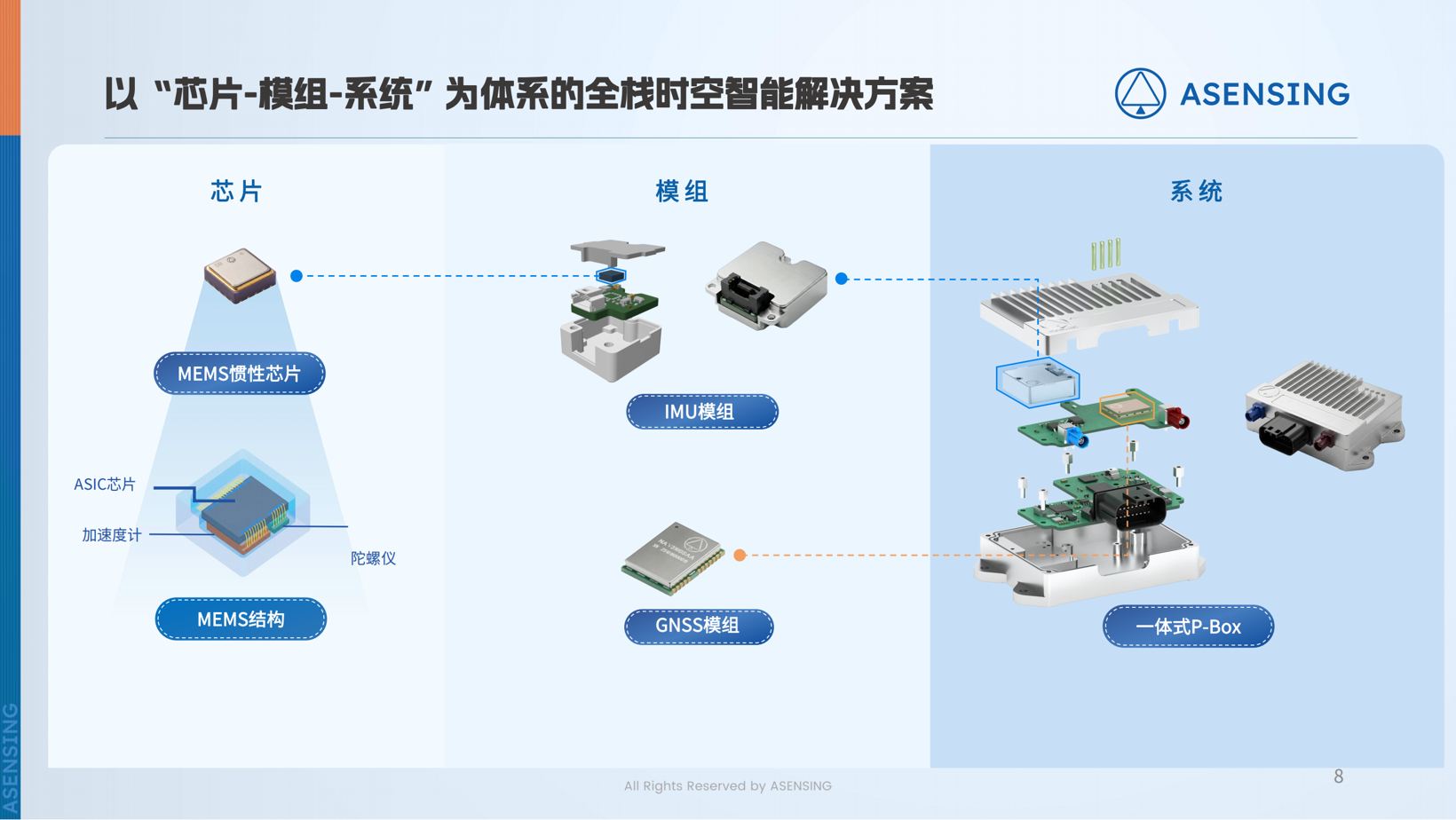
Grounded in the core needs of the robotics industry and the critical value of IMUs, the demands for IMUs from the automotive and robotics sectors show a trend of convergence.
In terms of performance, the needs of robots and automobiles for high output frequency and high-precision data are highly consistent, with automotive-grade standards providing solid support for robotics. At the same time, as robot applications expand globally, covering environments from cold northern regions to the hot equatorial zone, Asensing's automotive-grade devices can operate stably across a full temperature range of -40°C to 105°C. They possess ultra-strong shock resistance, withstanding 2,000g of extreme shock, ensuring reliable execution during high-intensity actions like rolling and jumping. Regarding mass production and cost, automotive-grade IMUs have already completed million-level delivery verification. Relying on the mature automotive supply chain, they offer not only distinct cost advantages but also guarantee consistency in large-scale production, providing assurance for the industry's large-scale commercialization.
Source: Speaker Materials
Asensing's Automotive-Grade IMU: Technical Advantages and Comprehensive Solutions
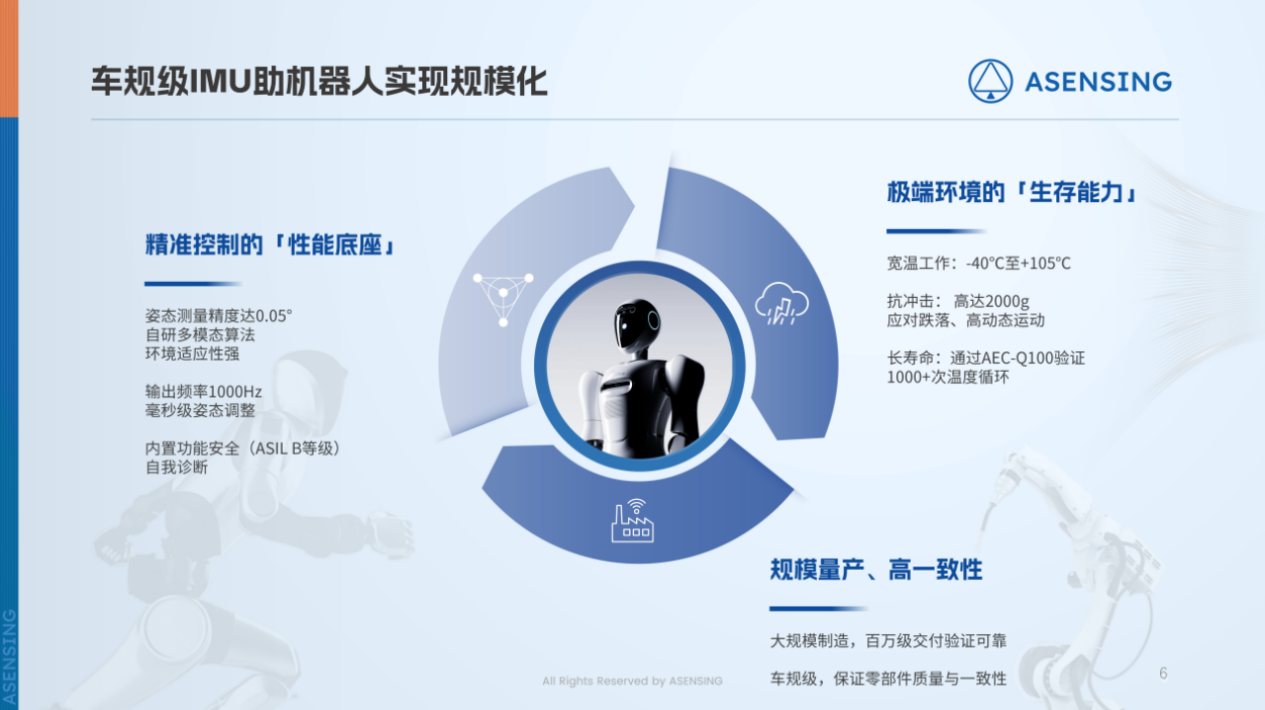
Based on the underlying needs of the robotics industry and combined with the technical adaptability of automotive-grade IMUs, Asensing has specifically constructed a comprehensive spatiotemporal perception solution. It lays out products across the full hierarchy of chips, modules, and systems to precisely meet the perception and navigation needs of different scenarios. Depending on diverse client needs, it can flexibly provide individual products like chips or modules, or integrate them into a complete solution. Specifically in the module product line, it has created a highly platform-based product system capable of meeting different functional requirements such as six-axis, nine-axis (with magnetometer), and attitude output, providing customized, highly adaptable product support for various client applications.
Source: Speaker Materials
Notably, as the only company in the industry to achieve autonomous, controllable full-link capabilities in automotive-grade inertial chip design, calibration, testing, and system integration within the automotive sector, ceramic packaging technology serves as Asensing's core competitive moat. Traditional consumer-grade MEMS chips mostly use plastic packaging processes, where external moisture can penetrate the chip interior during long-term use, causing moisture erosion and chemical corrosion to the micro-electromechanical structure. Asensing's ceramic packaging process, leveraging the characteristics of ceramic material—high hardness and low thermal expansion coefficient—combined with inert gas filling inside the package structure, has been verified through testing to improve the product's long-term durability and bias stability by 70% compared to plastic chips.
Meanwhile, the automotive-grade packaging process ensures that the robot can maintain stable performance output throughout its entire lifecycle of over ten years. In the calibration and testing stages, Asensing pioneered the application of precision rate turntables, where angular measurement accuracy can reach 0.0001°, and module geometric alignment errors are controlled within 0.05°, ensuring high-precision standards from the testing phase.
Aiming at the diverse application needs of the robotics industry, Asensing's automotive-grade IMU products are continuously upgrading in performance and adaptability. They cover core application scenarios in robot environmental perception and motion control, offering six major advantages.
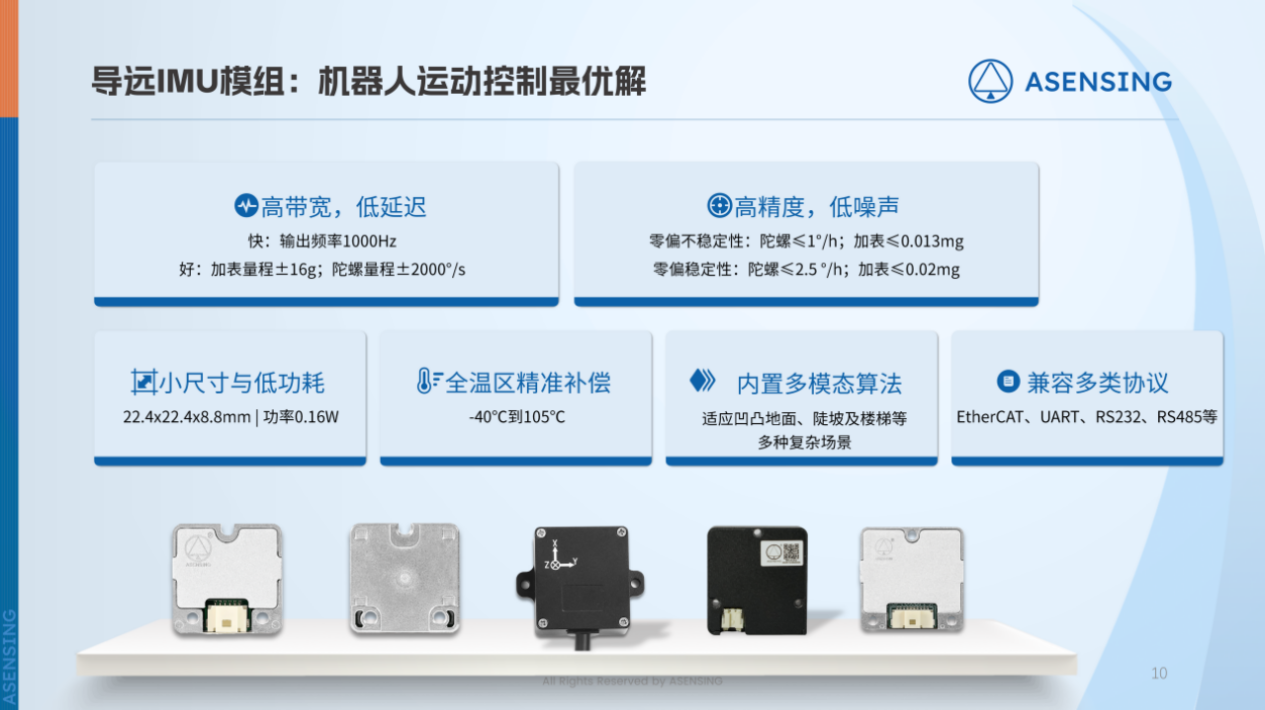
First, in terms of real-time response capability, the products feature high bandwidth and low latency, supporting high-frequency output and large measurement ranges. The accelerometer range and gyroscope range reach ±16g and ±2,000°/s respectively, meeting the measurement needs of robots in various motion states.
Second, at the perception precision level, the products achieve high precision and low noise performance, with gyro bias instability controlled within 1°/h, effectively reducing attitude perception errors during static or low-speed motion.
Third, in structural design, it combines small size with low power consumption, making it adaptable to various miniaturized robot platforms and helping to extend the robot's battery life.
Fourth, regarding reliability, the products employ automotive-grade manufacturing processes and can cover operating environments ranging from -40°C to 105°C. Through precise compensation mechanisms, they meet robotic demands in various operational scenarios.
Fifth, in algorithmic capability, the IMU is built-in with multi-modal algorithms that can adapt to complex scenarios such as uneven ground, climbing slopes, and navigating stairs, enhancing the robot's motion stability and adaptability in complex environments.
At the system integration level, the products support multiple communication protocols including UART, EtherCAT, RS232, and RS485, significantly lowering the barrier to customer deployment and debugging.
Relying on superior performance metrics, reliable automotive-grade processes, and a highly adaptable full-stack solution, Asensing's automotive-grade IMU provides solid core support for the robotics industry. From precise motion perception to stable operation in complex environments, and further to mass production and flexible integration, the product's comprehensive advantages ensure that robots can achieve efficient and reliable performance during development, application, and deployment, laying a solid foundation for industry technology upgrades and large-scale development.
Source: Asensing
Twelve Years of Dedication: Empowering Safe Deployment in the Robotics Industry
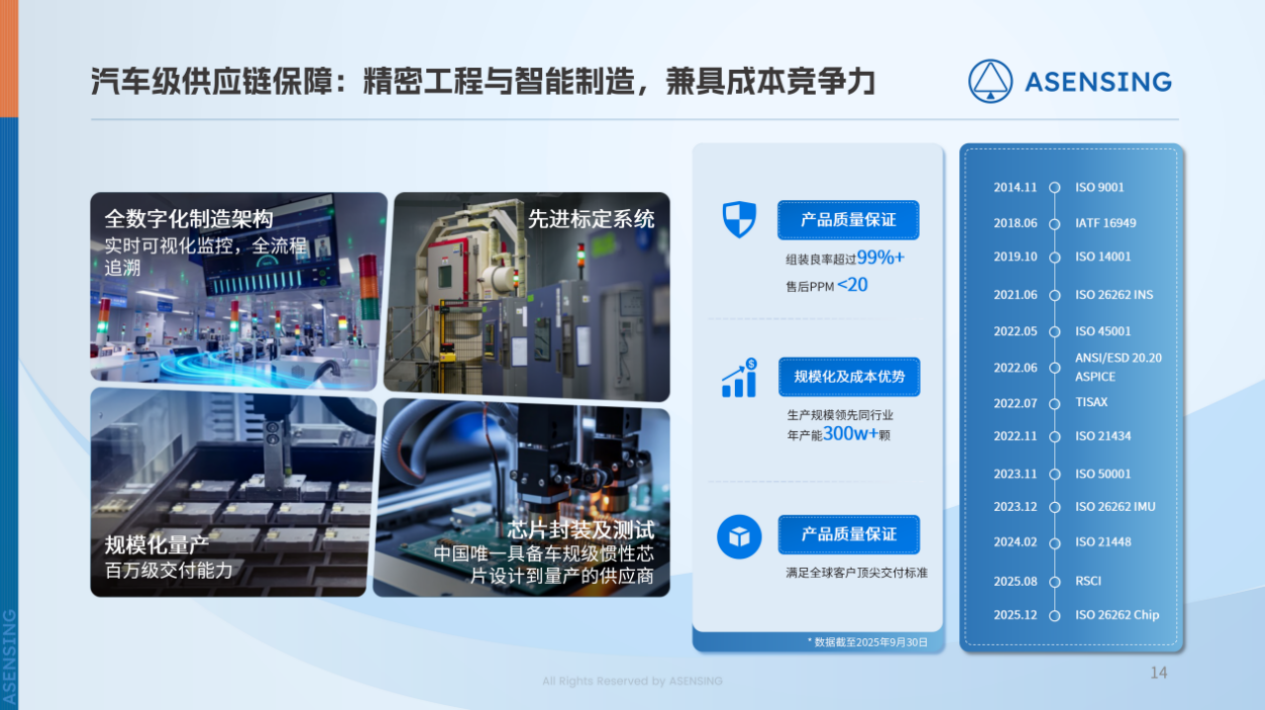
Profound technical accumulation and a comprehensive industrial layout are the solid foundation for Asensing's deep cultivation and empowerment of the robotics industry. Since its establishment in 2014, the company has dedicated itself to the spatiotemporal intelligence field for 12 years, laying out R&D centers in Guangzhou, Beijing, Shanghai, and Hefei, establishing a general assembly production base in Guangzhou, and building a proprietary chip packaging and testing plant in Nantong, Jiangsu, thus constructing a full-link layout integrating R&D and production.
In terms of development path, Asensing has continuously seized key windows of opportunity in the industry, achieving multiple phased leaps. In 2016, the company identified the convergence trend of spatiotemporal intelligence and smart mobility, formally entering the intelligent driver assistance sector; in 2017, it took the lead in winning the first domestic OEM designation; in 2019, it built a dedicated chip packaging and testing production line; in 2021, it completed designations from 11 domestic OEMs, achieving a rapid breakthrough in the domestic market; in 2023, it expanded overseas, successfully obtaining designation orders from leading international OEMs, marking a critical step in global layout. A series of continuous breakthroughs at key nodes have enabled the company to gradually complete the transition from technical layout to large-scale market validation.
At the level of proprietary core technology, Asensing continues to invest and achieve key breakthroughs. In 2025, the company's self-developed chip successfully passed the autonomous controllability assessment issued by the Fifth Institute of the Ministry of Industry and Information Technology (MIIT), achieving complete autonomous controllability from R&D to production of the chip. Subsequently, it successively obtained AEC-Q100 certification and ISO 26262 functional safety product certification, reaching the ASIL D highest safety level requirements. Recently, the company has further deepened its robotics business layout, carrying out deep collaboration with GalaxyBot, a leading enterprise in the field of embodied AI, continuously expanding the application boundaries of core hardware in emerging scenarios.
Upholding the philosophy of "Precision Engineering + Smart Manufacturing," Asensing has built a complete digital manufacturing architecture, realizing real-time visual monitoring and full-process traceability of the production process. Currently, the company's production line yield exceeds 99%, and the PPM value is less than 20, meaning that for every million products delivered, there are no more than 20 defective units after sale. Relying on mature automotive-grade mass production experience, Asensing's annual production capacity has already exceeded 3 million units, fully capable of meeting clients' million-level delivery needs. At the same time, the company has established a delivery system meeting international top-tier standards and successfully secured designation orders from multiple top-tier overseas enterprises. High-standard module automated production lines and leading calibration processes also provide long-term stable guarantees for product performance and quality.
Source: Speaker Materials
With years of technical accumulation and continuous innovation, Asensing continues to refresh industry benchmarks and repeatedly create "firsts": It not only took the lead in achieving mass production of automotive-grade MEMS combined navigation but has also long maintained a leading position in installations in this field both in China and globally, with a domestic market share exceeding 50% and a global share reaching 27.6%, and its cumulative shipments rank at the forefront of the industry; furthermore, the company is the only high-precision positioning solution supplier to enter international OEM systems, continuously promoting the extension of automotive-grade spatiotemporal perception technology to broader application scenarios.
Looking to the future, as robots accelerate their deployment in scenarios such as service, logistics, medical care, and manufacturing, industry requirements for safety and reliability will continue to rise. Against this backdrop, automotive-grade IMUs with high functional safety levels are gradually becoming an important support for robot core perception systems. Asensing will further deepen the application of automotive-grade technology in the robotics field, working with industry partners to promote product upgrades and large-scale deployment, continuously improving the stable operation capability of robots in complex environments, and providing solid support for the industry's move towards safe, intelligent, and large-scale development.


