



Gasgoo Munich- On January 29, Black Sesame Technologies announced a strategic partnership with Apollo Go, Baidu's autonomous ride-hailing arm, marking a new step in closer collaboration between China's chip developers and autonomous mobility operators.
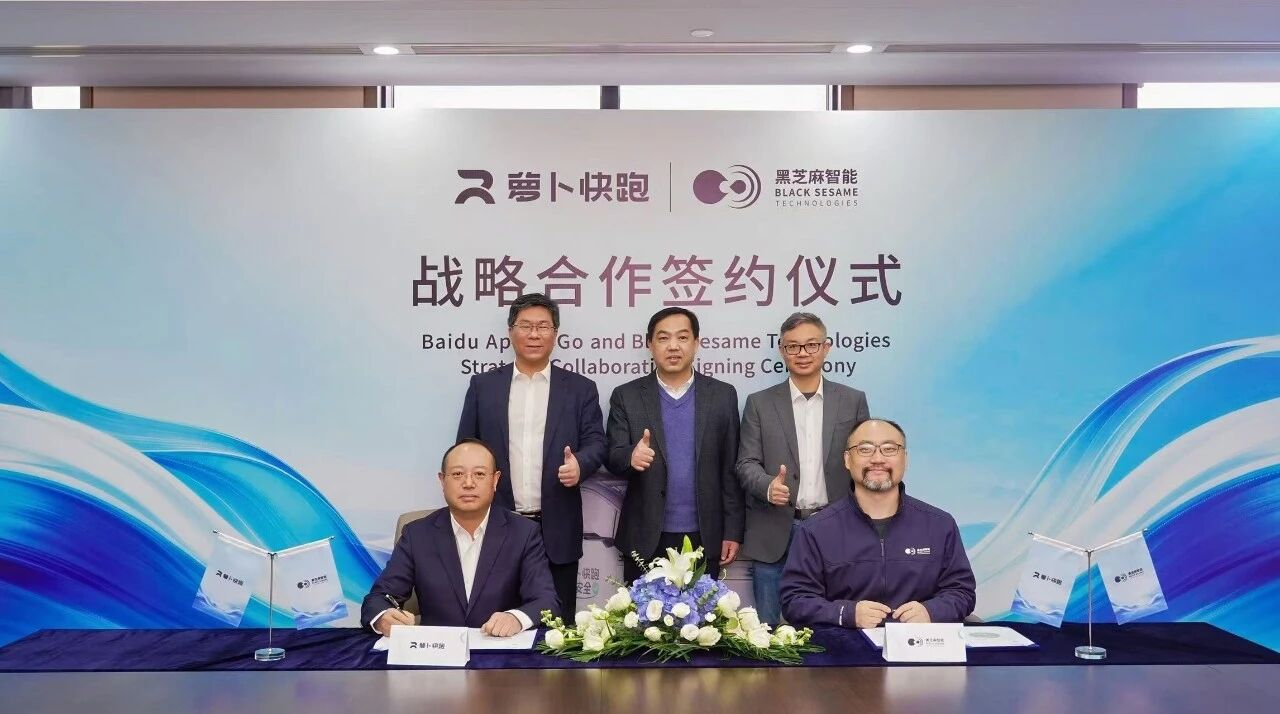
Image source: Black Sesame Technologies
Under the agreement, Black Sesame Technologies will provide computing chip technologies to support Apollo Go's product development, while Apollo Go will offer validation expertise and application-level feedback to accelerate technology verification and commercialization. The two sides aim to jointly cultivate an autonomous driving ecosystem, drawing in additional industry partners and helping advance the maturity of China's intelligent driving supply chain.
Black Sesame Technologies has built a broad foundation in automotive computing chips, spanning core technologies, diversified product portfolios and large-scale mass production. Apollo Go, meanwhile, has emerged as one of the world's most prominent autonomous mobility platforms, with commercial or pilot operations rolled out across 22 cities including Beijing, Shanghai, Wuhan, Hong Kong, Dubai and Abu Dhabi, giving it extensive real-world deployment experience across varied urban scenarios.
Commenting on the partnership, Black Sesame Technologies founder and CEO Shan Jizhang said the company sees the collaboration as a strong fit between high-performance, reliable and open computing platforms and leading autonomous driving applications. He noted that by combining Black Sesame's computing capabilities and engineering efficiency with Apollo Go's operational know-how, the two companies are well positioned to accelerate progress across the Level 4 autonomous driving value chain.
Wang Yunpeng, Baidu vice president and president of its Intelligent Driving Group, said the alliance reflects Baidu's long-standing strategy of working closely with leading partners across the industry chain. By integrating Apollo Go's accumulated strengths in autonomous driving with Black Sesame's core competencies in in-vehicle computing chips, he said the partnership is expected to drive collaborative innovation and support the next phase of development for China's autonomous driving industry.


