



Gasgoo Munich- On the first workday following the Lunar New Year holiday, a "Land Carrier" aircraft ascended above Jiulong Lake Park in Guangzhou's Huangpu District, marking the first flight of the Year of the Horse. That same day, at the Guangdong High-Quality Development Conference, Party Secretary Huang Kunming signaled that the province would maximize efforts to deregulate technological innovation and market exploration, enabling the low-altitude economy to take off.
From policy to industry, and from the ground to the sky, Guangdong is advancing a "Sky City" strategy. How will the province enable the low-altitude economy to take flight?
From "Encouraging Exploration" to "Active Deregulation"
At the start of 2026, policy signals in the low-altitude economy sector are increasing. Huang Kunming's call for deregulation at the development conference addressed a key bottleneck: the industry's main obstacle has been institutional barriers where "legacy regulations govern new productive forces."
In fact, Guangdong has already laid the groundwork for its low-altitude economy policy.
In May 2025, Guangdong released its "Action Plan for Promoting High-Quality Development of the Low-Altitude Economy (2024–2026)," explicitly targeting a sector size exceeding 300 billion yuan by 2026 to build a globally competitive industrial hub. That October, the province formally issued "Several Measures to Support the High-Quality Development of the Low-Altitude Economy," rolling out 16 specific initiatives covering airspace management, technical breakthroughs, and application scenarios.
This policy package reveals a clear strategic logic: using scenario applications and technical breakthroughs as "points," infrastructure and industrial chains as "lines," and a digital foundation and collaborative system as "planes." This approach fosters systematic advancement through a multi-dimensional interplay.
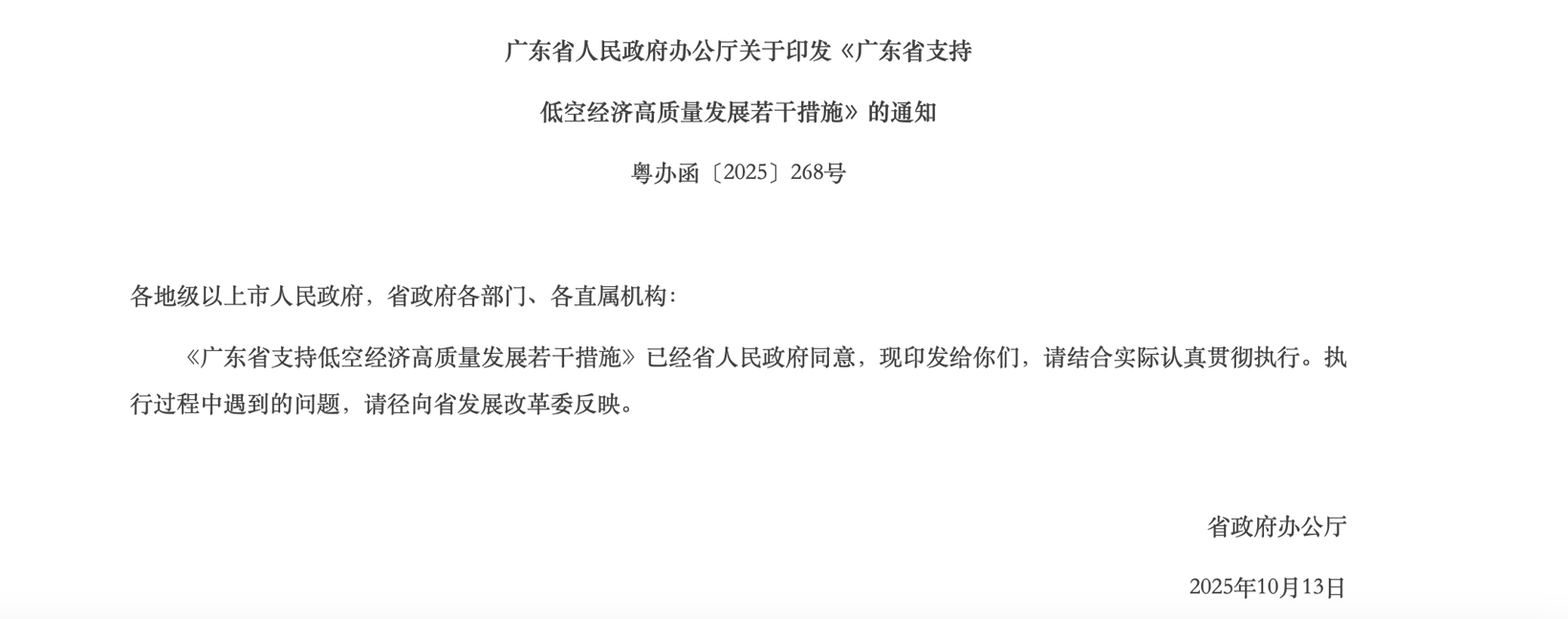
Image Source: The People's Government of Guangdong Province
Regarding airspace management, Guangdong is supporting Guangzhou, Shenzhen, and Zhuhai as pilot zones to steadily open intra-city and inter-city low-altitude passenger routes, while exploring traffic rules for low-altitude airspace and cross-border drone logistics in the Greater Bay Area. On airworthiness certification, the province is promoting the joint establishment of technical service agencies by provincial and municipal authorities to improve the efficiency and quality of aircraft certification.
The ultimate test of policy lies in industry response. Guangdong has gathered over 15,000 companies related to the low-altitude economy, building a complete chain from core components and aircraft manufacturing to operations. In 2025, civil drone production surpassed 6.9 million units, ranking first nationwide.
In the recently released 2025 Forbes China Low-Altitude Economy Industry selections, the Guangzhou Development District made a notable presence—two companies within its jurisdiction, EHANG and XPENG AeroHT, were named "Leading Enterprises."
Zhao Deli, founder of Guangdong ARIDGE, revealed that the team has grown to over 2,000 people and filed more than 1,000 core patents. Orders for the "Land Carrier" have exceeded 7,000 units. The company has mapped out a "three-step" strategy: first, launch a split-style flying car to encourage people to fly; second, roll out the A868 air taxi within 3 to 5 years; and third, realize a land-air integrated flying car in about 10 years.
Paving the Runway for "Takeoff"
For the low-altitude economy to take flight, solid ground support is essential. Guangdong's layout in infrastructure is decidedly forward-looking.
Currently, the province has built 73 general airports, over 3,500 various low-altitude landing points, more than 66,000 5G-A base stations, and 236 integrated sensing and communication base stations—all ranking at the forefront nationwide. Simultaneously, it has established a provincial low-altitude flight comprehensive service management platform that integrates collaborative operation management, flight services, and drone management, and took the lead in forming the country's first provincial-level technical committee for low-altitude economy standardization.
In 2026, Guangdong plans to build 2,500 new drone takeoff and landing points and 20 helicopter pads to construct a province-wide low-altitude intelligent network system. Take Guangzhou's Huangpu District as an example: it has already built two Class A2 general airports, six eVTOL landing points, and 17 automated hangars, establishing a low-altitude intelligent network. The Knowledge City area is planning a 5.2-square-kilometer low-altitude economy industrial park, equipped with an 800-meter test flight runway, to create a demonstration hub integrating R&D, manufacturing, and flight verification.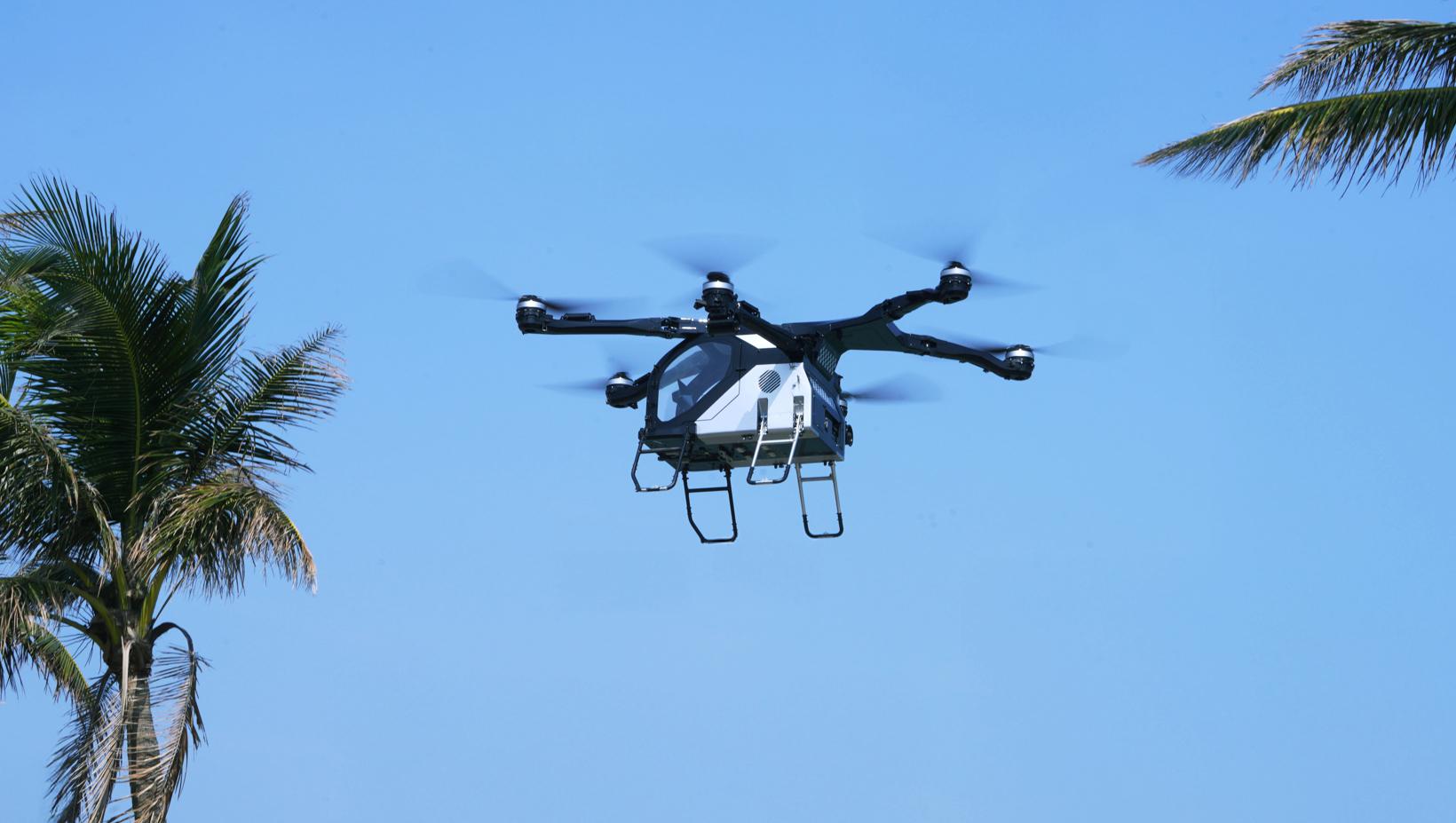
Image Source: XPENG AeroHT
If policy and infrastructure are the prerequisites for "takeoff," then scenario application is the real test once airborne.
In logistics and distribution, Guangdong is focusing on "trunk-branch-end" delivery needs, building drone logistics nodes, and launching inter-city drone transport and end-point distribution applications. Currently, annual logistics flights in the province have surpassed 800,000 sorties.
In the public sector, Guangdong has established the country's first provincial-level digital government drone system, integrating over 4,000 drones. It covers all towns and streets, supporting work in living environments, public services, social governance, and disaster relief.
In the consumer sector, low-altitude tourism is entering daily life. The Jiulong Lake Flight Camp will officially open to users this year, offering personal flight and flight experience services. Zhao Deli stated that using Guangzhou as a model, the company aims to complete a commercial layout in major cities nationwide this year, simultaneously launching a "6S" full-chain service covering display, sales, experience, delivery, after-sales, and training.
In January 2026, the Guangdong Provincial Development and Reform Commission deployed work to create comprehensive application scenarios for the low-altitude economy. Focusing on improving flight service guarantees, expanding key scenario applications, and strengthening industrial clustering, the move aims to promote the normalized operation of multiple scenarios including low-altitude logistics, medical rescue, air traffic, and agricultural monitoring.
2026 marks the final year of the "Action Plan for Promoting High-Quality Development of Guangdong's Low-Altitude Economy," with the target set at a 300 billion yuan industrial scale. Will this year mark a turning point where the low-altitude economy shifts from pilot programs to widespread adoption, and from takeoff to practical application? Guangdong's performance in the sky is worth watching.


