



Gasgoo Munich-23.057 million charging connectors, up 43.2% year-on-year. The national car-to-pile ratio is approaching 2:1.
That is the scorecard as of the end of June 2026. The numbers look impressive, yet the industry isn't smiling.
The vast majority of charging operators are stuck with razor-thin margins or even losses. According to a report by CCTV's "Economic Half-Hour," leading firms net just 0.04 yuan per kilowatt-hour. From small players to state giants, almost no one is profiting from this chaotic price war.
"Scale is up, but the money isn't."
Behind the headline numbers lies a structural shortage of public resources, severe regional imbalance, and rigid, outdated business models. As the charging network shifts from "availability" to "quality," the sector faces a fundamental question: after 23 million, where is the road ahead?
A 2:1 Overall Ratio, But 10:1 Anxiety for Public Charging
Break down the figure of 23.057 million, and the contradictions immediately surface.
In the first half of 2026, charging infrastructure increased by 2.965 million units, down 9.7% from a year earlier. Public charging facilities added just 292,000 units—a 43.5% plunge—while private installations jumped to 2.673 million. The bulk of the growth was locked behind private parking spots.
Two consequences followed.
First, public charging resources remain tight. The 2:1 national ratio includes private piles. Strip those away, and the actual ratio in the public sector approaches 10:1. While the total volume looks sufficient, holiday queues at highway service areas persist. During this year's May Day holiday, highway charging sessions hit 3.978 million, with daily charging volume up 14.09% compared to the Spring Festival—another record high.
Second, the regional distribution is severely uneven. The top 10 regions—Guangdong, Zhejiang, Jiangsu, Shandong, Shanghai, Fujian, Henan, Anhui, Sichuan, and Hubei—account for 66.2% of all public charging facilities. Urban areas hold 85%, leaving rural areas with just 15%.
Lower-tier markets are catching up. By the end of June, county-level charging infrastructure coverage had risen to 98.61%. But coverage does not equal usability.
During this year's Qingming Festival, Xuancheng in Anhui province—viral on social media—saw a tourism surge. Ms. Liu arrived in her pure electric sedan, and the nightmare began: the first station was blocked by internal combustion engine cars, the second had closed, and the third had more broken piles than working ones. It took 30 minutes of hassle just to plug in. In Xuancheng, 30 minutes is enough time to cross the entire city.
The official data is even more ironic: as of April 2026, Xuanzhou district alone had over 40 registered operators, 400 charging sites, and more than 4,000 connectors. The numbers are impressive, but few are functional.
It is a microcosm of "built but unused, used but underutilized." Operators crowd into commercial districts fighting for turf, driving down single-pile utilization rates, while older residential communities and rural counties remain blind spots. The tidal mismatch is equally stark: commercial stations sit idle at midnight, while highway service areas are empty on weekdays yet gridlocked on holidays.
The real challenge for the charging pile industry isn't building more, but building the right ones and using them well.
If the conflict between scale and structure is the industry's "surface," the profitability crisis is its "core".
In early 2024, charging service fees ranged from 0.2 to 0.3 yuan per kWh; by 2025, they had fallen to around 0.17 yuan. After deducting equipment and land costs, profit sits at just 0.04 yuan per kWh. During low-price electricity periods, operators even pay to charge.
The era of instant profitability upon station opening is gone. Capital rushed in to seize territory. Now, oversupply has spawned vicious competition, driving service fees down while rent and depreciation costs refuse to budge. Industry insiders told Gasgoo that new stations may need seven, eight, or even ten years to break even.
Technological iteration is adding to the pain. The average power per connector rose from about 45 kW in 2025 to 49.35 kW by June 2026. Low-power piles built in earlier years have become inefficient assets—obsolete before they ever paid for themselves.
Ultra-Charging Goes Mainstream, The Era of Megawatts Arrives
Distress is driving a technological revolution.
In January 2026, Huawei released ten trends for the charging network industry. Wang Zhiwu, president of Huawei's Intelligent Charging Network Domain, noted that charging networks are still in an early stage of development.
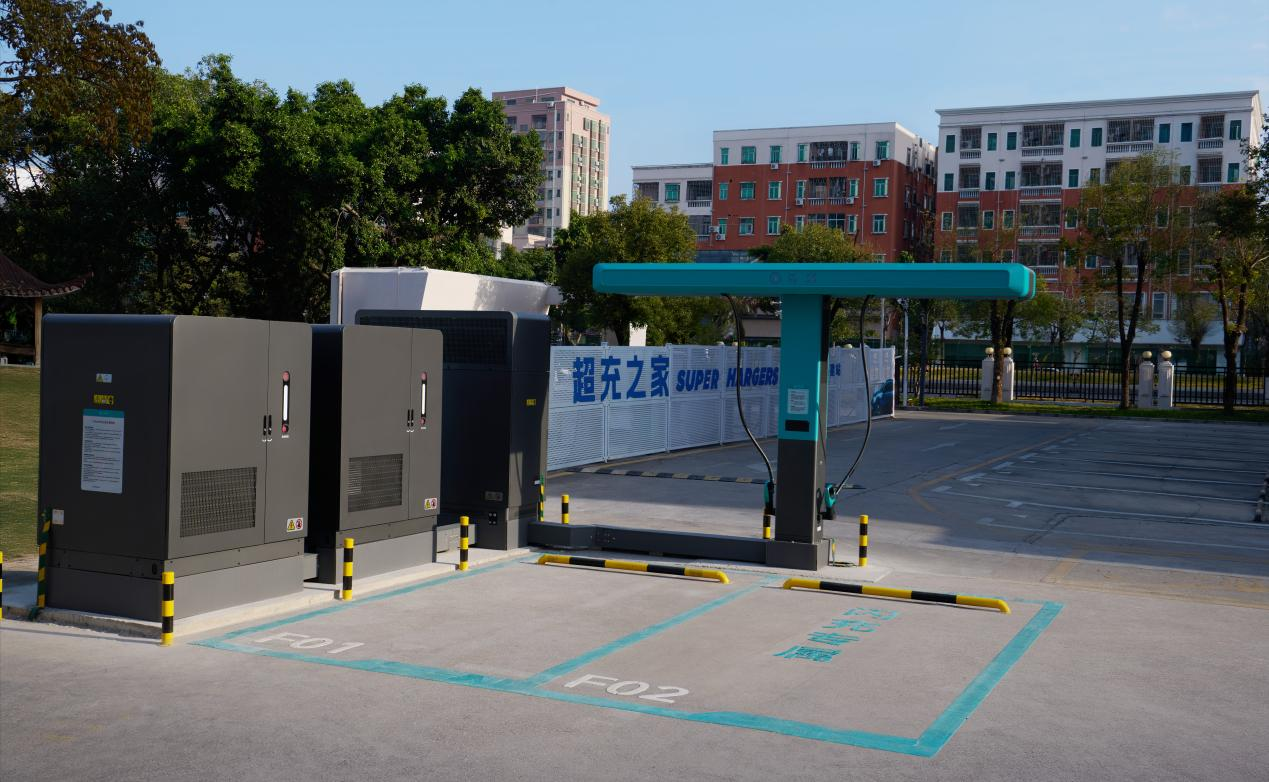
BYD ultra-fast charging "station within a station", Image source: BYD
Comprehensive ultra-charging is the first wave. Third-generation power semiconductors are seeing widespread application, and high-rate battery installations are rising, pushing ultra-fast models from the premium segment to the mass market. Huawei's 600 kW liquid-cooled ultra-charging terminal delivers 300 kilometers of range in five minutes. Compared to traditional air cooling, liquid cooling offers higher heat dissipation, thinner cables, and resilience against high heat, humidity, and salt spray.
Megawatt-level logistics follow close behind. Heavy trucks shifting from oil to electricity are moving from closed scenarios to all-encompassing use cases. A notice on promoting the scientific planning of high-power facilities proposes piloting megawatt-level charging for heavy trucks and ships.
Storage-charging DC-ization and campus microgrids are advancing in tandem. Grid-forming photovoltaics and storage are merging with all-liquid-cooled ultra-charging to create a one-stop "PV-storage-charging-vehicle-cloud" solution.
Technology is moving from concept to reality. The Fanzhuang Smart Ultra-Charging Station in Datong, Shanxi, is equipped with four 480 kW liquid-cooled ultra-charging piles and two V2G piles, replenishing 1 kilometer of range in just 1 second. The first photovoltaic-storage-charging demonstration station in Guangzhou's Baiyun district reduced transformer capacity by about 40%, increased photovoltaic self-use by 50%, cut charging costs by 20%, and boosted utilization by 30%.
Shenzhen has launched the country's largest single-station megawatt vehicle-to-grid (V2G) flash-charging demonstration station, featuring the nation's first liquid-cooled single-gun megawatt V2G pile for passenger cars. Vehicles can add 400 kilometers of range in as fast as five minutes and act as distributed energy storage units participating in grid peak shaving and frequency regulation.
From "City of Ultra-Charging" to "City of Megawatt Ultra-Charging," charging infrastructure is undergoing an unprecedented technological leap.
Farewell to "Selling Power," Hello to "Selling Dispatch"
Technology provides the possibility, but the shift in business models is the true revolution.
The core path is V2G (Vehicle-to-Grid interaction). Electric vehicles are no longer just "power-consuming" terminals, but "energy storage" nodes—charging during off-peak hours and feeding back to the grid during peaks. Operators no longer earn the spread on electricity prices, but dispatch service fees for helping the grid balance loads.
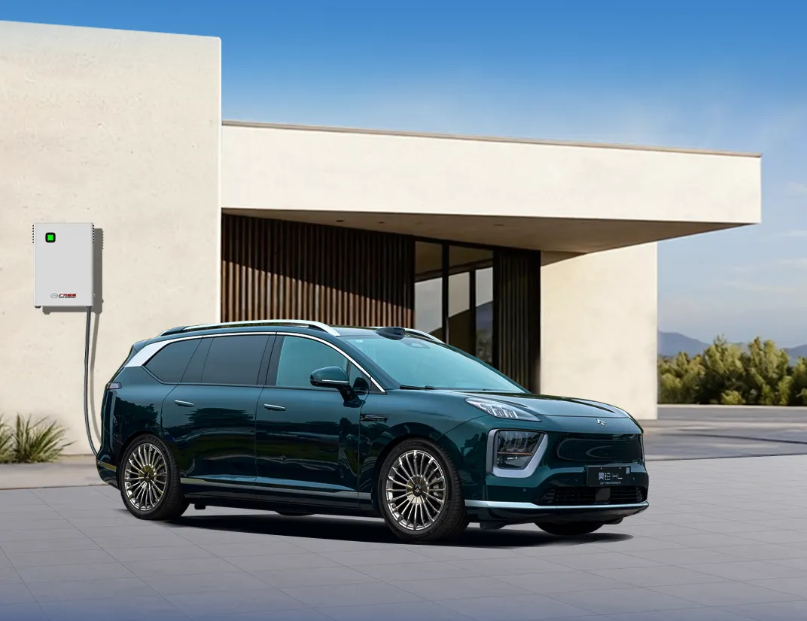
On December 9, 2025, GAC's V2G project cumulative discharge surpassed 1 million kWh; Image source: GAC Energy
By the end of 2025, China's new energy vehicle ownership reached 43.97 million, creating a massive "mobile energy storage pool" across the country.
Policy support is accelerating. The "15th Five-Year Plan" for New Energy System Construction proposes reaching 40 million charging infrastructures by 2030, with vehicle-grid interaction aggregating an adjustable charging scale of 50 million kW. The "15th Five-Year Plan" to Expand Consumption requires the capacity to support over 100 million electric vehicles.
If the "14th Five-Year Plan" was about scaling from zero to one, the "15th Five-Year Plan" is the leap from existence to excellence.
Commercialization paths are landing. On July 1, 2026, a pilot for V2G reverse power sales from private residential charging piles launched in Wuhan, turning car owners from "power consumers" into "prosumers." Hefei and Shenzhen simultaneously launched V2G discharge power support. Dongfeng Motor and State Grid Jiangsu Electric Power released the first residential AC V2G mass-production solution. China Southern Power Grid and Dongfeng Yiipai globally launched the first mass-produced AC V2G vehicle, achieving bidirectional charging and discharging via OTA upgrade without hardware modification, with supporting charging piles priced at just the 1,000-yuan level.
Diversified value-added services are being explored in parallel. An "PV-storage-charge-swap" station under Anhui Petroleum formed a virtual power plant to participate in grid peak shaving, completing 12 valley-filling responses in the first half of the year. "Response revenue has become a crucial income channel for the station."
According to calculations by the Chebaihui Research Institute, once vehicle-energy integration matures, it is expected to create a trillion-yuan comprehensive economic benefit by 2030. But the transition is not smooth; V2G remains constrained by practical issues like grid dispatch mechanisms, electricity market rules, and battery cycle life.
Market Reshuffling: Who Will Win?
The logic of industry development is shifting, and the competitive landscape is restructuring rapidly.
The trend toward concentration at the top is clear. The top 10 operators hold a combined 2.45 million public charging connectors. But in terms of charging volume share, the landscape has been reshaped. As of March 2026, Didi Charging ranked first nationwide with a 34.22% share, followed by TELD at 10.06% and YKC at 9.54%. One ride-hailing platform's charging volume exceeds that of the next three competitors combined.
Each model has pros and cons. TELD and StarCharge represent the heavy-asset model, building their own stations with leading fixed assets but facing heavy depreciation pressure and long return cycles. Didi Charging represents the platform aggregation model, rising rapidly on platform capabilities and high-frequency ride-hailing users. BYD, Huawei, and CATL are accelerating their layouts, forming a "four-way war" that signals the industry's shift from a "price war" to a "technology value war".
Lower-tier markets and the heavy truck track have become new battlefields. The Ministry of Finance, Ministry of Industry and Information Technology, and Ministry of Transport have launched a 2026 pilot to patch gaps in county-level charging and swapping facilities, planning to support 59 joint pilot counties, with 200 supported in total.
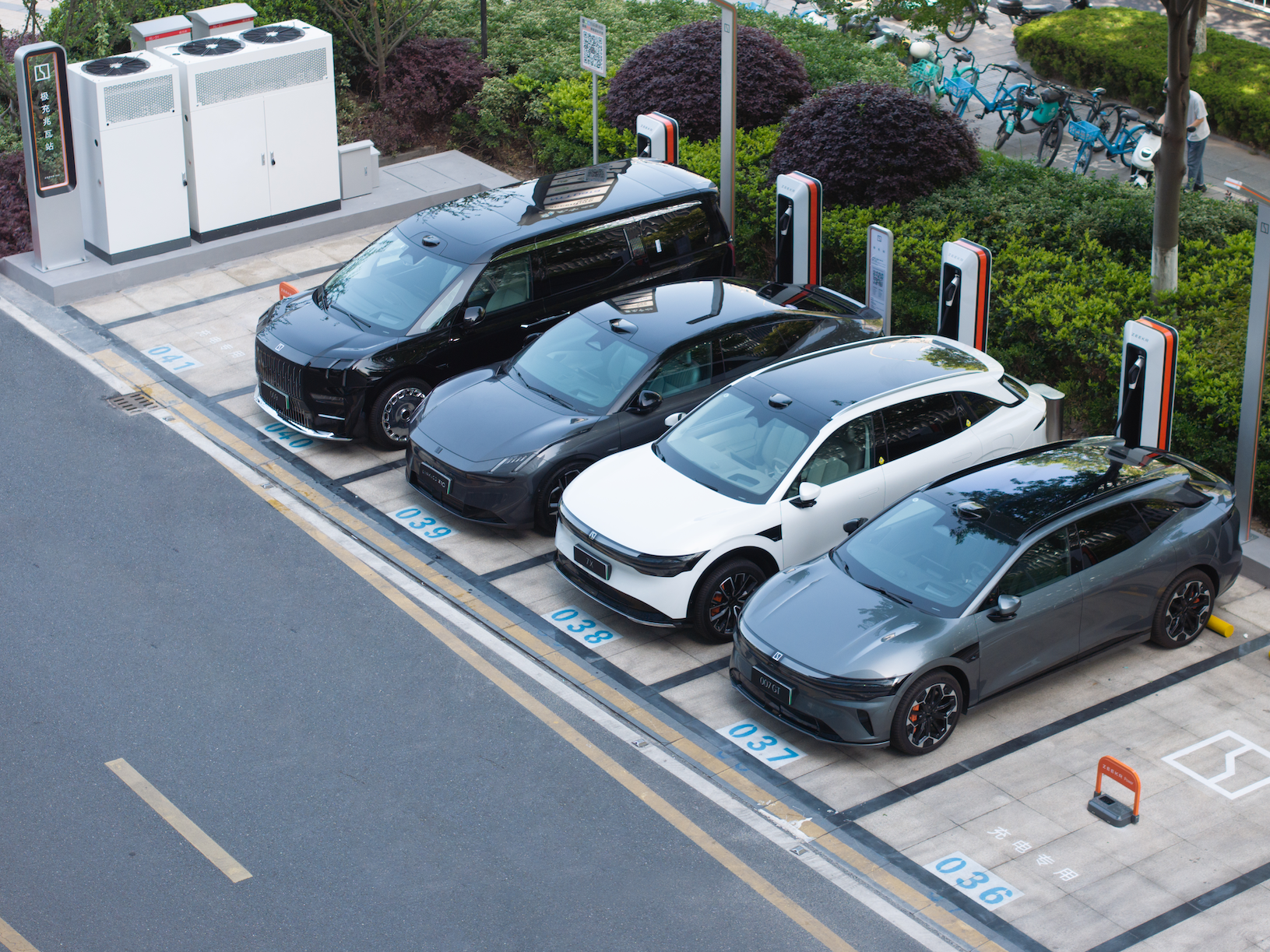
Image source: ZEEKR
The industry is moving from "land-grabbing" to "intensive farming." Early capital grabbers who cannot improve operational efficiency are being eliminated. Those with technical prowess and superior user experience are accelerating their market share grab.
As one industry insider put it: scale is no longer the core of competition. The future battle is a comprehensive contest of precise insight into user needs, technological integration of grid interaction, and operational service capabilities across diverse scenarios.
23 million charging facilities are a milestone, far from the finish line. From "having it" to "having it good," from "selling power" to "selling dispatch," from "ultra-charging" to "megawatt ultra-charging," the charging infrastructure industry stands at a new starting point. Only those enterprises that complete their business model transformation, precisely layout public resources, and deeply integrate into the energy internet will be the ones to go the distance in this marathon.


