



Gasgoo Munich- The forensic findings are in for the Xiaomi SU7 Ultra crash on Chengdu's Tianfu Avenue, with a series of judicial reports now released. Data from the Sichuan Xihua Traffic Judicial Appraisal Center’s opinion warrants a closer look.
A 167 km/h Impact and a Severed Circuit
Start with the impact speed: the vehicle was traveling at 167 km/h when it struck the car ahead, having topped 200 km/h just three seconds prior. The speed limit on that stretch of road is 80 km/h. Chengdu police had already confirmed in an earlier briefing that the driver, identified only as Deng, was suspected of drunk driving.
Why did the doors fail to open? The forensic report points to a technical chain reaction: the violent impact crushed the battery, causing a short circuit in the cells. High-voltage current then surged into the low-voltage system, cutting power to the vehicle’s entire electrical grid.
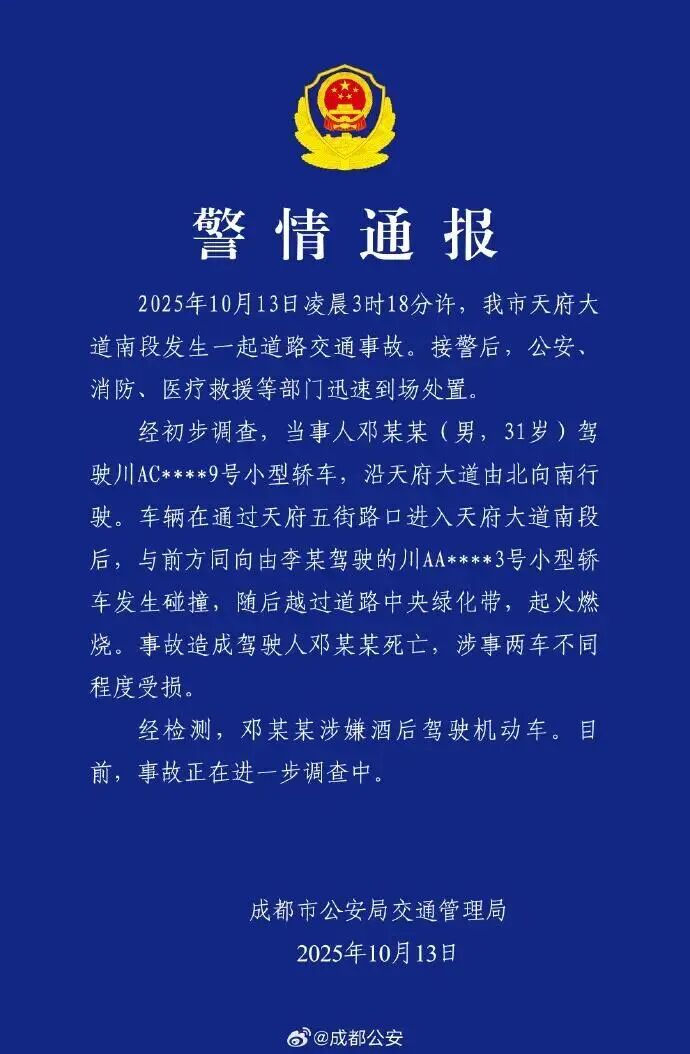
Image source: Chengdu Public Security
The Xiaomi SU7 Ultra involved in the crash uses electronic release buttons on the exterior, with no external mechanical emergency handle. Once the low-voltage system died, those exterior releases were useless. While the car does have a hidden mechanical release handle inside, using it would have been nearly impossible in an emergency involving a rollover and fire—especially if the occupant was unconscious—and it cannot be operated from the outside.
The Chengdu Public Security Bureau’s forensic institute determined that Deng died from the fire, not from the impact itself.
On February 13, 2026, Chengdu traffic authorities concluded their investigation, assigning full responsibility to Deng for drunk driving and severe speeding. Because the driver died in the crash, no criminal charges will be pursued.
Deng’s family, however, disputes the allocation of liability. They argue that the vehicle’s design—relying on electronic buttons without an external mechanical handle—meant the power failure locked the doors, preventing escape. They claim the automaker should share responsibility. As of now, the family and Xiaomi have not reached a settlement.
Electrical Safety Logic and the Evolution of Standards
This crash has thrust the logic of electrical safety in new energy vehicles into the spotlight. While Xiaomi’s customer service had previously stated that the SU7 is designed to unlock automatically upon collision, a physical circuit interruption in this instance bypassed that safety protocol.
Significantly, the systemic issues highlighted by this tragedy are already drawing an institutional response.
Starting July 1, 2026, the mandatory national standard "Safety Requirements for Electric Vehicles" (GB18384—2025) will take effect. The new rules mandate a physical disconnect between the vehicle’s high-voltage circuit and its rechargeable energy storage system. It defines a "one-button power cut" as a physical device, replacing software-controlled solutions. When the vehicle is stationary and not charging, drivers can trigger this with a single action—a tap or a long press.
Also taking effect that day is the "Safety Requirements for Power Batteries for Electric Vehicles" (GB38031—2025), touted as the strictest battery standard to date. It upgrades thermal diffusion testing: instead of merely providing an alarm five minutes before fire or explosion, the new requirement is "no fire, no explosion" (with an alarm still required), ensuring smoke does not harm occupants. It also adds bottom-impact testing and safety checks after fast-charging cycles.
Safety requirements for door handles are now mandatory, too. The "Technical Requirements for Safety of Automotive Door Handles" (GB 48001-2026), effective January 1, 2027, stipulates that every exterior door handle must have a mechanical release device, and every interior handle must have at least one. Operating any interior handle independently must open the corresponding door. The standard also requires that permanent markings be clearly visible, easy to identify, and unobstructed.
Meanwhile, the Society of Automotive Engineers of China began drafting the "Guidelines for Rescue-Friendly Design of Electric Vehicles" in April 2025. This group standard covers structural, electrical, and functional design, as well as rescue manuals, aiming to ensure rescue-friendly design throughout the entire process from accident occurrence to emergency response.
As technology accelerates, the backstop role of standards becomes ever more critical. While this accident has reached a verdict on liability, the debate it has ignited—over electrical safety logic, emergency design, and the pace of regulatory updates—may only just be beginning.


