



A name that holds the memories of two generations is making a comeback.
Chery Automobile has officially announced the "Chery QQ Night" on February 6, marking the formal launch of the all-new pure electric model, the Chery QQ3. With the tagline "I'm back, and the memories of that youth are back," the brand instantly awakened the collective nostalgia of those born in the 1980s and 1990s.
This return, spanning two decades, comes just as China's new energy vehicle market reaches a boiling point. In the small electric vehicle segment, models like the Wuling Hongguang MINI EV and BYD Seagull are already competing fiercely.
Questions inevitably arise: Is this classic IP, laden with youthful nostalgia, merely selling sentiment, or does it arrive with genuine substance?
What Surprises Does the All-Electric QQ Hold?
Based on filings from the Ministry of Industry and Information Technology (MIIT) and official teasers, the new Chery QQ3 displays product capabilities that are starkly different from the original model.
In terms of design and dimensions, the QQ3 has undergone a comprehensive expansion and style refresh. Externally, the new QQ3 retains the family's classic rounded genes while incorporating modern EV design elements, striking a balance between nostalgia and fashion.
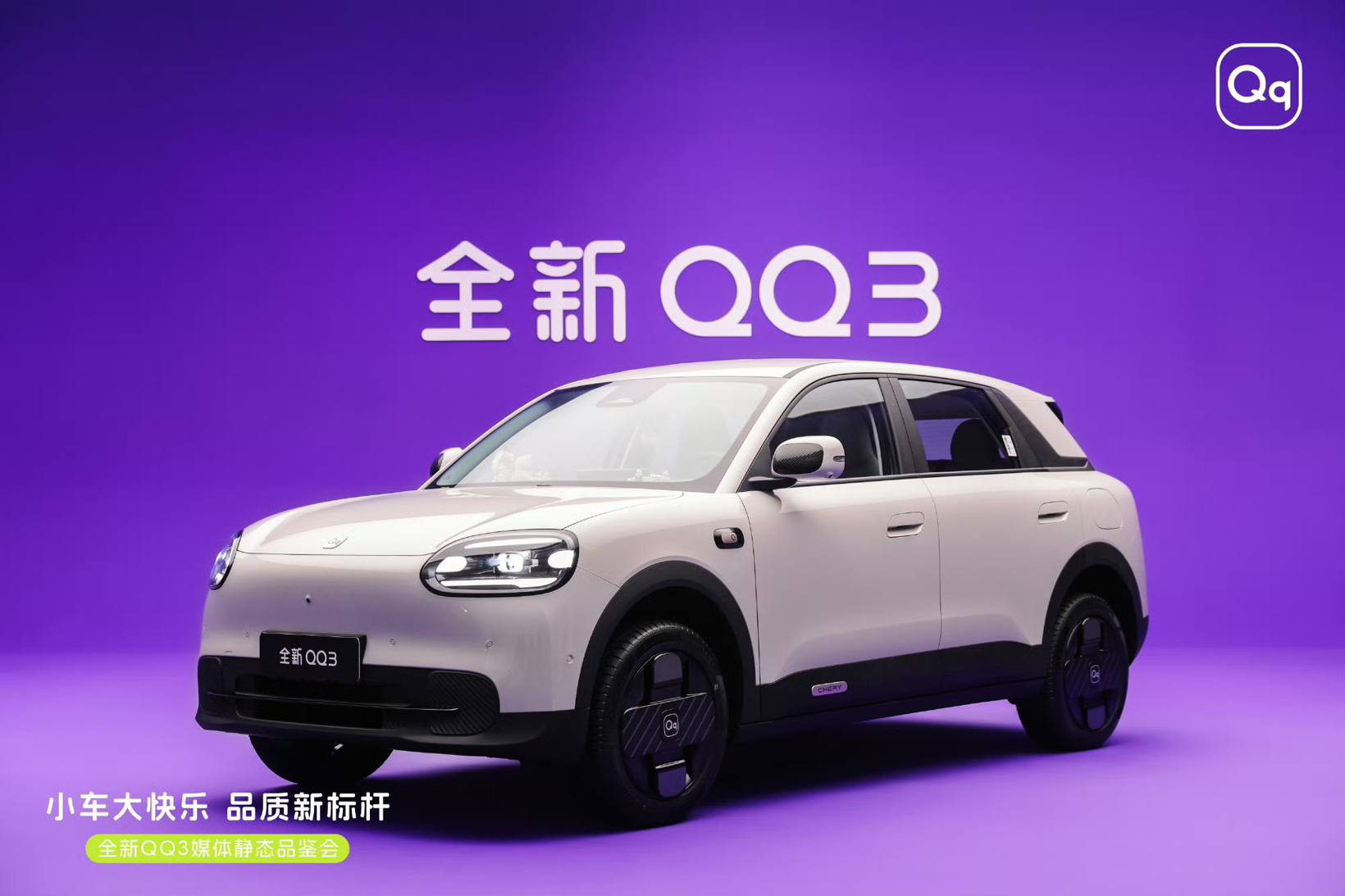
Image Source: Chery
The front features a closed grille paired with rounded, agile headlights, preserving the cute demeanor of the original QQ while highlighting its electric identity.
The side profile is sleek, equipped with semi-hidden door handles and low-drag wheels, enhancing refinement while reducing wind resistance.
A comprehensive increase in size is a major highlight of the new QQ3. Its dimensions are 4,195 mm in length, 1,811 mm in width, and 1,569 (1,573) mm in height, with a wheelbase reaching 2,700 mm—a significant jump over the original Chery QQ. It adopts a five-door, five-seat layout, fully meeting the daily travel needs of families.
On the powertrain front, the new QQ3 has fully switched to electric drive, offering two motor power options with maximum outputs of 58 kW and 90 kW respectively. Both boast a top speed of 125 km/h, easily handling city commutes.
For batteries and range, the new model is equipped with lithium iron phosphate (LFP) battery packs from Gotion High-tech, balancing safety with practicality. According to MIIT filings, the CLTC range offers two versions: 280 km and 401 km, covering various user scenarios.
Intelligent technology has become the most eye-catching core selling point of the new QQ3, a positioning that stands in stark contrast to the original model.
The smart cockpit features the "AI Lingxi Intelligent Cockpit" based on the Qualcomm 8155 chip, equipped with a 15.6-inch 2.5K floating central screen. It integrates the Carmind large model and supports advanced AI voice interaction and "visible and speakable" functionality.
The interior and comfort configurations are generous, employing a black-and-white color scheme with bright accents. It comes with a dual-spoke multifunction steering wheel, a fully digital instrument cluster, a wireless phone charging panel, and 256-color ambient lighting. The front seats offer ventilation, heating, and memory functions.
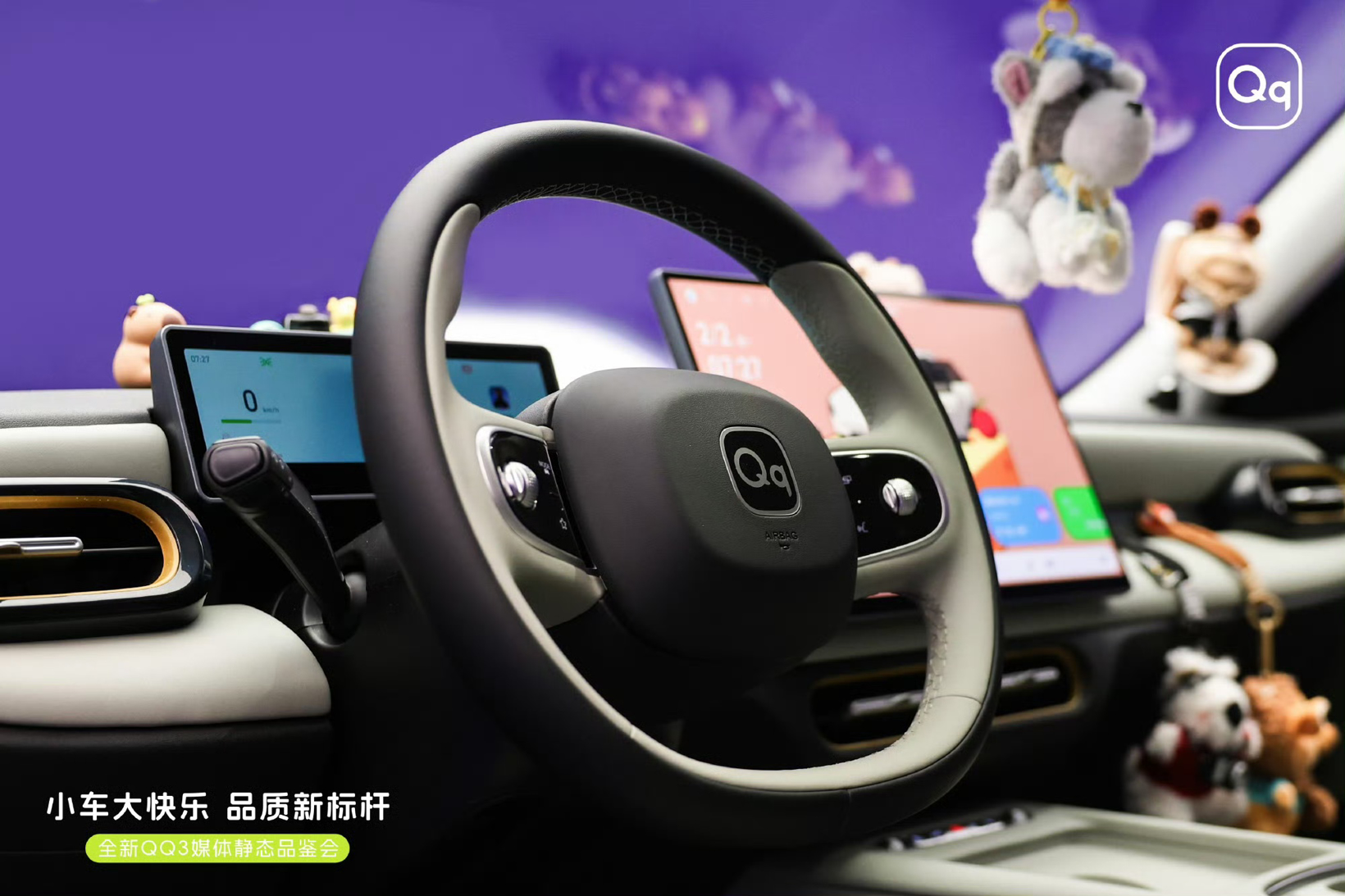
Image Source: Chery
Notably, the QQ3 sees significant investment in intelligent driving assistance systems, coming standard with Chery’s self-developed "Falcon 500" system.
Official data indicates the system supports Highway NOA (Navigate on Autopilot), including automatic on-ramp and off-ramp navigation and stalk-initiated lane changes. It also possesses full-scenario parking capabilities, supporting recognition of over 300 scenarios, memory parking, and trail reversing. It even offers city memory navigation with a range of up to 150 km.
Such comprehensive intelligent driving features appearing on a small electric vehicle demonstrate Chery's determination to break through the fiercely competitive market through technological differentiation.
Judging by these specifications, the new QQ3 is no longer just a commuting tool, but aims to become a companion for users' intelligent mobility.
A Brief History of the Chery QQ — From National Icon to Strategic Rebirth
To understand the significance of the QQ3's return, one must trace the brand's developmental trajectory.
The glorious beginning and era-defining significance of the Chery QQ started around 2003. At that time, China's private car market was just taking off. Joint venture models like the Jetta, Fukang, and Santana were generally priced over 100,000 yuan, leaving the purchasing needs of ordinary families unmet and creating a clear gap in the micro commuter car market.
Chery keenly captured this market opportunity. Positioning the Chery QQ series as "the first car for young people" and an "affordable commuter," the company broke the monopoly of joint ventures on the low-end market, ushering in an era of affordable micro cars in China.
The model's cumulative sales exceeded 1.4 million, making it the single model with the highest market share at the time. This sales legend remains an important chapter in the history of China's automotive industry.
The QQ was not just a car, but a cultural phenomenon. Its "Talking QQ" feature pioneered in-car voice interaction; its personalized decoration competitions popularized car modification culture; and its "QQ Culture Festival" built early user communities. These innovations allowed the QQ to transcend its function as a vehicle, becoming a youthful memory and social symbol for a generation.
During China's urbanization in the early 2000s, the QQ fulfilled the car ownership dreams of countless families. Its success lay not only in the product itself but in accurately grasping the consumer demands of that specific historical stage.
As time passed and the market shifted, the Chery QQ faced unprecedented challenges. After 2010, the Chinese auto market saw a wave of consumption upgrading; consumer demand shifted from "having a car" to "driving a good car," and the QQ, with its low-price core, gradually lost its competitive edge.
Although Chery attempted to launch derivative models to extend the brand's life, these efforts failed to gain market acceptance. By around 2014, the Chery QQ gradually ceased production, and a generation of the national icon bid farewell to the historical stage.
During the QQ brand's dormancy, Chery did not completely abandon this classic IP. With the rise of the new energy wave, Chery launched the micro electric vehicle QQ Ice Cream, which can be seen as a continuation and market test of the "QQ" name in the NEV sector.
It wasn't until March 2025, at Chery's intelligent strategy conference, that officials explicitly announced the return of "QQ," positioning it as "China's MINI and Smart." This statement marked the strategic rebirth of the classic IP.
Subsequently, the new car appeared in MIIT directories under names such as "Domi," sparking widespread market attention. The formal return of the QQ3 is a strategic move by Chery to combine the classic IP with the group's latest achievements in electrification and intelligence. It no longer focuses solely on absolute low prices but strives to use intelligent technology and emotional resonance as competitive differentiators in the compact electric vehicle segment.
The final pricing of the all-new Chery QQ3 will determine its market success. Whether it can find the right positioning and win over both new and old users remains to be seen after the official launch on February 6 and subsequent market testing.


