



Gasgoo Munich- Data compiled by the China Association of Automobile Manufacturers (CAAM) from the General Administration of Customs shows that in the first quarter of 2026, China's auto parts exports reached $23.83 billion, up 3.7% year-on-year, with growth accelerating further compared to the full year of 2025. Imports climbed to $4.83 billion, a 4.5% increase, marking a sharp reversal from the significant downturn seen throughout 2025. With exports rising steadily and imports rebounding, the landscape of auto parts trade is undergoing a subtle shift.
Export Resilience: Steady Growth and Continued Expansion
In the first quarter of 2026, China's auto parts exports maintained the steady momentum seen in recent years.
Data from CAAM reveals that despite March exports slipping to $7.31 billion—down 5.7% month-on-month and 12.2% year-on-year—the cumulative total for January through March still posted a 3.7% annual gain. That demonstrates remarkable market resilience.
Looking back at 2025, the full-year export total for auto parts hit $95.11 billion, a 2.4% increase. This marked yet another year of positive growth, cementing the sector's role as a stable foundation for the industry's global expansion.
Viewed over the long term, China's auto parts exports have successfully transitioned from low-level volatility to stable, high-volume operation.
Data compiled by Cui Dongshu, secretary-general of the CPCA's passenger car committee, shows a steady upward trend in monthly export values from 2022 to 2026. In 2022, with a lower base, monthly exports fluctuated between $5.1 billion and $7.9 billion. Levels rose steadily through 2023 and 2024, with most months exceeding $7.5 billion. By 2025, the figure stabilized in a high range of $7.4 billion to $8.6 billion. The start of 2026 was particularly impressive: January exports hit $9.1 billion, a recent high, and growth continued into April with $8.6 billion, underscoring the sector's strong resilience.
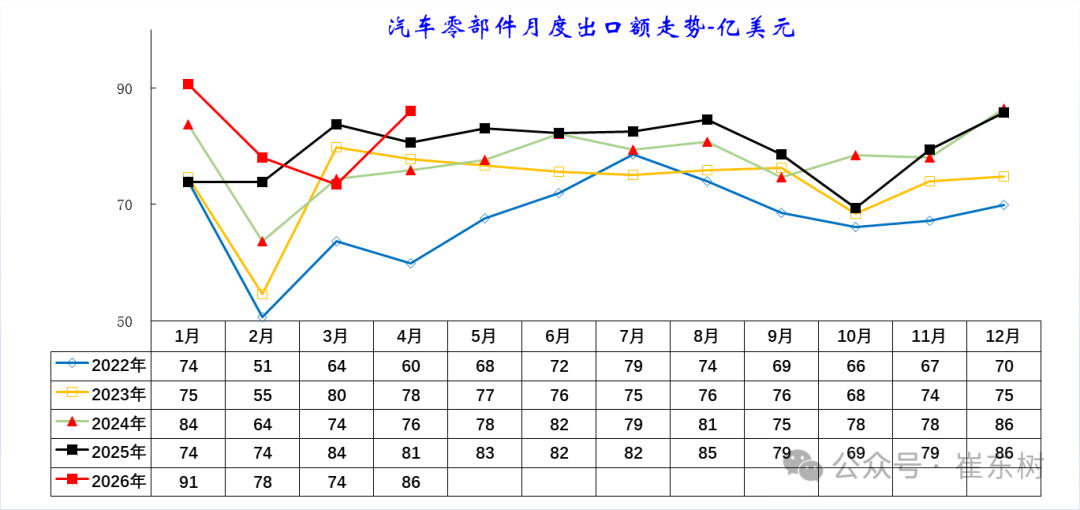
Image Credit: Cui Dongshu
This pattern of steady, moderate growth stands in stark contrast to the explosive surge in complete vehicle exports. According to Cui's data, China exported 939,000 vehicles in April 2026, generating $16.1 billion in revenue—up 51% and 44% respectively. For the first four months, cumulative exports reached 3.28 million units, a staggering 52% annual increase.
In his view, this divergence stems from the nature of auto parts demand, which is largely driven by maintenance and repair markets in Europe and the United States.
That is not hard to understand. Demand for replacement parts is rigid and less volatile, offering relatively stable room for growth. Vehicle exports, by contrast, target new purchase demand globally—a sector amplified by the shift to new energy, making explosive growth more attainable.
Looking at growth patterns, the sector has completed a transition from rapid expansion to high-quality growth. Cui notes that when the base was low in 2021, growth hit 34%. It gradually cooled to single digits between 2022 and 2025, before returning to a stable growth corridor of around 5% in 2026.
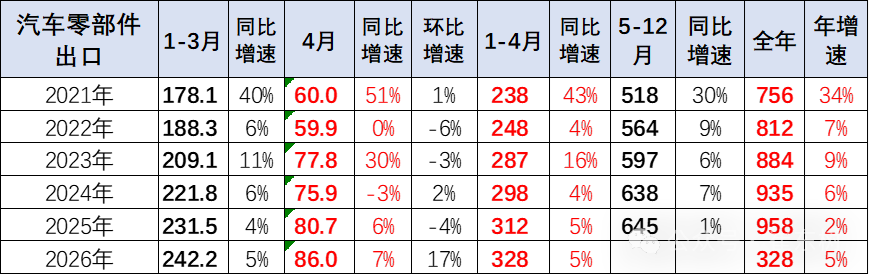
Image Credit: Cui Dongshu
This shift does not signal weakening momentum, but rather an upgrade in the industry's development stage. The old model of relying on low prices to drive volume is fading, replaced by a new logic focused on higher technological value, stronger supply chain stability, and optimized customer structures.
Import Reversal: Why the Rebound After a Sharp Slump?
Turning to the import sector, CAAM data shows a significant downturn in 2025. Full-year imports fell to $21.12 billion, a 21.7% drop year-on-year. December alone saw imports of $1.63 billion, down 15.9%, marking months of double-digit declines.
The industry views this trend as a clear signal that local supply chains are rising and import substitution is accelerating. Behind it lie three core drivers: technological breakthroughs, the restructuring of supply chain security, and prominent cost advantages.
Technological breakthroughs are the fundamental driver of this import substitution. Domestic companies are gradually conquering core component fields that long relied on imports. In new arenas like new energy vehicle "three-electric" systems (battery, motor, electronic control), smart cockpits, and in-vehicle connectivity, Chinese firms have moved from playing catch-up to running neck-and-neck, or even taking the lead. The rapid rise of domestic core components—represented by power batteries, drive motors, and intelligent driving systems—not only meets the high-end needs of local OEMs but also forces traditional foreign suppliers to adjust their prices and strategies. This form of "import substitution" is high-quality and high-value-added, directly impacting demand for imported high-end parts.

Image Credit: VCG
At the same time, supply chain security logic is reshaping procurement systems. Recent global uncertainties have prompted automakers to prioritize "security, controllability, and resilience" over cost. Leveraging advantages like geographic proximity, rapid response times, and easier collaborative R&D, local suppliers have gained unprecedented strategic priority. OEMs are forging deeper strategic partnerships with core domestic parts makers, engaging in joint development and iteration to create a supply chain loop that is difficult to replace. This deep "integration" reduces reliance on single external sources at the source.
Furthermore, cost and efficiency advantages are solidifying the foundation for substitution. In numerous mature component categories, Chinese manufacturing has built scale and clustering advantages that are hard to match globally. From basic castings and forgings to interior and exterior trim and body structures, local enterprises not only offer highly competitive costs but also achieve international advanced levels in delivery speed, flexible production, and quality consistency. This makes importing many mid-range, and even some high-end, parts economically unviable.
However, it is worth noting that just as the market expected parts imports to keep shrinking, Q1 2026 data showed a reversal: imports reached $4.83 billion, up 4.5% year-on-year, with March rising 3.4% month-on-month. This phenomenon of "decline followed by recovery" is not due to weakening local competitiveness, but rather likely the result of overlapping short-term and structural factors.
First, the base effect is significant, allowing for cyclical recovery. Imports fell sharply in Q1 2025, making it easier for Q1 2026 to show growth on a year-on-year basis. This is a statistical base-effect correction, not a reversal of the underlying trend.
Second, global supply chains have stabilized, releasing pent-up demand. In 2025, supply chain disruptions forced some companies to delay parts purchases. As 2026 began and logistics normalized, this backlog of restocking demand was released in a short burst, pushing up Q1 import figures.
Third, a wave of new model launches boosted imports of certain high-end parts. In Q1 2026, multiple new energy and intelligent connectivity models entered mass production or launch, driving up demand for high-performance chips, advanced sensors, and precision transmission components. In areas not yet fully served by local suppliers, companies still rely on imports, providing a short-term lift to the data.
Overall, the short-term rebound in Q1 2026 reflects the overlap of factors like the base effect, supply chain recovery, and new product launches, rather than a reversal of import substitution. In the long run, domestic capabilities in "three-electric" systems, smart cockpits, and core castings continue to improve. Imports will likely return to a norm of steady decline or fluctuation within a range.
A New Industrial Balance: Vehicle Exports Drive Parts Coordination
The current divergence and reversal in parts imports and exports is essentially an external manifestation of the strategic transformation of China's automotive supply chain. In terms of development logic, China's auto exports are undergoing a critical shift from being "parts-driven" to "whole-vehicle-driven."
For a long time, China's global presence was defined by parts exports, while vehicle exports were small and low-value. Today, vehicle exports are the core growth engine. In April 2026 alone, vehicle export value reached $16.1 billion—nearly double that of parts. The cumulative total for January to April hit $56.9 billion, up 54% year-on-year, far outpacing parts growth. Parts exports have shifted from "vanguard" to "stabilizer," supporting vehicle exports and creating a complementary pattern where parts cultivate the European and American aftermarket while vehicles tap into global incremental markets.
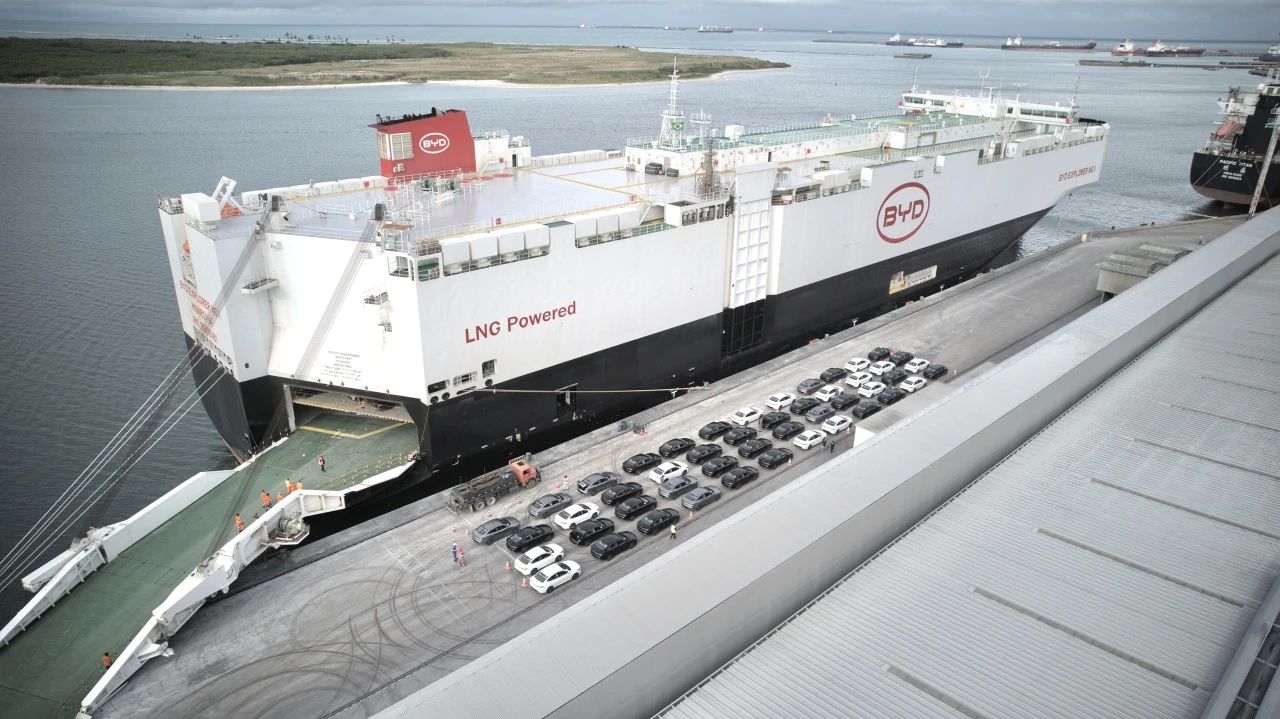
Image Credit: BYD
This transformation has elevated the value of the entire industrial chain. Previously, parts exports were dominated by low-end, standardized products with limited margins. Now, as vehicle exports move upmarket, they drive synchronous upgrades in components, shifting the export structure from low to high value. Simultaneously, automakers' global expansion is pulling parts companies along, encouraging them to build overseas production bases and R&D centers. This localization reduces logistics costs, mitigates trade risks, and boosts global supply chain competitiveness.
From the perspective of trade balance, China's auto parts sector is bidding farewell to the traditional model of "mass imports and mass exports," shifting toward a new balance of "optimized imports and exports, with a focus on exports." In the past, an imperfect domestic chain meant relying on imports for core parts. Today, local supply is largely self-sufficient. Imports are increasingly focused on niche areas like high-end scarce parts, specialty materials, and advanced chips, while exports cover a full range of categories and tiers. With the trade surplus widening, China's voice in the global automotive supply chain is growing significantly.
The Q1 import rebound offers a new lesson: import substitution is not about blindly rejecting imports, but pursuing supply chain autonomy and security. For high-end core parts that cannot be localized in the short term, reasonable imports ensure the pace of industrial upgrading. In areas where technological breakthroughs have been made, continuing substitution reduces costs and boosts competitiveness. Combining both approaches is the only way to build a supply chain system that is both secure and open.
Looking ahead, three trends are likely to emerge. First, exports will maintain steady growth with rising added value. Second, import trends will depend on the race between local substitution and high-end demand, with structural adjustments deepening. Third, the synergistic effect of vehicle and parts exports will strengthen, enhancing supporting capabilities and propelling China from a manufacturing giant to an automotive powerhouse.
Conclusion
From steady export expansion to rational import rebounds, and from parts-driven to vehicle-led globalization, every fluctuation in the data reflects a deep transformation of the supply chain. Currently, China's automotive supply chain stands at a pivotal juncture—moving from "integrating into the global system" to "reshaping the global landscape." This requires not only consolidating local advantages but also the ability to break through high-end technological bottlenecks. Only by finding a dynamic balance between independent innovation and open cooperation can China achieve its historic leap from a manufacturing giant to an automotive powerhouse.


