



Gasgoo Munich- On March 24, data obtained by Gasgoo from the China Passenger Car Association (CPCA) showed that from March 1 to 22, passenger car manufacturers wholesaled 1.084 million units nationwide, a 14% year-on-year decline but a 62% jump from the previous month. Cumulative wholesale volume reached 4.578 million units, down 11% annually. During the same period, retail sales stood at 920,000 units, falling 16% year-on-year while rising 19% month-on-month. Cumulative retail sales totaled 3.498 million units, an 18% drop from last year.
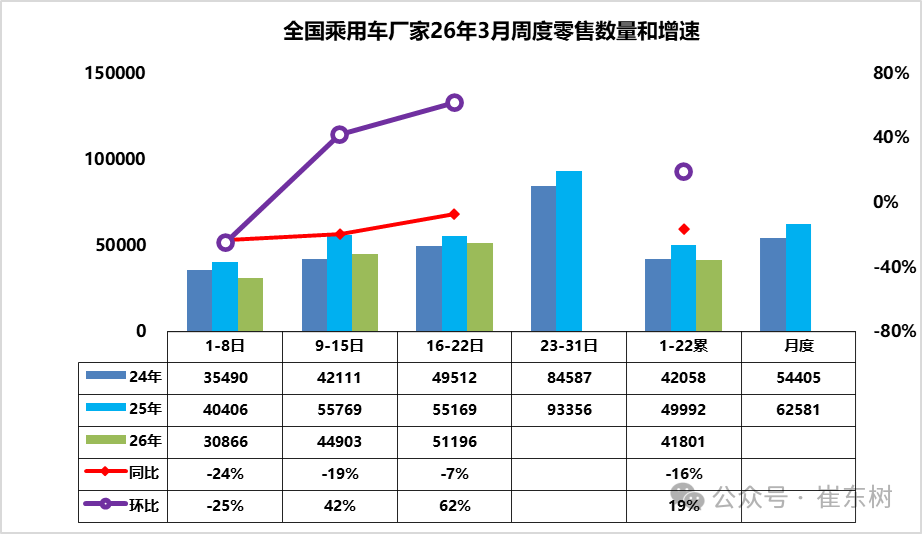
Image source: CPCA
On the new-energy front, manufacturers wholesaled 543,000 units from March 1 to 22, down 15% year-on-year but surging 71% from the prior month. Cumulative wholesale sales hit 2.133 million units, a 10% annual decline. NEV retail sales reached 495,000 units, slipping 17% year-on-year while climbing 66% month-on-month. Cumulative retail sales totaled 1.556 million units, down 23% from the previous year. The retail penetration rate for new-energy vehicles during this period hit 53.9%, with wholesale penetration at 50.1%.
A weekly breakdown reveals a gradual warming in retail trends over the first three weeks of March. Daily retail sales averaged 31,000, 45,000, and 51,000 units respectively, with the year-on-year decline narrowing from 24% to 7%. Month-on-month performance shifted from a 25% drop to a 62% gain. The wholesale side showed a similar recovery: daily averages for the first three weeks were 31,000, 58,000, and 62,000 units. The annual decline there shrank from 32% to 3%, while monthly growth turned positive, surging 126%.
Production data indicates that output of purely fuel-powered light vehicles stood at 637,000 units in the first three weeks of March, down 19% year-on-year but up 58% from February. Combined production of hybrid and plug-in hybrid models reached 245,000 units, falling 23% annually but jumping 87% month-on-month.
The CPCA analysis notes that the pre-Spring Festival sales cycle was extended this year. While the post-holiday market is in a normal recovery phase, retail performance was sluggish in early March, resulting in an overall steady trajectory.
Internal combustion engine vehicles enjoyed a pre-holiday boom, but the market has since entered a lull, waiting for new-energy product activity to pick up. Automakers face complex operational pressures due to rising costs for raw materials, oil, and chips, compounded by a policy environment pushing back against hyper-competition. Meanwhile, international geopolitical factors have driven up oil prices, delivering a negative shock to the fuel vehicle market.
In the new-energy sector, new models are expected to roll out throughout the year. However, the lag between technical reveals, pre-sales, and deliveries means volume growth is unlikely to materialize at the retail level in March.
Dealers are under significant pressure. While transaction prices are relatively stable, they have not met consumer expectations, and overall market sentiment is gradually recovering. The NEV market is currently in a wait-and-see period ahead of new model launches, as inventory strategies adjust to release schedules and manufacturer-dealer tensions intensify.
Market direction was unclear in the first week of March, but wholesale and retail data showed marked improvement in the subsequent two weeks.


