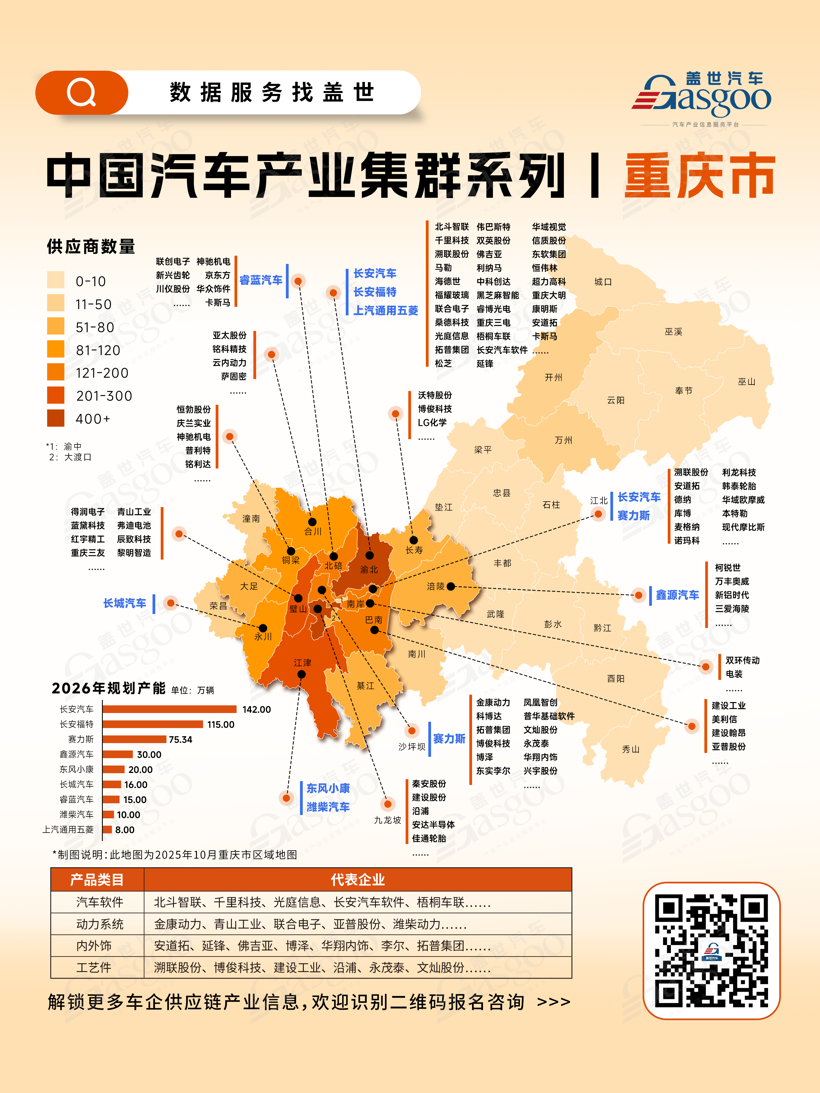
Gasgoo Munich-According to data compiled by Gasoo Global Automotive Industry Data, Chongqing has established itself as a vital automotive hub in western China. Leveraging a mature industrial foundation and supply chain, the city has created a development pattern defined by "core drive, regional coordination, and full-chain coverage." This secures a significant position in the national automotive landscape.
In terms of spatial layout, Yubei and Jiulongpo districts host over 400 suppliers each, anchoringChangan Automobile, Changan Ford and other majorvehicleenterprises to form the core of industrial development. Jiangjin and Bishan, with 201 to 300 suppliers respectively, primarily absorb production overflow. They form industrial belts focused on components. Meanwhile, supplier numbers are limited in the northeast and southeast, where scattered layouts play a supplementary role. This tiered structure stabilizes core production capacity while fostering coordinated regional development.
Regarding capacity, public information indicates Chongqing’s plannedvehicleoutput for 2026 is expected to exceed 4.31 million units. The Changan group commands a clear lead. Changan Automobile plans for 1.42 million units. Changan Ford and Seres target 1.15 million and 753,400 units respectively. This creates a structure led by Changan but advancing with multiple brands. The presence of Dongfeng Sokon, Great Wall Motor, and Shineray further diversifies the capacity mix, spanning passenger cars, commercial vehicles, and new energy models, providing a robust foundation for industrial growth.
Chongqing has also built supply capabilities across software, powertrains, interiors, and process components. In automotive software, firms like BICV Intelligence and Changan Software are active in intelligent connectivity. For powertrains, Jinkang Powertrain and Qingshan Industry deliver key assemblies, while Adient and Chongqing Sulian Plastic provide component support. This comprehensive layout mitigates supply chain risks to an extent and supports the manufacturing needs of automakers.
On the transformation front, Chongqing is accelerating the development of new energy and intelligent connected vehicles. Leveraging its location along the New International Land-Sea Trade Corridor, the city is expanding exports of vehicles and components, boosting its regional and global influence.
Overall, as a key automotive stronghold in western China, Chongqing maintains a solid development foundation through its cluster construction, capacity planning, and supply chain refinement. As new energy and intelligent technologies advance, the city's industrial structure is poised for further optimization. However, future growth will depend on sustaining innovation and navigating an increasingly competitive market.