



Gasgoo Munich- "Cyber workers" punching in on the factory floor are moving from concept to daily reality.
Xiaomi recently offered an update on its humanoid robots at its auto plant: the success rate for dual-sided operations at a self-tapping nut station has climbed to 98%, lagging human precision by just 1%. Meanwhile, in the final assembly logistics zone, robots are sorting center console covers and folding bins—tasks where they’ve already hit a 90% success rate.
In late June, Galaxy General also revealed progress in applying its humanoid robots at CATL’s production lines. Since passing acceptance testing at the Ningde HX base in March, the company’s Galbot S1 has directly replaced human labor in high-intensity tasks like material handling and picking on CATL’s smart production lines.
Around the same time, Zhiyuan announced that "Nengzai No. 1," developed jointly with SAIC-GM, has been deployed on the mass-production battery line for the Buick E7 since March. Thanks to high-precision positioning within ±0.1mm, the robot can process mixed 2D and 3D data for multiple battery cells in one second, achieving an operational efficiency of about two seconds per unit.
Just two years ago, scenes like this existed mostly in demos.
Today, as more robots take their places alongside actual production lines and logistics aisles—sharing space with ordinary workers and keeping pace with production schedules—automotive manufacturing is gradually shifting from "human-machine isolation" to "human-machine collaboration."
The Logic Behind "Cyber Workers" Entering the Factory
At a recent industry conference on embodied intelligence hosted by Gasgoo, Wan Xin, head of strategy and product at UQI, forecast that with over 5 million people currently working in automotive manufacturing across China, a 15% replacement rate would generate demand for at least 750,000 humanoid robots domestically within the next three to five years. Globally, that demand could exceed 5 million units.
Looking further ahead, Wan argues that humanoid robots will become a disruptive product on par with personal computers, smartphones, and new energy vehicles, potentially reaching an industrial scale more than 10 times that of the automotive market.

Image source: UQI
UQI is a smart logistics subsidiary founded as a joint venture between UBTECH and Tianqi Share. It has already deployed nearly 10,000 robots across hundreds of automotive manufacturing plants globally, counting clients like BYD, ZEEKR, Lynk & Co, and Honda—giving it substantial experience in real-world automotive applications.
Wan’s forecast rests on two dilemmas facing auto manufacturing: a widening labor shortage that traditional automation simply cannot fill.
"The labor shortage in the auto industry is concentrated in assembly, picking, and inspection," Wan notes. "These jobs involve heavy repetitive labor, frequent bending, and long periods of standing, which take a physical toll. They universally face difficulties in recruitment and continuously rising labor costs."
While traditional automation solutions—such as robotic arms, automated guided vehicles (AGVs), and driverless logistics carts—have become standard equipment in the industry, they struggle to handle unstructured roles like assembly, picking, and inspection.
Moreover, in both automotive and consumer electronics, production line iterations are accelerating. Every model change can mean a major retrofit of traditional non-standard equipment—and higher modification costs.
"A typical example: supplying different automakers. Even for battery packs of the same specification, details like label placement can vary," says Cang Yu, VP at Beijing Galaxy General Robotics and GM of the Industrial Business Unit. "In scenarios requiring flexible adjustment, traditional non-standard automation is hard to adapt. Retrofitting a line takes a long time—often, you haven't recouped the product profit before the next model change arrives."

Image source: FAW Die & Mold
Lu Peng, director of final assembly technology at China FAW Group, agrees that traditional industrial automation technology acts more like a "rule-following executor" with clear limitations in practical application.
"First, weak generalization: they usually adapt to only a single scenario and rely on preset programs and fixed trajectories, making it hard to cope with the complex, ever-changing production environment of auto final assembly," Lu explains. "Second, single-dimensional perception with a lack of environmental understanding. Third, limited collaboration—current industrial robots, even collaborative ones, either work in enclosed areas or require speed reductions that sacrifice efficiency. There is still a significant gap from true human-machine collaboration."
By comparison, embodied robots feature an integrated architecture combining perception, decision-making, execution, and feedback. They demonstrate advantages traditional solutions lack—whether in environmental adaptability, task generalization, human-machine collaboration, or the ability to learn and evolve continuously.
This is especially true given the mature digital foundation of today’s auto plants. Systems like MES, ERP, and WMS are already widely deployed. "Robots entering factories rely on swarm intelligence, not just individual smarts. These mature digital systems provide an excellent foundation for coordinated robot operations," Wan says.
Embodied robots are also set to play a critical role as Chinese automakers and supply chains expand overseas—a reality underscored by the partnership between Galaxy General and CATL.
"Whether in Europe, Mexico, or North America, Chinese companies face the same problem: people," Cang Yu points out. "In European manufacturing, much of the workforce comes from Turkey and the Arab world, involving issues like religious customs. In Mexico, workers are generally paid on a daily basis. If Mexico wins a World Cup match, the entire factory might be empty the next day."
This is no longer just a cost issue; it is a supply chain risk that directly impacts production delivery.
What Can They Do in the Factory?
Getting "cyber workers" onto the factory floor is just the first step. The real question that needs answering now is what exactly these robots can do—and how well they can do it.
One increasingly clear path is emerging: first, take over the "jobs humans hate the most," then extend into scenarios where "humans perform poorly—or simply can't perform at all."
Logistics and material handling is the first scenario being widely discussed.

Image source: Galaxy General
From the Galaxy General Galbot S1 on CATL’s lines and FAW’s "Qixiaozhi" to the "Nengzai No. 1" on SAIC-GM’s Buick battery line, the "Jingchu" robot at Dongfeng’s M-Hero smart manufacturing workshop, and the Figure 03 at BMW plants—all are starting with logistics. They are taking on repetitive, high-intensity tasks like material transfer, parts handling, and warehouse picking.
The logic behind this is straightforward: handling tasks are relatively standardized with low environmental complexity and less stringent precision requirements than assembly. Even if mistakes occur, the consequences are relatively controllable. In other words, this is an entry point with a "large margin for error."
Some industry insiders suggest starting with simple scenarios, such as moving small parts, where dropping a component doesn't damage quality. "Get the project running and stable first. Only after it runs smoothly can you improve cycle times and expand to full scenarios. Simply put, you need a successful case to promote it—doing it once is better than talking about it ten thousand times."
Moreover, in logistics scenarios, humanoid robots can deliver tangible cost savings.
According to Xu Yuhan, AI product director at Dongfeng Yi Pai Technology, using humanoid robots for flexible handling can cut the extra costs of modifying factories for AGVs, magnetic tracks, or QR codes. In picking and palletizing, relying on humanoid robots to sort materials for island-style production can lower the costs of switching robot programs.
Of course, this assumes the price of humanoid robots falls within a reasonable range.
Quality inspection is another direction mentioned repeatedly.
Take gap and flush detection on vehicle bodies, for example. Due to high precision requirements, a worker typically spends 1 to 2 hours inspecting a single car. Full inspection is simply not realistic manpower-wise, so many OEMs rely on random sampling. "If robots do this, overall efficiency will improve significantly," notes Tan Yingcong, deputy chief engineer at Changan Automobile.
Song Weijia, director of final assembly process at FAW Group, also believes that replacing humans with embodied intelligence in quality-critical tasks that directly affect customer experience would be a major breakthrough.
If logistics and inspection are scenarios where "humans can do the job but robots do it better," there is another category: jobs humans cannot do—or shouldn't do—due to high safety risks or poor ergonomic conditions.
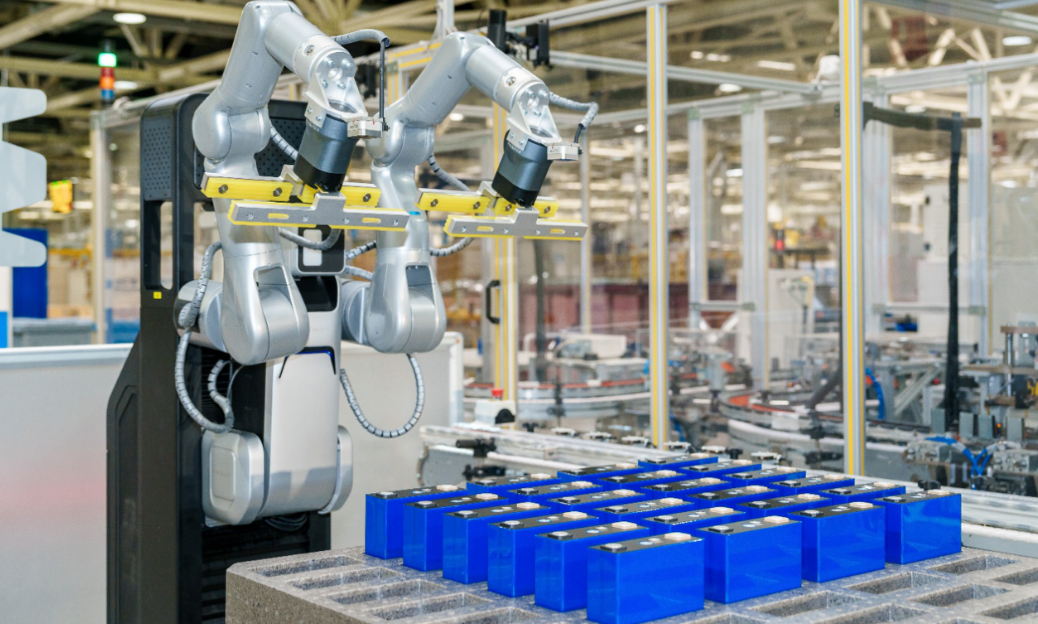
Image source: SAIC
Xu Xiaoshun, technical lead for intelligent equipment at SAIC-GM Power Technology, categorizes these scenarios as "dirty, dangerous, difficult, and stuffy." Examples include handling high-voltage components like battery cells, live electrical work during final assembly, and tasks involving chemical raw materials.
"We’ve seen test cases from suppliers where certain special adhesives require manual application on-site, forcing workers to wear gas masks and use exhaust ventilation. These jobs are better handed over to robots," Xu says.
Song Weijia points out that whether in final assembly or stamping, welding, and painting, there are many scenarios closely tied to safety. For instance, high-voltage connections in EV assembly pose dangers to humans, and chassis assembly workers often suffer physical strain from looking up for long periods. Replacing these with embodied intelligence would be a significant breakthrough.
"To sum it up, there are two directions: promote robots for tasks they can handle as soon as possible, and develop robots for special scenarios humans cannot handle," says Fan Jianqiang, COO and co-founder of FMC³ Robotics.
However, despite the broad application scenarios for humanoid robots in auto manufacturing, their ultimate goal is not to replace traditional industrial robots but to complement them—filling the voids where traditional solutions cannot reach.
In Xu Xiaoshun’s view, as large model technology advances and the supply chain matures, humanoid robots will gradually evolve from "strongest interns" into "gold-medal employees" capable of holding their own, building a new, efficient, and safe smart manufacturing ecosystem alongside humans.
"In the long run, the proportion of industrial robots, composite collaborative robots, humanoid robots, and human workers in future factories is expected to settle into a 7:1:1:1 ratio," Xu predicts.
But even with the right scenarios and the right direction, the door to large-scale deployment of embodied robots in auto manufacturing has not yet swung wide open.
Why Haven't They Spread Yet?
Entering 2026, although embodied robots have been deployed in numerous scenarios, total shipments of humanoid robots this year will likely remain in the tens of thousands—struggling to break the 100,000 mark.
In fact, for teams earnestly advancing industrial applications, shipments this year may fall rather than rise.
"Because the industry has shifted to being market-driven. To truly launch a product, you need massive R&D and validation, plus standards and certifications. For example, to enter the European market, we are processing relevant certifications for Europe and the UK. These cycles are very long," Cang Yu explains.
While global humanoid robot shipments surpassed 10,000 units for the first time last year, it is undeniable that a significant portion did not come from genuine market demand.
"Some were government-funded, or suppliers pushed inventory to boost numbers, so last year's bubble was actually quite severe. This year, government enthusiasm has cooled, and the layout plans of top vendors are largely complete. Meanwhile, the government has realized mid-tier vendors struggle to break through, so that demand has been slashed directly—and that segment accounted for the bulk of last year's shipments," an industry insider revealed.
With the phantom demand fading, the "hard bones" of technical challenges remain to be gnawed.
A lack of data is the primary challenge facing the industry right now.
Estimates suggest that achieving an embodied large model with general autonomous capabilities requires at least 10 million hours of high-quality real-world interaction data. Yet as of early 2026, the total volume of high-quality real physical interaction data globally is just 500,000 hours—leaving a gap of over 95%.
"Why is data so scarce? Two main reasons: first, there is no existing data accumulation in this field. Second, no factory is willing to make its process data public," Cang Yu points out.
Consequently, facing this data desert, many companies are pinning their hopes on simulation-based generation.
But in Xu Yuhan’s view, this path is far from smooth. Industrial precision assembly relies on the precise simulation of micrometer-level displacements and non-linear friction forces—details existing physics engines struggle to replicate. This causes strategies that perform perfectly in simulation to see a cliff-like drop in success rates when deployed on real machines.
"Embodied AI model training also relies heavily on massive, highly diverse failure samples to optimize decision boundaries. Yet the core rule of manufacturing is 'get it right the first time' and 'zero defect tolerance,' pursuing ultimate production stability. This is fundamentally at odds with the trial-and-error learning mode of AI."

Image source: Xiaomi Technology
Without enough data fuel, model training is restricted, leaving cognitive decision-making and operational control as weak points.
Lu Peng points out that current capabilities in multi-modal perception, dynamic decision-making, and computing power still lag behind the demands of automakers and the requirements of complex on-site environments. On the software side, unreliable factors remain in environmental adaptability and operational safety risks—for instance, robots still suffer falls and pose risks of bumping into or interfering with humans.
Hardware challenges are equally unavoidable. The stability of the body, failure rates, the flexibility of dexterous hands, and overall battery life are all practical issues that cannot be bypassed during implementation.
"These problems constrain our process design in three areas: precision, efficiency, and availability," Lu says.
In particular, dexterous hands have become the most prominent hardware bottleneck restricting the development of embodied robots.
Currently available commercial dexterous hands either suffer from prohibitively high costs that hinder scaling, or fail to simultaneously meet the complex demands of industrial assembly in terms of degrees of freedom, tactile sensing, and load capacity.
"Current dexterous hands can't provide tactile and high-precision force feedback to large models. Many companies promote lab data, but when it comes to commercialization, cost and reliability are hurdles you can't avoid," an industry insider revealed.
Load capacity is another major weakness. "A human hand can carry 10 kilograms—lifting an 18-liter bottle of water is no problem. But current dexterous hands, whether using tendon, linkage, or other structures, output roughly 30N of force per finger—about three kilograms. And that’s in ideal conditions. In actual grasping, if there’s a slight off-center load, the hand can’t withstand it and is easily damaged."
Beyond these widely acknowledged challenges, there are questions that have yet to find a unified answer.
For example: Does the product form have to be humanoid?
Early on, one logic for humanoid robot development was that human production scenarios are designed for the human form, making other shapes hard to adapt. But in actual implementation, many industrial scenarios can be customized with non-humanoid structures based on task needs—lowering costs and boosting efficiency. Forcing a humanoid shape might sacrifice performance for form and raise the barrier to entry.
Therefore, a growing number of voices question whether bipedal humanoids are the optimal solution for scenarios like auto manufacturing. While bipedal robots have mature technical support in navigation, task planning, and motion control, their battery life and mean time between failures still need optimization. By comparison, wheeled dual-arm robots are easier to deploy.
Some even suggest: rather than finding a robot for the scene, it is better to redesign the scene for the robot.
"The current factory operating model is still designed around the logic of human assembly and manufacturing. Yet robots—whether in detection precision, assembly precision, or operational efficiency—will eventually surpass humans. Under that premise, will the layout and flow design of every section, from welding and painting to final assembly, remain as they are? I think by 2027, some companies might take the lead in changing."
In other words, the default path of "adapting robots to existing scenarios" may also be rewritten. It will no longer be just technology compromising to the scenario; the scenario itself will be redesigned due to technological evolution.
However, despite the heavy challenges, the industry’s judgment on the future is surprisingly consistent: it may take another two or three years for embodied robots to achieve true large-scale application. About five years from now, they will begin entering homes to handle housework and elderly care services.
This is not a radical prophecy, but a pragmatic consensus. Between "working in factories" and "serving in homes" lies the depth of data accumulation, the precision of hardware iteration, and the depth of scenario validation. None can be rushed; none can be bypassed.
This is not a race for speed, but a marathon of patience.


