



Gasgoo Munich- As the auto industry's transformation plunges into the deep waters of electrification and intelligence, the relationship between automakers and their partners is no longer a simple buyer-supplier dynamic. Instead, it has reached a critical juncture for reconstruction.
Dong Yang, chairman of the China Industrial Alliance of Power Battery, co-chairman of the China Automotive Chip Industry Innovation Strategic Alliance, and vice chairman of China EV 100, recently argued that building new partnerships between automakers and key collaborators is necessary for technological progress, new industrial ecosystems, and shifting market demands. It is, he asserts, an inevitability of the times.
As technology cycles accelerate and market demands shift, the flaws in traditional OEM-supplier relationships are becoming glaringly obvious. Constructing a deeply integrated, symbiotic model is no longer just about survival for automakers—it is the core lever for China’s auto industry to break into the global high-end market.
Image Source: VCG
Dual Drivers of Tech and Market Make New Partnerships Essential
Technological boundaries in the auto industry are eroding. The convergence of electrification, intelligence, and connectivity has brought the era of "going it alone" to a definitive close. Dong Yang cuts to the chase: "The industry is facing major technological breakthroughs across multiple fields. No single automaker can possibly master or lead development across all of them."
Upgrading battery energy density, developing solid-state batteries, deploying AI large models in smart cockpits, optimizing high-level autonomous driving algorithms, and building vehicle-road-cloud systems—every track requires long-term R&D investment and technical accumulation. Even leaders like Tesla and BYD cannot stay ahead in every domain. Deep cross-company collaboration has become the only viable path for moving technology from the lab to the market.
The mature application of new technology is never a one-way street; it requires a two-way friction between technology and the market. Dong Yang argues that new tech must be refined collaboratively by both developers and market demand to deliver a mature experience to users.
Take autonomous driving: AI firms provide the algorithmic core, but automakers hold massive amounts of real-world road data and user scenarios. Only through iterative collaboration can the industry move past the "great in the lab, terrible on the road" trap and achieve true mass adoption.
More importantly, automotive technology is in a state of constant iteration. This means the relationship between automakers and suppliers can no longer be a one-off transaction; it requires a long-term mechanism to jointly drive continuous technological upgrades.
Shifting market demands are forcing an upgrade in these relationships. In Dong Yang’s view, rolling a new car off the production line and selling it is no longer the finish line for technology—it is merely the starting point for further progress and feature iteration. Consumers now see cars not just as commuting tools, but as "intelligent mobile spaces," expecting continuous functional improvements throughout the vehicle's lifecycle, much like a smartphone.
Remote updates for battery management systems, improved voice interaction in smart cockpits, and continuous algorithm optimization for autonomous driving—all require close communication between automakers and suppliers. Only a solid, long-term partnership allows for rapid responses to market shifts and the ability to address user pain points with high-quality service over the vehicle's life. This is the fundamental difference between the new model and the old.
Ditching "Winner-Takes-All" for Symbiotic Growth
During the industry's intelligent transformation, there was a surge of enthusiasm for "full-stack in-house development," with some companies even transplanting the internet sector's "winner-takes-all" mentality to the auto world. But in Dong Yang’s view, this mindset is not only ill-suited for the automotive industry but potentially damaging to its development.
Many view Tesla as the gold standard for full-stack in-house development, but the reality is more nuanced. Dong Yang explains that Tesla’s initial independence from traditional suppliers wasn't born of a preference for doing everything itself; rather, legacy suppliers couldn't keep pace with its technological needs and iteration frequency. Yet in the critical realm of power batteries, Tesla has built a deep partnership with CATL. According to CATL, Tesla is a "very reasonable long-term partner that looks after its collaborators' interests." This case proves that even industry leaders cannot thrive without strong partners.
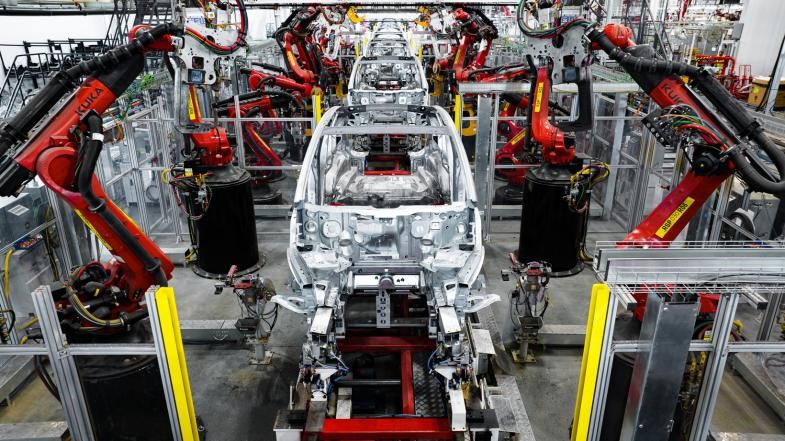
Image Source: Tesla
The "winner-takes-all" mentality clashes with the auto industry primarily because of two inherent characteristics of the sector.
First, automobiles are long-life durable goods. Monopolies on new technologies or structures are difficult to sustain, making technological homogenization inevitable.
In a recent dialogue between Zhao Fuquan, a professor at Tsinghua University, and Wu Xiaoru, co-founder and president of iFLYTEK, it was noted that while automotive products cannot avoid technological convergence, they can still deliver distinct user experiences and product character using the same technology. Dong Yang agrees. He believes the focus of competition shouldn't be who deploys a new technology first, but who uses it better.
Second, automobiles are high-speed machines with extreme safety requirements—a fundamental distinction from the internet model of "iterate as you go." Dong Yang emphasizes that any new technology or device applied to a car must meet rigorous safety standards. Being first to market is commendable, but never at the expense of safety.
The recent massive damages case against Tesla in the U.S. serves as a warning bell for the industry. Dong Yang bluntly states that similar scenarios could easily arise in China.
The safety red line is inviolable. This demands joint investment from automakers and suppliers to repeatedly test and validate new technologies and devices, ensuring they are safe before deployment. None of this is possible without long-term, deep collaboration.
The auto industry is currently at a critical juncture of technological innovation and structural restructuring, making the overhaul of OEM-supplier relationships a major trend. Dong Yang admits that the industry currently leans too heavily toward full-stack in-house development and tends to ignore—or at least mistreat—its partners. This imbalance needs urgent correction.
"We must remember that cars are durable goods used over long periods and high-speed products with strict safety requirements," Dong Yang concluded. "Now, as we face long-term innovation across multiple technological fields, we need to build new OEM-supplier relationships more than ever. Automakers must engage in close, long-term collaboration with their key partners."


