



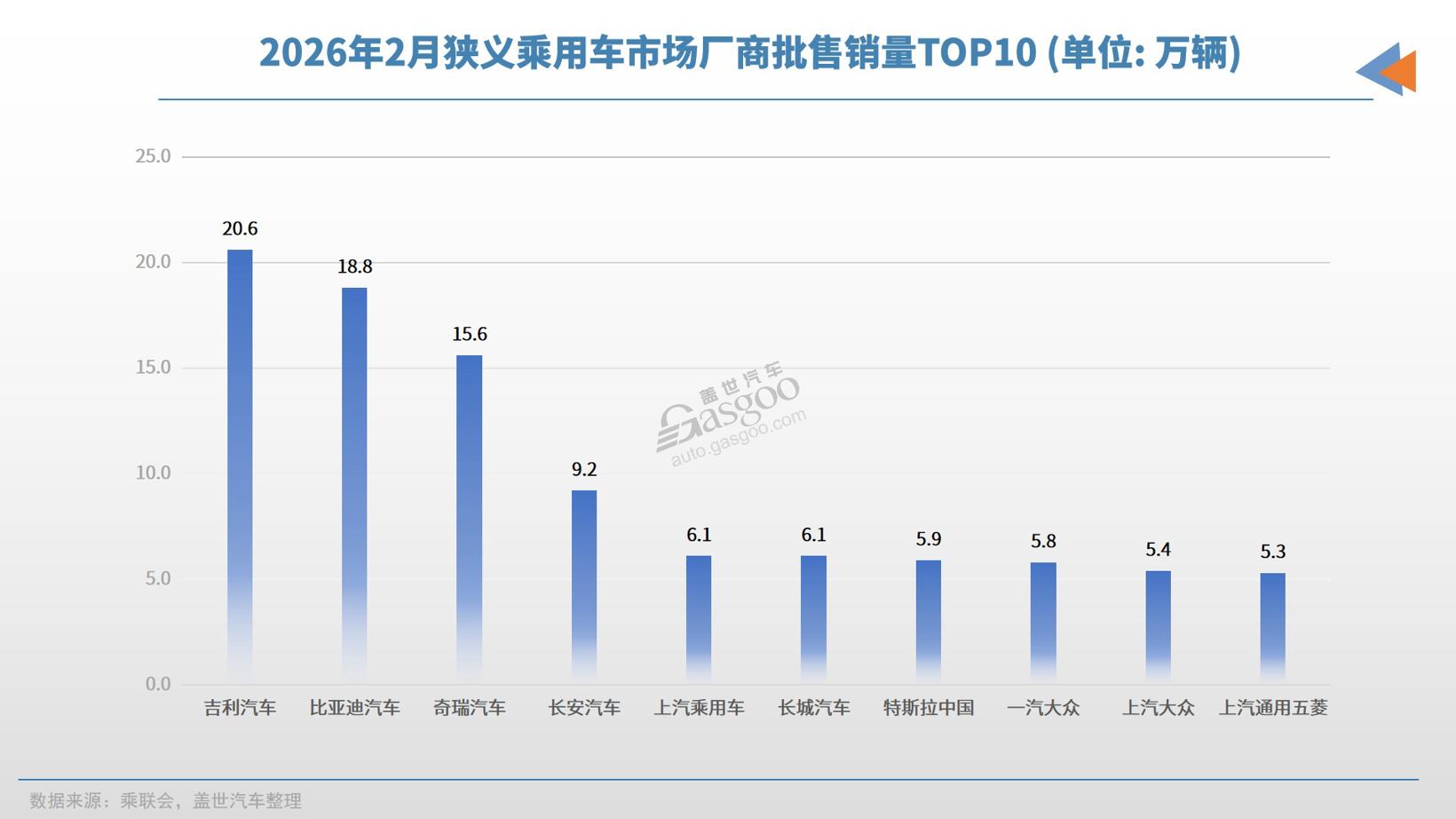
Gasgoo Munich- Wholesale sales data for China's passenger vehicle market in February 2026 has been released. On the list of the top ten automakers by wholesale volume, domestic brands occupied seven spots, sweeping the first six positions. With Tesla China in seventh place, non-traditional joint ventures have established absolute dominance among the top seven.
This profound shift is more than a mere reshuffling of monthly rankings; it is the concentrated expression of years of structural transformation in China's automotive industry. Bolstered by technical accumulation, rapid product iteration, and strong support from overseas markets, domestic brands are demonstrating formidable systemic capabilities. Meanwhile, once-unshakable joint venture giants are collectively buckling under the waves of electrification and intelligence, facing unprecedented challenges to their market share. Tesla's counter-cyclical surge, for its part, offers a textbook case of breaking through via product strength and innovative financial strategies.
Domestic Brands Lead the Pack
The most striking feature of February's wholesale sales rankings was the powerful cluster effect formed by domestic brands. Geely Auto claimed the top spot with 206,000 units, edging up 0.6% year-on-year. Against a backdrop of overall market volatility, this steady growth—coupled with a 13.6% market share—highlights the "siphon effect" of leading enterprises.
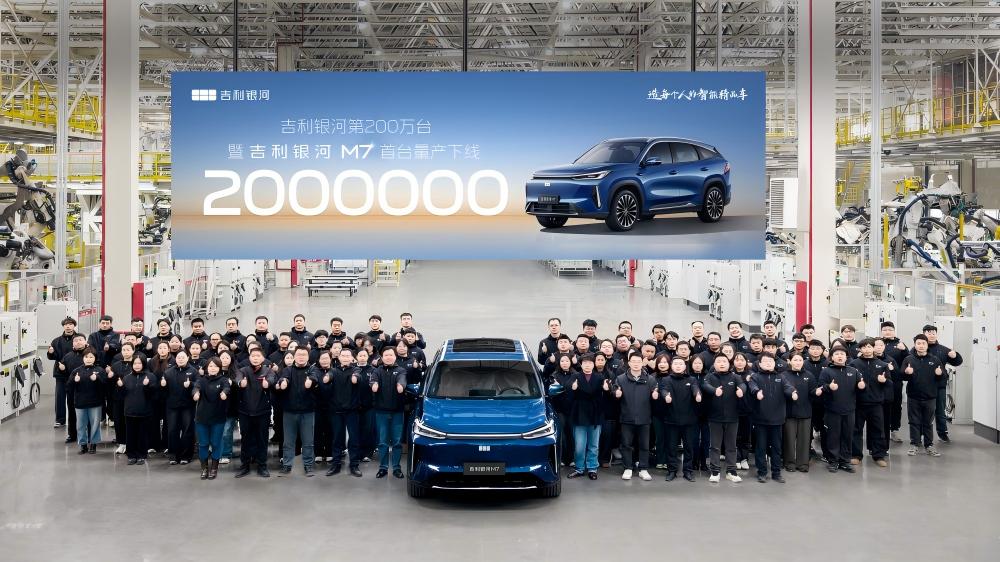
Image Source: Geely Auto
BYD followed in second place with 188,000 units, demonstrating a deep market foundation. Chery Automobile and Changan Automobile took third and fourth with sales of 156,000 and 92,000 units respectively. SAIC Motor Passenger Vehicle, Great Wall Motor Motor, and SAIC-GM-Wuling also made the list, collectively forming a "Great Wall Motor" of domestic brands on the wholesale side.
Cui Dongshu, secretary-general of the CPCA, noted that the strong wholesale performance of domestic brands is largely driven by robust export growth. As competition at home turns white-hot, overseas markets have become a strategic space for these brands to absorb capacity, boost economies of scale, and diversify risks. This "domestic-external linkage" model provides a wider runway for growth.
The collective rise of domestic brands is no overnight success; it is the result of years of deep technical cultivation and product upgrades.
Traditional veterans like Geely, Changan, and Great Wall Motor have successfully broken the monopoly of joint ventures in mainstream price segments by balancing internal combustion engine and new energy vehicle layouts, while making continuous breakthroughs in intelligence and high-end positioning. Their product matrices are increasingly comprehensive, offering competitive choices ranging from compact sedans to mid-to-large SUVs, and from daily commuting to high-end luxury.
Particularly in smart cockpits and driver assistance systems, localized innovations by domestic brands better align with Chinese consumer needs, creating a unique user experience advantage.
Furthermore, BYD's technological branding in new energy, and Chery's years of cultivation in engine technology and global markets, have each built difficult-to-replicate competitive barriers. Together, these factors mean domestic brands not only lead in sales volume but also display unprecedented confidence in supply chain control and upward brand breakthroughs.
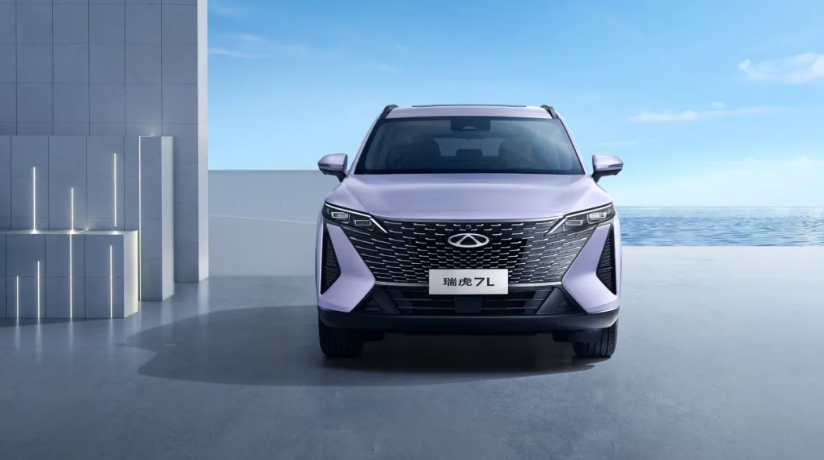
Image Source: Chery Automobile
The top six spots on the monthly sales leaderboard—occupied exclusively by domestic brands—mark a turning point where Chinese companies are evolving from market followers into rule-makers.
Financial Leverage Unlocks New Growth
Beyond the glow of domestic brands, Tesla China delivered another standout performance on the February wholesale list.
Tesla China recorded monthly sales of 59,000 units in February—a staggering 91% year-on-year jump. It was the only company among the top ten to achieve near-doubling growth, a result that stands out sharply against a backdrop of slowing overall market momentum.
Tesla's sustained heat stems first from its powerful product definition and brand appeal. The Model 3 and Model Y, after years of market testing, still lead their segments in market performance and intelligent experience, while frequent price adjustments have effectively stimulated latent demand. Yet product strength alone cannot fully explain such explosive growth. Cui Dongshu's analysis reveals another critical variable: the leverage of financial policy. Recent offers from Tesla and others—such as "5-year 0% interest" and "7-year low-interest" loans, plus insurance subsidies—have drastically lowered the barrier to purchase, delivering an immediate boost to sales.
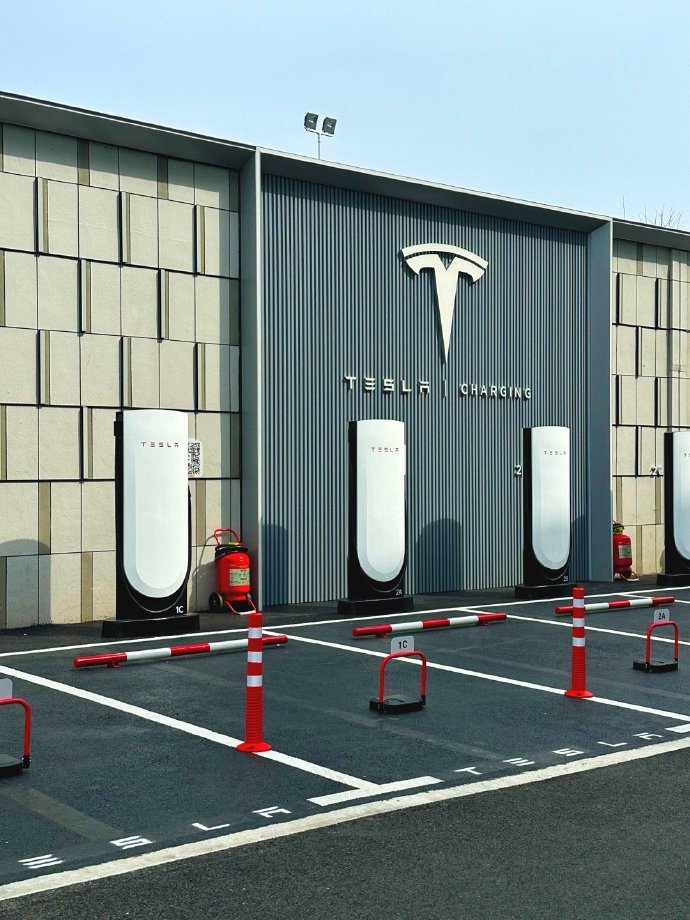
Image Source: Tao Lin's Weibo
This phenomenon reflects a broader reality: auto finance is becoming a decisive factor in the competitive landscape.
In the current macroeconomic environment, consumer confidence remains fragile, and decisions on big-ticket items are made with caution. Low-interest loans act as a substantial subsidy without forcing a cut in the official sticker price. This preserves the brand's pricing architecture while easing the cash-flow burden on buyers.
For automakers, this is an efficient market activation tool; for banks, auto loans—with their higher interest rates and low default rates—have become rare high-quality credit assets. Cui noted that banks are currently grappling with negative growth in residential mortgages and an excess of deposits with few quality projects to fund, magnifying the potential of auto finance.
Tesla seized this precise moment, combining financial innovation with product strength to achieve growth far above the industry average. This offers a lesson for all players: future competition will not just be a battle of technology and product, but a comprehensive contest of financial innovation and resource integration. Those who best utilize financial leverage will be the ones to unlock incremental growth in a zero-sum game.
Joint Ventures Under Sustained Pressure
In stark contrast to the high spirits of domestic brands and the dazzling performance of Tesla, traditional joint venture brands are collectively fading.
The final three spots on the top ten wholesale list were occupied by FAW-Volkswagen, SAIC-Volkswagen, and SAIC-GM-Wuling. Notably, SAIC-GM-Wuling is not a traditional joint venture in the strict sense, as its lineup consists largely of proprietary products. In other words, the "North-South" VW partnership stands as the sole representative of traditional joint ventures on the bestseller list.
These figures are no accident; they are a concentrated reflection of the systemic challenges facing joint venture development in China.
For decades, joint ventures built a formidable moat in China backed by brand heritage, powertrain technology, and mature dealer networks. Yet the accelerating waves of electrification and intelligence are rapidly filling that moat. Domestic brands and new entrants have seized consumer mindshare through faster tech iteration, feature definitions that better understand local needs, and more agile marketing models. Especially in new energy, joint ventures have been slow to roll out products, while their existing internal combustion models face fierce competition from domestic rivals at similar price points, leading to a continuous erosion of market share.
The February data serves as a warning bell for joint ventures: without fundamental changes in product definition, intelligence levels, and cost control, their positions on the leaderboard are likely to slip further. The reconstruction of market share for joint ventures in China has, perhaps, only just begun.
Looking at the February 2026 wholesale data, a clear picture of market divergence has emerged. Domestic brands are leading comprehensively through systemic advantages, while traditional joint ventures are struggling to find their way through the pains of transition.
These changes are not short-term fluctuations, but the inevitable result of China's auto industry entering a new stage of high-quality development.
Looking ahead, competition will escalate into a multi-dimensional contest involving technology reserves, global layout, cost control, and the use of financial instruments. Domestic brands must guard against quality and brand risks as they scale up; joint ventures must accelerate localization to recover lost ground; and disruptors like Tesla will continue to play the role of market "catfish." For all participants, only by deeply understanding the shifting logic of the market and continuously innovating in products, technology, and business models can they remain invincible in this profound industry reshaping.


