



Gasgoo Munich- At the 2026 Agibot Partner Conference, founder, chairman, and CEO Deng Taihua presented a scorecard. It showed 1.05 billion yuan in revenue for 2025. This is a nearly 20-fold surge from 60 million yuan in 2024. "We have become the fastest robotics company in China to achieve 1 billion yuan in revenue," Deng said.
Even more striking is the "358" blueprint Deng unveiled. The plan targets 10 billion yuan in revenue by 2027. It aims for 100 billion yuan by 2030.
Moving from 1 billion to 10 billion, and then 100 billion, represents a massive jump. Is this three-year-old startup benefiting from industry growth, or building an overly aggressive narrative?
Tenfold in Three Years: Where Does Agibot's Acceleration Come From?
Financially, Agibot is on a steep growth curve.
Revenue was just 60 million yuan in 2024. It surged to 1.05 billion yuan in 2025. This is a nearly 20-fold year-over-year increase.
Meanwhile, Unitree's prospectus shows the competitor achieved 1.708 billion yuan in revenue in 2025. This is up 335.36%. Net profit exceeded 600 million yuan, a jump of 674.29%.
Unitree set an industry benchmark with 1.708 billion yuan in revenue. This invited comparisons with Agibot's growth.
Unitree was founded in 2016. Agibot, by contrast, reached the billion-yuan milestone in roughly a quarter of that time.
This velocity is underpinned by volume production and delivery.
As Gasgoo reported on March 30, Agibot rolled out its 10,000th general-purpose embodied robot. The breakdown includes 2,126 units from the Yuanzheng series (A1/A2/A3). It includes 5,008 from the Lingxi series (X1/X2). It also includes 2,909 from the Jingling series (G1/G2).
Agibot's manufacturing capacity has expanded rapidly over the past year and a half.
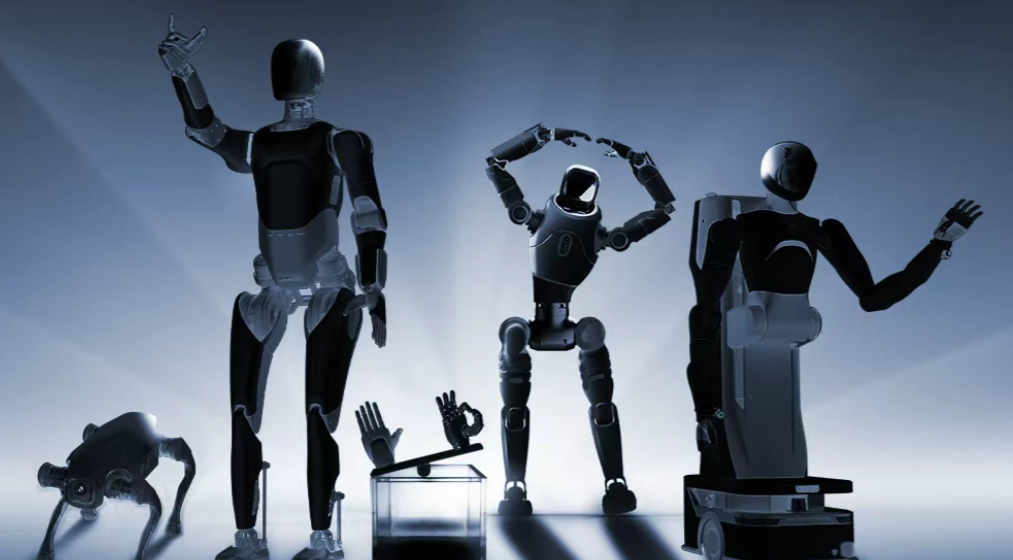
Image Source: Agibot Official Website
Between January 6 and December 8, 2025, output climbed from 1,000 to 5,000 units. From December 8, 2025, to March 28, 2026, Agibot surpassed the 10,000-unit mark. This demonstrates a rapid rise in manufacturing capability. It also represents a breakthrough in scaled production.
Wang Chuang, partner and senior vice president, revealed a target. The company expects to deliver its 100,000th general-purpose embodied robot by the end of 2027.
In terms of capital, Agibot has joined the 10-billion-yuan valuation club. It forms the first tier of the embodied intelligence sector. This is alongside companies like Unitree and Galbot. Unitree has an IPO valuation of about 42 billion yuan. Galbot is valued at roughly 21 billion yuan.
These figures support Agibot's three-stage evolution. It moves from the Year of R&D to the Year of Mass Production. It is now the Year of Commercialization.
The Leap from 10 Billion to 100 Billion: Logic and Challenges Behind Aggressive Targets
Deng outlined Agibot's future using a three-curve framework:
In 2025, Agibot's third year, the company achieved 1 billion yuan in revenue. This marked its entry into productivity and initiated the first curve;
By 2027, Agibot targets over 10 billion yuan in revenue. This achieves the zero-to-one deployment of productivity. It launches the second curve;
By 2030, the goal is to exceed 100 billion yuan in revenue. This scales productivity from one-to-many. It ushers in the third curve.
This implies a tenfold revenue increase within three years. It requires a compound annual growth rate of roughly 215%.
Such velocity is not unprecedented in the tech sector.
Tesla experienced similar rapid growth during the Model 3 ramp-up. However, Agibot faces an embodied intelligence market that has yet to mature.
Agibot's product roadmap for this year offers certainty regarding that target. The company debuted Seven Productivity Solutions for Deployment. It aims to implement embodied intelligence in various scenarios. These include production line loading and industrial handling. Others are logistics sorting, guidance, and shopping assistance. The list also includes retail service stations, security patrols, and industrial and commercial cleaning.
Deng noted that Agibot will launch new products across four series in 2026. Notably, the full-size humanoid Yuanzheng series will enter its third generation. Single-model shipments will exceed 10,000 units.
The leap from 10 billion to 100 billion yuan is difficult.
The industry grapples with core technical bottlenecks. Specifically, the embodied brain remains a critical weakness. Dexterous hands account for an excessive portion of total cost and lack technological maturity.
Most current shipments go to non-work applications. These include research institutions and data collection centers. A genuine commercial closed loop has yet to take shape.
As capital market enthusiasm cools, the validity of Agibot's 358 plan will be tested. It is unclear if it is strategic foresight or an aggressive narrative. Mass production deliveries and commercial orders will provide the answer.


