



Gasgoo Munich- What major events shook the global auto industry this week?
Government Work Report Highlights: Embodied Intelligence and Flying Cars Emerge as New Frontiers
On March 5, 2026, the fourth session of the 14th National People's Congress opened in Beijing, where Premier Li Qiang delivered the government work report. The report reviewed achievements from 2025 and laid out tasks for the opening year of the 15th Five-Year Plan, with the automotive sector and related industries taking center stage.
The report emphasized developing "new quality productive forces" and building a modern industrial system. Among emerging pillar industries, it called for strengthening integrated circuits and the low-altitude economy, with the latter given particular prominence. Looking to future industries, the report outlined plans to cultivate future energy, embodied intelligence, and 6G. Notably, "embodied intelligence" was proposed independently for the first time, signaling a coming revolution in human-machine interaction.
As 2026 marks the first year of the 15th Five-Year Plan, the report set specific requirements for this year's government work, many of which are closely tied to the automotive and associated sectors.
Boosting Consumption and Investment: The government will allocate 250 billion yuan in ultra-long special treasury bonds to support trade-in programs for consumer goods and 200 billion yuan for equipment upgrades. It also aims to guide private capital toward new frontiers like intelligent connected vehicles.
Deepening "AI+": The report calls for implementing projects such as intelligent computing clusters and computing-power coordination, alongside an upgraded "5G + Industrial Internet." These initiatives aim to provide the computing and network infrastructure needed for autonomous driving and vehicle-to-infrastructure coordination.
Cultivating Emerging Industries: Authorities will accelerate airworthiness certification and standard-setting for the low-altitude economy (flying cars), while promoting the application of embodied intelligence in automotive manufacturing and intelligent cockpits.
Green Transition: The report sets a target to reduce carbon dioxide emissions per unit of GDP by 3.8%. It calls for building a new power system, developing new energy storage and smart grids, and pushing vehicle-to-grid (V2G) interaction—pressuring traditional automakers to accelerate their low-carbon transformation.
Gasgoo Comment: The policy compass is clearly pointing toward embodied intelligence and the low-altitude economy, yet bridging the gap from laboratory to market—a "valley of death" for commercialization—remains a formidable challenge.
2026 Auto Industry Proposals at the "Two Sessions": When Regulation Can't Keep Pace with Technological Frenzy
With the "Two Sessions" recently underway, industry heavyweights like Feng Xingya, Lei Jun, He Xiaopeng, and Li Shufu have collectively submitted over 30 proposals directly addressing the automotive and future sectors. Topics span more than a dozen niche areas, from autonomous driving and humanoid robots to the low-altitude economy and talent development. The message is clear: the boundaries of the auto industry are rapidly dissolving, and representatives are looking far beyond just the "car" itself.
The core debate revolves around the race between regulation and technology. In autonomous driving, tensions are flaring over the path forward: XPENG's He Xiaopeng advocates for policies that leapfrog from L2 to L4, skipping intermediate steps and granting local governments more autonomy to pilot innovations. GAC's Feng Xingya stresses the need to accelerate the establishment of unified national standards and evaluation systems to build a solid foundation. Xiaomi's Lei Jun, meanwhile, focuses on the user experience, suggesting penalties for L2 "hands-off, eyes-off" behavior and strengthening education on human-machine co-driving.
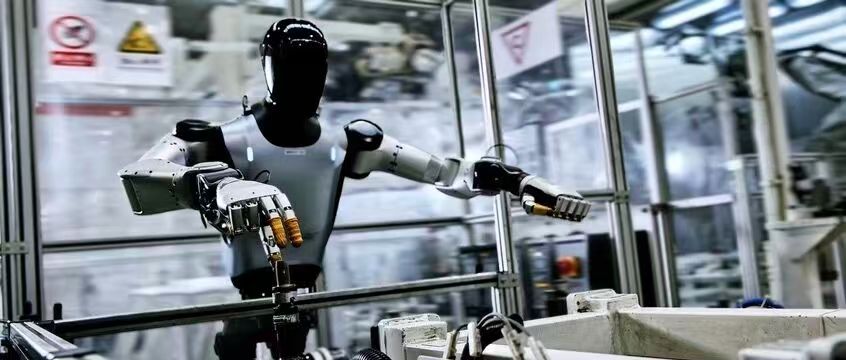
Image source: Xiaomi
Regarding humanoid robots, representatives highlighted the "apprentice dilemma." Lei Jun proposed setting clear KPIs—such as achieving a Mean Time Between Failures (MTBF) of 10,000 hours in industrial settings by 2027—to push the technology out of labs and into factories. He Xiaopeng warned of the "weak brain" risk, calling for breakthroughs in on-device large models to prevent China from falling behind international competitors.
On the low-altitude economy, deregulation is the consensus. Feng Xingya suggested top-level planning to create a digital airspace map. He Xiaopeng pointed out that airspace approval powers are too centralized, recommending they be decentralized to local governments and that tax classifications for flying cars be clarified.
Furthermore, facing a shortfall of millions of interdisciplinary talents in "intelligent electric vehicles," Lei Jun and Li Shufu both proposed establishing first-level interdisciplinary disciplines to reconstruct the training system from the ground up. Hu Chengzhong focused on solid-state batteries, urging the swift creation of unified national standards to secure a voice in the global arena. Amid the clamor over technology, Feng Xingya and Li Shufu also paid attention to "the forgotten," offering thoughtful proposals on bridging the digital divide for the elderly and improving accessible taxi services.
Gasgoo Comment: As technology sprints ahead, the lag in regulatory supply has become the biggest brake on innovation. The debate among representatives is essentially a search for the balance point between safety and efficiency.
Middle East Tensions Disrupt Auto Exports for Multiple Automakers
Sources reveal that escalating tensions in the Middle East, blocked shipping routes, and soaring freight costs have forced several Indian automakers to delay shipments to the Middle East and North Africa. Companies including Tata Motors, Maruti Suzuki, Hyundai's Indian unit, and Volkswagen's Indian subsidiary have all postponed deliveries of passenger and commercial vehicles.
According to a March 5 report by Nikkei, Toyota is cutting nearly 40,000 units of production in Japan for the Middle East market to address international logistics concerns sparked by military actions led by the U.S. and Israel against Iran. The automaker has reportedly notified parts suppliers of adjusted production plans for March and April. The cuts primarily affect popular models in the Middle East produced domestically, including SUVs like the Land Cruiser, as well as sedans and commercial vans.
It's not just foreign automakers. Foxconn's chairman recently stated that if the conflict involving the U.S., Israel, and Iran persists, everyone will feel the impact on oil and raw material prices. He added, however, that the impact on Foxconn remains limited for now.
Gasgoo Comment: The geopolitical "black swan" has once again proven that the resilience of the global automotive supply chain is far weaker than imagined. The ripple effects of regional conflicts are transmitting rapidly to the production floor.
EU Officially Unveils "Industrial Accelerator Act"
On March 4, the European Commission officially released the Industrial Accelerator Act (IAA), proposing to introduce "Made in EU" requirements for public procurement and public support programs. The plan aims to raise manufacturing's share of the EU's GDP from 14.3% in 2024 to 20% by 2035.

Image source: European Commission
The "Made in EU" principle applies to key strategic sectors like steel, cement, aluminum, and automobiles. For the auto industry, for instance, subsidies require that over 70% of components (excluding batteries) and over 25% of low-carbon aluminum be produced within the EU. Beyond local content rules, the bill imposes strict restrictions on foreign direct investment within the bloc, specifically targeting countries accounting for more than 40% of global production capacity—in most cases, China. For investments exceeding 100 million euros, specific conditions apply: EU employees must make up at least 50% of the workforce, foreign ownership cannot exceed 49%, and technology transfer must be achieved through licensing agreements.
Gasgoo Comment: Trade protectionism is quietly escalating under the guise of "Made in EU." The regional restructuring of global supply chains has shifted from trend to reality, with the automotive industry first in the line of fire.
Report: DENSO to Acquire ROHM Semiconductor for $8.2 Billion
Nikkei reported on March 6 that Japanese auto supplier DENSO has launched a takeover bid for Kyoto-based electronics group ROHM Semiconductor. The deal could be worth up to 1.3 trillion yen (approximately $8.2 billion).
If completed, the combination would create a major player in Japan's power semiconductor market, a sector critical for electric vehicles and data centers. DENSO reportedly made the offer in February or earlier. ROHM has established a special committee to discuss whether to accept the bid. Should ROHM reject the offer, DENSO may initiate a hostile takeover.
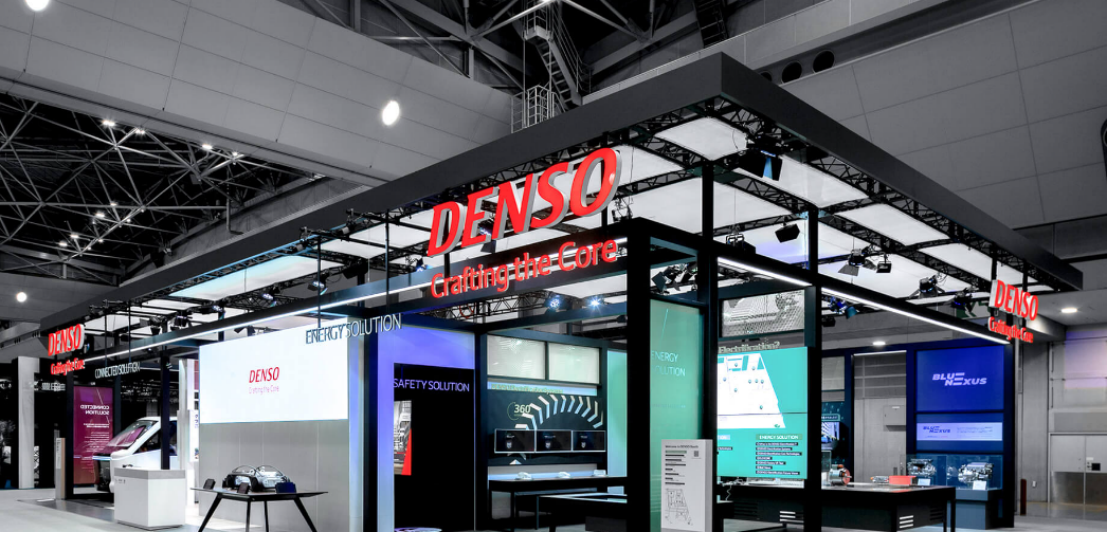
Image source: DENSO
As a Toyota Group company, DENSO announced expanded cooperation with ROHM last May, planning to jointly develop analog semiconductors for EV sensors and other components. By last July, DENSO held nearly 5% of ROHM's shares. As of March 5, ROHM's market capitalization was about 1.1 trillion yen. If DENSO moves to acquire the remaining roughly 95%—assuming a premium—the total deal value could reach 1.3 trillion yen. As vehicles become increasingly software-defined, demand for power semiconductors that drive motors and manage batteries is surging. This potential deal highlights how Japanese auto suppliers are racing to secure chip capacity.
Gasgoo Comment: Traditional Tier 1 giants are spending heavily to expand upstream into chips. The battle in the auto industry has shifted from "horsepower" to control over "computing power" and "power semiconductors."
Nexperia's China Operations Halted as Control Dispute Escalates
On the afternoon of March 6, 2026, Nexperia issued a notice to customers stating that its core office and production systems had suffered a sudden paralysis.
The incident occurred at 19:02 on March 3, when Nexperia B.V. (the Dutch headquarters) batch-disabled office accounts for all employees in China, blocking access to critical environments like Office 365 and SAP systems. Consequently, parts of the production process—specifically the "SAP order entry for customer-supplied wafers"—were disrupted.
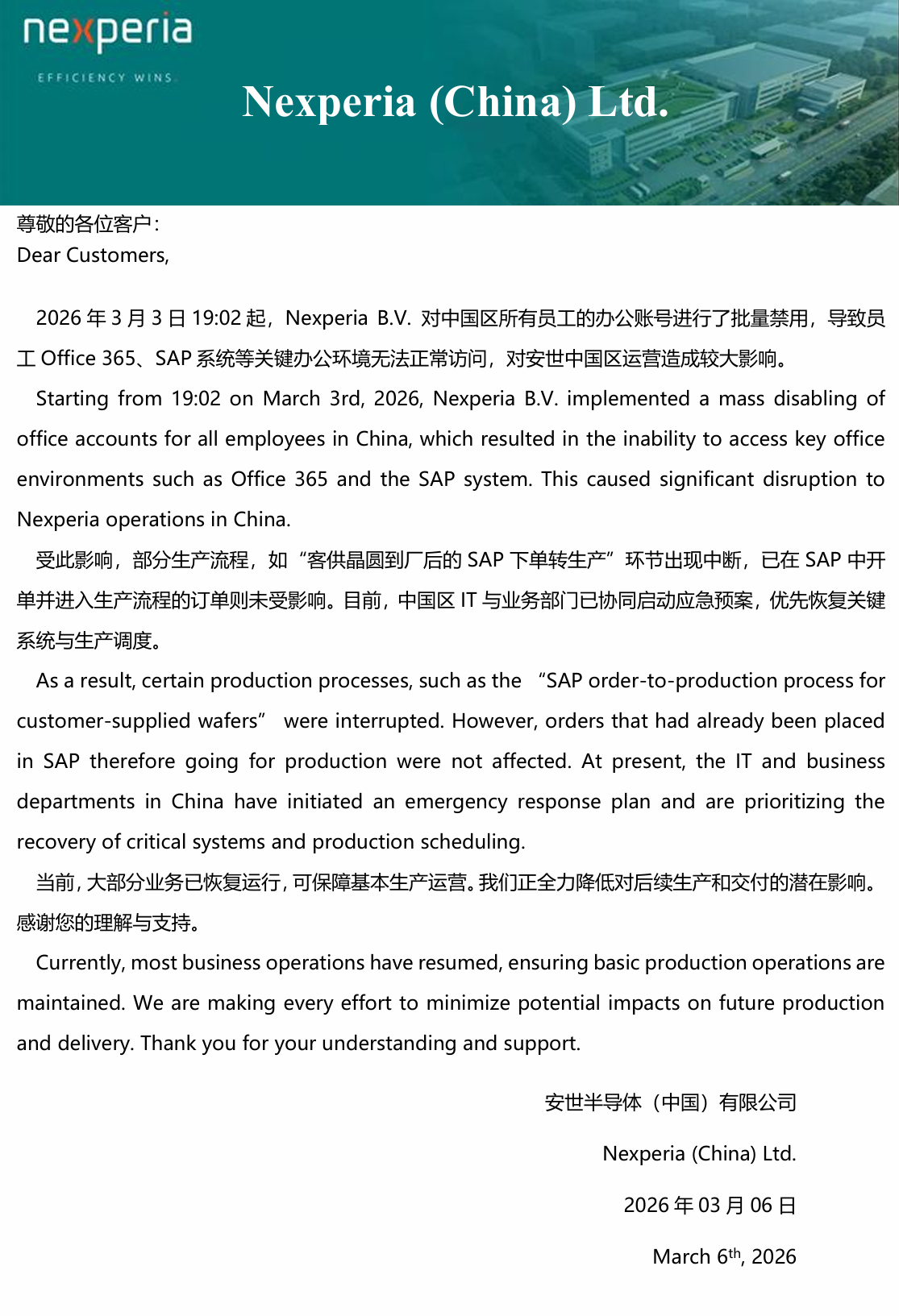
Image source: Nexperia
In its notice, Nexperia (China) stated that most operations have been restored through contingency plans, ensuring basic production and business continuity.
Gasgoo Comment: The battle for control over core semiconductor assets between Chinese and foreign capital has spilled over from the boardroom into production systems. Disputes over technological sovereignty are now threatening the stability of the supply chain.


