



What were the major headlines in the global auto industry this week?
SAIC and GM Renew Partnership, Extending Joint Venture by 20 Years to 2047
On August 5, SAIC Motor and General Motors officially signed a strategic renewal agreement. The deal extends their joint venture, SAIC-GM, by another 20 years through 2047.
The original SAIC-GM contract was signed on October 31, 1995, with the joint venture officially established in June 1997. The 30-year agreement had been set to expire in June 2027.

Image Source: SAIC-GM
Following the renewal, SAIC-GM aims to leverage China’s strengths in consumer insights, R&D, manufacturing, and supply chain efficiency. The goal is to export products defined, developed, and manufactured in China to global markets. This shifts the country’s role from a recipient of global technology to a source of innovation and a global supplier hub.
Gasgoo Take: On the surface, this is a partnership renewal. Underneath, it looks like a traditional joint venture attempting to redefine its value division as China’s automotive supply chain capabilities mature.
Mandatory National Standard for Autonomous Driving Safety Released, Taking Effect July 2027
Recently, the State Administration for Market Regulation and the Standardization Administration of China jointly approved a mandatory national standard, "Safety Requirements for Autonomous Driving Systems of Intelligent Connected Vehicles" (GB 44721—2026), developed by the Ministry of Industry and Information Technology. The standard will officially take effect on July 1, 2027.
This marks China’s first mandatory national standard targeting Level 3 conditional autonomous driving and Level 4 highly autonomous driving systems. It applies to M-category passenger vehicles and N-category freight vehicles equipped with these automation levels, though automated parking systems fall outside its scope.

Image Source: Ministry of Industry and Information Technology
Notably, this mandatory standard represents a systematic upgrade over the 2024 recommended national standard, "General Technical Requirements for Autonomous Driving Systems of Intelligent Connected Vehicles" (GB/T 44721—2024). By shifting legal status from recommended to mandatory, the move signals a regulatory push to strengthen safety requirements for autonomous driving.
Technically, the standard sets detailed requirements for Level 3 and Level 4 systems and clarifies safety boundaries. It refines user requirements, such as notifications and operator training, and establishes a unified test scenario system. These designs align with the UN Global Technical Regulation on Autonomous Driving Systems (ADS GTR), approved in June 2026. They also adapt to China’s road conditions and management needs, enhancing operability for domestic implementation.
Gasgoo Take: Autonomous driving is shifting from a "technology race" to a "regulatory race." The implementation of mandatory standards means automakers will be competing not just on feature experience, but on safety boundaries and liability frameworks.
China Auto Dealer Inventory Warning Index Stands at 61.1% in July 2026
The latest "Automobile Dealer Inventory Warning Index Survey" (VIA) from the China Automobile Dealers Association (CADA) shows the inventory warning index for July 2026 reached 61.1%. That’s an increase of 3.9 percentage points year-on-year and 3.9 points month-on-month, keeping the index above the boom-bust line.
Dealers expect the market’s weak seasonal performance to persist into August. Scorching heat across most of the country is suppressing offline foot traffic, and consumer wait-and-see sentiment isn’t likely to improve significantly. However, concentrated demand from the graduation and back-to-school seasons should provide some lift, with sales projected to outperform July.
Gasgoo Take: Rising inventory pressure suggests the price war is far from over. Behind the sales growth, dealer profitability and channel health remain lingering concerns for the industry.
Wu Yun Appointed SAIC Volkswagen General Manager to Lead NEV Transition Push
On August 3, SAIC Volkswagen announced a management change: Wu Yun, former executive vice president of human resources and organization, has succeeded Tao Hailong as general manager. The move is part of SAIC Motor’s routine talent rotation between its vehicle and components sectors. Tao Hailong will return to Huayu Automotive Systems as general manager, completing a two-way flow of talent between the group’s vehicle and components divisions.
The announcement reviewed Tao Hailong’s performance over the past two years. After taking the helm in July 2024, Tao established the core strategy of "advancing internal combustion and electric vehicles together, and making both intelligent," driving the company’s comprehensive transition to new energy.

Wu Yun. Image Source: SAIC Volkswagen
The new general manager, Wu Yun, is a homegrown composite manager at SAIC Volkswagen. Born in 1979 with a bachelor’s degree in engineering, he joined the company in 2003 and brings over two decades of experience. His career spans product engineering, manufacturing, marketing, strategy, and vehicle lifecycles. He has overseen the full cycle from R&D to launch for multiple best-selling models and spearheaded the launch of Audi’s new "AUDI" brand in China, along with its localization strategy and NEV product matrix planning.
In 2025, Wu was seconded to Bosch Huayu Steering Systems as general manager, gaining deep insight into upstream component logic. He returned to SAIC Volkswagen in 2026 to lead human resources and organizational work, focusing on optimizing the organizational structure and building talent pipelines to solidify the management foundation for the company’s electrification transition.
Gasgoo Take: The recent string of personnel changes sends a clear signal: SAIC is shifting from an era driven by scale to one defined by organizational efficiency and new energy capabilities.
Chery Plans $75 Million Investment in South Korean Automaker KG Mobility
According to a recent Reuters report, KG Mobility said Chery Automobile has agreed to invest $75 million through convertible bonds. If the bonds are converted into equity, Chery would acquire approximately a 10% stake in KG Mobility.
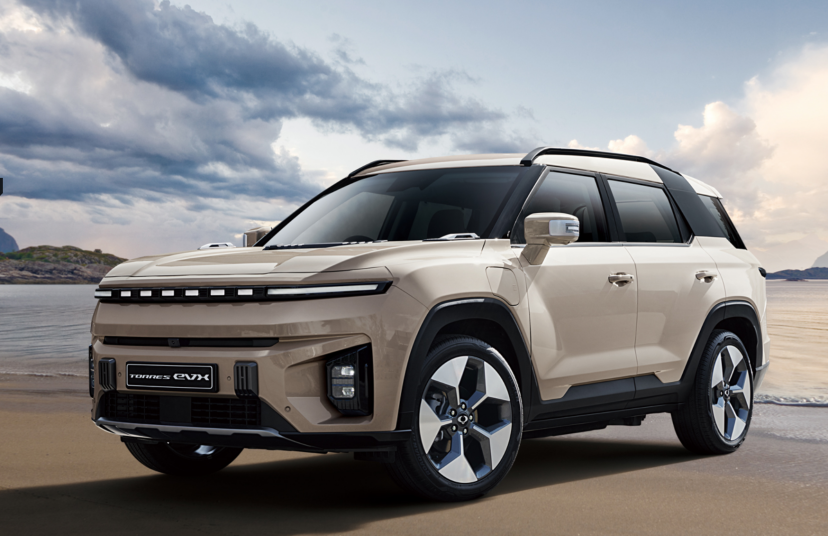
Image Source: KG Mobility
Chery International President Zhang Guibing told media in Seoul that Chery’s global network of production bases could serve as a key platform for future cooperation. "We can explore sharing global capacity and engaging in multi-dimensional cooperation in manufacturing," he said, adding that there is broad room for collaboration spanning sales channels and even branding.
Chinese automakers are increasingly partnering with established overseas players to revitalize underutilized factory resources. "Expanding overseas markets is naturally one of our core goals," Zhang noted. Chery is currently China’s largest auto exporter. Sales data released on August 1 shows the group sold 276,820 vehicles in July, a 23.3% year-on-year increase. Exports surged 70.1% to 202,533 units, marking a fifth consecutive month of record-breaking single-month exports and making Chery the first Chinese automaker to surpass the 200,000-unit export mark in a single month.
Chery executives also revealed that the company is actively studying feasible plans to enter the U.S. market, though entry requires compliance with a wide range of local laws and regulatory requirements.
KG Mobility plans to launch a mid-size SUV, codenamed SE-10, next January. The new vehicle will be built on Chery’s T2X platform and will be available in both internal combustion and plug-in hybrid versions, targeting both the domestic South Korean market and overseas markets.
KG Mobility Chairman Kwak Jae-sun stated there are currently no plans to export this model to the U.S., but did not rule out the possibility in the future. He also added that Chery and KG Mobility have agreed to form a task force to explore cooperation in semiconductors, robotics, raw materials, and steel.
The predecessor of KG Mobility was SsangYong Motor. Its sales in the South Korean domestic market rank behind only Hyundai, Kia, and General Motors. The SUV-focused manufacturer reported cumulative sales of over 55,000 units domestically and overseas in the first half of the year, with exports accounting for approximately 60% of total sales.
Gasgoo Take: Chery’s move into South Korea isn’t simply about buying overseas assets. More importantly, it leverages the capabilities and capacity of a mature market player to accelerate the shift from simple product exports to global industrial synergy.
Construction Officially Begins on Yanfeng’s New Anting Project Base
On August 7, Yanfeng Automotive Interiors’ new project base in Anting entered the pile-driving phase. With a total investment of 1.45 billion RMB, the facility integrates smart cockpit R&D and production. Once completed, it will inject new momentum into Jiading’s bid to build a world-class automotive industry hub.
The new base is located west of the Gupu River and south of Minfeng Road in Anting Town. Covering approximately 190,000 square meters, the project plans to construct five individual buildings with a total floor area of about 200,000 square meters. This includes three smart factories, a four-story parking garage, and other auxiliary facilities, requiring nearly 4,000 piles in total.
As a major industrial project in Jiading this year, the new base will provide close-range support for mainstream OEMs including SAIC Volkswagen, SAIC Audi, SAIC Motor, BYD, Li Auto, and Volvo. The project will also collaborate with Yanfeng’s global technical experts and international branches, following a green, low-carbon, and circular development path to provide automakers with comprehensive cockpit solutions from design to mass production.
The construction team revealed the contract period is 555 days. Piling is scheduled for completion between late September and early October of this year. Main structures are expected to top out in June 2027, with full construction slated for the first quarter of 2028.
Gasgoo Take: As the smart cockpit becomes a new battleground for automotive competition, parts suppliers are transforming from traditional vendors into technology solution providers—reshuffling the industry value chain.


