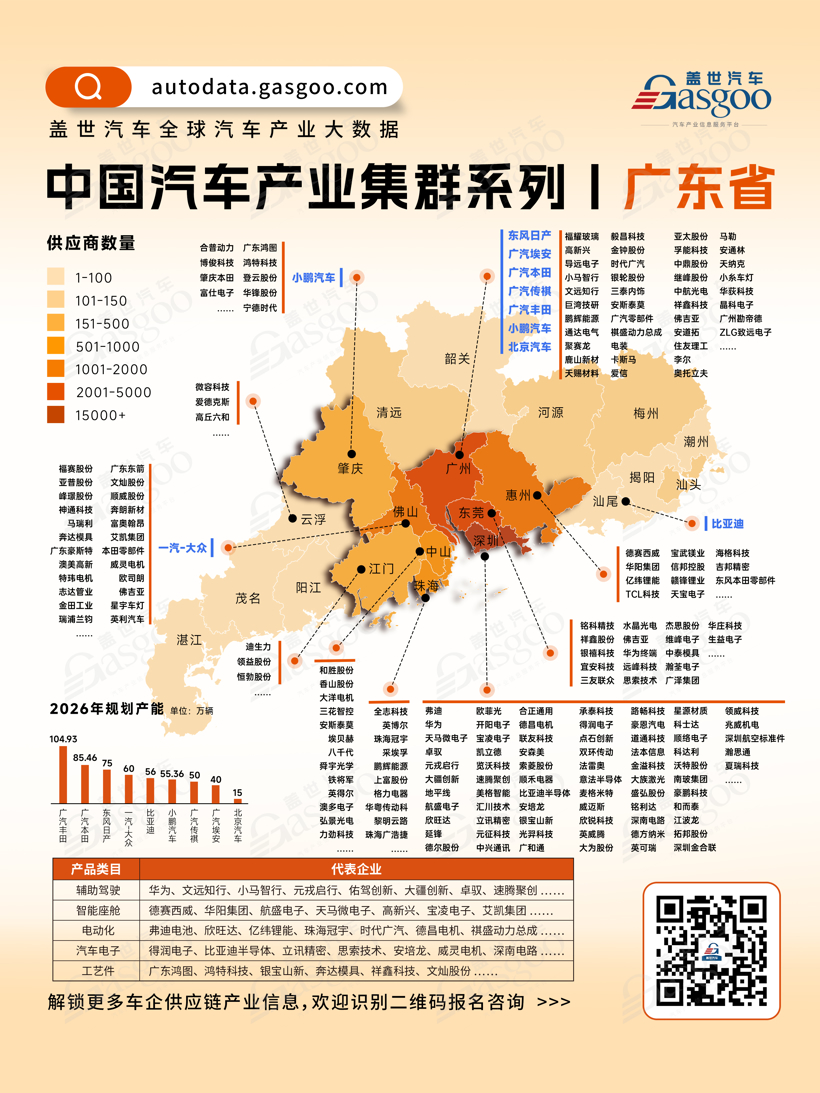
According to Gasgoo's global automotive industry big data map, Guangdong's auto cluster has evolved into a powerhouse driven by core cities, coordinated supply chains, and a concentration of innovative resources. This ecosystem plays a pivotal role as China's automotive industry shifts toward high-end manufacturing and electrification.
Geographically, the industry is defined by a core concentration in the Pearl River Delta that radiates outward to drive growth across the entire region. Anchored by OEMs like GAC Group and BYD, and bolstered by critical sectors such as power batteries and intelligent systems, the province has built an industrial ecosystem covering major technological pathways. Shenzhen, Guangzhou, and Dongguan form the backbone of development, while Foshan and Zhaoqing play vital roles in key components. Meanwhile, eastern and western Guangdong have become crucial hubs for industrial transfer and capacity absorption. This "core-led, multi-point synergy" spatial layout not only boosts efficiency but also supports coordinated regional development.
In terms of capacity planning, traditional automakers and new forces are advancing side by side. Looking ahead to 2026, established players like GAC Toyota and GAC Honda are maintaining massive footprints, with individual planned capacities nearing or exceeding 1 million units. At the same time, emerging players like XPENG are ramping up their planned output, creating synergy with BYD's new energy capacity. This "dual-track" approach secures the foundation for traditional internal combustion engine vehicles while carving out space for the large-scale expansion of new energy vehicles.
Regarding product structure, the province has established a relatively complete supply system across major categories and critical manufacturing stages. In electrification, power battery makers led by FinDreams Battery have built local capabilities covering cells, battery systems, and supporting components, continuously strengthening the foundation for core new energy parts. In intelligent connectivity, leveraging its strength in the electronic information industry, Guangdong has attracted a cluster of companies with system development and engineering capabilities in areas like driver assistance, smart cockpits, and automotive software, accelerating the application of these technologies. Overall, Guangdong boasts a complete automotive chain with clear division of labor, holding significant sway in the national system while deeply integrating into the global automotive landscape.
Currently, Guangdong's auto cluster is navigating a phase defined by simultaneous scale expansion and technological evolution. Moving forward, the province must further amplify the technological spillover and collaborative drive of Guangzhou and Shenzhen, guiding eastern and western regions to achieve "innovative integration" as they absorb industrial transfers. At the same time, building on its existing foundation, Guangdong needs to double down on frontiers like automotive-grade chips and solid-state batteries. This will help the industry cluster steadily evolve from "scale advantages" to "technological strengths," securing a more proactive position as the global automotive landscape is reshaped.