



Gasgoo Munich- Since 2026, the global auto industry has been stuck in a structural bind over automotive-grade memory chips. The AI boom keeps hogging high-end production capacity, worsening the supply-demand imbalance. Soaring prices and widening shortages show no sign of easing, leaving automakers squeezed between rising storage costs and chronically low chip fulfillment rates.
At the same time, the push for smarter cars is accelerating. As smart cockpits and advanced driver-assistance systems become standard, the demands on storage capacity, bandwidth, and reliability per vehicle keep climbing. Storage chips are no longer just components; they are now key to defining a vehicle's performance.
Against this backdrop, a critical question looms for all industry players: How to resolve this structural shortage, break down coordination barriers across the supply chain, and build a local ecosystem that is autonomous and secure?
Where Is the Structural Gap Coming From?
Extending the crisis that began earlier in the year, the imbalance between supply and demand for automotive memory is deepening. What started as short-term volatility is shifting into a structural shortage.
AI data centers are relentlessly siphoning off high-end capacity. Combined with the high barriers to entry and long certification cycles for automotive-grade parts, the memory shortage has evolved from a temporary blip into a long-term structural challenge for the industry's intelligent evolution.
A Morgan Stanley report notes that the supply-demand gap for traditional memory chips is widening. Strong demand for advanced nodes like DDR5 and HBM is crowding out capacity allocation for mature processes like DDR4. Constrained by supply limits, DDR4 prices could jump 50% in the first quarter, with the rally extending into the second quarter—hitting sectors like automotive hard.
Meng Qingpeng, vice president of supply chain at Li Auto, has issued a public warning: the automotive industry's memory chip fulfillment rate could fall below 50% in 2026. William Li, chairman of NIO, echoed the sentiment, noting that rising memory prices have become the industry's biggest cost pressure this year.

Image source: Huaban
On the demand side, the industry is wading into the deep end of automotive intelligence. The spread of smart cockpits and advanced driver-assistance systems is driving up both capacity and performance requirements per vehicle. Micron Technology CEO Sanjay Mehrotra pointed out that Level 4 autonomous vehicles will need over 300GB of memory—nearly 20 times the 16GB found in today's mainstream models.
The industry is demanding more: higher capacity, bandwidth, reliability, and energy efficiency. Deep coordination between automotive SoCs and memory is becoming the new technical barrier. Storage is no longer a passive component; it must be co-designed with the main chip to help define the vehicle's overall performance.
Chip designers like Unisoc note that as automotive SoCs evolve toward higher integration and computing power, the requirements for bandwidth, reliability, and boot speeds in supporting memory are rising. Deep synergy between the two is essential for elevating vehicle intelligence.
Yet, this structural mismatch exposes deep-seated pain points. Long-standing information barriers between the auto and memory sectors have led to inefficient matching of supply and demand, and traditional procurement models are ill-equipped for today's capacity crunches and price volatility. UBS estimates that the AI data center construction boom has already caused a memory shortage, with supply disruptions likely surfacing in the second quarter of 2026—potentially triggering a significant downturn in global auto production.
Meanwhile, high-end production capacity remains heavily reliant on foreign sources. Whether local firms can master core technologies and end-to-end capabilities will determine the supply chain's resilience and security. As Li Shaohua, deputy secretary-general of the China Association of Automobile Manufacturers, put it, this is not a short-term cycle but a structural imperative as the industry enters the deep waters of intelligence.
Amid these struggles, a new consensus is emerging. Solving the memory crunch isn't a job for one company; it requires the entire supply chain to leverage specialized strengths, deepen collaboration, and build robust local capabilities. The relationship between the auto and memory industries is being redefined—from short-term spot buying to long-term ecological synergy.
How to Plug the Gap?
For automakers, the strategic value of memory chips is being rewritten. At a recent industry forum, Cao Lijun, deputy general manager of supply chain management at China FAW Group, shared his outlook on automotive memory trends.
He noted that as vehicle intelligence shifts from adding features to deep evolution, memory chips have become the cornerstone of performance. A symbiotic relationship is forming, where demand drives tech upgrades and technology, in turn, fuels scenario innovation.
This captures the essence of the current dilemma: memory is no longer a mere component but a strategic asset deeply bound to vehicle performance. Ensuring its stable supply and continuous evolution is now a critical challenge for automakers.
Solving it requires memory makers to offer systemic capabilities beyond simple product supply. One local player's strategy stands out. Longsys, an early mover in automotive memory, made it a priority seven years ago. It has since built a comprehensive solution supported by business model innovation and end-to-end capabilities—spanning controller design, firmware development, and advanced packaging and testing.
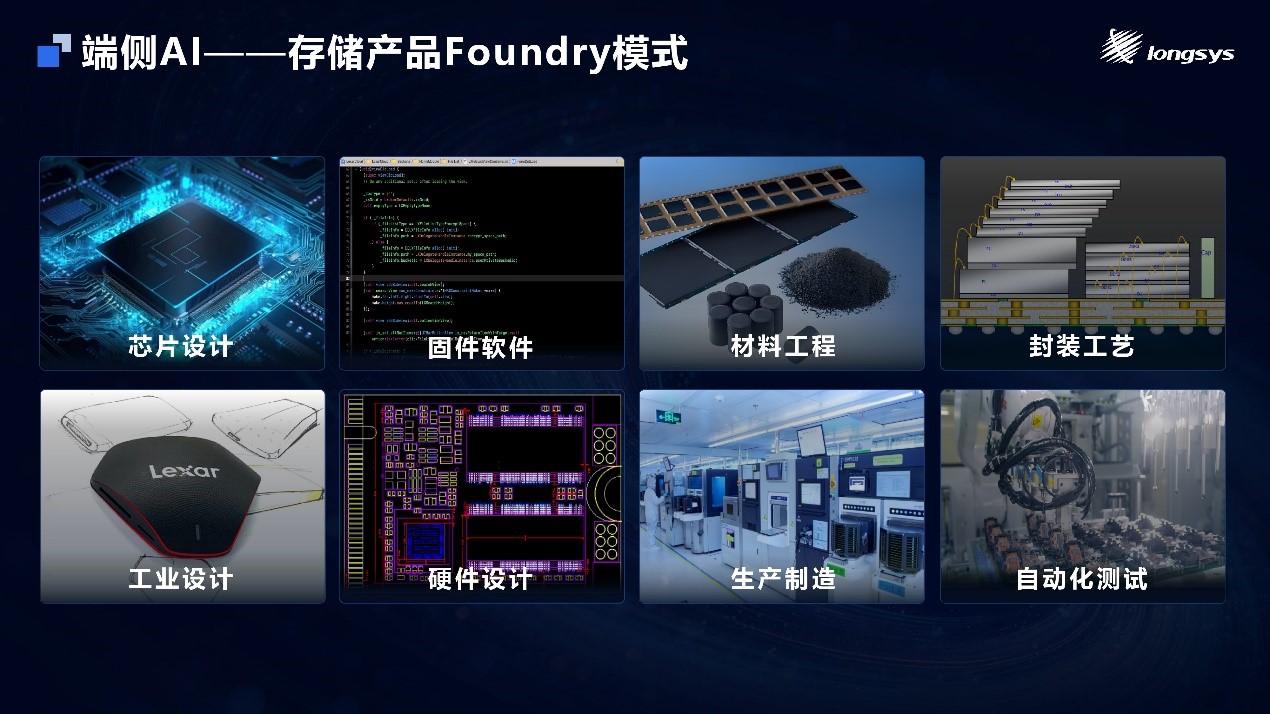
At the recent MemoryS 2026 summit, Longsys unveiled a strategy for "edge-side AI integrated storage," identifying smart vehicles as a key deployment scenario. Its edge-side AI storage foundry model spans the entire chain—chip design, packaging, and material engineering—to deliver customized memory support for AI scenarios like advanced driver-assistance systems.
The company's two models—TCM and PTM—offer direct answers to these industry pain points.
The TCM model (Technology Contract Manufacturing), first proposed by Longsys in 2024, aims to bridge the gap between wafer fabs and automakers. It integrates resources from memory makers, proprietary controllers, packaging and testing, firmware algorithms, and FAE services into a one-stop solution for OEMs and Tier 1 suppliers.
This mechanism creates a direct link between automakers and fabs. By aligning on resource pricing and supply planning, the relationship shifts from short-term transactions to secure, long-term contracts.
Leading automakers have already validated the model's value. Cao Lijun highlighted three advantages: high production certainty ensuring stable supply and uninterrupted lines; reliable quality backed by a full automotive-grade system and zero-defect standards for safety-critical functions; and strong product competitiveness that meets custom needs for smarter, more differentiated experiences.
In his view, TCM is a prime example of OEM-supplier collaboration. Only through such deep cooperation and a secure supply chain ecosystem can the industry achieve co-created value.
The PTM model (Product Technology Manufacturing) acts as a "foundry" within the storage sector. It provides deeply customized solutions—from hardware to firmware—tailored to specific automakers and domain control architectures. This approach reduces the cost and risk of adaptation, validation, and supply switching for OEMs and Tier 1 suppliers, closing the loop from definition to delivery.
Underpinning these models is nearly a decade of end-to-end capability building. On the controller front, subsidiary Huiyi Microelectronics focuses on high-end designs using advanced nodes. Its proprietary controllers cover mainstream and high-end categories like eMMC, SD cards, UFS, and USB storage. Automotive-grade eMMC products now use the in-house WM6000 controller, while future UFS products will adopt the WM7000 series. As the "brain" of the memory, this in-house capability sets the ceiling for performance and customization flexibility.
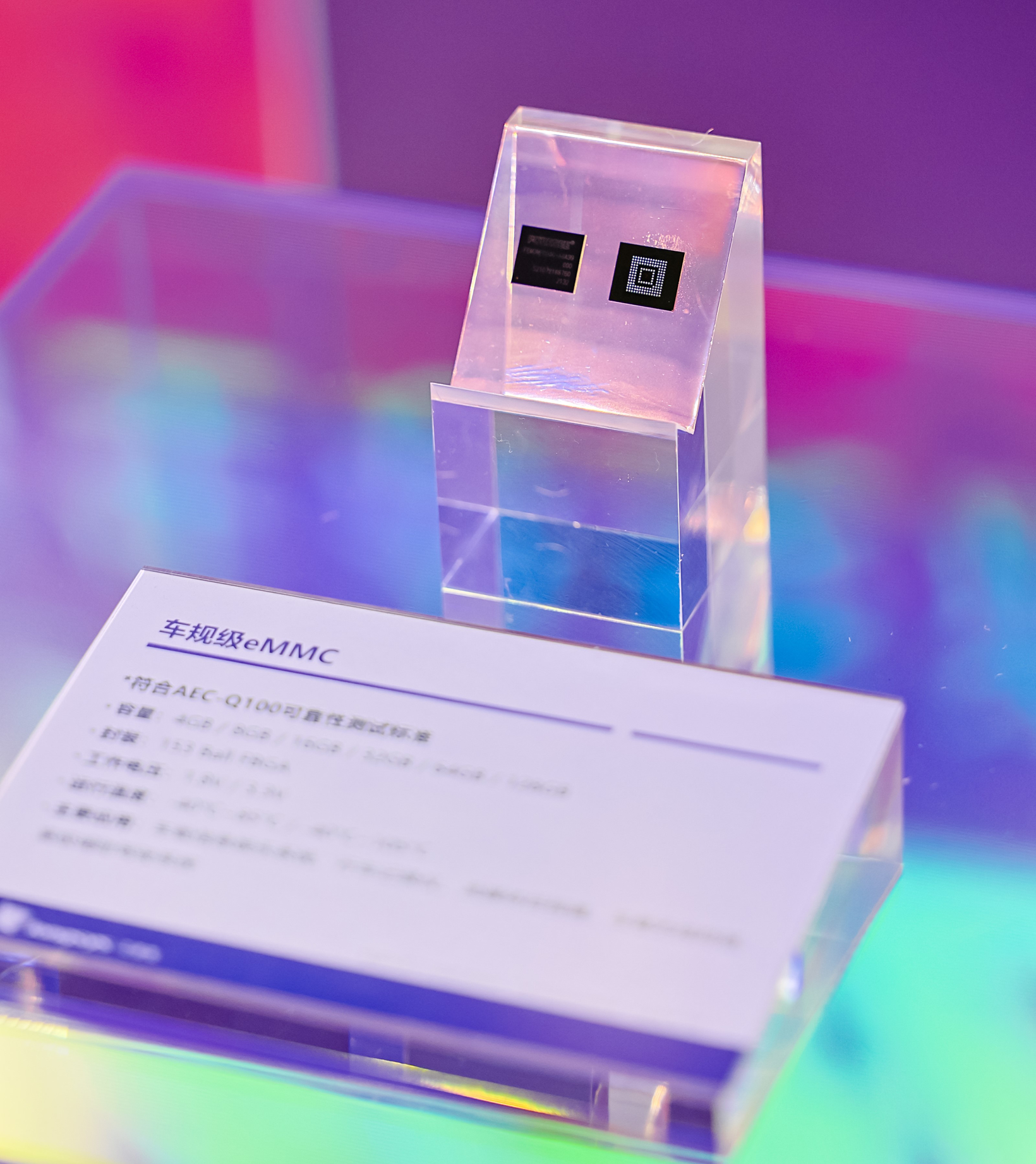
In packaging and testing, the subsidiary Yuancheng Technology has secured dual certifications: AEC-Q100 for reliability and IATF16949 for quality management. The facility operates a dedicated line for automotive-grade memory chips, ensuring full-chain compliance in materials, tooling, and processes.
This dual autonomy in controller design and manufacturing sets Longsys apart from local rivals reliant on third-party controllers or outsourcing. It allows the company to control reliability at the source, providing a solid foundation for its business models.
On the product front, Longsys offers a full matrix of automotive-grade memory—including eMMC, UFS, and LPDDR—covering core scenarios like smart cockpits and autonomous driving. Its premium consumer brand, Lexar, has leveraged in-house controllers to create automotive storage solutions, becoming standard equipment for several automakers and bridging the gap from consumer to automotive grade.
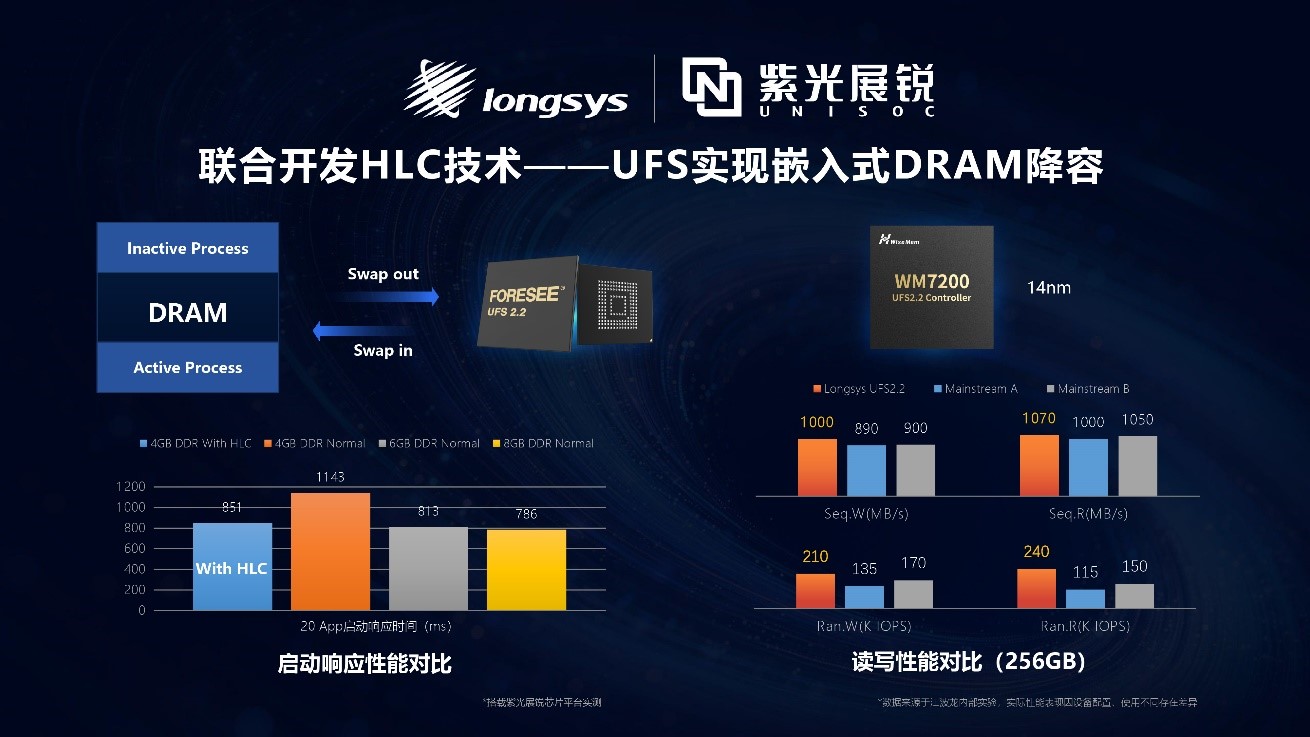
Notably, as edge-side AI accelerates, Longsys has launched an SPU (Storage Processing Unit) and integrated its proprietary HLC (High-Level Cache) technology with SPU and UFS. In embedded applications, a partnership with Unisoc showed that 4GB of DDR paired with HLC technology achieved an app launch time of just 851ms across 20 apps—comparable to standard 6GB or 8GB DDR configurations. Additionally, Longsys' UFS 2.2, featuring the 14nm WM7200 controller, outperforms mainstream rivals in read/write speeds. This maintains performance while reducing DRAM capacity needs and optimizing BOM costs. Future automotive-grade UFS products may adopt the WM7000 series, potentially enabling capacity reductions for automotive-grade LPDDR.
On the ecosystem front, Longsys is connecting major automakers like FAW, Dongfeng, NIO, and Xiaomi with chipmakers like Unisoc, as well as upstream fabs and Tier 1 suppliers. This promotes deep integration between automotive SoCs and memory, fostering value co-creation. By acting as a bridge with its end-to-end capabilities, Longsys is facilitating the merger of the local memory and automotive sectors to build a secure, self-reliant supply chain.
Conclusion
The structural gap in automotive memory stems from a fierce battle for capacity between the AI and automotive sectors. Plugging it requires upstream fabs and downstream automakers to align their supply chains and establish long-term cooperation, while local firms must master core technologies like packaging and controllers. Longsys' approach—combining full-chain tech R&D with business model innovation—offers a viable path out of the impasse.
As the industry dives deeper into AI and high-level autonomous driving, memory demands will become more complex and stringent. Building a self-reliant, secure supply chain is about more than one company's competitiveness; it will determine whether the smart car industry can navigate this transformation successfully. The final answer lies in continued collaboration across the entire supply chain.


