



Gasgoo Munich- On March 5, Jin Yuzhi, CEO of Huawei's Intelligent Automotive Solution BU, took to social media to break down the technical details of the "new-generation dual-optical-path image-grade LiDAR" unveiled just a day prior. Boasting 896 lines, it stands as the highest-spec mass-produced LiDAR globally, signaling a shift in vehicle perception from the "3D point cloud era" to the "3D imaging era."
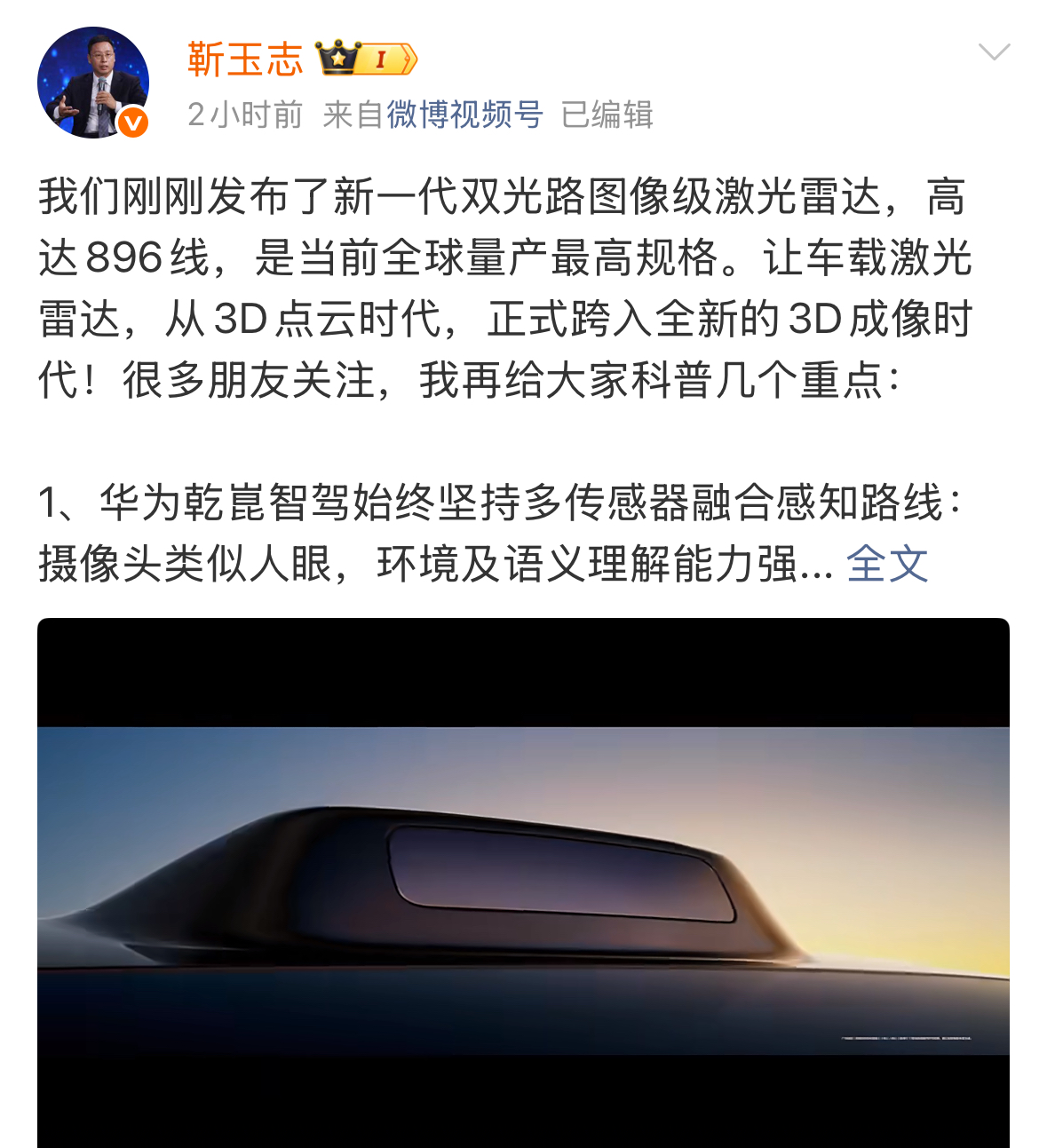
Image Source: @Jin Yuzhi
According to Jin, Huawei Qiankun Intelligent Driving remains committed to a multi-sensor fusion approach, where cameras, millimeter-wave radars, and LiDARs complement each other for full-scenario coverage. The latest LiDAR employs a proprietary "dual-optical-path" technology—a first in the industry—integrating both wide-angle and telephoto laser receiving units. This setup achieves "dual-focus in one body": the wide-angle unit takes in the broad view, while the telephoto unit locks onto distant details, delivering a high-definition "picture-in-picture" effect. The result is a fourfold increase in resolution.
On core performance metrics, the LiDAR breaks through typical industry bottlenecks. It can stably detect small obstacles just 14 centimeters tall from 120 meters away—think rocks or cardboard boxes on the road. Detection range for low-reflectivity obstacles at night, such as fallen black tires or pedestrians in dark clothing, has jumped by 190%. For irregular obstacles like fallen traffic cones, range has improved by 77%. Furthermore, the radar features an industry-first tempered glass window design, boosting hardness by 25% and doubling durability.
Jin confirmed that the new LiDAR will make its debut on the Maextro S800 and the AITO M9 flagship edition, with more flagship models partnering with Huawei Qiankun to be announced soon. He emphasized that "safety is the first principle of Huawei Qiankun Intelligent Driving; all technological innovation is aimed at making the user experience safer." To date, Huawei Qiankun Intelligent Driving has accumulated over 8.76 billion kilometers of assisted driving, averting more than 3.54 million potential collisions.


