



Gasgoo Munich-March 31 marked a milestone for China's intelligent connected vehicle industry.
Gasgoo has learned that Changan Automobile has officially secured an L4-level Robotaxi testing license. Approved unanimously by six departments in the Yongchuan policy pilot zone of Chongqing, the automaker now holds full compliance for unmanned driving tests across all scenarios.
The license stands out for two key phrases: "full compliance," signaling it passed the strictest joint review in the pilot zone, and "full scenarios," pointing to the ability to operate without safety drivers within designated areas.
In the spring of 2026, as L3 autonomous driving only just enters pilot access and the industry debates whether to skip L3 entirely, Changan offered its answer with this L4 license: not a leapfrog, but a parallel path.
Scaling Autonomous Driving to Mass Production
The L4 Robotaxi isn't a standalone prototype. It runs on the core Tianshu end-to-end large model, sharing the same technological roots and highly reusable underlying algorithms as its mass-produced L2 and L3 models.
This means Changan's high-level autonomous driving isn't confined to lab vehicles. It already possesses the capability to migrate from driver assistance to highly autonomous driving at scale.
In 2025, Changan Automobile officially unveiled its self-developed "Tianshu Intelligent Driving," an end-to-end interactive navigation assistant. The system integrates core technologies across driving, cockpit, and chassis—including end-to-end navigation, multimodal AI models, distributed electric drive, and wire-controlled chassis. It achieves four-wheel independent control, slashing drive and brake response times to 10ms, cutting hydroplaning risks by 76%, and correcting trajectories within 0.1 seconds during a tire blowout.
Changan plans to further sharpen perception. By the third quarter of next year (2026), the company expects to boost the precision of its self-developed satellite-architecture LiDAR to over 200 lines and triple computing power—all while cutting costs by 30% compared to peers. Fully matched with the Tianshu end-to-end model, these upgrades aim to significantly improve recognition in extreme scenarios like night driving, car-following, and traffic jams.
But what truly gives this L4 license its weight is the testing ground: Chongqing.
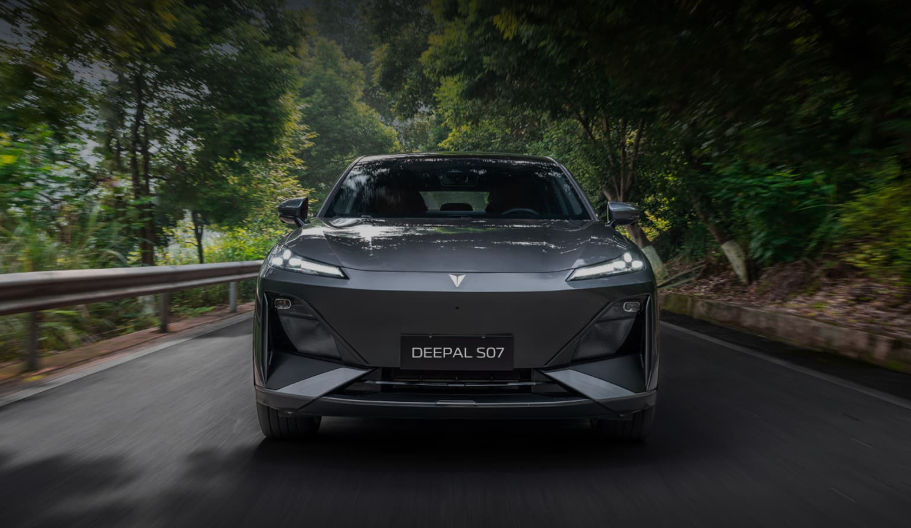
Image Source: Changan Automobile
Known for its "8D magic" road conditions, the city is a labyrinth of stacked overpasses, complex tunnels, and steep, sharp turns. Coupled with frequent fog, it is widely regarded as the industry's "ultimate exam" for autonomous driving.
Such rigorous testing creates a unique "terrain barrier" for Changan's L4 solution in terms of reliability. If it can navigate Chongqing, it can adapt anywhere else.
From L3 to L4: Balancing Tech Rhythm and Industry Landscape
Securing the L4 license is no isolated event; it is the latest move in Changan's high-level autonomous strategy.
Just last December 20, Changan obtained the country's first dedicated L3 autonomous license plate, "Yu AD0001Z." It took the automaker only three months to bridge the gap from "compliant road access" with L3 to "unmanned driving" tests with L4.
This dual-track pace reflects a deep divergence in current industry roadmaps.
From late 2025 to early 2026, L3 pilot models from Changan and BAIC's Arcfox gained MIIT access to start road trials on designated routes. Meanwhile, "leapfroggers" are calling for skipping L3 entirely, aiming straight for L4 full-scenario autonomy.
Beneath the surface clash of routes lies a rational calculation at the commercialization tipping point. L3 resolves liability and insurance issues for human-machine co-driving, paving the regulatory road. L4 targets the ultimate removal of safety drivers, vying for the commanding heights of future mobility services.
Changan's strategy looks more like a "dual-track" approach. It accumulates real-world data and user feedback through mass-market L3 models while using the Robotaxi license for forward-looking L4 validation. This avoids the risk of being trapped in the "transition phase" of a pure L3 path, or the distant commercialization horizon of a pure L4 bet.
The key lies in "technological homology." L2, L3, and L4 share a single underlying algorithm architecture. Advances in high-level capabilities feed back into the driver assistance experience of mass-produced cars, while data from those cars continuously trains the high-end models—a virtuous cycle.


