



July 2026. China's auto industry is undergoing a dramatic split between fire and ice.
On one side, memory chipmakers are delivering staggering first-half results—Shenzhen Longsys Electronics saw net profit surge more than 740-fold, while GigaDevice's quarterly earnings topped three times its total for the previous year. On the flip side, automakers like SERES, GAC, and JAC have issued profit warnings. SERES didn't mince words in its performance report, citing "a sharp rise in memory chip prices pushing up production costs" as a primary driver of its losses.
This tidal wave of price hikes is reshaping the destiny of two entirely different supply chains.
The AI Era Ignites a "Super Fuse" for Memory Chips
The root cause of this surge is a "thirst for computing power" triggered by artificial intelligence.
A top-tier AI training server packs over 100GB of high-bandwidth memory (HBM)—dozens of times the DRAM used in a standard server. As CCTV Business has reported, Samsung, SK Hynix, and Micron have shifted 70% to 80% of their advanced process capacity to HBM and premium server DDR5 memory to meet explosive demand. General-purpose DRAM and NAND capacity has been systematically squeezed, and this supply-demand mismatch ignited the price spike.

In this battle for capacity, the automotive industry—claiming only about 3% of the global DRAM market—has been pushed to the back of the line. As AI server orders swallow up every bit of advanced capacity like a black hole, automotive buyers are struggling to secure sufficient quotas, even at premium prices.
Just last week, Micron Technology announced it was raising investment in its new U.S. plant to $250 billion. Simultaneously, Ford and GM revealed supply agreements with Micron to lock in stable sources of memory and storage chips.
Surging demand is only half the story. A report from Sinolink Securities notes that a single AI server carries 8 to 10 times the DRAM of a traditional server and 3 times the NAND flash. This structural shift has moved the memory chip industry from a simple "inventory cycle" to a "long-term boom driven by AI infrastructure."
In the second quarter of 2026, contract prices for traditional DRAM rose roughly 58% to 63% quarter-over-quarter, while NAND Flash contract prices jumped 70% to 75%. A July report from UBS shows global memory chip sales hit a record $74.6 billion in June, up 31.7% from May. UBS forecasts full-year industry revenue of $992 billion in 2026, nearly doubling to $1.76 trillion by 2027.
Zheng Yali, deputy secretary-general of the Society of Automotive Engineers of China, offers this analysis: "The structural shortage in automotive memory isn't a traditional cyclical fluctuation. It's a cross-sector capacity battle sparked by the explosion in AI computing and the rapid rise of smart vehicle penetration, creating a deep mismatch in the supply-demand system."
She stresses that while this creates short-term headaches, it also opens a rare strategic window for domestic memory chipmakers.
A Profit Carnival for Memory Chipmakers
If 2025 was the year of recovery for the memory industry, then the first half of 2026 is the year of collective fortune.
Consider the listed players first. Longsys (301308.SZ) led the charge on July 3 with its half-year forecast, projecting net profit of 9.2 billion to 11 billion yuan—a staggering 62,204.03% to 74,393.95% jump, the fastest among A-share companies reporting so far. A year earlier, that figure was just 147.663 million yuan. By the first quarter, its gross margin had hit 55.53%, with a net margin of 40.16%.

Image Source: Longsys
GigaDevice (603986.SH) followed closely, forecasting revenue of about 11.5 billion yuan, up 177%, and net profit of roughly 6.9 billion yuan, a 1,099% increase. Its second-quarter net profit of about 5.439 billion yuan is triple the 1.648 billion yuan earned in all of 2025. Its stock has soared, climbing 186.65% since the start of 2026.
Shannon Core (300475.SZ) expects first-half net profit of 3.5 billion to 4 billion yuan, a surge of 2,118% to 2,434%. Second-quarter profit is estimated at 2.173 billion to 2.673 billion yuan, representing quarter-over-quarter growth of 63% to 101%.
All three memory companies posted lower-limit profit growth exceeding tenfold. The memory supply chain has become the brightest-performing niche in this round of interim reports.
Those racing toward IPOs are posting similarly explosive numbers. Domestic DRAM leader CXMT filed its STAR Market prospectus on July 9, setting subscription for July 16 and aiming to raise 29.5 billion yuan—the year's largest A-share IPO. The filing shows first-quarter revenue of 50.8 billion yuan, up 719%, and net profit of 24.762 billion yuan, a 1,688% jump. It expects full-half revenue of 110 billion to 120 billion yuan, with net profit between 50 billion and 57 billion yuan.
In Hong Kong, Hongxinyu resubmitted its listing application on July 7. For the first four months of 2026, revenue hit 8.012 billion yuan with profit of 3.841 billion yuan—a 3,020.8% surge from 123 million yuan a year earlier. The prospectus attributes the boom to "rising market prices for memory products and economies of scale." The average price per GB of its DRAM products skyrocketed from 12.24 yuan in the first four months of 2025 to 34.98 yuan in the same period of 2026—an increase of 1.86 times.
Xintianxia filed its HKEX prospectus on July 10, with gross margins leaping from 22.8% in 2025 to 55.6% in the first quarter of 2026. Unigroup Guoxin has submitted a prospectus to the Beijing Stock Exchange, forecasting first-half net profit of 616 million to 681 million yuan.
Memory chipmakers are "printing money" at unprecedented speed. But the flip side of that coin is the cost pain being absorbed by the auto industry.
Profits Sucked Out of the Auto Industry
While memory chip executives celebrate record profits in boardrooms, the mood in the auto industry is far less festive.
On the evening of July 12, SERES released a profit warning, projecting a first-half net loss of 1.5 billion to 1.8 billion yuan—a swing from profit to loss year-over-year. Its core subsidiary, AITO, is expected to post a net loss of 1.05 billion to 1.3 billion yuan. This is a sharp reversal from the first quarter, when SERES still reported a net profit of 754 million yuan. The speed of deterioration in the second quarter is shocking.
SERES explicitly attributes the loss to "rising production costs driven by higher prices for key raw materials like memory chips, industrial metals, and lithium carbonate." SERES Group Chairman Zhang Xinghai previously broke down the math at a forum in Chongqing: The unit price of a memory chip jumped from 20 yuan to nearly 100 yuan—a fivefold increase—while lithium carbonate climbed from 80,000 yuan per ton a year ago to 180,000 yuan.
Industry estimates suggest the average cost per AITO vehicle has risen by 15,000 to 20,000 yuan. For automakers already facing margin pressure, that cost must either be absorbed—eroding profits—or passed on to consumers. In a market overheated by a price war, the latter is nearly impossible.
The ripple effect of these hikes is visible at the retail level: BYD raised the price of its intelligent driving option package for several Dynasty and Ocean network models from 9,900 yuan to 12,000 yuan—a hike of over 21%. XPENG increased the price of its XNGP advanced driver-assistance package by 20%, and the high-trim version of the Exeed ET5 converted a previously free intelligent driving package worth 28,800 yuan into a paid add-on.
SERES is not alone. GAC Group forecasts a first-half net loss of 4.06 billion to 4.57 billion yuan, while JAC Motor expects a loss of about 740 million yuan. Intensifying competition and rising raw material costs are the common culprits behind these declines.
NIO's first-quarter 2026 earnings call offered a concrete example. Founder William Li revealed that rising raw material costs have increased pressure on the average cost per vehicle by over 10,000 yuan. NIO Vice President Ma Lin was blunt: "We lost money spending 300 million yuan on Nvidia chips; self-research is the only way to save." That remark captures the real anxiety automakers feel as core chip costs spiral out of control—better to own the technology than to be held hostage by upstream suppliers. Yet the barrier to entry for self-developed chips is high, making it an out-of-reach option for most automakers.
Looking at the broader industry, Cui Dongshu, secretary-general of the China Passenger Car Association (CPCA), points out that auto industry revenue from January to May grew just 1.4% year-on-year, while costs rose 2.3%—outpacing revenue and driving profits down 20%. The industry's sales profit margin has slipped to 3.4%, far below the 6.1% average for downstream industries. National Bureau of Statistics data shows that while profits for industrial enterprises above a designated size grew 18.8% over the same period, auto manufacturing profits fell 19.8%.

Image Source: Cui Dongshu
Adding to the anxiety is the inability to pass these costs on effectively. The first half of 2026 saw a flood of new product launches in China, but demand remained sluggish. Data from the China Association of Automobile Manufacturers (CAAM) shows domestic sales of 9.921 million vehicles in the first half, a 21.1% year-on-year drop. Most automakers have been forced to sacrifice price for volume, trapped in a dilemma of "selling more but earning less."
Against this backdrop, Li Peizhi, R&D vice president of Harman China's Smart Cockpit Division, told Gasgoo Auto that restructuring vehicle E/E architecture is urgent. Under traditional distributed architectures, the cockpit and ADAS systems use independent DRAM, leading to data duplication and redundant processing. Cockpit-ADAS fusion, however, uses a single SoC and shared memory to enable data reuse, boosting storage efficiency and reducing DRAM consumption at the source.
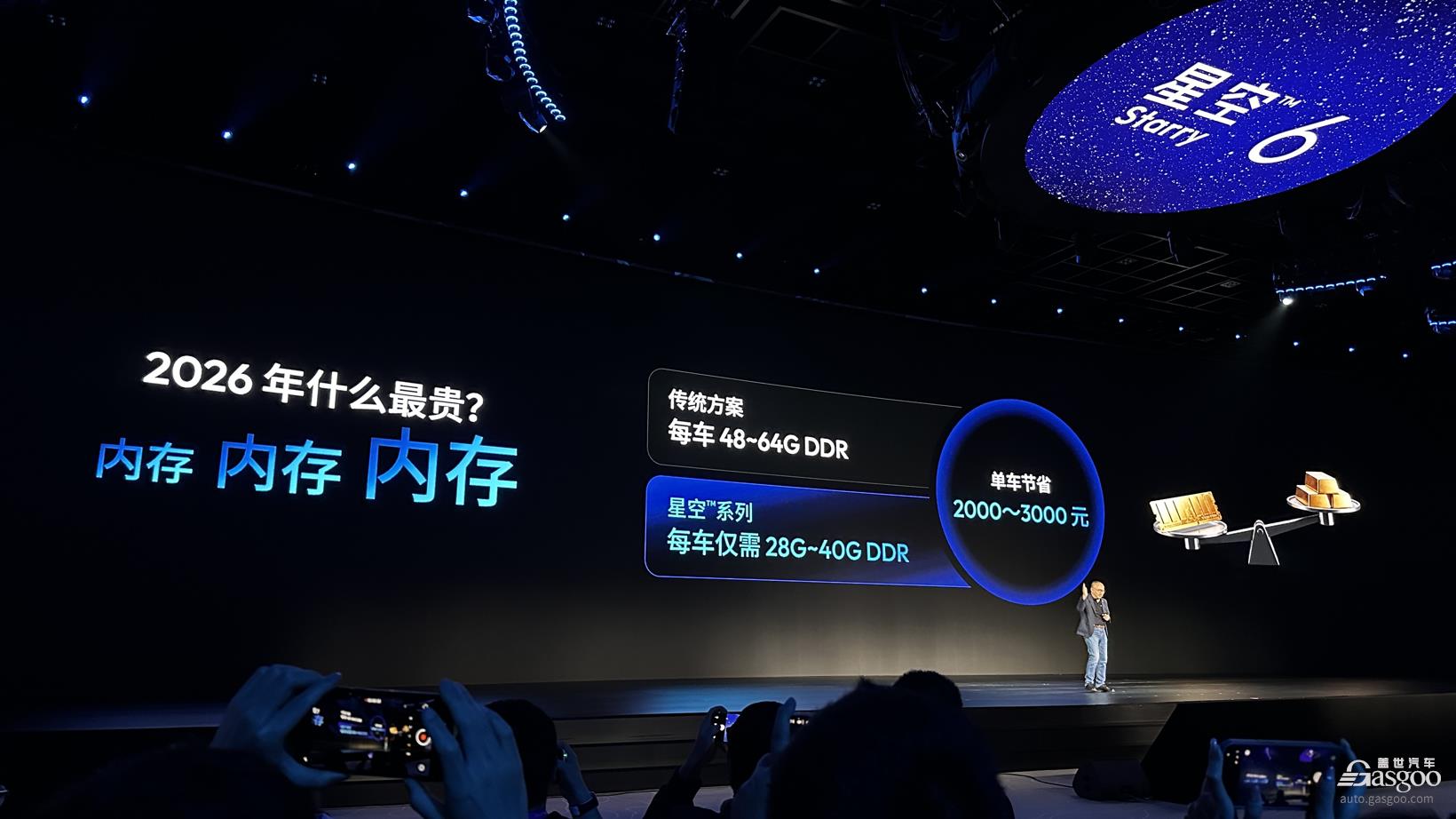
This approach is gaining traction. Beyond Zhuoyu, which has already achieved mass production of its cockpit-ADAS fusion solution in the Arcfox Alpha T5, Alpha S5, and WenDao V9, Horizon Robotics released China's first "Starry" series chip for integrated cockpit and driving in April. It simplifies two memory systems into one via a unified architecture. Founder Yu Kai has done the math: given the sustained rise in automotive-grade memory prices, memory optimization alone can save 2,000 to 3,000 yuan per vehicle.
Additionally, Black Sesame Intelligent announced a platform-level partnership with Dongfeng Motor, with its Wudang C1296 chip slated for mass production between 2026 and 2027. BYD, meanwhile, unveiled its self-developed 4nm intelligent driving chip, the "Xuanji A3," in May.
The rise in memory chip prices is essentially a transfer of wealth from the income statements of terminal manufacturers to those of upstream semiconductor firms. For automakers mired in cost challenges, cockpit-ADAS fusion is not just a technological choice—it is one of the few strategic paths available to "cut costs at the source" as rising memory prices continue to erode profits.
When Will the Price Hikes End?
After rising for so long and by so much, is there an end in sight for memory chip prices?
The bad news is that industry insiders believe prices are far from peaking. Recently, as memory module maker ADATA released its performance report, Chairman Chen Libai stated that memory and flash prices will see another significant hike in the third quarter of 2026. Memory manufacturers have already notified customers that DRAM contract prices will rise 20% to 30%, while NAND Flash will increase 35% to 40%.
UBS went even further in its July report, sharply raising price expectations: it now forecasts a 32% increase for DRAM in the third quarter (up from 17%) and a 30% hike for NAND. UBS estimates that the supply-demand imbalance in the DRAM industry will persist at least through the first half of 2028.
A latest report from TrendForce expects the overall DRAM landscape to remain extremely tight in the third quarter of 2026. However, due to downward revisions in consumer demand and a high price base, contract price growth will converge to a quarterly increase of 13% to 18%. NAND Flash contract prices are expected to rise 10% to 15%. Prices are still climbing, but the acceleration is slowing.

Image Source: Huaban.com
Even more noteworthy is the subtle shift in market sentiment. On June 25, Apple announced price hikes across its Mac, iPad, and smart home device lines, with some models jumping by as much as 3,500 yuan. That same day, Samsung, SK Hynix, and Micron faced a class-action lawsuit in the U.S., accused of colluding to restrict traditional DRAM capacity and driving memory prices up roughly 700% over the past four years. Almost simultaneously, the South Korean government announced an investment of 800 trillion won to build four new wafer fabs, aiming to double DRAM capacity within five years.
Price hikes, litigation, and expansion—three signals appearing at once. The semiconductor index plunged 7.9% last week, its steepest single-week drop since April 2025. The market is re-evaluating the limits of this super-cycle.
Yet, just as anxiety about a turning point spreads, a new variable is surfacing: humanoid robots. On June 24 local time, Micron Technology Chairman and CEO Sanjay Mehrotra stated bluntly during the fiscal third-quarter earnings call: The storage capacity of a humanoid robot is roughly ten times that of an L2+ autonomous vehicle.
He positions humanoid robots as the next core growth engine for the storage industry. In his view, the five-year cycle around 2030 will mark the beginning of mass deployment for humanoid robots, driving incremental demand for memory and flash for decades to come. "We anticipate that a sustainable, massive, multi-decade cycle of memory demand will officially kick off between 2026 and 2030."
Internal research from Micron shows that L2+ autonomous vehicles carry about 16GB of DRAM, while those with L4 capabilities require over 300GB. Micron believes the perception, planning, and control chains of humanoid robots demand storage bandwidth and capacity at the same technical tier as high-level autonomous driving systems—multiplied by ten.
From an industrial logic perspective, the end of the memory price hike depends on three variables: the sustainability of AI capital spending, the pace of capacity expansion by manufacturers, and the limit of downstream endurance. Micron's assessment of "tenfold storage demand from humanoid robots" adds a fourth variable to the equation.
In other words, if humanoid robots truly achieve mass deployment around 2030, the growth curve for storage demand will be significantly extended, potentially washing out the expected inflection point in 2027–2028 with a new wave of demand.
For the auto industry, there is no light at the end of this cost-pressure tunnel in the short term. The "chronic condition" described by Zheng Yali means automakers must prepare to coexist with high-cost chips for the long haul, rather than waiting for the cycle to naturally correct itself.
Closing Remarks
For the automotive industry, this pain may serve as a profound warning: amidst the wave of intelligence, the security of supply chains for core components and the ability to control costs will become strategic issues determining survival or extinction.
As Zheng Yali suggests, automakers' response strategies must shift from "emergency relief" to a systematic reconstruction of long-term capabilities, collaborating deeply with chip companies on demand definition, co-design, and supply chain mechanisms. For memory chipmakers, the true long-term test will be how they use technical strength and product innovation to hold the profit "water line" once the super-cycle recedes.
The end of price hikes may not arrive in 2026, but the starting point for a return to rationality may not be far off.


