



Gasgoo Munich- As the original founder makes a quiet exit, seven industry veterans are stepping into their roles on the very same day.
On March 6, MagicLab buried a low-key announcement beneath a flurry of executive appointments: Wu Changzheng, its founder and CEO, has confirmed his departure.
According to the official statement, these appointments span every critical function—from R&D and data architecture to core hardware and global commercialization. The goal: to navigate the embodied intelligence sector's pivot toward mass deployment.
Founded in January 2024, MagicLab specializes in embodied intelligence and the R&D, production, and industrial application of general-purpose humanoid robots. Committed to full-stack in-house development, the company has achieved a self-sufficiency rate of over 90% for core hardware components like joint modules and dexterous hands. Its product lineup now features the full-size MagicBot Gen1, the highly dynamic MagicBot Z1, and a series of quadruped robots.
The company revealed earlier that by 2025, all its products had entered small-scale mass production and delivery. Building on that, MagicLab aims to boost shipments to the thousands in 2026.
At the same time, MagicLab is pushing toward an IPO, with key capital market developments expected this year. Consequently, industry insiders view this sweeping management overhaul as a critical step in that sprint.
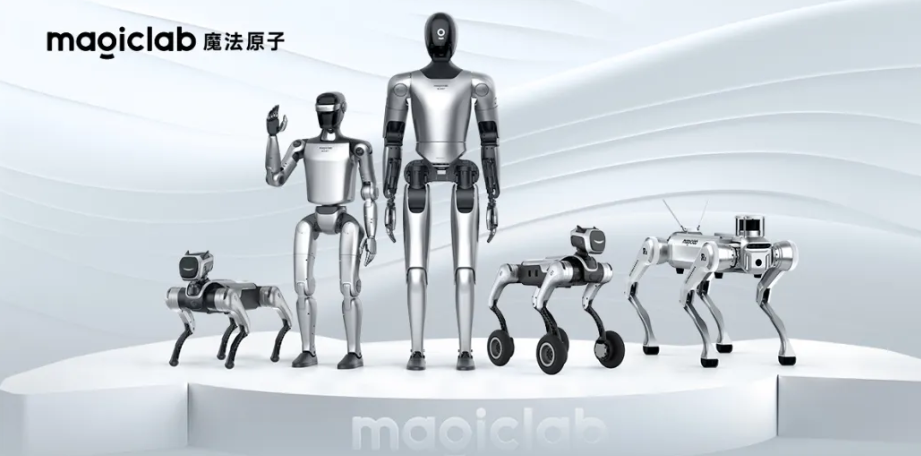
Image source: MagicLab
From the Spring Festival Gala to MWC: MagicLab's Spotlight Moments
From the Spring Festival Gala stage to the MWC exhibition halls, MagicLab has made two high-profile public appearances in the past month—showcasing two distinct sides of its technical prowess.
Mobile World Congress (MWC) Barcelona 2026 recently kicked off with a grand opening. During the event, MagicLab displayed its full-size general humanoid robot GEN1, the high-dynamic bipedal MagicBot Z1, and the MagicDog series for consumer and industrial use. The presence sent a clear signal: the company is accelerating its globalization strategy and vying for dominance in the global robotics sector.
Just prior to that, MagicLab made a high-profile appearance at the 2026 CCTV Spring Festival Gala.
At the main venue, six MagicBot Z1 units and two MagicBot Gen1 robots performed alongside artists in a segment titled "Smart Manufacturing Future." Meanwhile, at a sub-venue, the Z1 pulled off a series of high-difficulty stunts, including Thomas flares and 360-degree corkscrew kicks.
At the Yibin sub-venue, over a hundred quadruped MagicDog robots—dressed in "panda suits"—took to the stage in unison, marking one of the largest coordinated swarm displays of quadrupeds on a public stage.

Image source: MagicLab
Even more noteworthy, MagicLab brought real-world service scenarios to the Gala stage for the first time. The MagicBot Gen1 transformed into a "cyber noodle chef," precisely scooping Yibin's famous spicy noodles into bowls. It then demonstrated a "wine pouring" stunt—filling a glass without spilling a single drop.
For MagicLab, these spotlight moments served as a critical technical parade.
As a nationally televised event with massive viewership, the Gala demands extreme levels of equipment stability, motion control precision, swarm scheduling capability, and real-world task execution.
That MagicLab's robots could execute such complex maneuvers on a high-exposure stage is not only a comprehensive test of their technical strength but also proof that these products have the potential to move from the lab into real-world applications.
Yet, it must be noted that landing a spot on the Gala stage is merely an admission ticket to the real world—not a graduation certificate.
For humanoid robots, the real test lies in generalization across real-world scenarios, task success rates, and hardware stability—areas where the industry currently lacks public verification data.
During this year's "Two Sessions," He Xiaopeng, a National People's Congress deputy and chairman of XPENG, noted that most humanoid robots in China rely on software-based control and demonstrate strong motion control capabilities. However, he argued that the industry has yet to establish an advantage in "brain" functions like autonomous thinking and decision-making, the coordination between the "brain" and "cerebellum" for motion control, and the ability to generalize tasks across multiple scenarios for commercial viability.
Viewed through this lens, MagicLab's new management team directly addresses these industry-recognized bottlenecks: the brain, data, hardware, and market expansion. Zhang Tao bolsters algorithms; Wu Zhengfang builds the data feedback loop; Gao Chunchao strengthens hardware engineering; and Tan Yongzhou and Yang Ke spearhead domestic and overseas markets, respectively.
The logic behind MagicLab's moves is easy to guess: before sprinting toward an IPO, the company is first "upgrading" the full puzzle—from technical R&D to commercial execution.
Ultimately, whether MagicLab can generate true synergy depends on more than just stacking talent. The key will be whether the data loop effectively feeds algorithm iteration, whether hardware optimization keeps pace with algorithmic demands, and whether market expansion moves in sync with technical progress.
The Other Side of the Shuffle: Eyeing an IPO?
Behind this executive shuffle lies another noteworthy move: the sprint for an IPO.
Earlier this year, MagicLab co-founder Gu Shitao revealed that the company is accelerating its listing process on the fastest possible timeline, with news expected in the secondary market by 2026.
So, what is MagicLab's leverage just two years after its founding?
A crucial factor is undoubtedly the dual "endorsement" of capital and industry.
Although MagicLab has only publicly disclosed two funding rounds since its inception, its investor list holds telling details. Empyrean Venture and Kington Capital have both participated twice, while other backers include UNT Capital, Meridian Capital, and Oriza Holdings. Together, they form an investment network rich in both industrial resources and financial firepower.
Of particular note is Empyrean Venture. As the corporate venture capital arm of Dreame Technology, its repeated backing has provided MagicLab with not just funding, but also rich opportunities for scenario synergy.
As early as 2024, MagicLab's humanoid robot "Xiao Mai" was already handling tasks like loading, quality inspection, transport, and boxing at Dreame's factories. This made MagicLab one of the first teams in China to verify multi-robot collaboration technology in a real-world setting.
Second is its proven ability to commercialize.
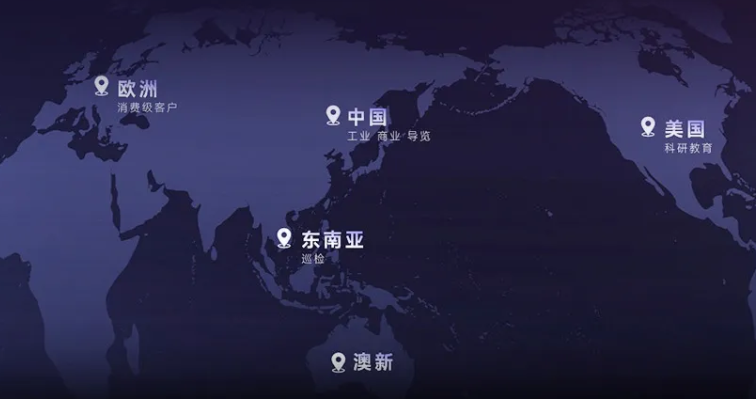
Image source: MagicLab
According to data previously disclosed by MagicLab, sales began in May 2025. Within six months, the company secured 500 million yuan in intended contracts and 130 million yuan in signed orders. Notably, overseas business has steadily risen to account for over 30% of revenue, peaking above 60% in a single month. The company now covers 27 countries, including localized networks in Japan, South Korea, North America, and the Middle East.
In terms of deployment, MagicLab's robots have entered industrial production lines and commercial service settings. Through its "unmanned store" solutions, the company is also expanding into diverse consumer sectors like coffee and catering.
Building on this, MagicLab plans to cover 1,000 cities and roll out 10,000 stores over the next one to two years. This pace of expansion is clearly preparation for large-scale replication following a public listing.
Furthermore, the immense market potential of embodied robotics provides external support for MagicLab's IPO ambitions.
After embodied intelligence was included in the government work report for the first time in 2025, the state has now explicitly identified it as a future industry requiring cultivation. The government emphasized establishing a growth mechanism for future industry investment and encouraged state-owned enterprises to lead the way in opening application scenarios.
According to the latest forecasts from IDC, the global intelligent robotics hardware market will approach $30 billion in 2026. China is poised to lead this growth, becoming the dominant force in the sector's expansion. By then, the market for embodied intelligent robots in China is projected to exceed $11 billion, with Chinese vendors accounting for over 85% of global shipments of service and consumer robots.
For MagicLab, sprinting toward an IPO at this moment means riding the wave of industry momentum.
Yet, beneath these multiple positives, concerns linger.
Wu Changzheng's departure remains a topic that cannot be ignored. While MagicLab has denied claims of a "divergence in development philosophy," questions persist about potential differences in strategy between the founding team and investors. When a high-profile startup shifts from being "product-driven" to "capital-driven," is the founder's exit inevitable?
Additionally, it will take time to test whether the seven newly appointed industry veterans can quickly build team cohesion and sustain long-term combat effectiveness.
A deeper question remains: What is the narrative after the listing? Capital markets often chase short-term growth, whereas the robotics industry demands deep, long-term technical cultivation. Balancing that contradiction will be crucial.
For MagicLab, the assembly of this new team is merely the end of the deployment phase; the real battle is just beginning. After all, in the embodied intelligence race, the ultimate test of quality is never the spotlight or even the IPO—it is every point of contact in the real world, whether on factory floors, in commercial settings, or within homes.


