



Gasgoo Munich-The race in intelligent driving is shifting from a pure technology showdown to a comprehensive test of commercial viability and technical adaptability.
On March 31, 2026, Shenzhen MINIEYE Technology Co., Ltd. (MINIEYE, stock code: 2431) unveiled its first full-year earnings report since going public. Driven by a mission to "improve road safety," the company posted 759 million yuan in total revenue for 2025 — a 16.0% year-over-year increase. Gross margins improved, climbing from 16.0% to 18.6%. Even more striking, its autonomous vehicle and operations services contributed 65 million yuan in revenue during their first commercial year.
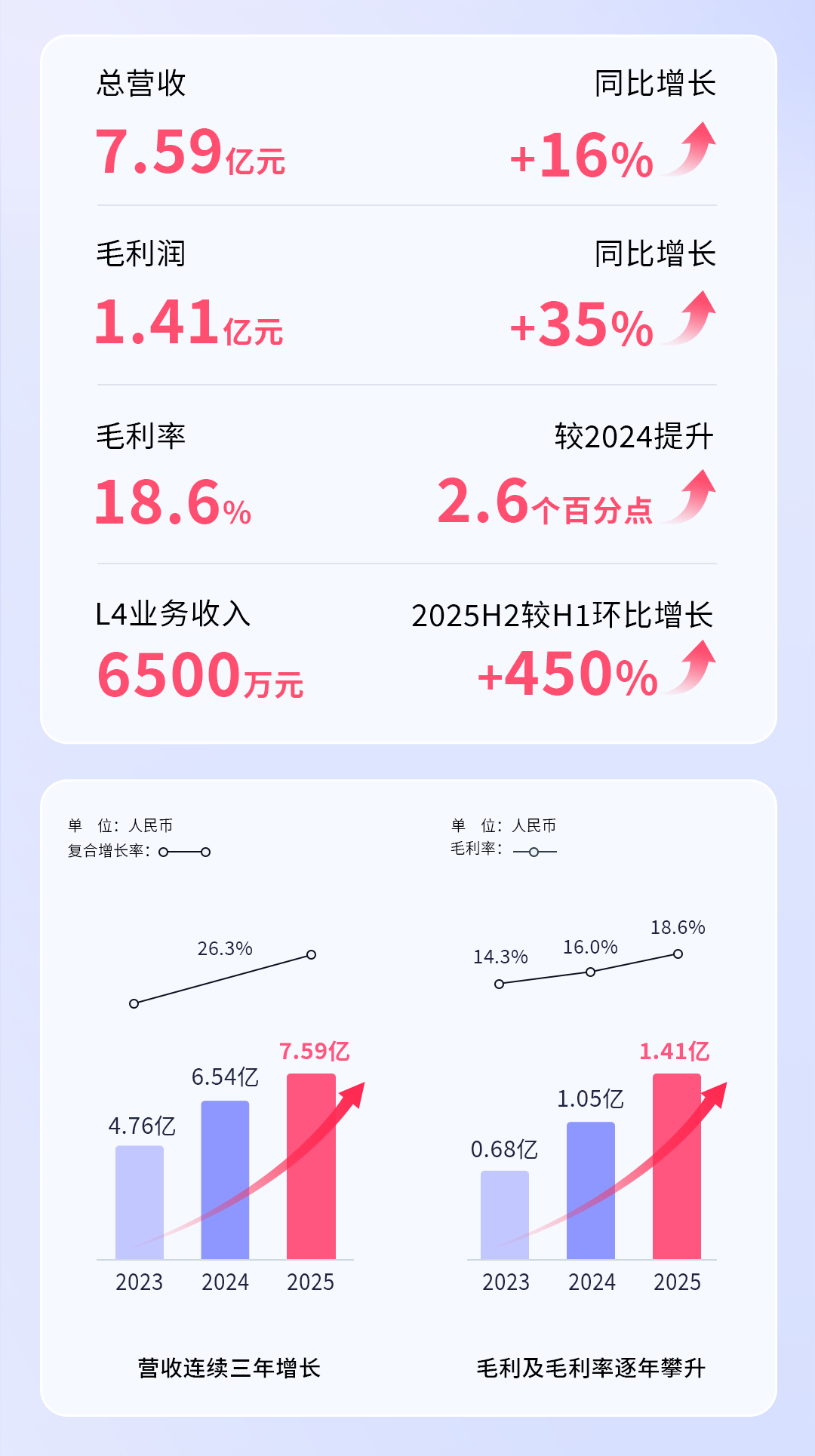
Image Credit: MINIEYE
Yet the other side of the coin reveals surging costs. Research and development expenses jumped 113% to 333 million yuan, pushing the total comprehensive loss for the year to 417 million yuan. Amid a new landscape driven by "L2+ OEM mass production" and "L4 scaled operations," MINIEYE stands at a critical juncture, transitioning from a phase of heavy investment to one of scalable returns.
A Dual-Engine Strategy Takes Shape
The most pivotal shift in MINIEYE’s 2025 financial report lies in the fundamental reshaping of its business structure.
The company consolidated its intelligent driving and smart cockpit businesses into a "Smart Components & Solutions" segment, while spinning off "Autonomous Vehicles and Operations Services" as a distinct second growth curve. This "dual-drive" model remains a rarity among current intelligent driving firms.
Smart Components & Solutions remains the current revenue pillar, generating 649 million yuan for the year — accounting for 85.5% of total revenue. The smart cockpit business stood out, fueled by a regulatory push toward mandatory Driver Monitoring Systems (DMS). With domestic DMS fitment rates at just 24.6% in 2025, and mandatory regulations slated for 2027, the market potential remains largely untapped.
MINIEYE is already positioning itself to capture this upside. In 2025, it secured a program award from a joint venture brand under a globally renowned automaker, marking a critical leap in its customer structure from domestic brands to international players.
Meanwhile, its mid-to-high-end intelligent driving solution, the iPilot series, has entered a phase of volume expansion. With the mass delivery of iPilot 4 products, revenue in this segment climbed 39.0% to 120 million yuan. More significantly, MINIEYE secured back-to-back platform-level program awards from a state-backed automaker and a leading automotive giant targeting both domestic and overseas markets — with one single project’s total lifecycle order value expected to exceed 1.3 billion yuan.
This signals that MINIEYE’s mid-to-high-end driving capabilities have earned recognition from mainstream OEMs and are beginning to scale across platform-based vehicle models.
But what truly excites the market is the breakthrough of the autonomous vehicle business from zero to one. In September 2025, MINIEYE officially launched the "Xiaozhu" unmanned logistics vehicle. In just one year, the partnership scale surpassed 6,000 units, expanding to 18 cities and covering diverse scenarios such as express delivery, cold chain, agricultural wholesale, supermarkets, and hotels.
The unmanned minibus business is advancing rapidly as well. The company successively won bids for the World Internet Conference project in Tongxiang and the Ezhou Airport project in Hubei, successfully breaking into the airport sector where safety and reliability are paramount. Moving from demonstration testing to large-scale commercial operation, MINIEYE achieved a critical leap in L4 autonomous driving commercialization within a single year.
What Game Is Being Played Behind the Losses?
If the revenue structure reflects MINIEYE’s "present," then its R&D spending points to its "future."
In 2025, R&D expenditure surged from 156 million yuan in 2024 to 333 million yuan — a massive 113% year-over-year jump. This directly caused the total comprehensive loss for the year to widen to 417 million yuan, with the adjusted net loss margin dipping from -25.5% to -49.6%.
But is this money being spent where it counts?
MINIEYE repeatedly emphasizes a core logic: the technological assets accumulated from its L2+ OEM business can be efficiently migrated to L4 autonomous vehicle scenarios. This "technology reuse" spans four layers: algorithms, data, engineering, and application. Millions of kilometers of real-world driving data, end-to-end algorithm architectures, and automotive-grade hardware production systems all support the rapid iteration of unmanned logistics vehicles.
In other words, MINIEYE is not starting from scratch in the L4 sector. Instead, it is leveraging the scale of its L2+ business to provide a technical foundation for its autonomous vehicle operations. This synergy offers a unique advantage compared to pure-play L4 startups or traditional Tier 1 suppliers.
Another focal point of R&D investment is tackling urban NOA technology. MINIEYE plans to build a fully functional, highly reliable urban Navigation on Autopilot solution based on mid-range computing platforms, pushing advanced intelligent driving into mainstream price segments. If achieved, this would further expand its market share in smart components while providing richer urban scenario data for its L4 business.
Furthermore, the company is actively advancing cabin-driving integration products and its global expansion strategy. In 2025, MINIEYE secured 12 overseas program awards covering regions including the European Union, Australia, Southeast Asia, and the Middle East. Its strategic partnership with ZF has entered the mass delivery phase, while its signing with India’s Sterling Group strategically positions it to capitalize on local mandatory ADAS and DMS regulations.
In a sense, current losses are the price MINIEYE is paying to secure its position in the market landscape of the next three to five years.
Conclusion:
Looking back from the vantage point of 2026, MINIEYE has completed its evolution from a "single intelligent driving solution provider" to a dual-platform of "smart components + autonomous vehicle operations." Its business model of reusing technology across L2+ and L4 domains remains a scarcity in the industry.
For MINIEYE, 2025 was a year of "establishment" — establishing its business structure, solidifying L4 commercialization, and securing the trust of top-tier clients. In the coming year of 2026, the market will expect it to "stand firm" and take a substantive step toward profitability.
Rooted in Shenzhen with global ambitions, this technology company is carving out its own course amidst the rising tide of intelligent driving.


