Gasgoo Munich- "To be cautious, it is best not to sell all-solid-state battery vehicles in the next two years."
On March 13, 2026, at the China EV 100 Institute’s annual expert media exchange, Academician Ouyang Minggao delivered a blunt verdict that poured cold water on the red-hot race for all-solid-state batteries. With automakers scrambling to announce mass-production timelines and capital chasing the sector with fervor, the judgment from this authoritative expert stood out as jarringly contrarian, sparking deep reflection across the industry.
Leading in Patents and Capacity, Yet Hidden Risks Loom
Mention all-solid-state batteries, and Toyota—which has cultivated the technology for over a decade—often comes to mind first. Yet Ouyang Minggao made it clear at the briefing that China is advancing at a startling pace, shifting from "catching up" to "running neck-and-neck," and even taking the lead in specific areas.
"China really began pushing hard on all-solid-state batteries in 2024, and in just one year, we achieved a qualitative leap," Ouyang revealed. By 2025, newly published Chinese patents for all-solid-state batteries accounted for 44% of the global total, officially surpassing Japan to become the leader in global patent positioning.
Still, leading in patent volume does not equate to a comprehensive technological overtaking. When it comes to foundational original patents and the depth of positioning for core materials—such as sulfide electrolytes—Japanese and South Korean giants, led by Toyota, still maintain formidable barriers. This remains the critical hurdle Chinese enterprises must clear in the subsequent push for industrialization.
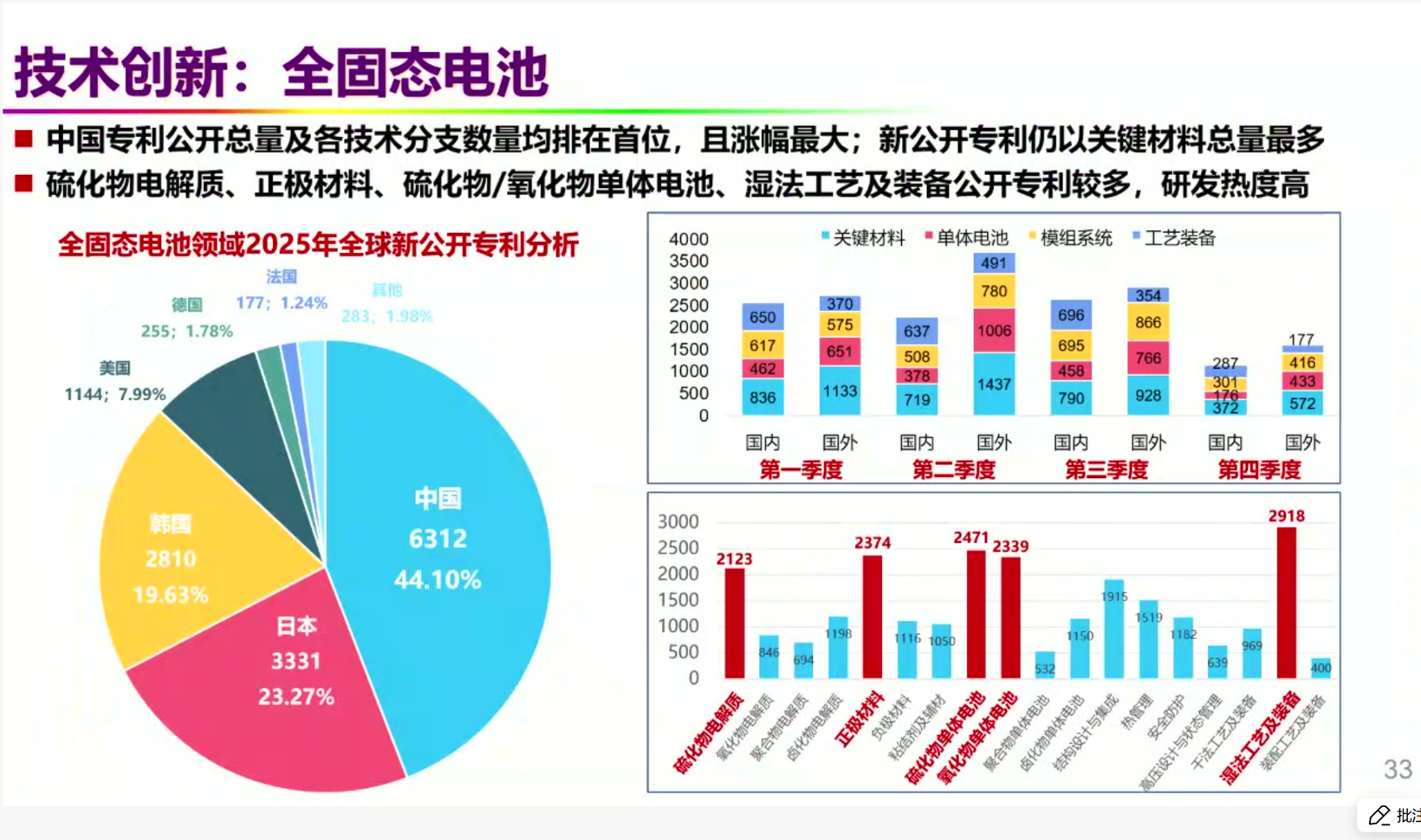
Image Source: Report by Academician Ouyang Minggao
This achievement is no accident. Data from Qichacha shows that by the end of 2025, China held 14,400 solid-state battery-related patents, with invention patents making up over 90% of the total—a testament to solid R&D strength. Ouyang acknowledges that this is backed by China’s massive battery industry foundation.
"Our battery industry output value has already reached 3 to 4 trillion yuan, supported by at least 1 million engineers and 100,000 graduate students dedicated to the field." In his view, this powerful industrial cluster and talent reserve give China the unique ability to "rally quickly on command" in all-solid-state batteries—the core reason China managed to overtake Japan in just two years.
Beyond patent leadership, China has also made breakthrough strides in production capacity and cost control for core materials. Ouyang highlighted solid sulfide electrolytes—a key component of all-solid-state batteries.
"The cost of solid sulfide electrolytes is falling faster than expected, dropping from an initial 20 million yuan per ton to less than 1 million yuan per ton today, while China’s production capacity is rapidly scaling up." This shift suggests that the industrialization of all-solid-state batteries is drawing nearer.
Yet Ouyang is not celebrating. He repeatedly emphasizes that "technology is not built overnight." Even with China leading in patents and capacity, it does not mean we have solved every technical challenge facing all-solid-state batteries.
In reality, significant challenges remain behind the falling costs of sulfide electrolytes. Industry research indicates that the key raw material, high-purity lithium sulfide, remains expensive. Furthermore, production requires anhydrous and anaerobic environments, driving up equipment investment and operating costs. This implies there is still considerable room for cost reduction in mass production.
"The progress we see now is just the tip of the iceberg. All-solid-state batteries are a revolutionary technology with an extremely high threshold, and the difficulty is far greater than we imagine." Ouyang’s words precisely capture the reality of China’s all-solid-state battery industry: beneath the halo of leading in patents and capacity lie formidable hurdles in basic science and mass-production processes that have yet to be overcome. The road from a "disruptive breakthrough" in the lab to a "reliable product" for vehicles remains long.
Revolutionary Breakthroughs Require Clearing "Multiple Hurdles"
Why does Ouyang Minggao advise against selling all-solid-state battery vehicles in the next two years? The core reason is simple: the technology is not yet mature, and many critical problems remain unsolved.
In his view, overcoming the technical hurdles of all-solid-state batteries is not about a single breakthrough; it requires a comprehensive effort across multiple dimensions—key materials, interfaces, electrodes, and cells. A weakness in any single link prevents industrialization.
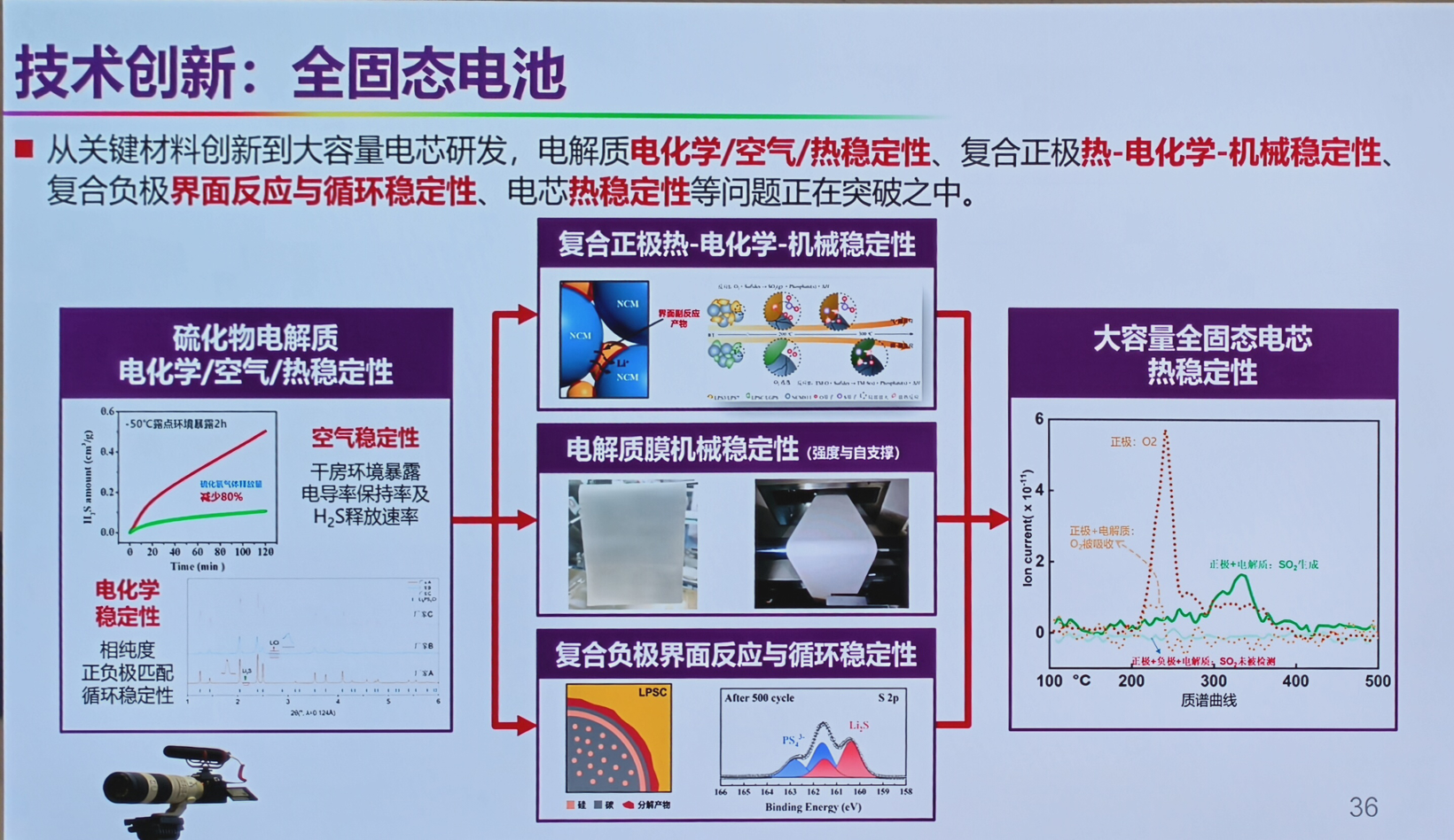
Image Source: Report by Academician Ouyang Minggao
Currently, the core technical bottlenecks for all-solid-state batteries are concentrated in four main areas—the very directions Ouyang’s team is focusing on.
The first hurdle is the stability of the electrolyte. "Electrochemical stability, air stability, thermal stability, and the mechanical stability of the electrolyte separator are all issues we are working hard to solve," Ouyang explained. The solid electrolyte is the "heart" of the all-solid-state battery, and its stability directly dictates the battery’s safety and lifespan.
More critically, sulfide solid electrolytes have intrinsic limitations. Studies show that to lower the lithium-ion migration barrier, sulfide electrolytes require heavy elements like sulfur and selenium. This results in a density over 30% higher than liquid electrolytes, potentially dragging down the battery’s gravimetric energy density. At the same time, their ionic conductivity remains lower than that of high-performance liquid electrolytes, and achieving high performance relies heavily on external high pressure—detached from actual battery operating conditions. Even more concerning, sulfide electrolytes release toxic hydrogen sulfide gas when exposed to moisture and can trigger spontaneous combustion when in contact with nickel-rich cathodes. Their safety advantages, it seems, have been vastly overstated.
The second hurdle is the stability of composite electrodes. "The thermal, electrochemical, and mechanical stability of composite cathodes, as well as the interface reactions and cycling stability of composite anodes, are difficult points that urgently need breakthroughs," Ouyang stated. The interface contact between the electrodes and the solid electrolyte is key to battery performance.
Due to significant differences in physical properties between solid electrolytes and electrode materials, interface gaps easily form, reducing ion transport efficiency. This, in turn, affects cycle life and charge-discharge performance. The compatibility issue becomes particularly acute when using high-nickel ternary cathodes with sulfide electrolytes, as it tends to trigger side reactions that compromise safety.
The third hurdle is the thermal stability of large-capacity all-solid-state cells. "No matter how good a single small cell performs, it doesn't represent the behavior of a large-capacity cell," Ouyang emphasized. Automotive applications require large-capacity cells, and managing heat in these is far more difficult than in small-format cells.
Currently, all-solid-state batteries in laboratories are mostly small coin cells, and their performance data cannot be directly transferred to automotive-grade large cells. In large cells, differences in electrode rigidity lead to uneven pressure distribution, amplifying the risk of interface failure and even triggering thermal runaway.
To tackle these challenges, Ouyang’s team has proposed a "three-generation technology roadmap" to advance all-solid-state battery development incrementally. The first generation targets 200–300 Wh/kg, focusing on establishing the technology chain with largely unchanged electrodes. The second generation targets 400 Wh/kg, focusing on high-silicon anodes. The third generation targets 500 Wh/kg, adopting the most difficult lithium metal anodes.
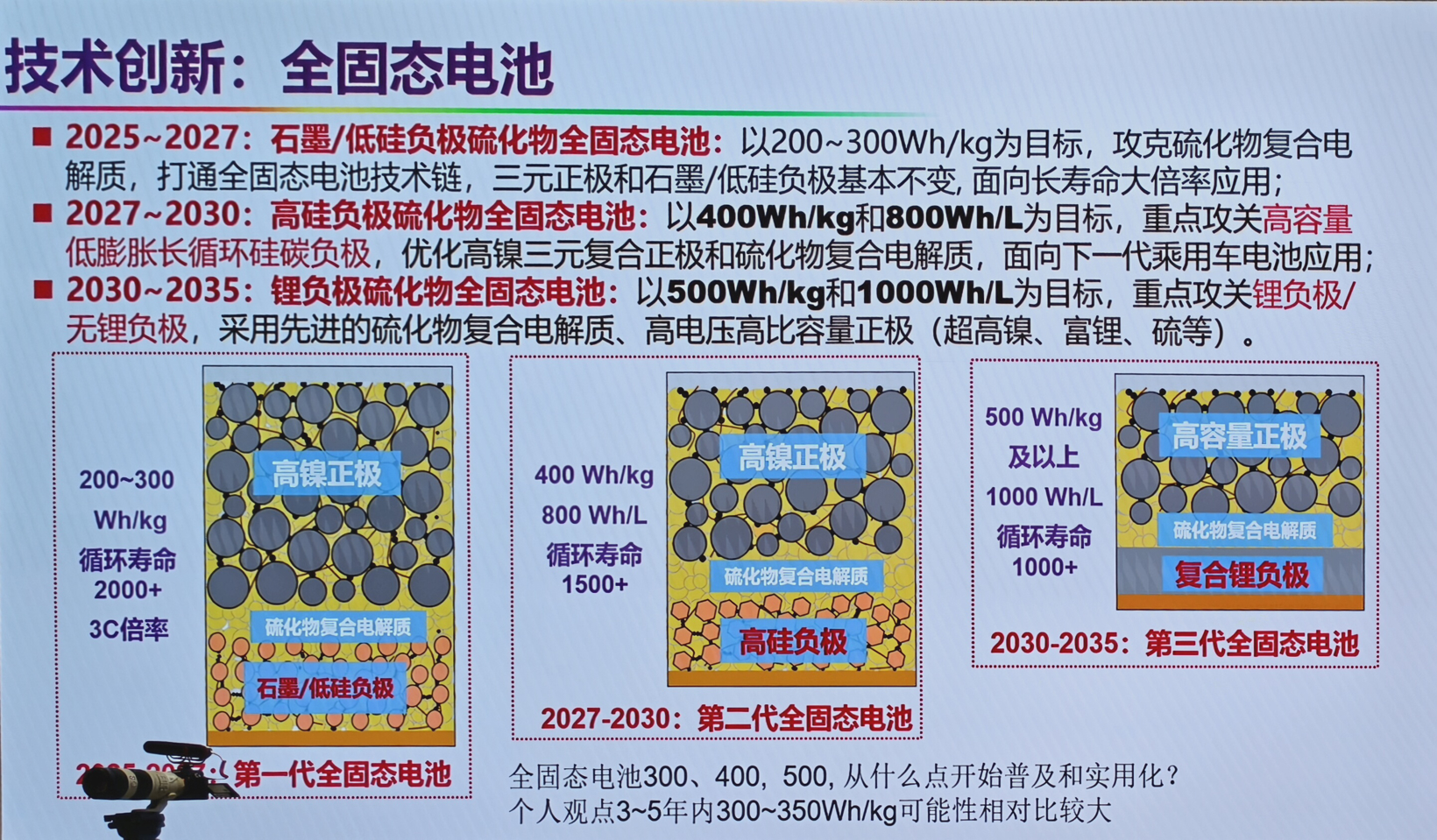
Image Source: Report by Academician Ouyang Minggao
"Lithium metal anodes are extremely difficult and require a long period of technical research." Ouyang admitted that while some models equipped with all-solid-state batteries will indeed enter the testing phase late this year or next, there is still a long distance between testing and mass production.
Take BYD’s "Global Fast Charge" technology released last year as an example: it only reached the market after deep optimization of the entire chain, including the battery system, silicon carbide chips, and thermal management. That was an iteration on the mature LFP system, yet it required such complexity and time. For all-solid-state batteries, which involve a more disruptive technology, the validation cycle will be even longer.
Regarding the timeline for widespread adoption, Ouyang offered a rational assessment: "Most likely, it will take 3 to 5 years. For initial adoption, an energy density of 300–350 Wh/kg is sufficient." He explained that higher specific energy brings greater technical difficulty and quality control challenges. Rather than seeking a "one-step solution," it is better to proceed incrementally to avoid frequent problems caused by immature technology.
Refusing to Rush Growth, LFP Remains the "Ballast Stone"
Ouyang’s warning is aimed not only at the technology itself but also at the "impetuous mentality" currently pervading the all-solid-state battery industry.
In his view, the sector currently suffers from a disconnect between "academic innovation and product implementation" and a divergence between "capital hype and industrial logic." Many mistake laboratory breakthroughs for market-ready products, while capital exploits public anticipation for new technologies to create "tech myths," pushing the industry into the trap of "pulling up seedlings to help them grow."
"Academic innovation focuses on a technology’s strengths; publish a paper, and the media hails a ‘major breakthrough.’ But products depend on a technology’s weaknesses." Ouyang pointed out incisively. A massive gap exists between academic innovation and product implementation, and the logic of capital is never the logic of industry.
He elaborated: "The logic of capital is to deify a technology while people are still confused, drawing them in. By the time people understand it, capital has already left. But industrial logic is about tangible technology implementation, long-term refinement, and optimization. It cannot be rushed."
This impetuous mindset will not only cause the "premature birth" of all-solid-state battery technology, leading to safety hazards and quality issues, but it may also lead to the neglect of a currently mature technology—lithium iron phosphate (LFP) batteries.
Asked if LFP still has a chance once solid-state batteries become widespread, Ouyang gave an emphatic yes, stating bluntly: "The LFP battery is one of the best gifts God has given us Chinese."
He believes that while LFP batteries have slightly lower specific energy, they already meet the needs of the vast majority of users. "Today’s LFP batteries can achieve a 1,000-kilometer range, are low-cost, and support 10-minute fast charging. What more is there to ask for?"
More importantly, LFP batteries offer irreplaceable advantages in stability and lifespan. In the energy storage sector, LFP is the absolute mainstay, capable of 2,000 Ah capacity, 15,000 cycles, and a 20-year lifespan—feats no other battery can currently match.
Even in the era of solid-state batteries, LFP will persist. Ouyang stated that the advent of all-solid-state batteries merely expands the "trade-off range" of battery performance; it does not break the "impossible triangle" of energy density, safety, and cost. No single battery can be optimal in all aspects simultaneously.
"We hope all-solid-state batteries can achieve the safety of LFP batteries while offering high specific energy, but we can’t do that yet." He emphasized that all-solid-state batteries are still in their infancy, with many safety issues remaining to be solved. LFP batteries, meanwhile, will serve as the long-term "ballast" of China’s battery industry, continuing to play a vital role.
Regarding industry attempts to boost LFP energy density by adding manganese, Ouyang offered a rational warning: "Once you add manganese, the cycling stability of LFP batteries drops. Because manganese's electronic structure is unstable, it easily leads to the Jahn-Teller effect, causing energy level splitting and element loss. There is no good solution yet."
In his view, China’s strategic goal in developing all-solid-state batteries is to "prevent the disruption of China’s auto industry and maintain a sustainable competitive advantage," not to abandon existing mature technologies to blindly chase new ones. "Our battery industry base has reached 1.7 billion kWh, with a 60% growth rate last year. We cannot simply switch tracks."
Ouyang used a vivid metaphor to explain the laws of new technology development: "New technology is like a combustion explosion. It needs fuel, air, and a source of fire—corresponding to technology, market, and policy. Only when all three resonate can an explosion occur. The market is hot now, and policy is supportive, but the technology isn’t ready. Rushing forward will only achieve the opposite of the desired speed."
He also noted that the growth of emerging technologies often experiences two peaks. The first is a bubble driven by capital; after the bubble bursts, innovation must cross the "Valley of Death" to reach the second peak of true industrialization. "Our electric vehicle development did not experience that first bubble peak; instead, we accumulated slowly and then blossomed. All-solid-state batteries should follow this same pattern."
Conclusion:
Ouyang Minggao’s reminder that all-solid-state batteries "best not be sold for the next two years" is not a denial of the technology’s future, but an act of responsibility toward the industry and consumers.
There is no denying that all-solid-state batteries are the future direction for new energy vehicle battery technology. They can effectively address the range and safety pain points of liquid batteries and are a crucial lever for China’s battery industry to maintain its global lead. China’s rapid rise in the field—leading in patents and capacity—gives us reason to be optimistic about its future.
But we must remain soberly aware that the implementation of revolutionary technology is never achieved overnight. Moving from the lab to mass-produced vehicles requires solving countless technical problems, perfecting the supply chain, and enduring the honing of time and the scrutiny of the market.
The current new energy vehicle market already possesses mature liquid battery technology. LFP and ternary lithium batteries together support the industry’s development and meet the needs of different users. There is no need to anxiously await all-solid-state batteries, nor should we be swept up by the "tech myths" of capital hype in a blind pursuit of a "one-step solution."
The "composure" Ouyang Minggao repeatedly emphasizes is not only a rational judgment on the development of all-solid-state battery technology but also a warning to the entire new energy vehicle industry. Industrial development requires patience and steadfastness, a refusal to be fickle or eager for quick success, and a step-by-step approach to refining technology and perfecting products.
Of course, this does not mean we should stop R&D on all-solid-state batteries. As Ouyang said, science knows no bounds. We must intensify our R&D efforts to prevent others from "overtaking us by switching lanes." This is the strategic choice of China’s battery industry.
However, R&D and mass production are two different stages. R&D can involve bold exploration and courageous breakthroughs, but mass production must be rigorous, cautious, and striving for perfection.
The era of all-solid-state batteries will eventually arrive. But what it needs is calm refinement, not a hasty debut. Rather than rushing immature technology to market and struggling through a "trial by fire," it is better to settle down, conquer the technical hurdles, and perfect the industrial support. Then, when the technology is truly mature and conditions are right, it can calmly enter the lives of the public.
For consumers, there is no need to wait blindly for all-solid-state batteries. For enterprises, it is better to be more rational and less impetuous, holding the technical baseline and focusing on product refinement. For the industry as a whole, it should follow the laws of technological development, refuse to force growth, and let all-solid-state batteries grow steadily—truly becoming a new engine for the high-quality development of China's new energy vehicle industry.