



Gasgoo Munich- On March 16, ZEEKR officially launched pre-sales for its new mid-to-large SUV, the ZEEKR 8X, introducing two distinct series: the standard ZEEKR 8X and the ZEEKR 8X Yaoying. The standard lineup comes in Max, Ultra, and Ultra+ trims, with pre-sale prices ranging from 376,800 to 446,800 yuan, while the Yaoying edition starts at 516,800 yuan.
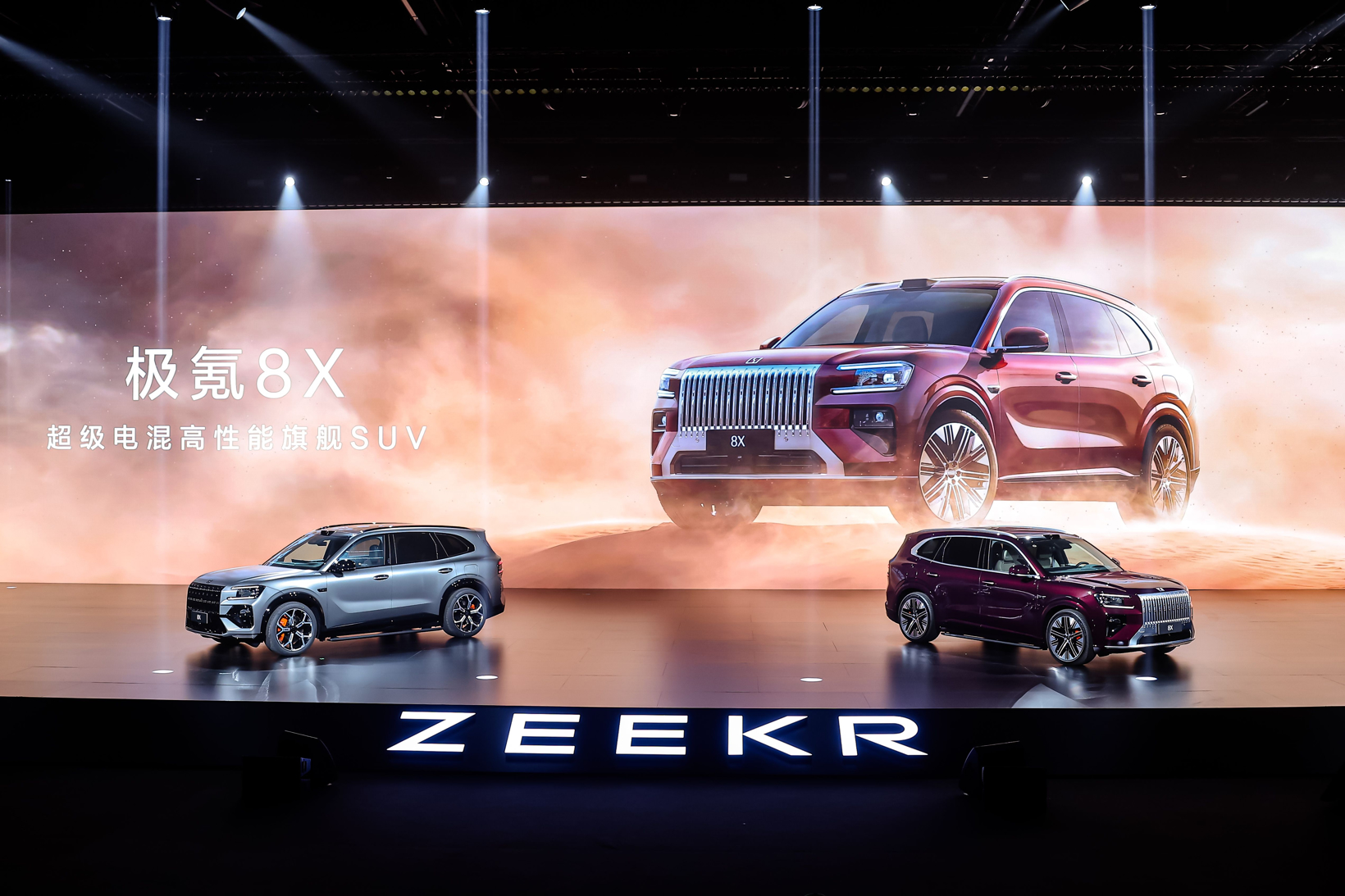
Image Source: ZEEKR
Officially dubbed the "New King of the Road," the model is equipped with ZEEKR's fully self-developed Super E-Hybrid architecture, a full-stack 900V high-voltage system, an AI digital chassis, and a next-generation driver-assistance system. The goal: to leverage a technological edge to breach the stronghold of traditional luxury high-performance SUVs.
Full-stack 900V + Tri-motor: A Tech Breakout for Super E-Hybrid
The ZEEKR 8X's core technological highlight is the SEP system. Built on a full-stack 900V hybrid high-voltage architecture, it achieves a generational leap over the current mainstream 400V hybrid platforms.
On the hardware front, the ZEEKR 8X offers two hybrid-specific battery packs: 55kWh and 70kWh. The 70kWh version supports a 6C charging rate with a peak power of 425kW, juicing the battery from 20% to 80% in just 9 minutes, according to official data. With a maximum pure electric range of 410km and a total range of 1,416km under CLTC standards, the vehicle sits near the top of its segment.
In terms of power, the dual-motor ZEEKR 8X delivers 660kW, sprinting from zero to 100 km/h in 3.7 seconds. The Yaoying version, however, upgrades to a tri-motor setup—290kW on the front axle and dual 370kW motors on the rear—totaling 1,030kW (roughly 1,400 horsepower). That propels it from zero to 100 km/h in 2.96 seconds, making it the only hybrid SUV currently capable of breaking into the "2-second club."
Notably, the 2.0T super hybrid engine boasts a maximum output of 205kW and a thermal efficiency of 46%, balancing performance with efficiency. Paired with a 145kW P1 generator, the system claims a zero-to-100 km/h time just 0.2 seconds slower in a low-battery state compared to full charge. If verified in real-world testing, this would effectively address the common hybrid issue of performance degradation when the battery is depleted.
ZEEKR has engineered a "3-engine, 12-mode" logic for the 8X, covering 12 scenarios across five categories: pure electric front- or four-wheel drive, series charging and discharging, parallel drive, direct drive, and energy recovery. An AI energy management system automatically switches modes based on navigation, weather, and driving habits. How well this system functions in practice will directly define the efficiency experience for drivers across varying conditions.
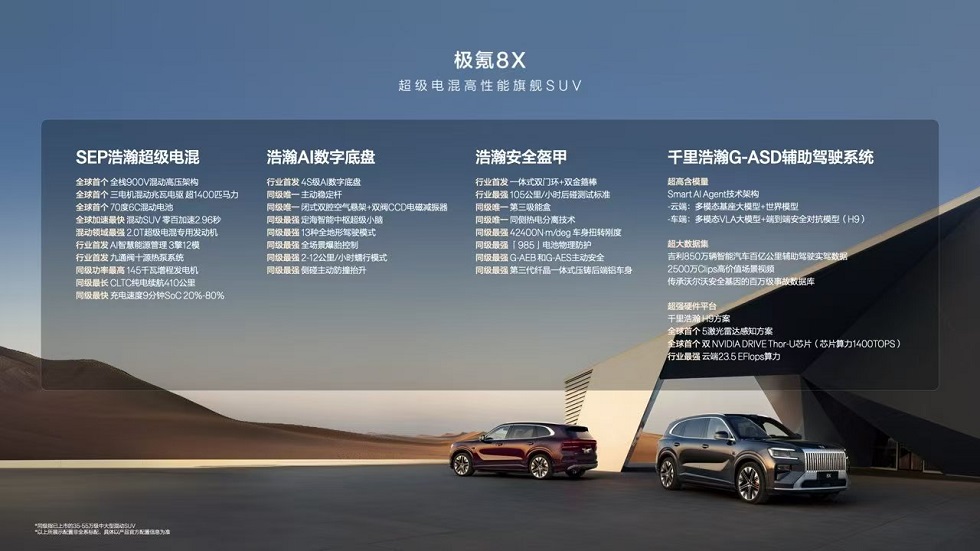
Image Source: ZEEKR
AI Digital Chassis + Dual-Valve Air Suspension: Moving Beyond Hardware Specs to System Integration
On the chassis front, the ZEEKR 8X features the Haohan AI Digital Chassis. The core innovation lies in the "Dinghai Intelligent Hub"—a unified controller that manages suspension, braking, steering, and powertrain, rather than merely relying on accumulated hardware specs.
In terms of hardware, the vehicle is equipped with a closed-loop dual-chamber air suspension and dual-valve CCD electromagnetic dampers. The dual-chamber setup allows for two-stage stiffness adjustment by connecting or isolating the main and auxiliary air chambers, while the dual-valve CCD design offers 2 to 3 times wider damping bandwidth than single-valve versions— theoretically improving filtration of continuous bumps. Additionally, an active stabilizer bar provides 1,400 N·m of balancing torque, keeping roll angle under 2 degrees during cornering at 80 km/h, according to official claims.
The real highlight, however, is the software integration. By synthesizing data from driver-assistance sensors, navigation, and body gyroscopes, the system recognizes specific scenarios—crosswinds, blowouts, or slick surfaces—and preemptively adjusts suspension parameters. In a crosswind, for instance, the CCD dampers and air suspension work in tandem; ZEEKR claims that even when facing a Force 10 gale at 100 km/h, lateral deviation is kept within 20 centimeters.
For all-terrain capability, the ZEEKR 8X offers 13 driving modes, including eight for specialized surfaces, and supports a crawl function at speeds between 2 and 12 km/h. Notably, the 500mm wading mode requires the optional "Qianli Haohan H9" package to unlock.
Pricing Logic and Market Competition at 376,800 Yuan
The ZEEKR 8X's pre-sale price is notably lower than the industry's general expectation of 430,000 yuan. This pricing strategy reflects ZEEKR's assessment of the fiercely competitive landscape for mid-to-large SUVs.
In terms of positioning, the ZEEKR 8X has carved out a relatively differentiated path: a high-performance, large five-seater. The 350,000 to 550,000 yuan bracket is currently crowded with six- and seven-seater models, with 29 new products expected to launch in 2026 alone. Flagship five-seaters, by contrast, are scarce. With a length of 5,100mm and a wheelbase of 3,069mm, the ZEEKR 8X aims to sidestep the "red ocean" of multi-seater competition.
Regarding benchmarks, the ZEEKR 8X targets traditional luxury internal-combustion SUVs like the BMW X5 and Porsche Cayenne, while the Yaoying version takes direct aim at the X5 M and Cayenne Turbo GT. While the ZEEKR 8X holds clear advantages in power specs, acceleration, and intelligent features, the gap in brand premium remains a significant hurdle to overcome.
Within ZEEKR's internal matrix, the 8X complements the 9X. The 9X targets the ultra-luxury market above 500,000 yuan, where it has held the sales crown for four consecutive months. The 8X extends down into the 370,000 to 450,000 yuan range, capturing buyers who demand performance and luxury but have a more constrained budget.
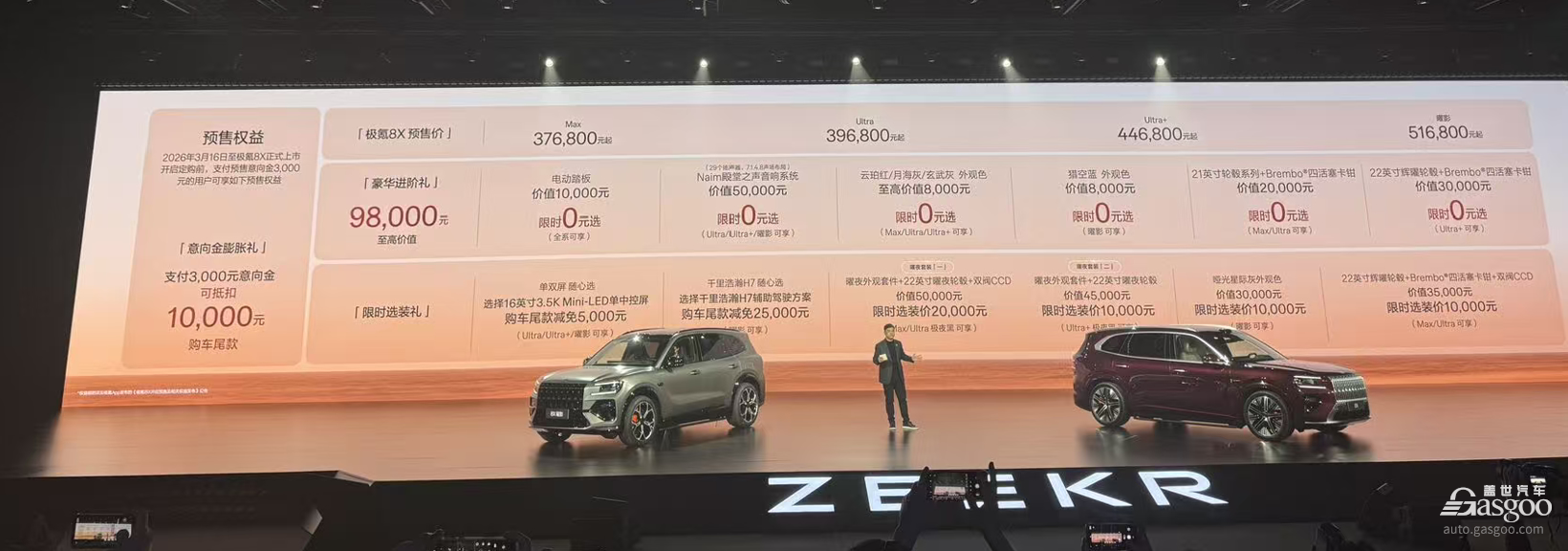
Pre-sale incentives include a 3,000 yuan deposit deducting 10,000 yuan from the final price and limited-time free options worth up to 98,000 yuan. These offers reflect the intense pressure in the new-energy market: even high-end models must rely on strategic incentives to drive order conversion.
Ultimately, the ZEEKR 8X's competitiveness hinges on two factors: first, whether the Super E-Hybrid system and AI digital chassis perform as advertised—specifically regarding power stability at low battery levels and the logic of its multi-mode switching. Second, whether ZEEKR can build a brand perception strong enough to justify a 370,000-plus yuan price tag in a segment long dominated by the German trio. Based on its specs and pricing strategy, the ZEEKR 8X has the foundation for a head-on fight, but the final market verdict will have to wait until deliveries begin in the second quarter.


