Gasgoo Munich - BYD continued to push its global expansion throughout 2025, with core markets consolidating while regional demand diverged. Mexico and Brazil held the top two spots, each exceeding 100,000 sales and accounting for nearly 40% of the top ten total. Belgium led the charge in Europe, while Indonesia became a Southeast Asian benchmark driven by pure electric sales. Meanwhile, markets like Australia and the UAE displayed distinct model preferences. BYD’s highly adaptable lineup is proving a precise fit for diverse market characteristics, solidifying the foundation of its global strategy.
According to export data from Gasgoo Automotive Research Institute, here are the top ten destinations for BYD passenger vehicle exports from January to December 2025:
NO.1 Mexico: From January to December 2025, BYD exported 54,511 pure electric passenger vehicles and 75,940 plug-in hybrid passenger vehicles to Mexico, totaling 130,451 units.
NO.2 Brazil: From January to December 2025, BYD exported 52,830 pure electric passenger vehicles and 67,087 plug-in hybrid passenger vehicles to Brazil, totaling 119,917 units.
NO.3 Belgium: From January to December 2025, BYD exported 51,832 pure electric passenger vehicles and 42,002 plug-in hybrid passenger vehicles to Belgium, totaling 93,834 units.
NO.4 Indonesia: From January to December 2025, BYD exported 81,034 pure electric passenger vehicles to Indonesia, totaling 81,034 units.
NO.5 United Kingdom: From January to December 2025, BYD exported 37,682 pure electric passenger vehicles and 41,944 plug-in hybrid passenger vehicles to the UK, totaling 79,626 units.
NO.6 Australia: From January to December 2025, BYD exported 36,320 pure electric passenger vehicles and 12,131 plug-in hybrid passenger vehicles to Australia, totaling 48,451 units.
NO.7 United Arab Emirates: From January to December 2025, BYD exported 8,522 pure electric passenger vehicles and 38,830 plug-in hybrid passenger vehicles to the UAE, totaling 47,352 units.
NO.8 Turkey: From January to December 2025, BYD exported 23,152 pure electric passenger vehicles and 23,206 plug-in hybrid passenger vehicles to Turkey, totaling 46,358 units.
NO.9 Spain: From January to December 2025, BYD exported 19,530 pure electric passenger vehicles and 21,787 plug-in hybrid passenger vehicles to Spain, totaling 41,317 units.
NO.10 Uzbekistan: From January to December 2025, BYD exported 11,978 pure electric passenger vehicles and 15,930 plug-in hybrid passenger vehicles to Uzbekistan, totaling 27,908 units.
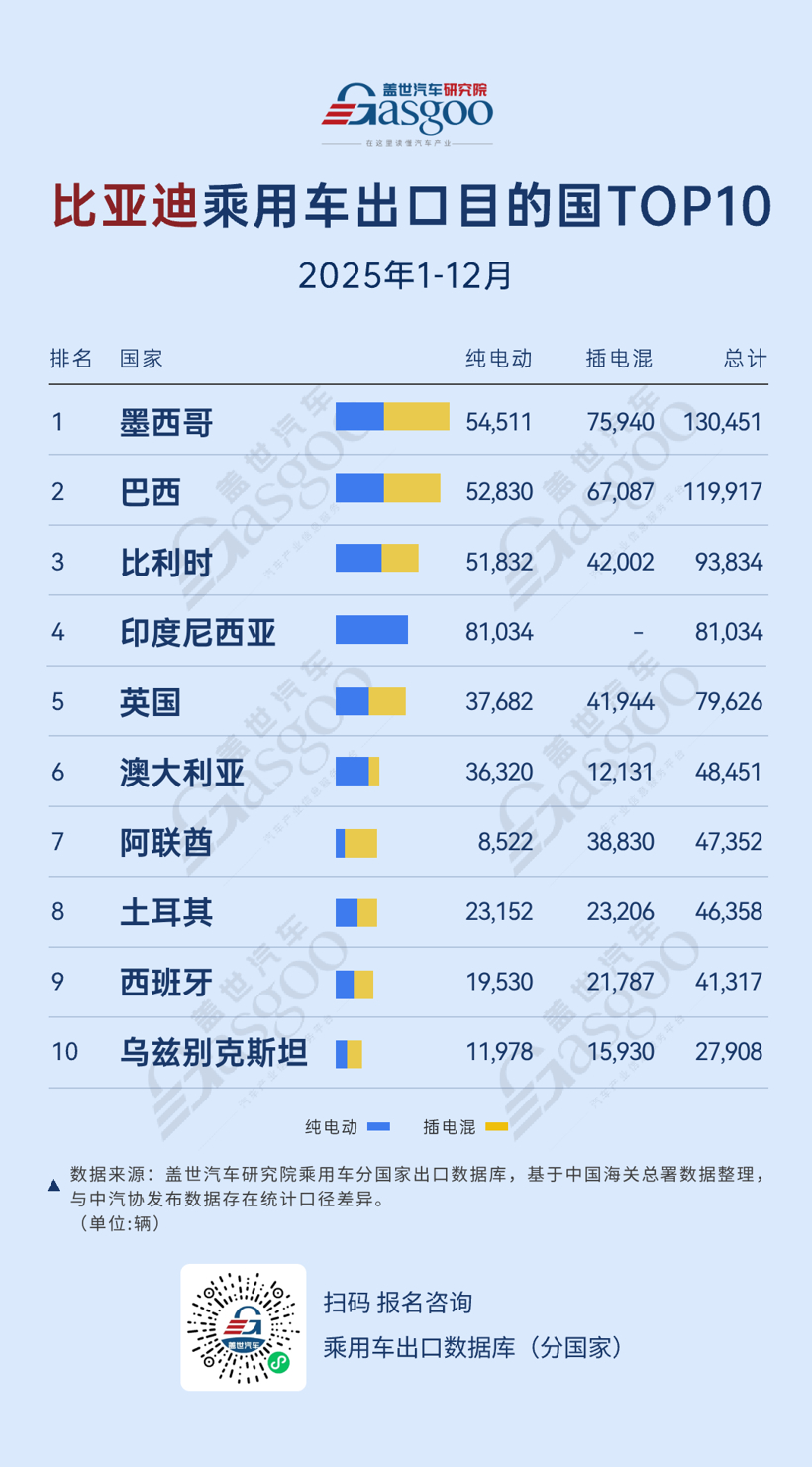
Regionally, Latin America delivered a standout performance. With Mexico and Brazil firmly holding the top two spots at 130,451 and 119,917 units respectively, the two nations combined to capture nearly 40% of the total export volume among the top ten. They have become the central pillars of BYD’s overseas operations.
In Mexico, plug-in hybrid sales hit 75,900—far outstripping pure electrics. That skew aligns with local demand for flexible long-range driving and the convenience of fuel refueling. Beyond consumer needs, Mexico serves as a critical gateway to North America; its rising export volume carries strategic weight for BYD’s supply chain layout and deep market penetration in the region. Notably, Mexico is set to raise tariffs on Chinese-made cars starting January 1, 2026, jumping from 20% to 50%. Anticipating this shift, BYD flooded the market with shipments in late 2025, cementing its lead before the policy change.
Brazil, meanwhile, presents a balanced “dual-engine” growth model. Pure electric sales climbed steadily to 52,830 units, fueled by the ride-hailing sector’s upgrade cycle and government subsidies. Yet plug-in hybrids led the segment with 67,087 units, perfectly matching the needs of a country with vast territory and diverse commuting scenarios—making them the primary engine of local growth.
In Europe, BYD continues to dig in. Belgium (93,834 units), the UK (79,626 units), and Spain (41,317 units) all cracked the top ten. Belgium, ranking third, acts as a key logistics and port hub; a significant volume of BYD vehicles enters through its ports before radiating across the continent. The market’s preference for pure electrics over hybrids mirrors Europe’s broader energy transition. Mature markets like the UK, Spain, and Turkey show a more balanced split between powertrains. However, European consumers are exacting about branding and localized service, meaning future growth will hinge on network expansion, pricing optimization, and deeper brand engagement.
At the same time, Indonesia claimed the fourth spot with 81,034 pure electric sales, becoming a Southeast Asian benchmark thanks to government support and a refresh of the ride-hailing and taxi fleets. Australia showed a clear preference for pure electrics, with 36,320 units far outpacing hybrids, signaling strong local acceptance. Conversely, markets like the UAE and Uzbekistan saw demand for hybrids significantly outstrip pure electrics—a divergence closely tied to local fuel prices, driving conditions, and the practical need for multi-energy compatibility.
Taken together, BYD’s vehicle matrix demonstrates strong cross-market adaptability, precisely aligning with different nations’ energy structures and usage scenarios. That flexibility is laying a solid foundation for the company’s global ambitions.