



Gasgoo Munich- Inside a training ground spanning over 5,000 square meters in Shanghai's Zhangjiang, nearly 100 humanoid robots of various shapes are undergoing "practical training" in simulated scenarios like industrial assembly and home services. The massive data they generate is collected and annotated in real time, feeding into an open-source community known as OpenLoong.
While the industry's gaze remains fixed on breakthroughs in hardware joints, the National Local Joint Humanoid Robot Innovation Center (hereinafter the "Shanghai Innovation Center") is quietly building a distinctly different kind of "soft" infrastructure in Shanghai.
Situated in the Zhangjiang Robot Valley with a registered capital of 1 billion yuan, this national platform has defined its core mission since its unveiling in May 2024.
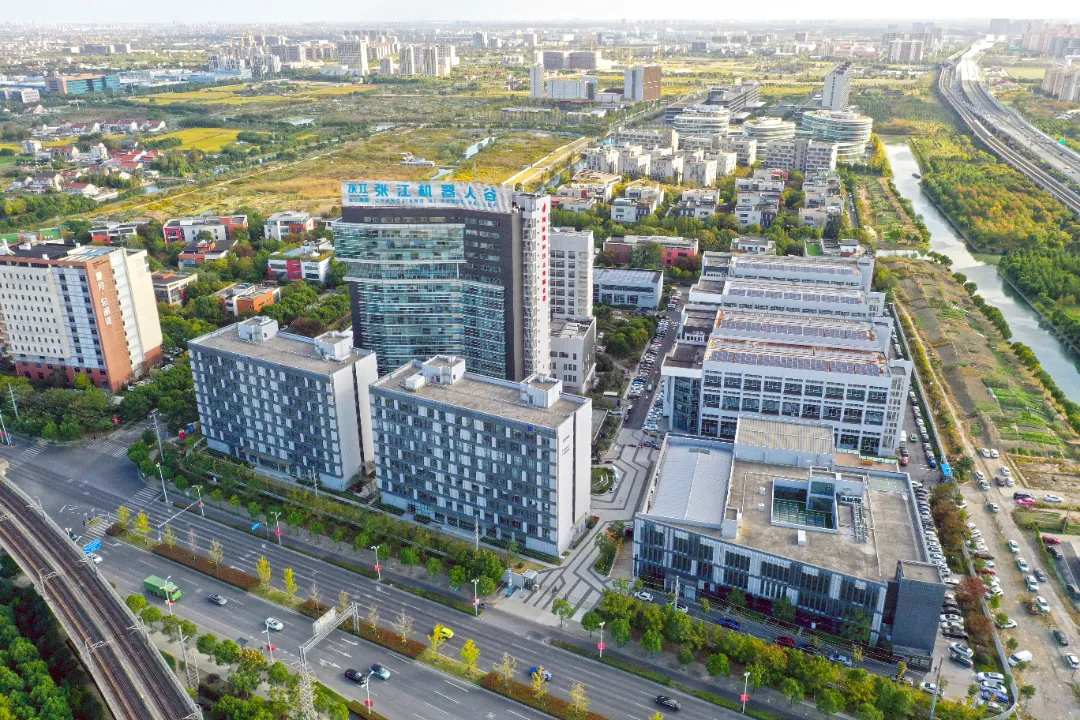
Image Source: Zhangjiang Release
1. Digital Infrastructure: Providing Public Goods for the Industry
A fundamental bottleneck in the humanoid robot industry is that the "development" of intelligent algorithms relies on massive, high-quality training data across multiple scenarios. Yet acquiring this data is prohibitively expensive and often hoarded by leading enterprises, creating formidable technical barriers.
The Shanghai Innovation Center's strategy begins with building industrial public goods for the digital age. Its flagship achievement is "Qilin," the nation's first heterogeneous humanoid robot training ground. This super-facility blends the virtual and the real, capable of accommodating over a hundred robots of different configurations for simultaneous data collection and training.
Phase one focuses on three key areas—smart manufacturing, public services, and specialized applications—constructing over 10 reconfigurable, high-fidelity scenarios compatible with more than 100 heterogeneous robots. The goal extends beyond mere data collection to generating China's leading open-source datasets for real and generative motions, ultimately training transferable general skill models.
2. Simulation Platform: Defining a New Paradigm for Intelligence
While the physical training ground solves the "reality-to-data" challenge, efficiently using that data to train intelligence demands more powerful simulation tools. In March 2025, the Shanghai Innovation Center, partnering with Shanghai University and Tsinghua University, released the "Gewu" embodied intelligence simulation platform.
"Gewu" distinguishes itself with "one-click training" and "one-click migration" capabilities. Its proprietary general reinforcement learning framework and automated model adaptation technology allow developers to train algorithms across more than 100 globally mainstream robots compatible with the platform using a single set of code, then seamlessly migrate those trained strategies to physical robots.
The "Gewu" platform has been fully open-sourced via the OpenLoong community. Industry experts view its release as a milestone, essentially providing a low-cost, high-efficiency "proving ground" for intelligent algorithms that dramatically accelerates the loop from algorithmic innovation to industrial application.
3. Open-Source Ecosystem: A Global Brainpool of Collective Wisdom
Beyond infrastructure and tools, the ecosystem is the core of the Shanghai model. In June 2024, the Shanghai Innovation Center launched OpenLoong, the world's first open-source community platform for humanoid robots. By July, the community had released "Qinglong," China's first open-source, full-size general humanoid robot, making its hardware design, software algorithms, and other technologies fully available to the public.
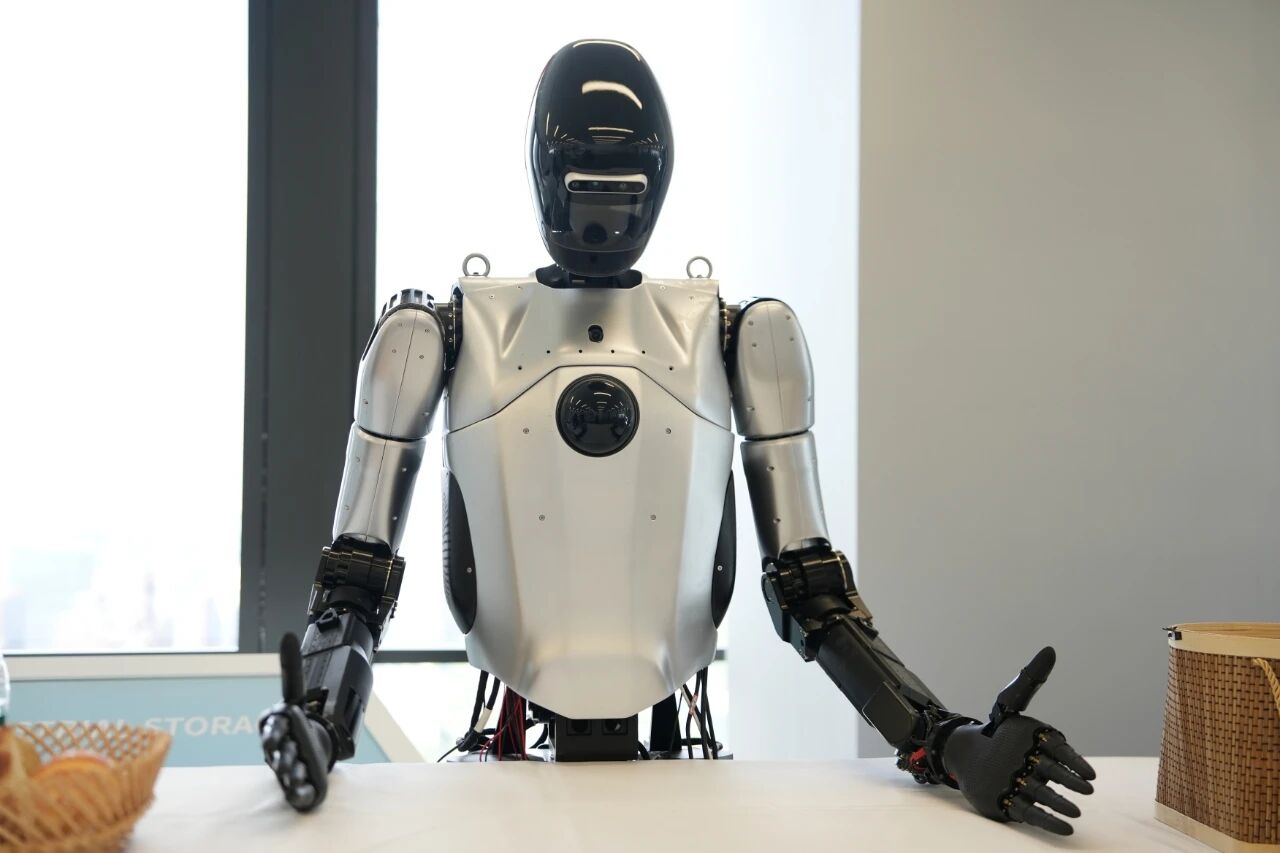
Image Source: Hello Zhangjiang
Standing 1.82 meters tall and weighing 82 kilograms, "Qinglong" boasts 43 active degrees of freedom, representing top-tier hardware design and offering developers a high-performance baseline reference. The pace of open-sourcing has only accelerated since. In October 2025, the center partnered again with Guyueju, a prominent ROS open-source community, to launch a new open-source embodied intelligence robot project. Covering bipedal robot hardware, software algorithms, and supporting curricula, the project is expected to launch in the first quarter of 2026.
The Shanghai Innovation Center has also established a 3 million yuan open fund, providing an average of 300,000 to 500,000 yuan per project to incentivize community innovation with tangible capital. Through a four-tier open-source membership model, the center promotes the sharing of training data and skill models, attracting global developers to contribute to the build.
4. Core Difference: The Shanghai Path of Software Definition and Ecosystem Aggregation
Unlike the Beijing Innovation Center, which focuses on defining a high-performance "body" and a general intelligence "base," the Shanghai Innovation Center is charting a distinct path defined by "software definition and ecosystem aggregation."
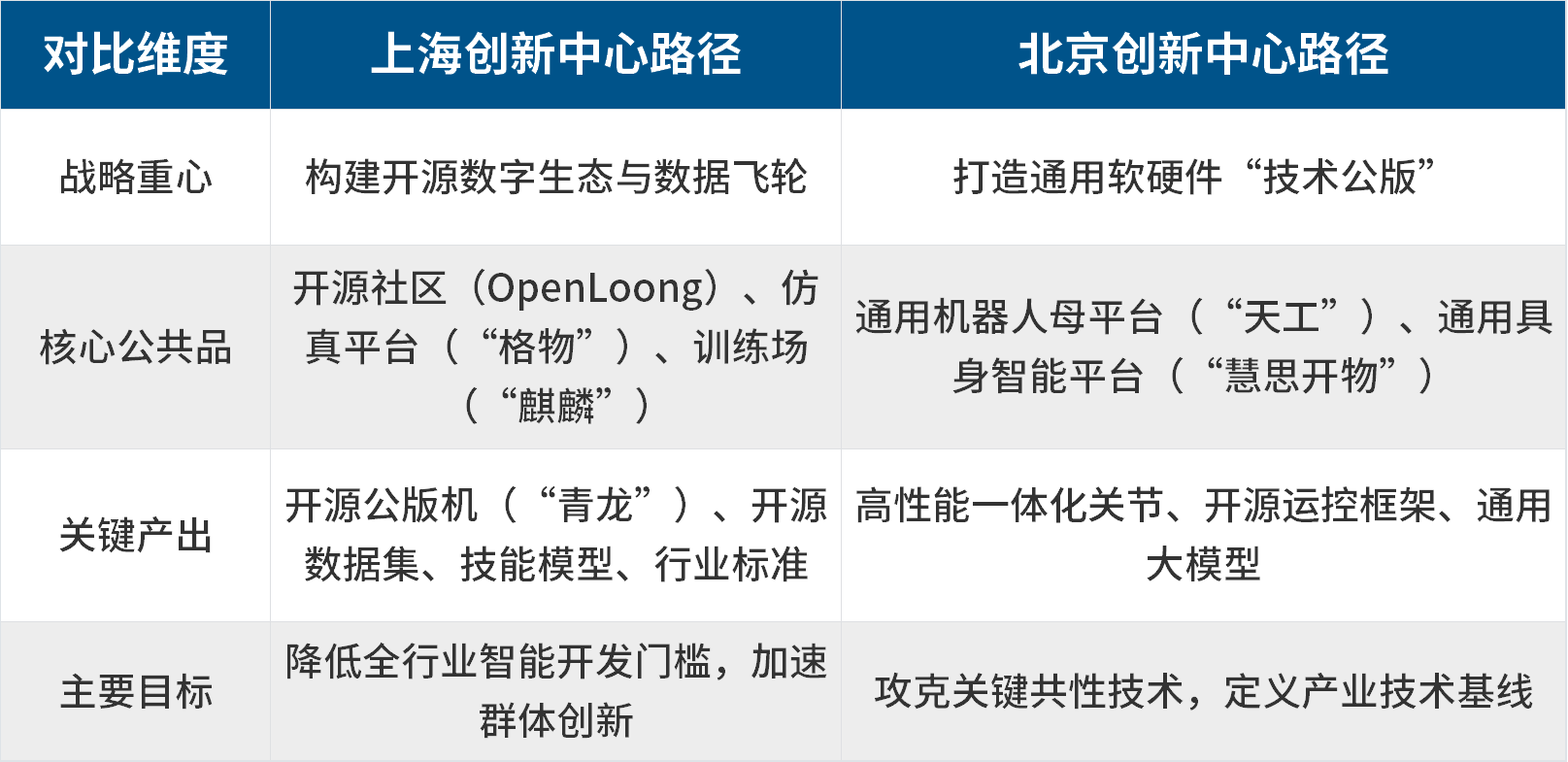
Shanghai's approach does not seek to replace hardware; rather, through open software, data, and standards, it aims to make "intelligence" more accessible to any hardware.
5. Defining Standards: Building Influence in the Future Industry
The Shanghai Innovation Center's strategy holds profound implications that extend beyond technological democratization to defining the rules of the future industry. The center is leading the nation's first national-level standardization pilot for embodied intelligence, with plans to formulate over 80 industry standards.
These standards will cover everything from data formats and communication interfaces to system architecture and testing evaluation. As global developers build using OpenLoong's open-source protocols, adopt "Gewu's" simulation interfaces, and follow its data standards, a global industrial ecosystem—with China's technical framework as a key reference—will begin to take shape.
By constructing a progressive digital infrastructure of "training ground-simulation platform-open-source community-standard system," the Shanghai Innovation Center is transforming Zhangjiang into the "digital root server" of the humanoid robot industry. It may not produce the most robots, but it is dedicated to making all robots smarter; it does not monopolize the most advanced technology, but through open-source sharing, it pools global wisdom to raise the foundation of intelligence across the entire industry.


