



Gasgoo Munich- On April 12, at the Automotive Design Forum (2026), Lou Yongqi, President of Shanghai University of Engineering Science and Member of the Royal Swedish Academy of Engineering Sciences
delivered a speech titled "Reshaping Human-Machine Relationships and Future Design." He shared insights on the transformation of design in the AI era, methods of human-machine collaboration, and the core priorities of future design.
Lou breaks down our world into four components: nature, humans, artifacts (such as cars and furniture), and the cyber world. He argues that the key to good design lies in managing the relationships between these four. Drawing on the original meaning of the Chinese character for design, he explains that design essentially involves four actions: speaking, calculating, deciding, and executing. Currently, AI is increasingly intervening in these stages—starting with calculation and speaking, and gradually extending into execution and decision-making.
The development of AI brings more than just potential downsides; it offers two tangible values. First, it can satisfy individual needs, shattering the industrial-era constraint of "mass production for the many." Second, it can apply industrial scale and efficiency to help solve global challenges like environmental protection and sustainable development, providing support for "repairing the planet." This represents a highly promising direction for the future.
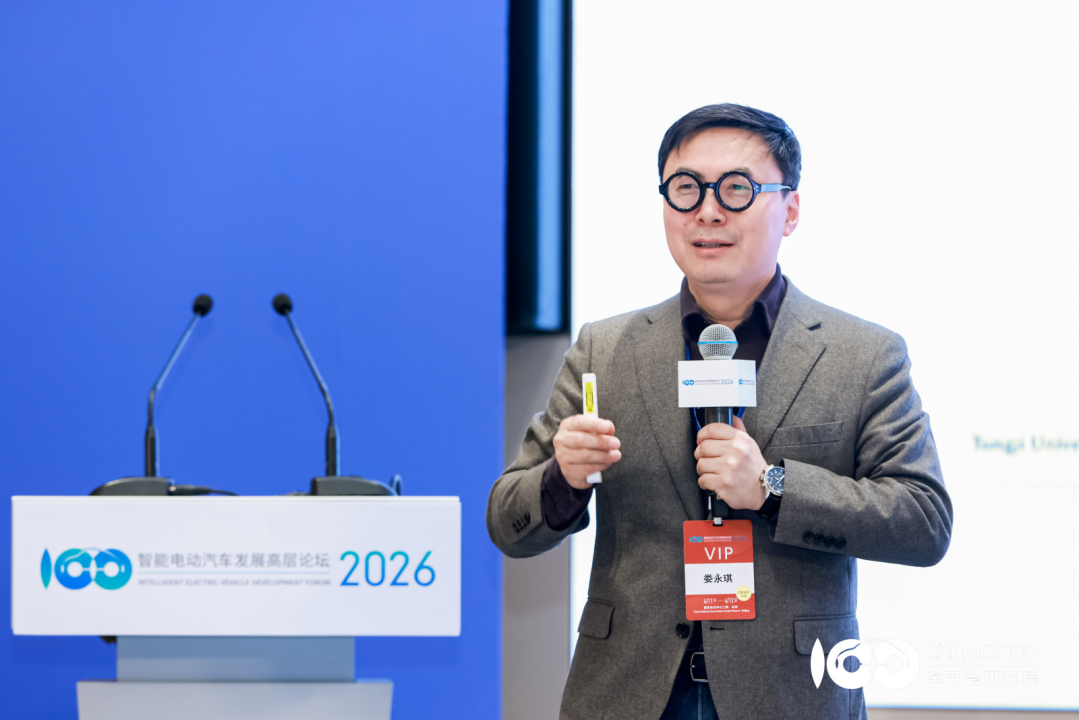
Lou Yongqi, President of Shanghai University of Engineering Science and Member of the Royal Swedish Academy of Engineering Sciences. Image Source: China EV100 Research Institute
On the subject of human-machine collaboration, Lou argues that AI should handle tasks humans are reluctant to do or perform poorly, while simultaneously sparking human creativity. Citing his own experience, he developed a design-focused AI model and converted the expertise of 100 experts into AI agents. He discovered that AI drives students to think proactively and deepens teacher-student interactions—demonstrating the tangible positive value AI brings.
He also analyzed the four core capabilities of design, defining the boundaries of what AI can and cannot replace. Simple calculations are easily substituted, but complex deductions are not. Pure linguistic expression is easily replaced, yet the human emotion embedded in design forms remains difficult for AI to replicate. Simple execution can be automated, but creativity cannot. The most critical tasks—decision-making and constructing order—are the hardest for AI to replace, and they constitute the core competitiveness of design.
Lou emphasized that every industry will be reshaped by AI. The core opportunity for design lies in integrating human experience and emotion; data infused with human warmth holds greater value. Take the bookshelves and furniture he designed as an example: their popularity hinges not on the objects themselves, but on the stories behind them. In the future, human values and emotional narratives will become the core competitive edge of design. Design isn't just about shaping appearances; it's about endowing products with meaning and establishing rational order. That is the essence of high-quality design.
In conclusion, he stated that the core mission of design in the AI era is to actively build high-quality AI. Good AI does not emerge naturally; it requires guidance through design. The ideal human-machine relationship sees AI excelling at what it does best, while humans focus on their own strengths. This offers a clear direction for the practical advancement of future design.

