



Gasgoo Munich- Influenced by seasonal factors such as the Lunar New Year holiday, China's power battery sector in February 2026 displayed a clear trend: total volumes pulled back month-on-month, while the structure continued to optimize.
Data from the China Automotive Power Battery Innovation Alliance (CABIA) shows that while production and sales of power and energy storage batteries slipped month-on-month, they still maintained double-digit growth year-on-year. Exports of energy storage and power batteries have emerged as the key drivers driving the sector. At the same time, domestic installations declined annually, with technology routes and market landscapes diverging faster. The industry is shifting from sheer scale expansion to high-quality development, creating a new competitive ecosystem.
Dual Drivers from Storage and Exports Upgrade Growth Momentum
In February, China's power and energy storage battery industry demonstrated strong resilience amid a complex market environment. Rapid growth in energy storage batteries, combined with a surge in power battery exports, acted together to continuously strengthen the sector's growth drivers.
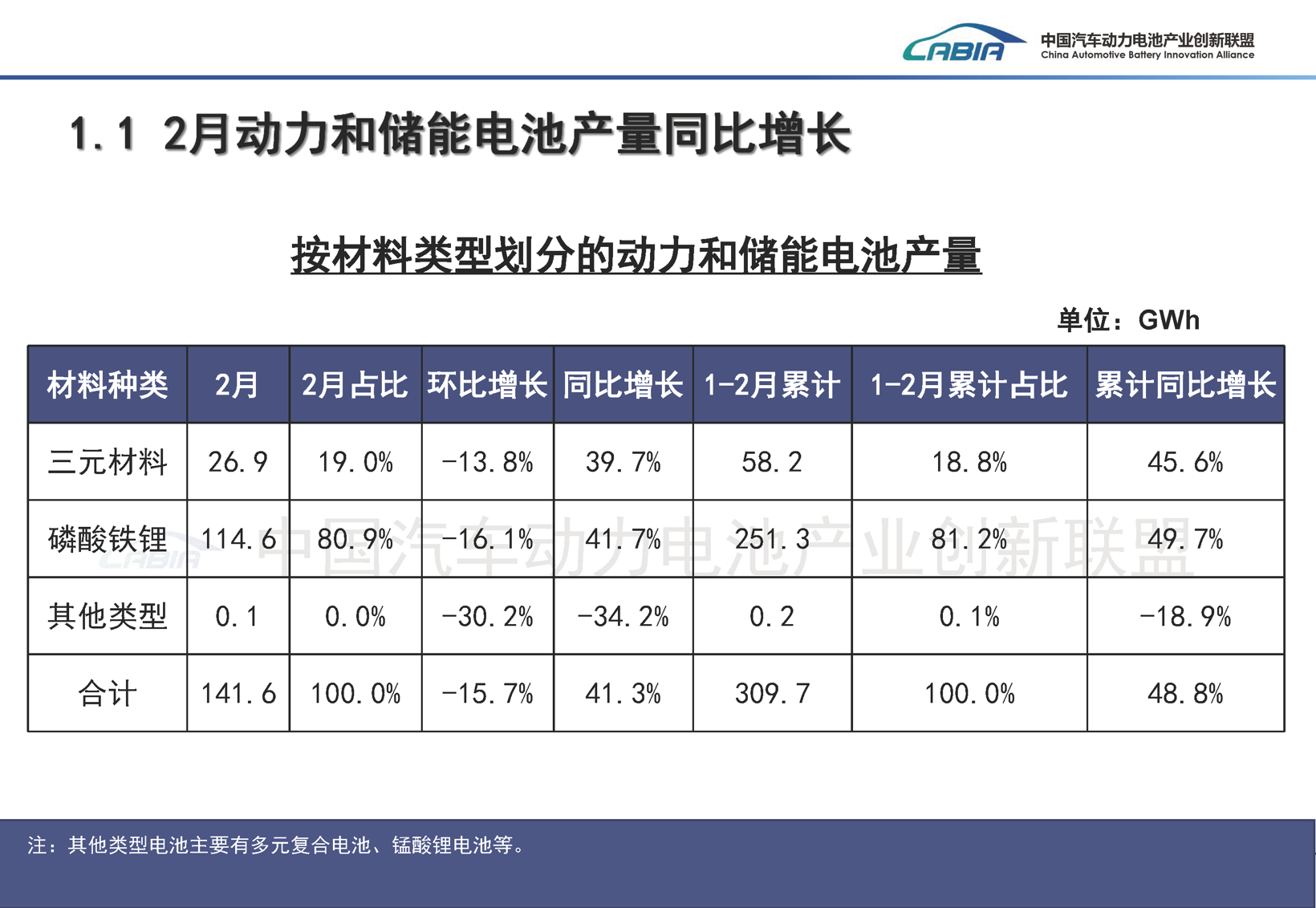
On the production front, combined production of power and energy storage batteries reached 141.6 GWh in February. While this represents a 15.7% dip from January, it still marks a robust 41.3% year-on-year increase. For the first two months, cumulative production hit 309.7 GWh, climbing 48.8% from a year earlier.
Source: CABIA (same below)
By chemistry, lithium iron phosphate (LFP) batteries retained their dominance, with production hitting 114.6 GWh in February. That accounts for 80.9% of the total, up 41.7% year-on-year, as their cost and safety advantages continue to remain prominent in both power and storage applications. NCM (ternary) batteries followed with 26.9 GWh, representing 19.0% of the total and rising 39.7% annually, sustaining steady demand in high-end mobility scenarios.
Shifts in sales structure offer a clearer view of industry trends. Total sales of power and energy storage batteries came in at 113.2 GWh in February, down 23.9% month-on-month but up 25.7% year-on-year. Energy storage batteries were the key driver: sales rose significantly by 67.3% annually to 38.6 GWh. For the January-to-February period, cumulative sales jumped 108.9% to 84.8 GWh, boosting their share of total sales to 32.4%—an 8.6-percentage-point increase from last year. This surge is fueled by the rapid expansion of the global storage market and the accelerated rollout of domestic wind-solar-storage integration projects.
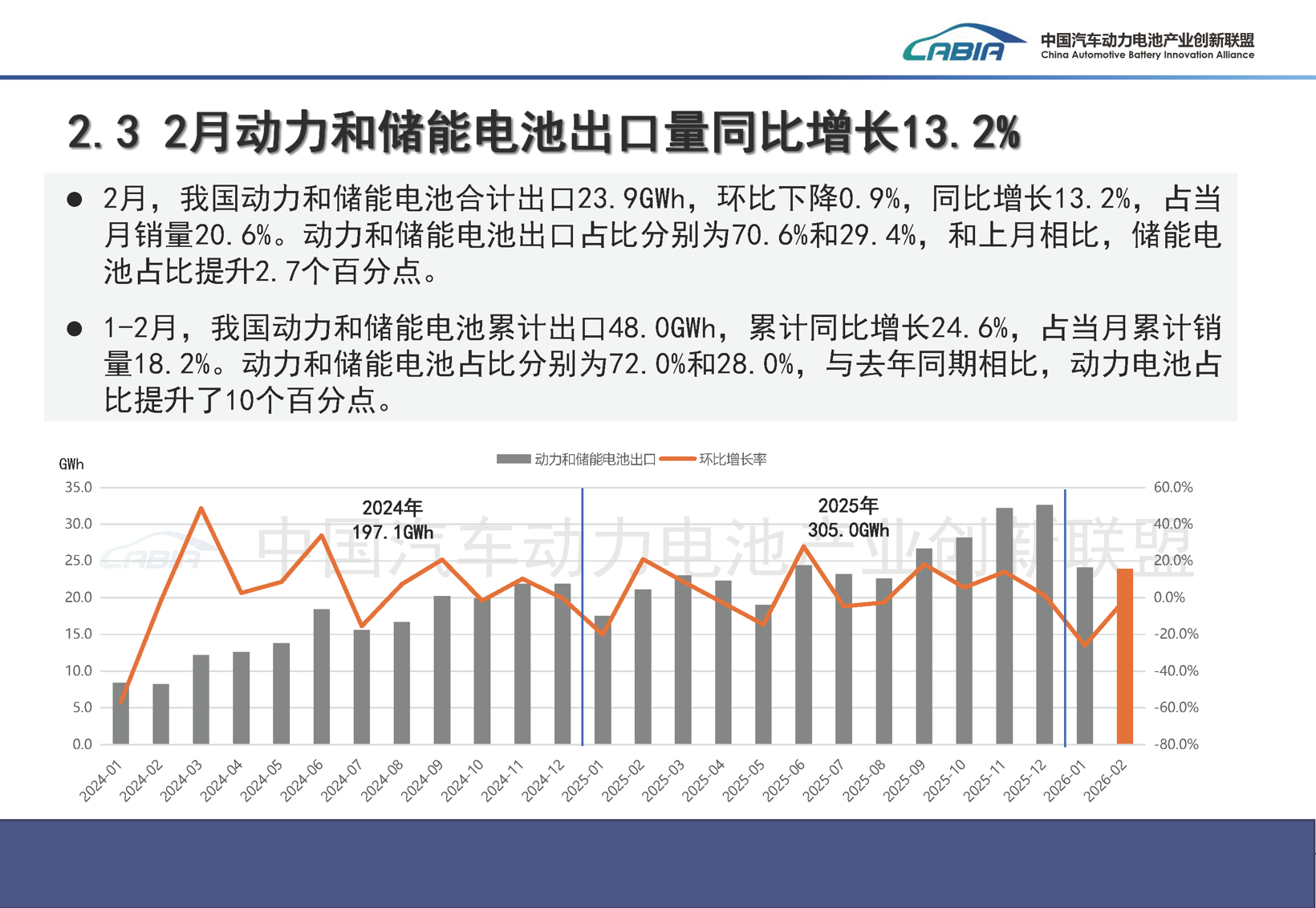
The export market also performed strongly, serving as a major contributor for industry growth. Combined exports of power and energy storage batteries reached 23.9 GWh in February, a 13.2% year-on-year increase that accounted for 20.6% of the month's sales. Power battery exports alone climbed 31.9% to 16.9 GWh, bringing the two-month cumulative total to 34.6 GWh—up 44.6% from a year ago. Both NCM and LFP chemistries saw significant export growth, with the former claiming 54.6% of the total and the latter surging 43.6%. Notably, while energy storage battery exports slipped 15.5% year-on-year, they rose 9.3% from January, signaling a gradual recovery in overseas demand.
Market Structures Diverge as Technology and Scenario Adaptation Become Competitive Keys
In February, the domestic installation market saw an annual decline, yet the divergence in market structure and technology application became even more pronounced. Competition among top-tier players intensified, while second-tier firms delivered strong performances. The precise alignment of technology roadmaps with application scenarios has emerged as the core logic for companies looking to gain a competitive edge.
Installation data reveals that domestic power battery installations totaled 26.3 GWh in February, a 37.4% month-on-month decline and a 24.6% drop year-on-year. Cumulative installations for the first two months fell 7.2% to 68.3 GWh, largely due to a slowdown in vehicle production during the Lunar New Year holiday.
On the technology front, LFP batteries maintained their dominance with 20.6 GWh of installations in February, capturing 78.3% of the market despite a 27.5% annual decline. NCM batteries accounted for 21.7% with 5.7 GWh, down 11.4% year-on-year. Still, their energy density advantage remains critical in the premium passenger vehicle segment, where cumulative installations for the first two months achieved a 0.6% gain.
Regarding market structure, the competitive dynamic of "two leaders at the top with the rest chasing" continues to evolve. CATL secured the top spot with 12.90 GWh of installations, holding a 49.10% market share, while BYD followed with 3.56 GWh and a 13.56% share. However, both giants saw their market share decline slightly compared to the previous month.
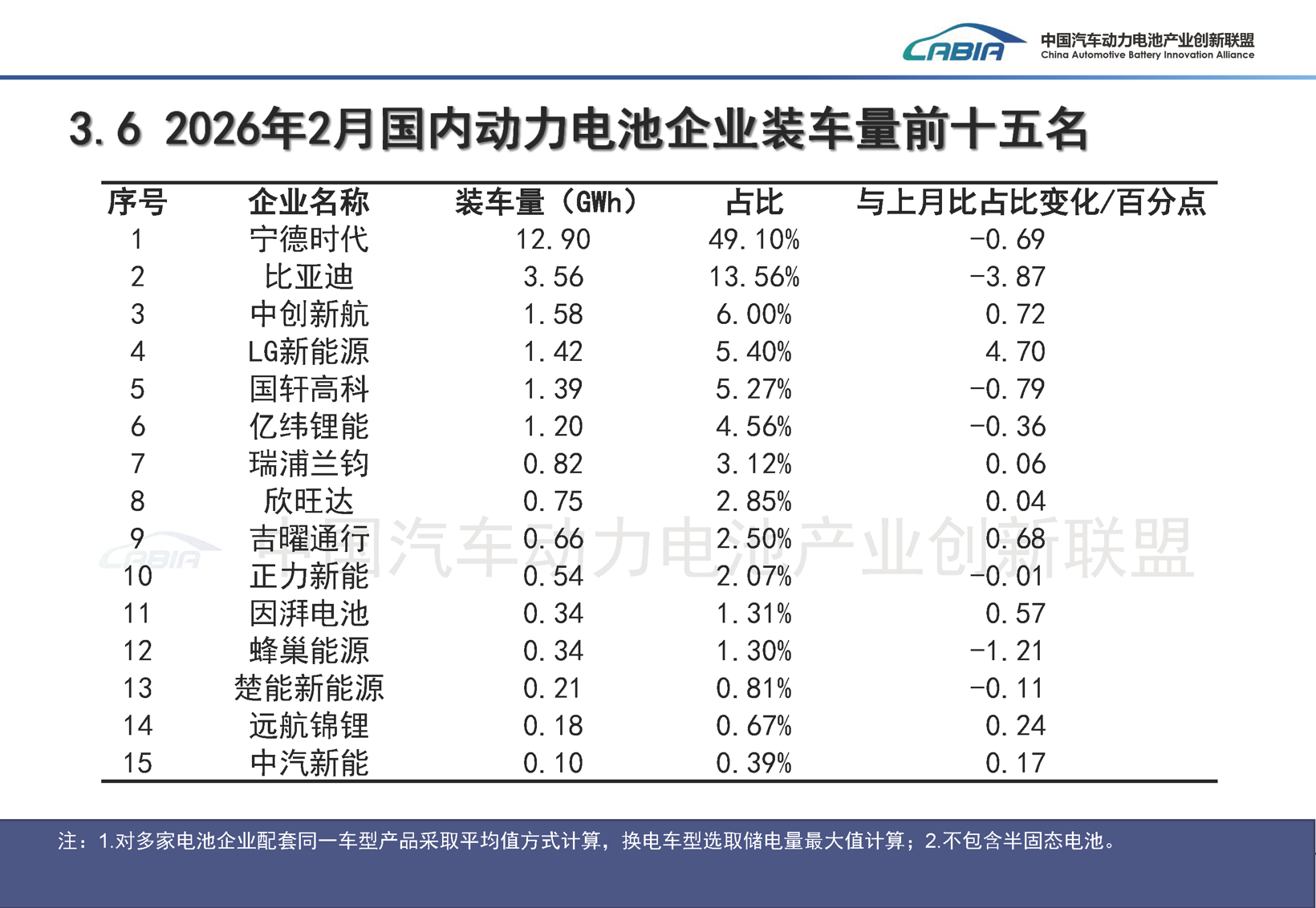
Meanwhile, second-tier players were active. CALB posted 1.58 GWh of installations in February, claiming a 6.00% share—up 0.72 percentage points from January. LG Energy Solution, utilizing its strength in NCM batteries, saw installations hit 1.42 GWh, pushing its share to 5.40%. Cumulative data for January and February shows that Gotion, Sunwoda, and REPT all gained market share year-on-year, suggesting a trend toward gradual dispersion in industry concentration.
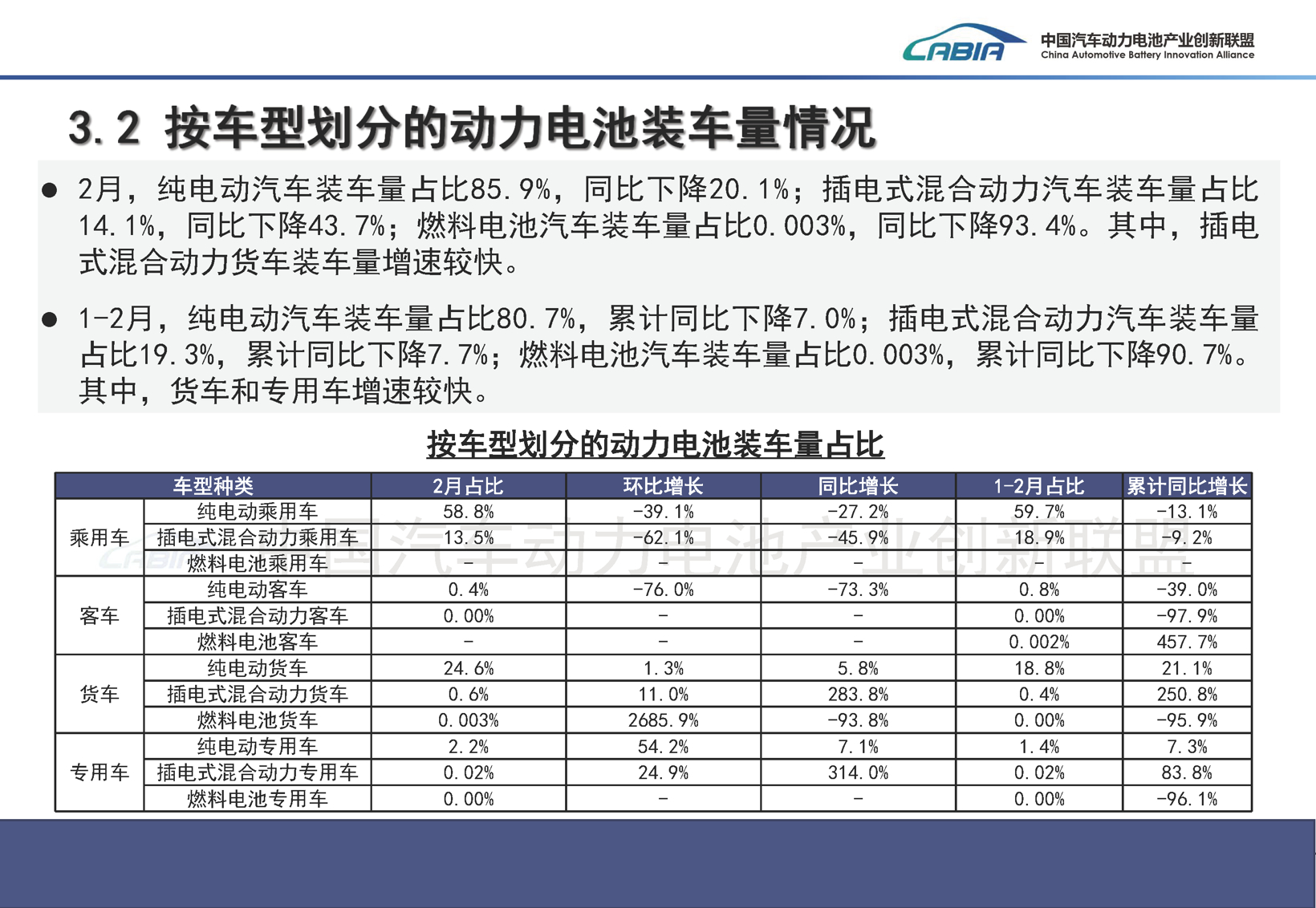
In terms of vehicle adaptation, differentiated demand across niche markets is becoming increasingly pronounced. Pure electric passenger cars accounted for 58.8% of installations in February. While this represents a 27.2% annual drop, they remain the core application scenario for power batteries. Pure electric trucks were a growth area, taking a 24.6% share with a 5.8% year-on-year rise, and cumulative growth of 21.1% over the first two months. Plug-in hybrid trucks and specialty vehicles became new growth drivers, surging 283.8% and 314.0% respectively in February, reflecting the accelerating electrification of commercial vehicles.
Furthermore, average battery capacity per vehicle continues to climb. In February, the average capacity for new energy vehicles hit 75.9 kWh, a 52.6% year-on-year increase. For pure electric passenger cars, the average stood at 68.6 kWh, up 28.5%, highlighting an increase in consumer demand for range.
Looking at industry trends, the power battery sector is undergoing profound structural adjustment in 2026. The rapid expansion of the energy storage market and the expansion of exports are injecting fresh momentum into growth, while short-term volatility in domestic installations is prompting companies to accelerate innovation and scenario adaptation. Moving forward, as LFP technology continues to break through in energy density and NCM batteries penetrate further into premium markets—combined with the sustained expansion of energy storage and commercial vehicle applications—the industry will achieve higher-quality development amid this divergence. Competition is shifting from a competition based solely on scale to a comprehensive competition of technology, cost, and scenario adaptability.


