



Gasgoo Munich- On March 13, the Geely Galaxy M7 made its technical debut at the Quzhou Jidian plant. Positioned as a "mainstream electric hybrid SUV," this new model is the first to feature the Aegis Gold Brick Battery. Armed with three core figures—a 225 km pure-electric range, an 81 km/h moose test score, and a 1,730 km total range—it sends a clear signal to the market: the technical bar for plug-in hybrid SUVs is being reset.
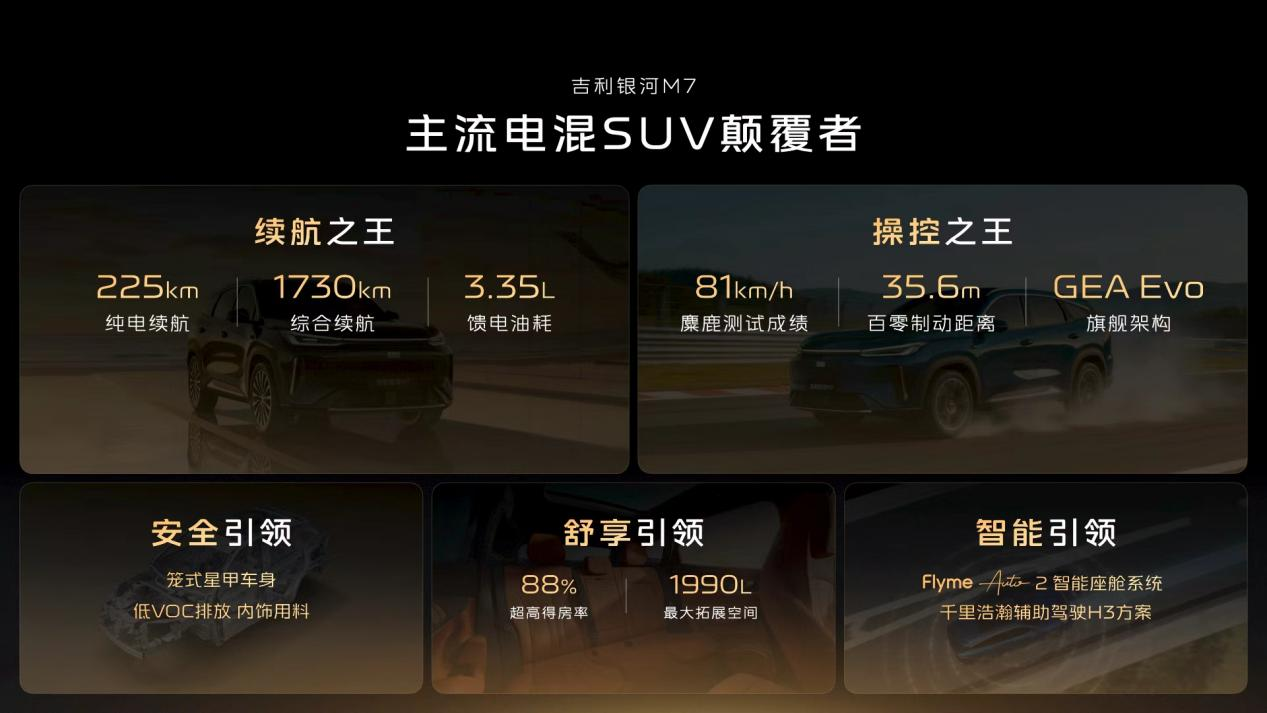
Image Credit: Geely
Details revealed at the event suggest the Galaxy M7 is no mere facelift or stopgap. It marks the debut of the Geely Galaxy brand’s M-series hybrid lineup and the first application of the Aegis Gold Brick Battery in a hybrid setup. More importantly, its sheer density of technical specifications clearly outstrips the standard for mainstream rivals in its class.
Battery Technology: Trickle-Down and Leveling Up
The biggest variable in the Galaxy M7’s tech equation is the hybrid version of the Aegis Gold Brick Battery.
Previously, the Aegis Gold Brick Battery was reserved for pure-electric models. The hybrid-specific pack debuting on the Galaxy M7 boasts a capacity of 29.8 kWh—roughly 12% higher than mainstream competitors. The direct payoff is a pure-electric range of 225 km, making it one of the few plug-in hybrid SUVs to breach the 200 km barrier.
The changes go beyond capacity. The hybrid series incorporates three material-level upgrades: a wet double-coated separator, a high-temperature self-polymerizing electrolyte, and a multi-particle cathode compound. Puncture resistance has improved by 20%, and thermal runaway suppression time extends to 300 minutes—significantly expanding the battery’s safety margin under extreme conditions.
Charging speed is another focal point. The Galaxy M7 charges from 30% to 80% state-of-charge (SOC) in 15 minutes—a figure that may not stand out among pure-electric vehicles, but places it in the "fast-charging first tier" for plug-in hybrids. As for cycle life, the official data points to 4,500 cycles, translating to a driving range in the millions of kilometers. The underlying logic is clear: resolve the persistent "battery anxiety" of plug-in hybrid drivers—covering not just range anxiety, but also concerns over degradation and charging times.
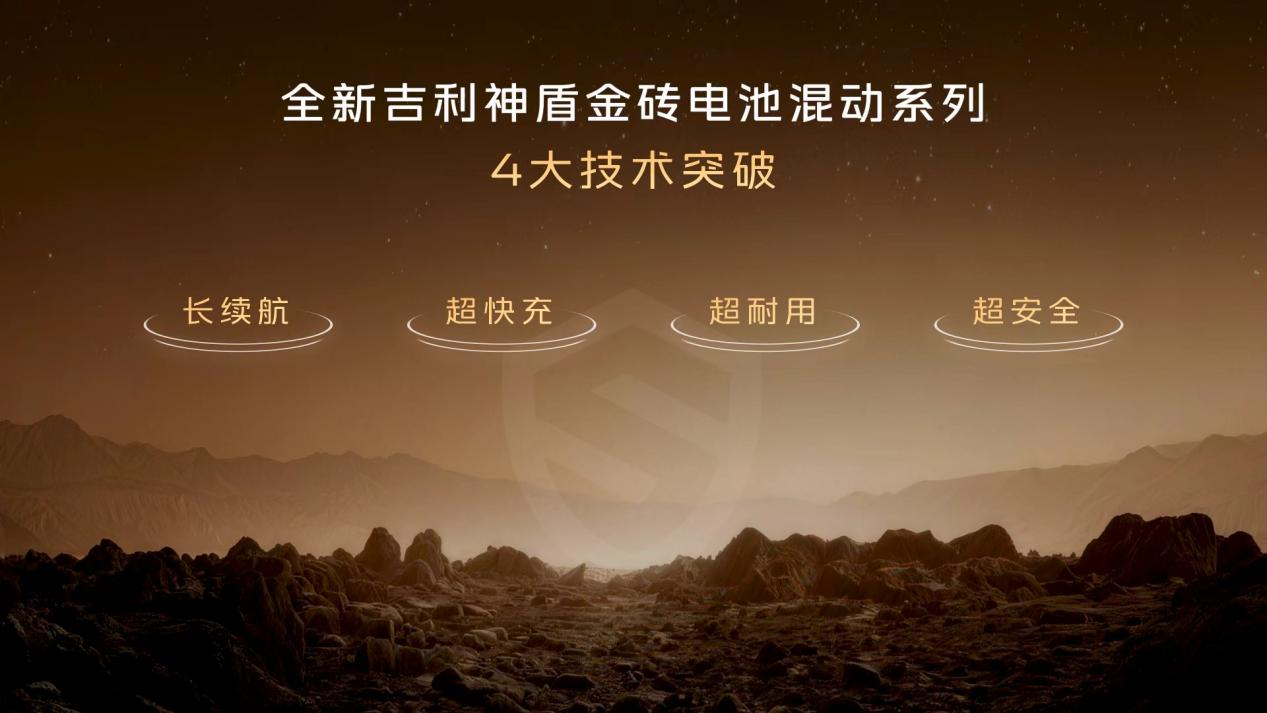
Image Credit: Geely
Technologically, introducing the Aegis Gold Brick Battery to the hybrid segment signals that Geely Galaxy is migrating its electric-drive expertise to hybrid models. This isn't a simple transplant; it involves systematic adjustments tailored to the space constraints, thermal management needs, and charging strategies specific to hybrids. For instance, a 5% improvement in pack utilization allowed engineers to squeeze an extra 3.2 kWh into a limited volume. Meanwhile, a patented "10-cycle" direct-cooling plate boosts cooling speed by 70% to handle the complex operating conditions of a hybrid powertrain.
A Two-Pronged Powertrain Strategy
Plug-in hybrids have long faced a technical paradox: larger batteries add weight, which hurts handling. The Galaxy M7’s solution is to stack technology in both the powertrain and chassis to counteract that.
On the powertrain front, the Lei Shen EM super hybrid engine achieves a thermal efficiency of 47.26%, thanks to a combination of a high-angle "duckbill" intake port and a "tornado" combustion system. The former optimizes intake tumble, while the latter controls flame propagation, ultimately delivering a fuel consumption of 3.35 L/100 km in battery-depleted mode. Paired with the Xingrui AI Cloud Power 2.0 system, the vehicle dynamically adjusts its fuel-electric distribution based on navigation road conditions, driving habits, and altitude changes. The system’s core value lies in shifting energy management from "rule-driven" to "data-driven."
In terms of handling, the 81 km/h moose test score stands as the Galaxy M7’s most direct "technical manifesto." This figure is backed by the GEA Evo architecture, which delivers a body torsional stiffness of 32,000 Nm/°, an all-scenario intelligent adaptive suspension, and the G-TCS intelligent traction control system. The logic behind G-TCS is particularly noteworthy: leveraging the microsecond response of the electric drive, it executes anti-slip intervention within 10 milliseconds on rain- or snow-slicked roads—two orders of magnitude faster than the torque control systems in traditional internal combustion engine vehicles.
Additionally, the Galaxy M7 incorporates targeted chassis lightweighting measures, such as double-layer hollow lower control arms and rear lower arms with integrated springs. The goal is to reduce unsprung mass and sharpen suspension response. On the steering front, a 27.88 mm kingpin offset—tuned to a "golden value"—combined with a steering wheel shared with the M9, achieves a tuning that feels light at low speeds and stable at high speeds.
This "powertrain-plus-chassis" strategy addresses a market reality: plug-in hybrid buyers are no longer motivated solely by cost savings. Their expectations for driving quality are converging with those of pure-electric vehicle owners.
Systemic Capability: A Higher-Dimensional Edge
The Galaxy M7’s spec sheet is long, but the real story lies in the systemic capabilities underpinning these technologies.
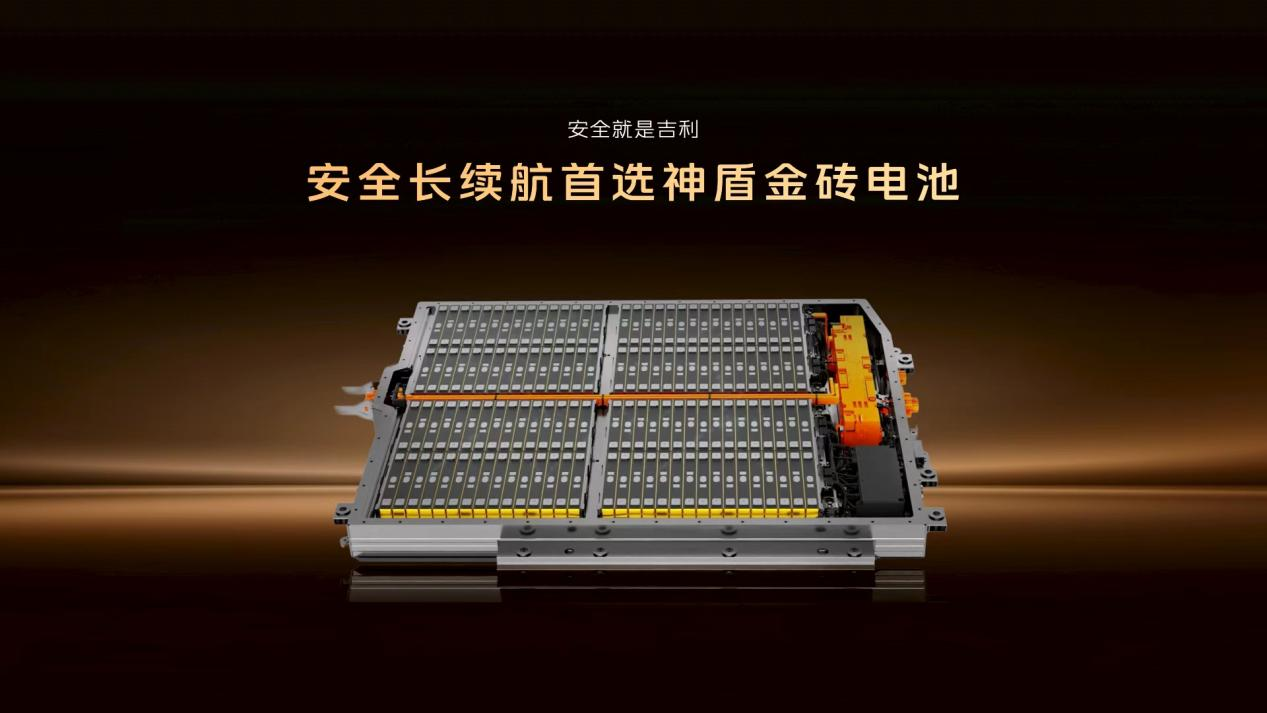
Image Credit: Geely
First is the synergy between battery and vehicle. The Aegis Gold Brick Battery's safety architecture spans four layers: cell materials, pack structure, vehicle protection, and cloud monitoring. The cell layer features the wet double-coated separator and high-temperature electrolyte; the pack layer uses an aerospace-grade aluminum frame and 11 levels of functional protection; the vehicle layer incorporates a "Star Armor" cage body and a "nine-horizontal, four-vertical" frame structure; and the cloud layer relies on Xingrui AI Cloud Power for real-time warnings. Such a multi-tiered defense system cannot be achieved through a single breakthrough; it demands the alignment of capabilities across five technical domains: battery, electronic control, body, chassis, and cloud.
Second is manufacturing support. The Galaxy M7’s technical debut was held at the Quzhou Jidian plant, the core production hub for the Aegis Gold Brick Battery. A factory’s process quality directly dictates battery consistency and yield—something lab data cannot replicate. Currently, the Aegis Gold Brick Battery powers 27 models and is exported to 85 countries and regions, proving its scaled manufacturing capabilities are fully operational.
Third is the integration of intelligent systems. The Flyme Auto 2.0 cockpit runs on a 7 nm "Dragon Eagle-1" chip, supporting features like AI Galaxy Spirit, Sentry Mode, and G-C Boundless Space. The Qianli Haohan H3 driver-assistance package enables highway NOA coverage across all road conditions and automatic parking that recognizes over 300 spot types. These smart features are rare in traditional plug-in hybrids but are integrated as standard capabilities in the Galaxy M7.
Looking at the Geely Galaxy timeline, the brand launched in February 2023 and is targeting 2 million units off the production line by March 2026. Within that 37-month window, it aims to close the loop from brand building to technological implementation. The Galaxy M7 is a pivotal node in that cycle—tasked with commercializing the Aegis Gold Brick technology into a mass-market model and carrying the "Galaxy Speed" momentum into an assault on the mainstream new-energy market.
The plug-in hybrid SUV market is shifting. For years, competition centered on fuel economy and eligibility for green license plates. Now, battery capacity, charging speed, moose test scores, and total range are becoming the new benchmarks. With the Galaxy M7’s entry, Geely Galaxy is using a "full-stack" of technology to redefine the baseline for mainstream electric hybrid SUVs.


