



Gasgoo Munich- As China's new-energy vehicle market continues to expand, resale rates are emerging as a critical metric for consumers. While NEVs have seen rapid growth in sales and technology over the past few years, their performance in the used market still lags noticeably behind traditional internal combustion engine vehicles.
A recent report on China's NEV resale rates for February 2026, released by China Automotive Data, shows that while some popular models maintain strong retention at the one-year mark, values slide sharply once the ownership cycle extends to three years. Across the board, most models fall below the 70% threshold.
Domestic High-End Brands Break Through
At the one-year stage, certain NEV models still manage to sustain relatively high residual values.
The AITO M9 claimed the top spot in both the pure electric and plug-in hybrid (including extended-range) segments, with retention rates of 82.1% and 84.1%, respectively, making it the "double champion" for the month. This reflects the premium market's acceptance of the HarmonyOS cockpit and smart driving system, shattering the traditional bias that new players see their values collapse immediately after launch.
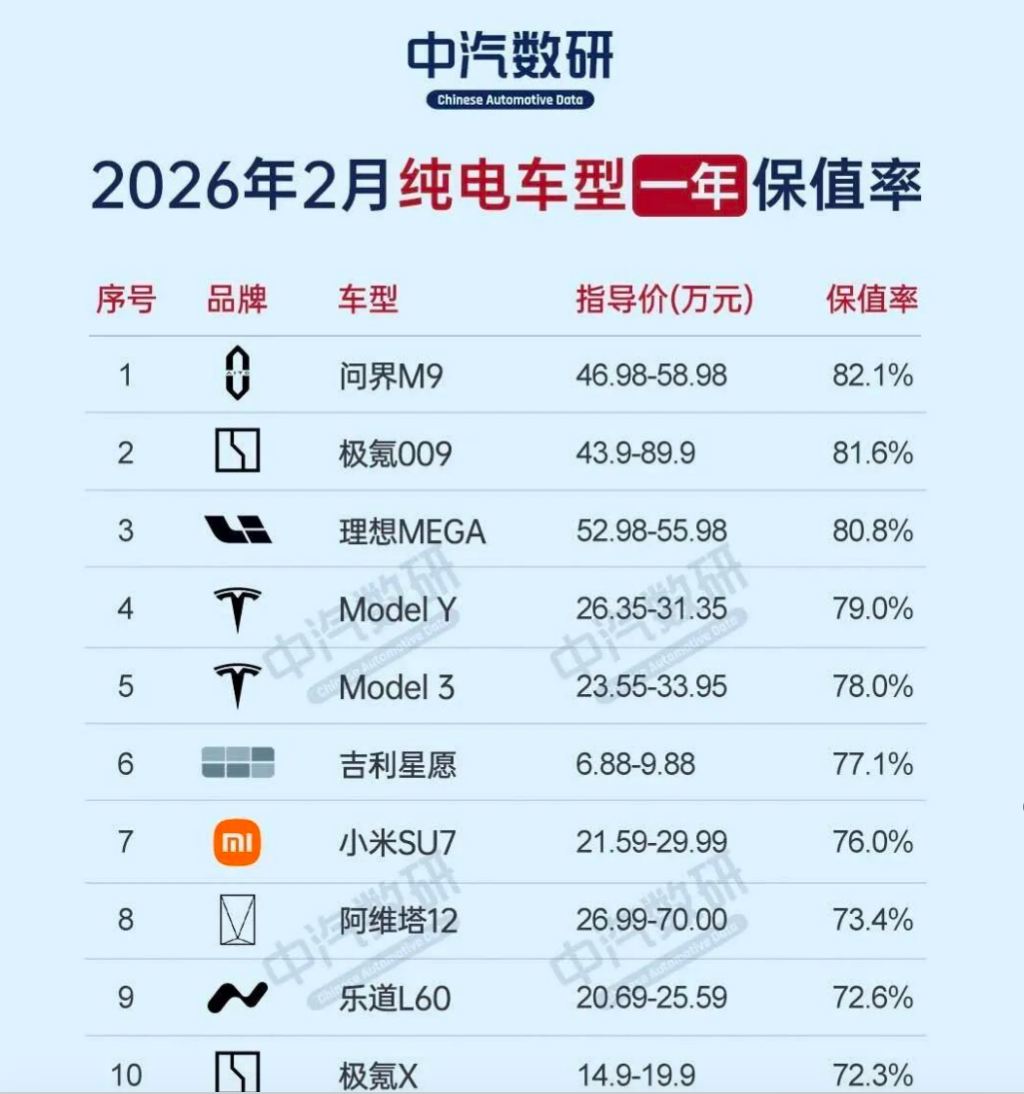
Image source: China Automotive Data
In the pure electric sector, the ZEEKR 009 (81.6%) and Li Auto MEGA (80.8%) followed closely behind the AITO M9. These three high-end models formed the first tier of resale value. By comparison, Tesla's Model Y and Model 3 took fourth and fifth places with 79% and 78%, respectively, while the closely watched Xiaomi SU7 ranked seventh at 76%.
The plug-in hybrid landscape paints a different picture. Aside from the AITO M9 leading the pack, the Tank series made a strong showing.
The Tank 400 New Energy (79.7%), Tank 700 New Energy (77.9%), and Tank 500 New Energy (76.9%) claimed the second, third, and fourth spots. This suggests that in the rugged off-road niche, domestic brands have secured strong pricing power in the used market by combining mechanical prowess with new energy technology.
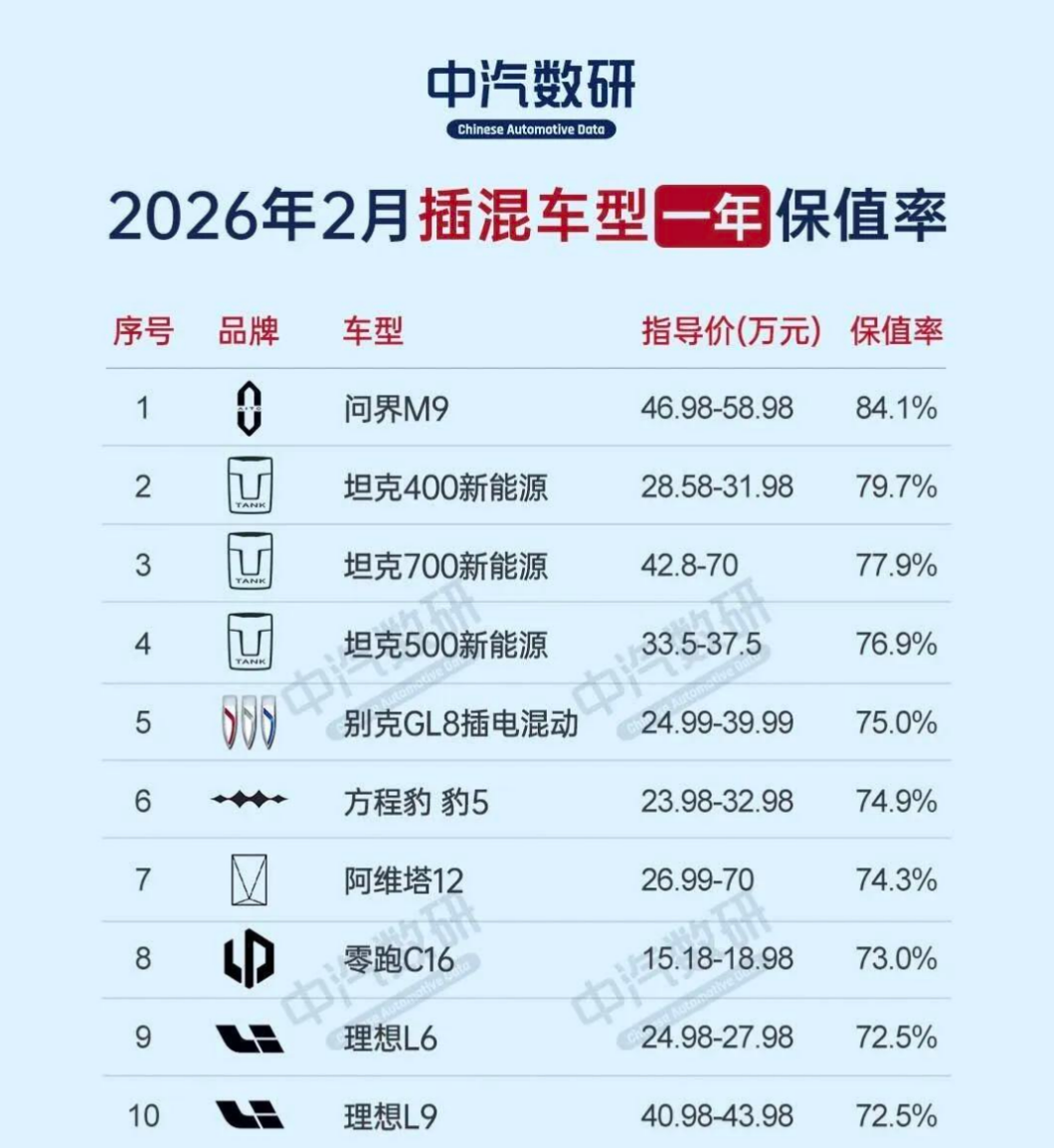
Image source: China Automotive Data
However, when viewed through the lens of a three-year ownership cycle, the resale curve drops steeply. The vast majority of new-energy vehicles see their retention rates fall well below 70%.
In the pure electric segment, while the Tesla Model X leads the three-year list with a 61.7% retention rate, that represents a severe shrinkage from its one-year value. Among domestic brands, the better-performing ZEEKR 009 and Avatr 12 managed only 54.1% and 52.9%, respectively.
For plug-in hybrids, the Tank 500 New Energy topped the three-year list at 64.2%, followed by the Haval Raptor at 60%.
Caught Between Rapid Tech Iteration and Price Wars
What is driving such rapid depreciation in new energy vehicles?
Industry insiders generally point to the breakneck speed of technological iteration as the primary cause. Over the past three years, battery energy density, driving range, and smart driving capabilities have seen quantum leaps. A model with a 500-kilometer range from three years ago is now considered entry-level, and smart cockpit systems from that era now feel like "dumb phones" by today's standards.
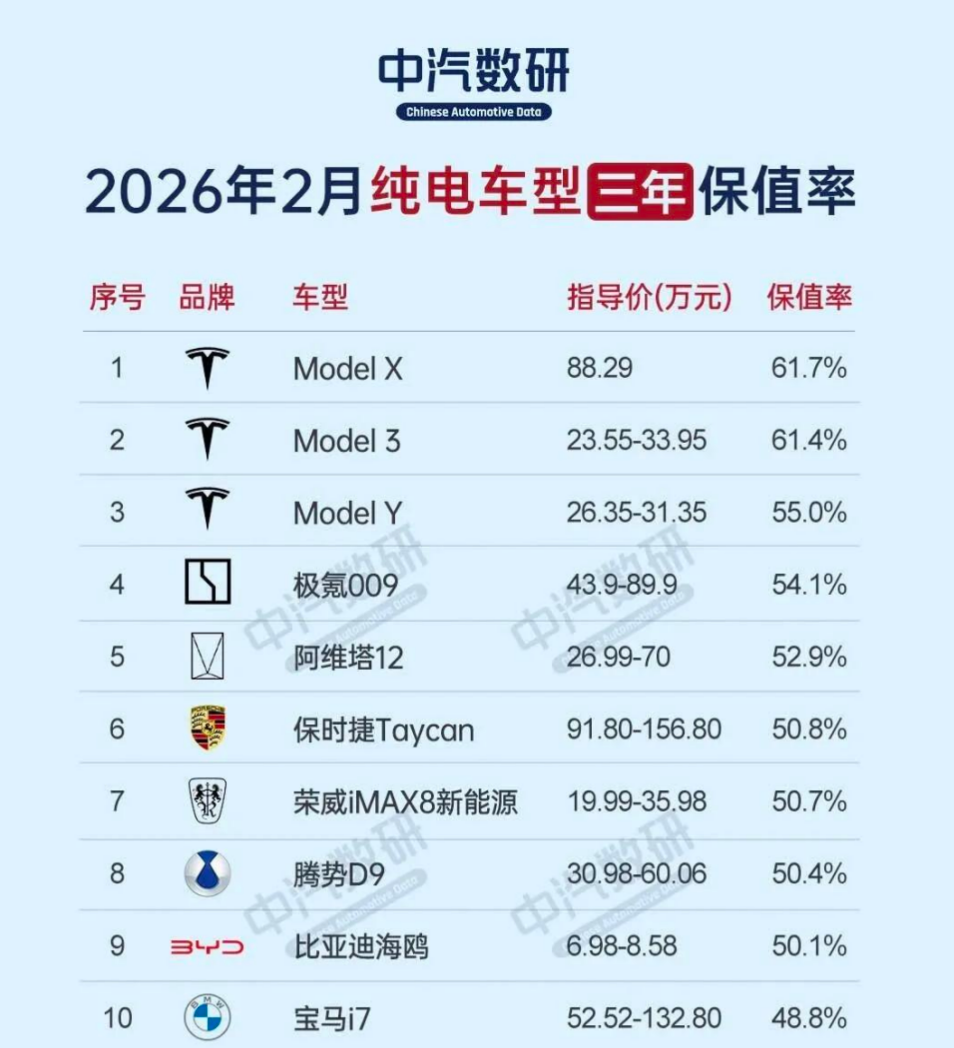
Image source: China Automotive Data
Rapid progress is exhilarating, but it renders models equipped with older technology obsolete almost overnight, naturally crushing their secondhand value.
Then there are the hurdles of battery costs and maintenance fees. As the core component accounting for nearly 40% of a vehicle's total cost, battery health directly dictates value. Yet with no unified testing standards and replacement costs running into the tens of thousands of yuan, used-car dealers and potential buyers are often spooked. A used car needing a new battery can effectively see its trade value hit zero.
At the same time, the market is reeling from the impact of price wars. To seize market share, numerous automakers have frequently slashed prices, added features, and launched more cost-effective models. Tesla, for instance, has adjusted prices on the Model 3 and Model Y repeatedly over the past few years.
Falling new car prices have forced down the ceiling on used models. Many early adopters have found their cars' residual values are actually lower than the transaction prices of new cars after discounts—a phenomenon known as "price inversion."
By contrast, traditional internal combustion engine vehicles generally hold above 50% after three years, with some luxury models exceeding 60%. The average for new energy vehicles remains noticeably lower.
NEVs depreciate far faster than fuel vehicles—a necessary cost of rapid technological evolution. For consumers, this means that when choosing a new energy car, a rational assessment of long-term value is just as important as looking at range, intelligence, or performance.
For automakers and the industry, the challenge is to build a better battery assessment framework and a more stable pricing structure while pursuing innovation. Ultimately, only when a car retains significant value after three years will new energy vehicles become a truly worry-free choice for mainstream consumers.
Current market performance shows NEV resale rates are still in a developmental phase. While some hot models hold value well at launch, three-year retention generally drops below 70%, and overall depreciation remains faster than for traditional fuel cars.
However, as the market matures, these issues are likely to improve. Advances in battery technology, better software upgrade capabilities, and a more robust used-car circulation system could all boost the long-term stability of NEV values. For buyers, resale rates are becoming an increasingly critical factor alongside range and specs.


