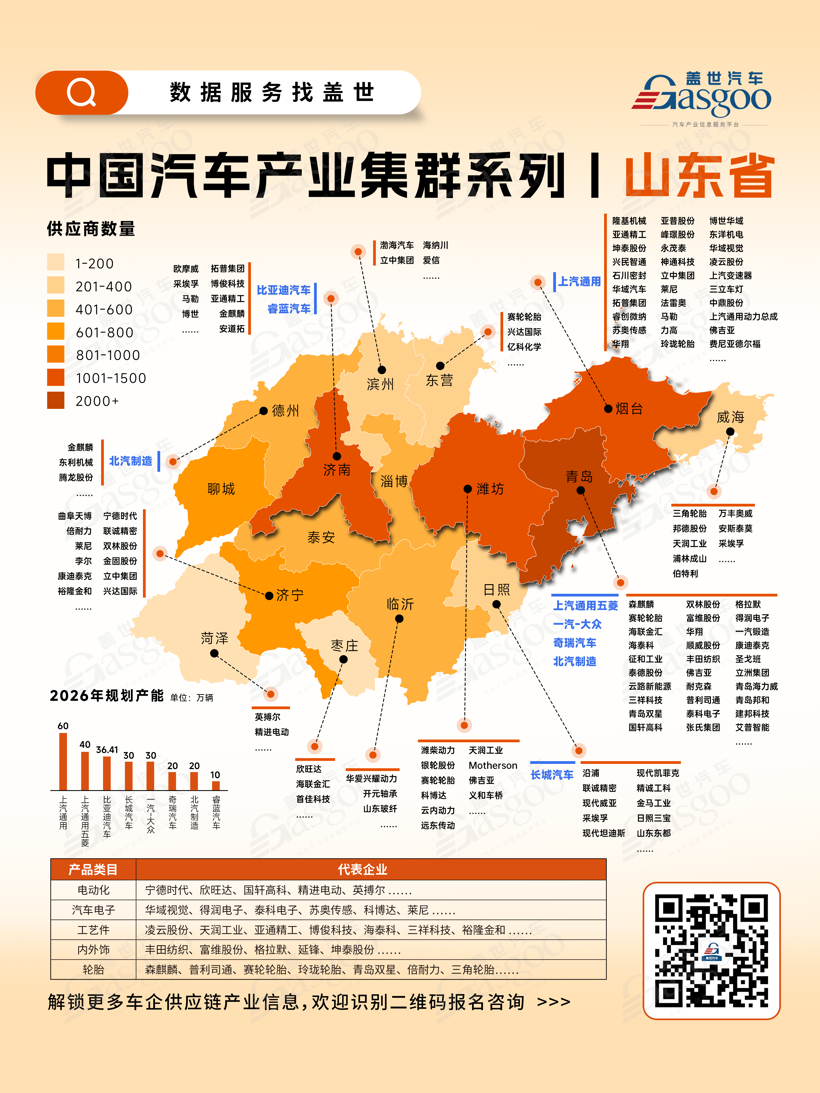
According to Gasgoo's global automotive industry data map, Shandong Province's automotive cluster has matured into a robust ecosystem defined by leading enterprises, comprehensive supply chains, and tight coordination. The region stands out for its distinct industrial agglomeration and synergistic growth.
Geographically, the sector is characterized by "multi-point support and full-domain coordination." Anchored by major automakers such as BYD, SAIC-GM, and FAW-Volkswagen, the region integrates key suppliers in electrification, electronics, and interiors to create a powerful industrial ecosystem with strong spillover effects. Qingdao, Yantai, and Weifang serve as the core pillars, while Jinan, Binzhou, and Linyi play vital roles in vehicle manufacturing and component supply. Meanwhile, cities including Heze, Zaozhuang, and Rizhao have become key destinations for industrial capacity transfer. This spatial layout—driven by core hubs and supported by multiple nodes—boosts coordination efficiency while fostering balanced regional development.
In terms of capacity planning, Shandong is pursuing a dual-track strategy that grows traditional automakers alongside new energy players. Looking ahead to 2026, SAIC-GM leads with a planned capacity of 600,000 units, establishing itself as a core pillar. SAIC-GM-Wuling, BYD, Great Wall Motor, and FAW-Volkswagen follow with significant capacities exceeding 300,000 units each. Chery, BAIC, and Livan Auto have planned capacities of 200,000, 200,000, and 100,000 units, respectively. This parallel development path not only consolidates the foundation of traditional internal combustion engine vehicles but also reserves sufficient space for the large-scale expansion of new energy vehicles.
Structurally, Shandong has built a comprehensive supply chain spanning electrification, automotive electronics, process components, interiors, and tires. In electrification, giants such as CATL, Sunwoda, and Gotion High-tech have established local matching capabilities from core components to assemblies. The electronics sector sees HASCO Vision, Deren Electronics, and TE Connectivity providing efficient support to OEMs. Process component manufacturers such as Lingyun Industrial Corporation, Tianrun Industry, and Yatong Precision Engineering demonstrate strong capabilities, while Toyota Boshoku, Faway, Sentury Tire, and Bridgestone leverage deep industry expertise in interiors and tires. Collectively, Shandong boasts a complete industrial chain with standout supporting capabilities, cementing its status as a key manufacturing and supply base in East China.
Currently, Shandong's automotive cluster is at a pivotal juncture, focused on consolidating its scale advantages while accelerating the shift toward new growth drivers. Looking ahead, the province must amplify the technological spillover effects from its core regions and guide supporting cities such as Zaozhuang and Heze to foster innovation. The goal is to transform industrial capacity transfer into a process of quality upgrading. By leveraging its existing foundation and increasing investment in new energy components and intelligent connectivity technologies, Shandong aims to evolve its cluster from one based solely on manufacturing strength to a dual advantage of technology and production. This strategy is designed to secure its position as a central hub in East China amid the global automotive transformation.