



Gasgoo Munich- Japan's auto market is undergoing a profound structural shift.
New car sales in Japan grew roughly 3% for the full year of 2025. At first glance, the figure suggests the market is shaking off the gloom from previous testing scandals and settling into a mild recovery. Yet a closer look reveals a landscape far more complex and tense than the surface data implies. Behind the overall growth lies a market at a crossroads—nurturing fractures within stability, hiding change within conservatism, and searching for a path between traditional moats and the currents of a new era.
From a macro perspective, that 3% gain wasn't a broad-based boom. It was driven by specific factors and business expansion. The engine came from two sources: first, a rebound in Toyota and Daihatsu models that had halted production due to certification irregularities. This bounce from a low base was essentially restorative compensation for an abnormal contraction, not organic demand growth. Second, while hybrids remain the market's bedrock, pure electric vehicles are beginning to stir, prodded by policy incentives and new product launches.
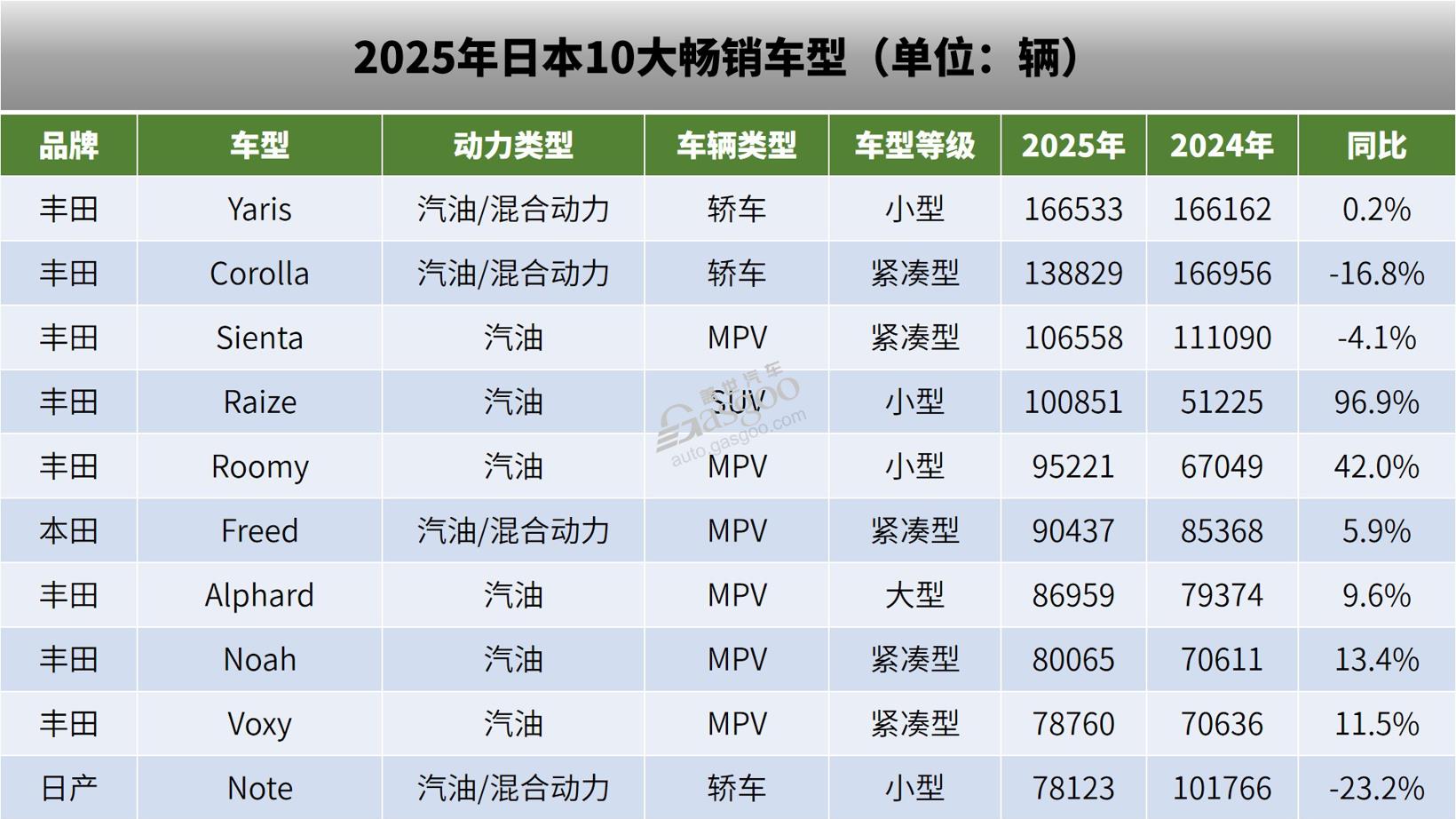
The top-ten bestseller list—dominated by eight Toyota models alongside one each from Honda and Nissan—highlights the market's core tension. On one side stands an impregnable fortress of domestic giants; on the other, foreign brands are launching a once-in-a-century offensive, using electrification and channel revolutions as their wedge. Over the past year, Tesla, BYD, and Hyundai have all made notable strides. As the electrification wave finally knocks on Japan's door, the technological paths and product logic of these local giants—long sheltered in the "world's most closed open market"—are facing unprecedented challenges.
At the same time, a generational shift in consumers is reshaping the fundamentals of demand. The phenomenon of Japan's urban youth "moving away from cars" is becoming increasingly common.
With extreme public transport networks, widespread car-sharing, and high ownership costs (parking, insurance, taxes), the value anchor of the car is drifting for the younger generation—a stark contrast to the buying frenzy of the 1970s economic boom. Today's market must simultaneously satisfy the aging society's demands for usability and safety, while addressing a younger generation rethinking the value of ownership.
Source: Gasgoo Automotive Industry Big Data Platform
Toyota's Absolute Dominance
On the 2025 bestseller list, the first thing that catches the eye is Toyota's "sweep" of the rankings.
Toyota occupies eight of the top ten spots. This is more than just market share advantage; it is the construction of a national mobility ecosystem defined by Toyota. This dominance didn't happen overnight. It is the result of years of democratizing technology, covering every product segment, and cultivating a deep dealer network. Yet beneath this seemingly calm hegemony, the year-on-year changes in model sales are surging like undercurrents beneath the sea.
The battle for the top spot is most striking. The Toyota Yaris defended its crown with 166,500 sales, widening the gap to the runner-up Corolla by nearly 30,000 units.
The Yaris perfectly embodies the Japanese pursuit of "just right." It isn't the most powerful or the most spacious, but with its compact design, excellent fuel economy (in both gas and hybrid versions), and evolving smart features, it hits the core Japanese demand: a competent, reliable, easy-to-drive commuter tool.
In stark contrast to the Yaris's stability, the Toyota Corolla—once a pillar of the mass market—saw a 16.8% sales plunge. This rise and fall hides a structural shift within the market. The Corolla's decline cannot be simply attributed to a lack of product strength; it is likely the result of consumer fragmentation and competition from rivals (including its own siblings).
The compact sedan segment where the Corolla lives is being squeezed from both sides by mini cars (like the Yaris) and MPVs (like the Sienta and Noah). For users chasing pure economy, the Yaris is enough; for families needing space, MPVs are the preference. The Corolla's "middle way" feels increasingly awkward in a market that demands extreme segmentation.
Another set of valuable comparisons comes from Toyota's "two pairs of twins": the Sienta and Roomy, and the Noah and Voxy. While Sienta sales slipped 4.1%, the smaller, uniquely positioned "boxy" Roomy surged 42.0%. This clearly indicates that Japanese consumers' understanding of space utilization is evolving.
The Roomy is akin to a Kei-car but with a larger engine, taking Japan's traditional "minimum footprint, maximum interior space" philosophy to the extreme. With its high roof and square cabin, it swallows large items easily, yet its compact exterior dimensions navigate Japan's narrow streets and tight parking spots with ease. The Roomy's explosion in sales is a concentrated outburst of demand for versatility from families on a budget with limited parking.
The Noah and Voxy, compact MPVs focused on a premium feel and practicality, posted significant growth of 11.4% and 11.5% respectively. This proves that the market for multi-member family transport remains resilient, and consumers are willing to pay for more spacious and dignified MPVs.
The breakthrough of Honda's Freed and Nissan's Note within Toyota's encirclement is also eye-catching. The Honda Freed sold 90,437 units, taking sixth place with 5.9% growth. Also a compact MPV, the Freed focuses on stylish design and flexible space, winning over young families and dual-income households. It proves that even in Toyota's shadow, precise product definition can still draw a warm market response.
The Nissan Note, however, became the list's biggest "loser," with annual sales crashing 23.2% and ranking dropping to tenth. The Note's Waterloo reflects potential rhythm issues in Nissan's product iteration and marketing, while also highlighting how the small sedan segment is being eroded by strong rivals and various crossover MPVs.
The Note's struggle is a microcosm of the shrinking survival space for traditional hatchbacks in Japan.
Decoding the Japanese Market
Looking at the top ten list for 2025, two core consumption codes of the Japanese auto market emerge clearly: an extreme preference for the MPV (multi-purpose vehicle) form, and a universal pursuit of the seemingly contradictory concepts of downsizing and maximizing space.
Strictly speaking, only three models on the top-ten list are sedans: the Yaris, Corolla, and Note. The remaining seven spots are occupied by MPVs and small SUVs/multi-purpose vehicles. To segment further, the Sienta, Freed, Noah, Voxy, and Alphard are standard MPVs, while the Roomy can be seen as the ultimate extension of MPV thinking onto a small chassis. This structure is no accident; it is the result of Japan's unique social culture, geography, and family structure.
Geographic environment and urban planning are the hard constraints shaping consumption habits at the most basic level. Japan's land area is small, and in urban clusters like Greater Tokyo, population density is extreme, road traffic is complex, and parking resources are incredibly tight. In this environment, buying a full-size pickup or large SUV often means exorbitant parking costs and a miserable driving experience on narrow streets.
Therefore, for convenience, the dimensions of daily transport vehicles must be strictly limited.
Yet at the same time, Japanese families—especially those with multiple children—and the rising culture of weekend getaways demand passenger and cargo capacity. MPVs solve this contradiction perfectly: they "contract" horizontally to fit into mechanical parking lots, while "expanding" vertically through high-roof designs to offer headroom and comfort far exceeding sedans.
The fact that the Toyota Alphard, a large MPV, can rank high on the list—and even grow 9.6%—proves the Japanese pursuit of ultimate comfort. The Alphard is more than a car; it is a mobile private room, a symbol of status and lifestyle. Its spacious rear seats and luxurious interior meet the dual needs of high-end business reception and family travel.
Considerations of energy efficiency and economy are also deeply ingrained in Japanese car consumption culture.
Japan's domestic resources are relatively scarce, and oil price fluctuations significantly impact household budgets. Many models on the top-ten list see a high proportion of hybrid sales. Toyota's ability to establish dominance in the domestic market is inextricably linked to its long-term accumulation of hybrid technology and cost control.
Hybrid systems not only deliver lower fuel consumption but also a smooth, quiet driving experience. This aligns highly with the Japanese pursuit of "Wa" (harmony) and a quiet, comfortable cabin environment. When choosing a Yaris or Noah, consumers usually favor the hybrid version because it offers tangible fuel savings over the vehicle's life cycle and commands a higher resale value. This calculation of total cost of ownership is a key mark of mature, rational consumer culture in Japan.
Furthermore, unique shifts in family and social structure are reshaping car consumption views. As the aging society intensifies, intergenerational interaction and travel needs within families are becoming more frequent. An MPV that allows the elderly to get in and out easily (via sliding doors), accommodates child seats effortlessly, and seats the whole family comfortably naturally becomes the top choice.
The Honda Freed's sales growth is largely due to its design friendliness toward female drivers and elderly passengers—lower floors, easy controls, and flexible layouts make it a veritable "all-purpose nanny car." The Toyota Roomy's surge, meanwhile, can be seen as singles or young DINKs finding a balance between personality and practicality. It is more stylish than a traditional micro-car and carries more than a standard sedan, perfectly satisfying the new generation's pursuit of a "low desire but high quality" life.
Real Challenges Behind Entrenched Habits
Japanese car consumption habits display a high degree of "involution" and path dependence. This formation is deeply rooted in post-war economic history, unique automotive culture dissemination paths, and long-term stable competition among companies.
Understanding these habits is key to grasping the future trajectory of the Japanese auto market.
On one hand, these habits reflect strong "groupism" and conformity. In Japan, a car is more than a tool; it is a social label. Choosing Toyota, the market share leader, means choosing reliability, value retention, and error-free decisions. This psychological need to avoid errors is particularly important in a collective culture. Thus, we see extreme concentration on the bestseller list: Toyota takes eight spots, with the other two going to traditional powerhouses Honda and Nissan. For new brands, especially foreign ones, shaking this structure is incredibly difficult. It is not just a question of product strength, but of challenging a social system of trust, service, and community identity.
On the other hand, habit formation is tied to Japan's automobile tax and inspection ("Shaken") systems. Long-term taxes based on displacement and weight lead consumers to favor light, small-displacement models. Meanwhile, strict inspections make ownership costs high, prompting consumers to buy new cars every few years. This ensures new market turnover but creates a highly mature used car market where resale value is crucial. Toyota's high resale values reinforce the motivation to buy Toyota, creating a self-reinforcing loop.
Japanese consumers' pursuit of functionality and detailed design is another key habit. They care less about hardcore specs like 0-100 km/h times or max engine power, and more about the ingenious design of interior storage, the ease of folding third-row seats, the position of handrails for the elderly, and instrument readability. This is why domestic MPVs thrive while foreign brands struggle to "stand out"—they often fall short in polishing those "people-oriented" details.
However, this deep-rooted habit faces unprecedented challenges in the face of the auto industry's "once-in-a-century" transformation.
First is the shock of electrification. With the global expansion of new forces like Tesla and Chinese EV brands, will Japan's relatively conservative consumption inertia become a burden on its transition? Currently, consumers still doubt charging infrastructure, range anxiety, and the long-term reliability of pure EVs. But as battery tech breaks through and infrastructure improves—especially as younger generations accept new tech products—consumer preferences could undergo a generational switch.
Second is the challenge of intelligence and connectivity. The iteration speed of infotainment and intelligent driving assistance in Japanese models appears conservative compared to some Chinese and American models. While Toyota's Toyota SafetySense continues to improve, Japanese demand for the car as a "mobile smart terminal" hasn't been fully triggered. As consumers with stronger internet DNA grow up, will they remain satisfied with the existing, relatively closed infotainment ecosystem? This will be another variable deciding future list rankings.
Finally, there is the long-term pressure of macroeconomics and social demographics. The trends of a declining birthrate and aging population are irreversible, meaning the overall new car market may see its peak and even shrink long-term. In this scenario, how to mine the stock market and meet the needs of increasing elderly drivers (easier operation aids, safer passive safety) will be the focus of competition. Meanwhile, the low desire and car detachment of the younger generation require automakers to use more attractive products to reignite interest.
Conclusion:
The 2025 Japanese auto market is a paradox of change breeding within stability and breakthrough sought within entrenchment. With its precise grasp of local needs, Toyota has built a nearly unshakable fortress; MPVs and small cars firmly hold consumer mindshare through space efficiency and practicality. These habits are the inevitable result of overlapping geography, society, and culture, reflecting Japan's extreme pragmatism and pursuit of collective identity.
Yet, the global industry's shift toward electrification and intelligence acts like an external flood, constantly washing against this seemingly solid dam.
In the short term, a disruptive upheaval in the Japanese market is unlikely. But the changing numbers on the bestseller list will increasingly reflect the game between tradition and reform, conservatism and openness. For all participants, understanding and respecting this uniqueness, while keenly capturing the faint signals of generational turnover and technological evolution, will be the key to winning the future.


