



Gasgoo Munich- Recently, XPENG and global auto glass leader Fuyao Group announced in Fuzhou that their jointly developed AI dimming privacy glass has entered mass production. The technology makes its debut on the GX, XPENG's new flagship.
This isn't "color-changing glass" in the traditional sense. Integrated with a large AI model, it automatically adjusts transparency based on ambient light, cabin scenarios, and user preferences—marking a leap from passive sunshading to active intelligence.
Breaking the Mold: From Aviation Tech to the Road
The AI dimming privacy glass on the XPENG GX stems from dimmable solutions used in aviation cabins. Its core relies on LC dye liquid crystal technology—using an electric field to control the alignment of liquid crystal molecules, allowing for continuous transparency adjustment.
Compared with traditional physical sunshades or fixed-tint privacy glass, the breakthrough here lies in speed and precision: switching from fully transparent to fully opaque takes just 0.16 seconds—instantaneously.
Even more noteworthy is the "AI" component.
This glass doesn't merely respond to on-off commands. It is deeply integrated into the vehicle's electronic and electrical architecture, leveraging a large AI model for intelligent dimming.
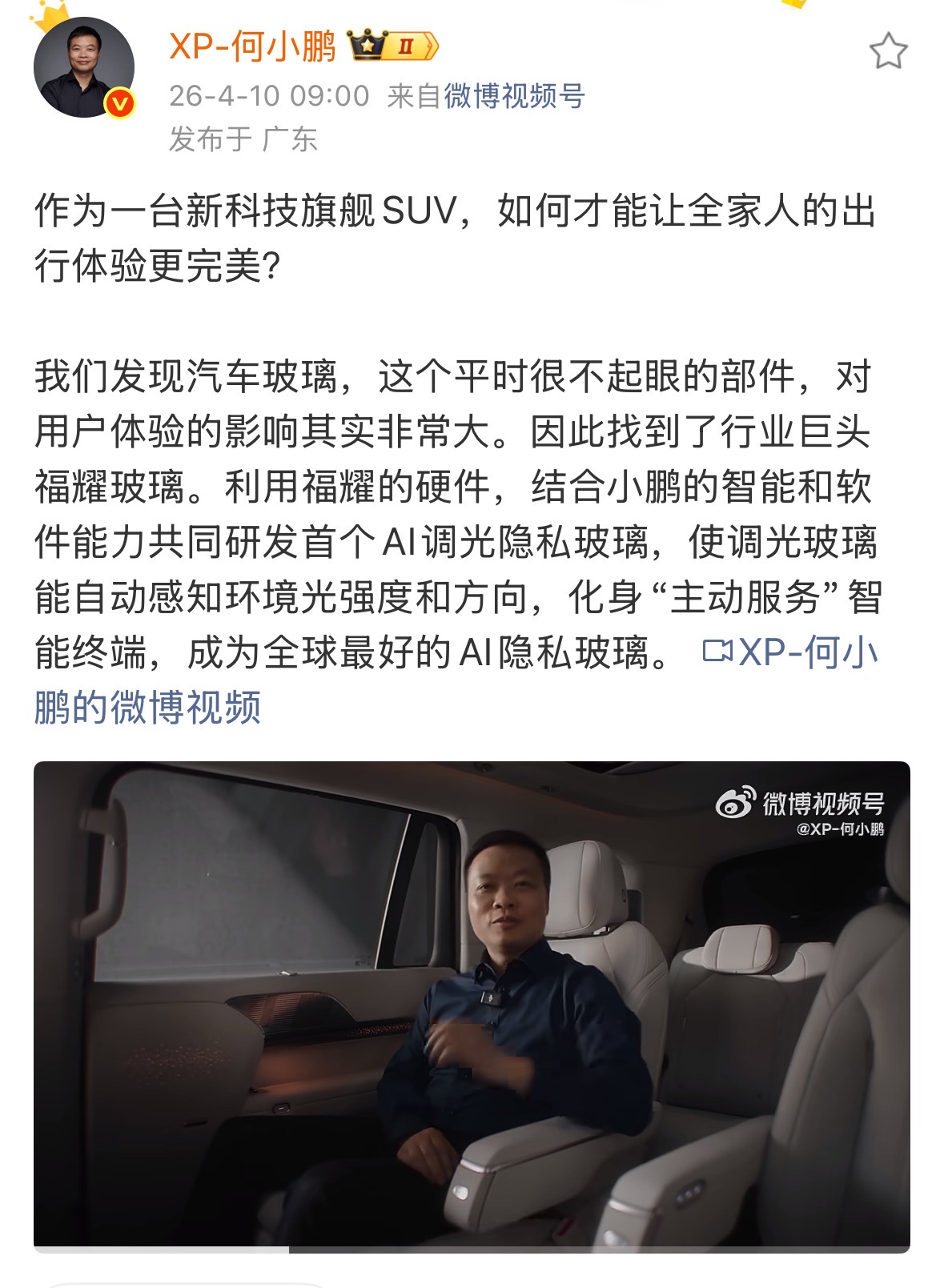
Image Source: He Xiaopeng's Weibo
It senses external light intensity, the sun's elevation angle, and driving direction, even recognizing specific cabin scenarios. For instance, it automatically dims the rear windows during highway driving to protect privacy, yet instantly switches to full transparency when entering a tunnel to ensure clear visibility.
This ability—to let glass "understand" light—transforms it from a physical component into a core sensor and actuator within the cabin's intelligent system.
Traditional cabin light management has undeniably hit its limit.
Physical sunshades eat up headroom, lack a premium feel, and offer zero intelligence. Standard tinted glass has fixed transmittance, unable to balance lighting and privacy across different scenarios. Even PDLC (Polymer Dispersed Liquid Crystal) glass, popular in recent years, only toggles between fully transparent and fully frosted states. It lacks continuous grayscale adjustment and often retains a hazy, frosted look even when transparent, compromising the visual experience.
The LC dye liquid crystal technology developed jointly by XPENG and Fuyao delivers a decisive advantage over traditional solutions on multiple fronts.
Official data shows the glass covers 1.88 square meters, spanning the entire second and third rows. It supports continuous grayscale adjustment from 0% to 65%, rather than a simple binary toggle. It also offers sound insulation 3 to 5 decibels better than tempered glass of the same thickness.
This means windows are no longer just structural components for ventilation and light. They are evolving into multifunctional intelligent terminals that combine privacy protection, light management, and noise reduction.
For Fuyao Group, this deep collaboration with XPENG goes far beyond supplying technology for a single model.
Its 2025 annual report reveals revenue surpassed 45.7 billion yuan, with net profit climbing 24% year-on-year. The company has explicitly set a core strategy to "expand the boundaries of a piece of glass," extending its industrial chain with smart glass at the center.
Behind a capital layout that sees annual R&D investment exceed 49.8 billion yuan lies the determination of this global auto glass giant to transform from a traditional manufacturer into an intelligent solutions provider.
The Automakers' "Glass Race": From Component to Experience Core
XPENG isn't the first automaker to push dimming glass into the spotlight.
A review of product trends over the past two years reveals that a "glass race" has been quietly unfolding among major automakers.
The 2025 Shanghai Auto Show featured dimming glass technology. The AITO M9 pioneered intelligent privacy windows, allowing users to adjust transparency via voice or touch to shift between business and family modes. IM's L6 and ZEEKR's 007 GT also displayed their respective dimming sunroof solutions, while Audi's E5 Sportback, representing foreign brands, included a dimming roof in its specs list.
Around the same time, the Xiaomi YU7 Max came standard with a next-generation EC (electrochromic) smart dimming roof from Amber Technology. It boasts a shading rate of 99.85%, blocks 99.9% of UV rays, and supports independent dual-zone dimming.
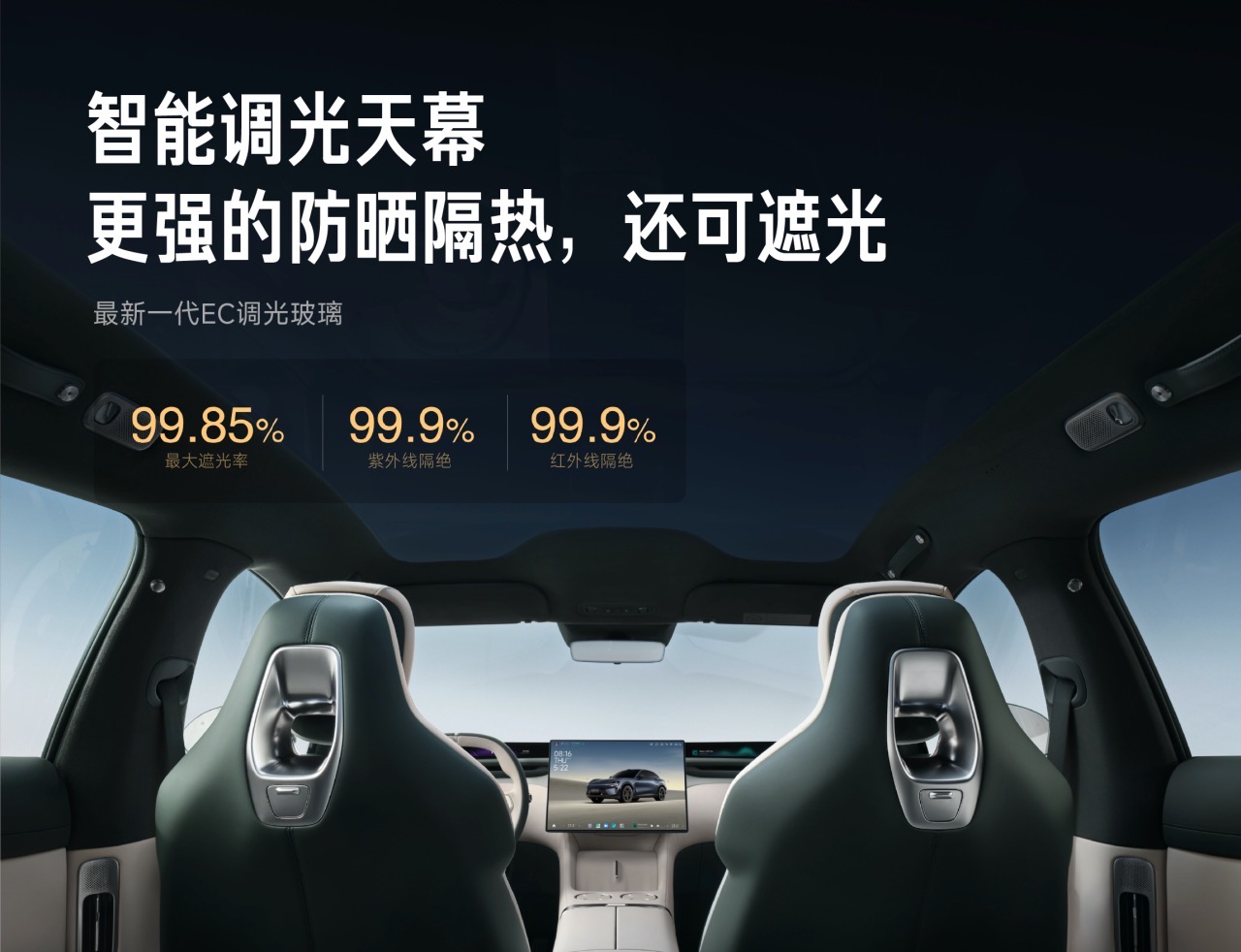
Image Source: Xiaomi YU7
By early 2026, Xiaomi's new SU7 Max was further upgraded with the latest generation of dual-zone EC dimming glass, featuring an intelligent dimming roof that balances sun protection and privacy.
At a March launch event, this feature was heavily promoted as a core selling point. The pitch—"noise stays out, heat doesn't burn"—resonated directly with the pain points of EV owners.
There is profound industry logic behind why automakers are focusing their attention on glass.
First, the design evolution of EVs. Data shows the installation rate of panoramic sunroofs in domestic new energy vehicles has exceeded 75%, with some brands making them standard equipment. Glass area per vehicle can now reach up to 5 square meters.
When glass becomes the largest and most visible part of a vehicle's body, its quality directly shapes the user's first impression.
Second, the escalating battle for the smart cabin. As specs like chip computing power, screen size, and seat functions begin to converge, automakers are desperate to find new avenues for differentiation.
Glass is a dimension long overlooked yet intimately tied to user experience—directly affecting interior lighting, privacy, thermal comfort, and NVH performance.
Whoever innovates within this "transparent space" will seize the advantage in an increasingly homogenized cabin experience market.
Third, the convergence of technology routes and falling costs. Early dimming glass, limited by immature tech and high prices, was optional only on million-yuan luxury models. But with breakthroughs in EC, LC dye liquid crystal, and PDLC technologies, and a maturing supply chain, costs per vehicle are dropping fast.
Research data indicates global sales of panoramic dimming glass for passenger vehicles reached 17.8 billion yuan in 2023. This is expected to grow to 43.56 billion yuan by 2030, representing a compound annual growth rate of 15.3%. Economies of scale are pushing this once-exotic technology into the mainstream market.
Notably, the national standard "Intelligent Color-Changing Glass for Automobiles" took effect in February 2025—China's first unified industry specification for automotive dimming glass. The standard's arrival signals both recognition of the technology's maturity and a market poised for explosive growth.
Conclusion: From "Having It" to "Which One"
If the first phase of competition focused on "whether to have dimming glass," the next phase will focus on "which glass" and "how smart it is."
The XPENG GX offers an answer: not just the roof, but full coverage for the second and third rows; not just manual control, but AI-powered sensing. This suggests dimming glass will expand from a single roof application to full-vehicle coverage, evolving from passive response to active anticipation, eventually becoming an integral part of the smart cabin ecosystem.
It is foreseeable that in the near future, "smart glass" will become standard equipment in mid-to-high-end vehicles, much like large central screens and HUDs are today. And the "glass race" among automakers has only just entered the fast lane.


