



Gasgoo Munich- Spring 2026. The 4th Embodied Intelligent Robot Industry Development Forum, hosted by Gasgoo, offered a snapshot of the sector's fierce tech race. Data collection, large models, humanoid robots, and generalization capabilities took center stage. Yet, beneath the surface, anxiety was quietly spreading through the venue.
Speakers vied to showcase proprietary achievements. "We built our own base model." "We developed a full-stack operating system." "Our data has reached XX hours." The claims echoed one after another, but they masked a nagging concern: everyone is fighting their own battles in isolation. Are these limited resources, scarce data, and top talents actually accelerating the industry—or just fueling a massive waste of resources?
This isn't a moral question; it's a mathematical one that will determine the industry's survival.
Data Silos and an Order-of-Magnitude "Data Famine"
To truly converge an embodied model, industry consensus holds that it requires at least several million hours of effective data—or perhaps even tens of millions.
Public data from overseas leaders like Tesla's Optimus and Boston Dynamics show their core training data has already breached the million-hour mark. But asked about China's standing, Xu Guoqiang, Director of the Research Ecosystem at Qunxun Intelligence, was blunt: "The combined data from all domestic embodied intelligence companies might only amount to a few hundred thousand hours. We are a full order of magnitude away from true model convergence."
More critically, even if the data from every top-tier domestic company were pooled, the volume would still fall short—and the quality would likely fail to meet the mark.
Most domestic data is concentrated on basic scenarios like robotic arms grabbing cups or simple movements. The proportion of effective, high-complexity, cross-scenario data is extremely low. Even aggregated, it struggles to support the true generalization capabilities models require.
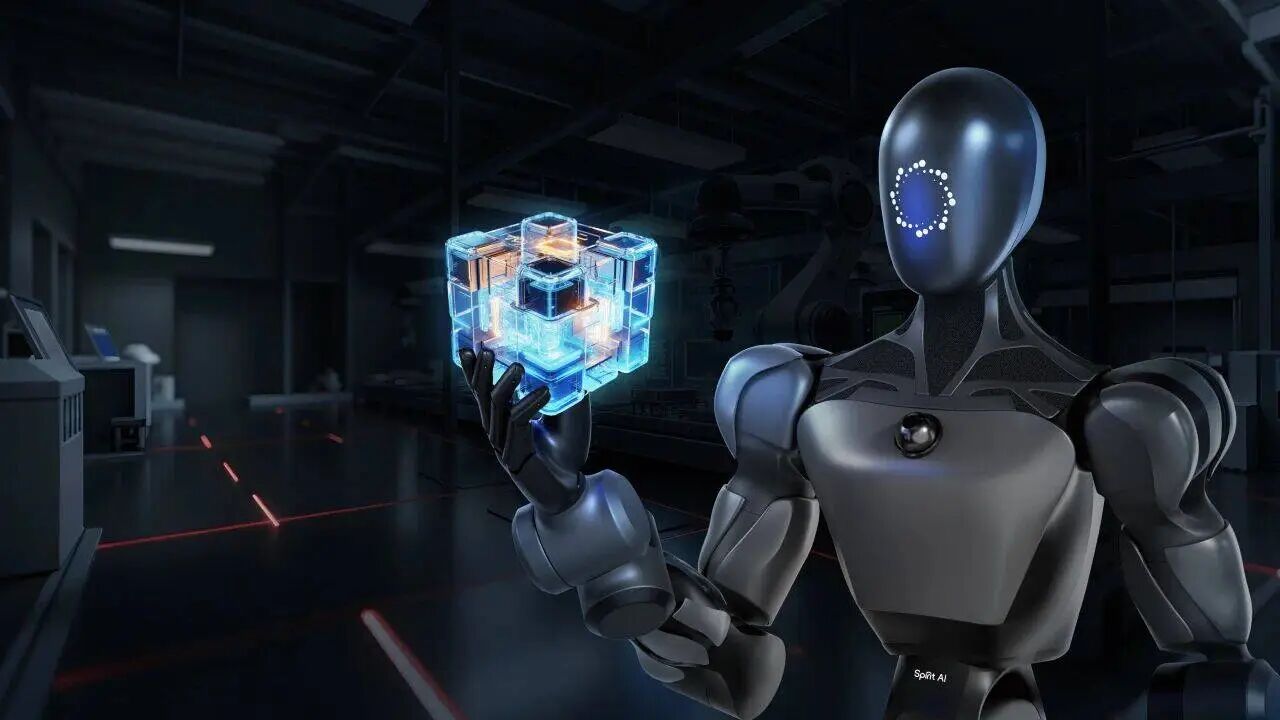
Image Source: Qunxun Intelligence
Data barriers are only exacerbating this predicament.
Today, data is not just the raw material for embodied intelligence; it is every company's "core asset." Xu describes the current mindset as treating data like a buried treasure: "Everyone holds their data tightly, unwilling to share, terrified that competitors might get a peek."
In this state, the entire industry resembles a group digging separate wells in a dry riverbed. If they just dug a little deeper, they would hit groundwater. Instead, they hover at the surface, repeatedly collecting basic data. The resulting waste of social resources is staggering.
This mirrors the data silos of the early automotive industry. Years ago, plant process data, vehicle-to-infrastructure data, and in-car operation data were all treated as top secrets. The barriers to interoperability became a major bottleneck for the industry's intelligent upgrade.
Compared to the "information silos" of the early internet, the data barriers in embodied intelligence are far harder to break. In the software era, copying code cost nothing. But collecting embodied data requires real physical equipment, space, and time. Every robot grab, movement, or stumble represents a tangible financial investment.
A turning point is budding. Xu reveals that China is pushing for the construction of national-level embodied intelligence data training grounds. Several universities have already incorporated embodied intelligence majors into their curricula and integrated data collection into daily student assessments. "This barrier will gradually be broken," he admits. "The current fragmentation is a specific characteristic of the industry's early stages. In the future, the lines of data sharing will blur."
But the question remains: Can the industry afford to wait? 2026 to 2027 is already viewed as the critical window for the commercialization of embodied humanoid robots. If the sector cannot cross the fundamental threshold of "data magnitude + quality," the so-called industry competition might just be a game lost before it even begins.
Beyond data silos, the internal friction over underlying operating systems is becoming another shackle holding the industry back.
Operating Systems: Waiting for the Disruptor to "Rule the World"
If data is the fuel, the operating system is the engine. As for whether the future robot OS will resemble the Windows-style dominance of the PC era or the Android-iOS duopoly of the mobile era, industry views are decidedly pragmatic.
The core issue right now isn't the future landscape, but the current quagmire of internal friction.
Lyu Jun, a research scientist at NonEmpty Intelligence, admits that the industry is still in its infancy. Technology has not yet achieved cross-scenario universality. Even within a single company, different delivery scenarios often require multiple operating systems running in parallel, making industry-wide unity out of the question. "This isn't because companies are doing a poor job," he explains. "Fundamentally, embodied intelligence technology hasn't reached the level of cross-scenario, large-scale application."
This strikes at the industry's most essential pain point: technological maturity is nowhere near the tipping point for "standardization." Windows unified the PC era because underlying hardware was standardized and software needs were clear. The mobile duopoly was built on a foundation of converging hardware form factors.
But in the era of embodied intelligence, robot forms vary wildly. Application scenarios differ vastly, from industrial production lines to home kitchens. A model that runs smoothly on Company A's wheeled robot might simply "crash" when ported to Company B's bipedal robot.
This scene closely resembles the internal friction over electronic control systems in the early auto industry. Years ago, hundreds of domestic automakers developed their own systems independently, resulting in repetitive investment and low efficiency. That trend was eventually ended by the unification of domain controllers and the convergence of in-car OS architectures. The breakthrough for embodied intelligence OS may well follow this path to standardization: first achieving internal OS unity, then gradually driving industry-wide compatibility and integration.
Lyu Jun voices a common expectation within the industry: "Personally, I hope to see one or two companies launch a stable, reliable general operating system compatible with different models and hardware devices. This would reduce homogeneous competition and encourage resource integration, allowing us to focus limited power on core technology R&D."
In fact, fueled by capital, "competition" is often equated with "vitality." But in fields where technology is immature and basic science has yet to see breakthroughs, premature and excessive homogeneous competition essentially crowds out scarce scientific research resources.
If every company has to reinvent the wheel, write underlying drivers from scratch, and build their own operating system, who will be left to solve the true core challenges—like "enabling robots to understand vague human commands" or "autonomous cross-scenario adaptation"?
Lyu Jun elevates the perspective: "Embodied intelligence is a cause requiring massive investment, and it concerns national-level technological competition. We cannot afford internal friction." If domestic companies fail to form a synergy at the OS level, what they face in the future may not be commercial competition, but a technological crushing defeat on the international stage.
Open Source and Integration: A Strategic Choice at the Crossroads
Facing the dilemma of going it alone, domestic companies have begun exploring paths to a breakthrough. Open source and vertical integration are proceeding in parallel, both pointing toward a hybrid ecosystem of "open-source base + private data."
In December 2025, Daxiao Robot released the ACE embodied R&D paradigm, constructing a full-link technical system of "environmental data collection — Kairos World Model 3.0 — embodied interaction." Through environmental data collection schemes, this system can achieve data collection on the scale of 10 million hours annually. Combined with the data enhancement capabilities of the Kairos World Model 3.0, it can generate training results equivalent to 100 million hours, alleviating the data bottleneck the industry has long faced.
Now, following the open-sourcing of the Kairos World Model 3.0 (Kairos 3.0)-4B series of embodied native world models, Daxiao Robot has officially open-sourced "ACE-Brain-0" to the entire industry. This is a general base model with spatial intelligence as its underlying framework, capable of crossing different embodied forms.
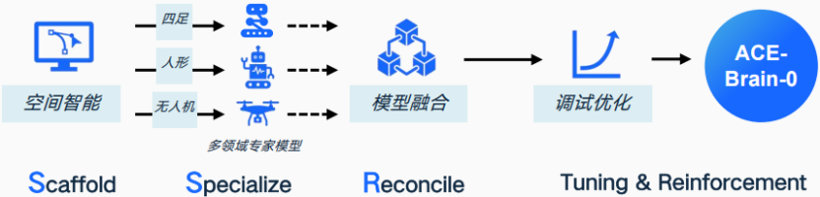
ACE-Brain-0 Architecture
Daxiao Robot's choice to open-source its core model may seem "counter-intuitive," but it actually rests on clear strategic considerations. "Embodied intelligence is still in the early stages of the industry, and commercial competition hasn't reached a white-hot phase yet. The current core goal is to get more people involved in R&D and achieve resource sharing—including data, models, and underlying toolchains."
This "infrastructure mindset" aims to amortize the industry's trial-and-error costs. Zhou Quan explains further: "We open-source part of our data, basic spatial intelligence models, and world models because we hope developers can use this foundation to explore vertical application directions at low cost. Together, we can improve the technical infrastructure and drive overall industry progress."
Beyond Daxiao Robot, several other domestic tech companies have also opened up their underlying robot control algorithms, attempting to jointly build an industry foundation and break the deadlock of cutthroat competition.
In contrast to the open-source trend is the logic of vertical integration. Yet even users who lean toward vertical integration maintain an open attitude toward the open-source ecosystem. Liu Shengxiang, Director of NIO's Manufacturing Operations Center, offers the most pragmatic perspective from the viewpoint of automotive production line applications.
"We collaborate deeply with ecosystem partners—including model experts, data collection manufacturers, and robot makers. The core is to solve actual scenario problems on automotive production lines and drive the industrial implementation of embodied intelligence."
The prerequisite for cooperation he emphasizes points directly to the core pain points of industrial scenarios: data security and privacy. "We can use open-source models, but the final deployment must be local. Training data cannot leave the enterprise."
This is also a common requirement in the automotive industry: operational data on production lines, process parameters, and assembly flows are core trade secrets. They can absolutely never be uploaded to the cloud for third-party model training.
Factory robot applications at automakers like BYD and Tesla also adopt the "open-source model + local fine-tuning" model, reducing R&D costs while ensuring data security.
This leads to a broad industry consensus: the future embodied intelligence ecosystem will be neither a purely open-source utopia nor a completely closed vertical empire, but a hybrid form of "open-source base + private data."
Open-sourcing basic models and underlying toolchains lowers the barrier to entry, allowing SMEs and developers to participate at low cost. Closed loops of enterprise private data protect core interests and data security, enabling adaptation to personalized scenarios.
This model avoids data silos and OS friction while balancing commercial competitiveness. The practices of the automotive industry have already provided a proven template for this approach.
Back to the Original Question: When Will the Waste of Building Separate Models End?
Judging by industry discussions, the answer is not pessimistic. The sector has soberly realized that "missing a zero in data magnitude" is not alarmist talk, and "OS friction" is not unfounded worry. National forces are intervening in the construction of data training grounds, leading companies are attempting open-source sharing, and users are calling for a new cooperation model that protects data sovereignty while lowering development costs.
Perhaps the "tipping point" for the embodied intelligence industry depends not entirely on whether a certain model's parameter count breaks into the billions, but on whether the industry can find the golden balance between "competition" and "collaboration." Just like the early internet: it was only after the TCP/IP protocol became a consensus that the prosperity of the World Wide Web followed.
For embodied intelligence, what the industry needs may not be a hundred incompatible "operating systems," nor a thousand disconnected data silos. It needs a stable and reliable underlying layer. It needs basic models to be open-sourced so developers can experiment at low cost. And, more importantly, it needs data barriers broken so that national public platforms and commercial forces can complement each other.
The rest note to this "waste" will ultimately be written by those enterprises brave enough to break the barriers first. As a century of automotive history has proven, it was Ford's assembly line standardization that ended the inefficiency of hand-built cars, and Tesla's open-source patents that drove the popularization of electrification.
At the dawn of embodied intelligence, we hope Chinese enterprises will demonstrate the same foresight and courage—because when the entire industry is struggling in the mud, no single company can make it to shore alone.


