



Gasgoo Munich- During the Auto China 2026 on April 24, Shenzhen Hangsheng Electronics Co., Ltd. unveiled three core technology foundations designed for the AI Car era: the Kongming 3.0 advanced intelligent driving solution, the DSSAD automated driving data recording system, and the Mozi 3.0 central computing platform paired with the Moyuan AI OS full-stack solution.
At the booth, Hangsheng’s management also outlined the company’s growth trajectory for the "15th Five-Year Plan," alongside updates on joint ventures, overseas expansion, and new business ventures.
Three Core Technologies: Intelligent Driving Solution, Data Recording System, and Central Computing Platform
The Kongming 3.0 solution emphasizes "software-hardware integration," built on a design philosophy where "algorithms define the chip" to achieve deep adaptation between the two. According to Hangsheng, the approach delivers a system cost reduction of over 30% while boosting performance. The chip features a built-in safety island compliant with ASIL-D functional safety standards, supports both air and liquid cooling, and is deployable across internal combustion and electric vehicles.
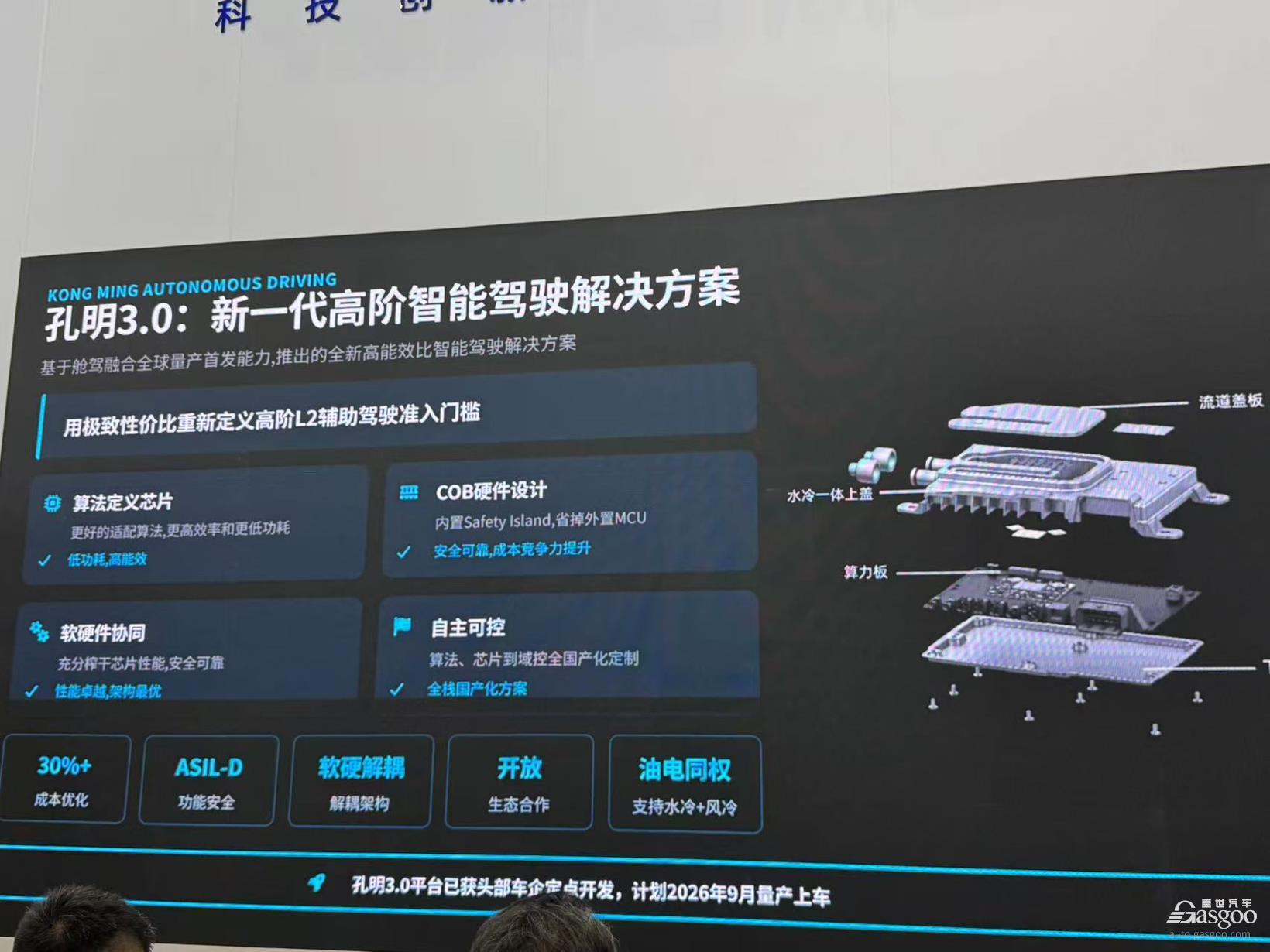
The solution has already secured designation from a leading automaker, with mass production scheduled for September 2026. In an interview, Hangsheng Electronics Chairman Yang Hong highlighted Kongming 3.0’s core advantage: "Algorithms define the chip, enabling deep software-hardware synergy for lower power consumption and higher efficiency." He added that the system achieves "full domestic autonomy and controllability, from core algorithms to domain controllers."
The DSSAD automated driving data recording system is designed strictly in accordance with the national GB 44497-2024 standard. It captures critical data, including vehicle operating status, automated driving system commands, environmental perception information, and driver inputs. The system features a fully automotive-grade design compliant with ASIL-D functional safety, equipped with hardware secure boot, data anti-tampering, power-loss protection, and defenses against fire and water immersion.
According to Hangsheng, the DSSAD system serves a dual purpose: providing an objective basis for determining accident liability, and driving algorithm iteration using real-world scenario data.
The Mozi 3.0 central computing platform achieves a "five-domain fusion" architecture, centrally managing the cockpit, intelligent driving, connectivity, vehicle control, and on-device AI computing. By replacing traditional, scattered ECUs or domain controllers with one or two high-performance computing units, the platform boosts resource utilization by more than threefold and reduces cross-domain data interaction latency to under 3 milliseconds.
Offering a full matrix configuration from standard to flagship editions, the platform delivers computing power ranging from 100+ to 1,000+ TOPS, catering to diverse needs from economy to luxury models. The accompanying Moyuan AI OS features an AI HMI cross-screen panoramic 3D interface and the HSClaw active service agent.
Powered by edge-cloud fusion large-model capabilities, HSClaw can function offline by relying on on-device computing power. For instance, if a user cannot locate their vehicle in a complex parking lot, simply asking "Where is my car?" prompts the system to fuse positioning data, surround-view camera feeds, and map information to actively identify the vehicle's location.
In the field of new energy power control, Hangsheng also showcased dual motor controllers, integrated generator controllers, and multi-gear, multi-mode powertrains for commercial heavy-duty trucks. The company stated that these technologies have achieved industry leadership in integration, efficiency, NVH control, and energy conservation.
Business Stratification, JV Implementation, and Overseas Expansion“Three-Step”
In an interview, Hangsheng Electronics Chairman Yang Hong outlined the company’s growth trajectory for the "15th Five-Year Plan" period.
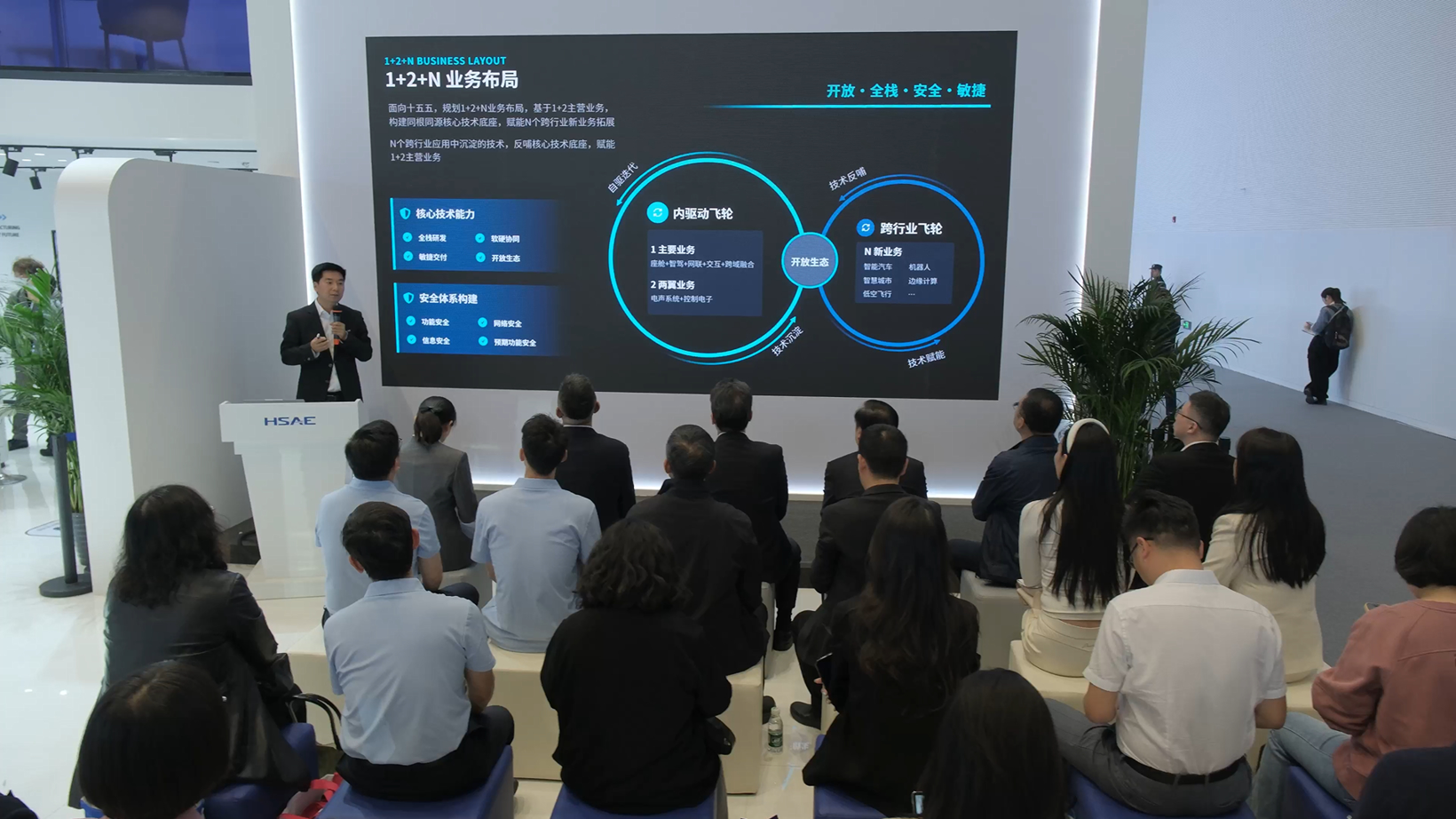
Image Source: Hangsheng Electronics
On the product front, Hangsheng is implementing a three-tier business portfolio comprising "Core, Growth, and Emerging" segments. Core businesses include cockpit domain controllers, intelligent driving, cabin-driving fusion, and intelligent interaction. Growth businesses cover central computing platforms, software services, and intelligent connectivity. Emerging businesses focus on embodied intelligence and vehicle-road-cloud integration.
On the market front, the company aims to solidify its joint venture base with partners like Nissan, Toyota, Honda, and Volkswagen while expanding into overseas markets including Europe, Southeast Asia, Japan, and North America. It also plans to deepen cooperation with Chinese domestic brands and emerging automakers.
Commenting on this strategy, Yang Hong stated: "Core businesses provide the cash flow and technological foundation for growth and emerging businesses, while emerging businesses open up new horizons for the next 5 to 10 years."
Regarding joint ventures, Suzhou Hangsheng-Autoliv Automotive Electronics Co., Ltd.—a partnership between Hangsheng and Autoliv—was officially inaugurated on April 16. Hangsheng revealed that the joint venture expects to achieve mass production for 13 projects by 2026, serving OEMs including Chery, Geely, Volvo, and Li Auto.
Yang Hong remarked on the partnership: "Our joint venture with Autoliv proves that Hangsheng has the strength to engage as an equal with international Tier 1 giants, enabling mutual empowerment." He expressed hope to explore similar deep partnerships with more international partners in areas such as intelligent domain controllers and next-generation perception systems.
In terms of overseas layout, Hangsheng is already establishing a production base in Thailand and plans to set up manufacturing facilities in Europe through partner channels. Over the past two years, the company has secured orders from major international clients, including Toyota in Southeast Asia, global Honda, global Suzuki, as well as Stellantis and Scania.
In an interview with media outlet Gasgoo, Yang Hong emphasized: "Going global cannot rely solely on cost advantages; we must uphold the bottom line of quality first to achieve the leap from 'going out' to 'moving up.'" Hangsheng targets overseas revenue to account for 30% of total revenue by 2030.
Expanding into emerging industries, Hangsheng is leveraging its technological foundations for intelligent vehicles to empower sectors such as robotics, the low-altitude economy, and microgrids. The company has already partnered with leading robotics manufacturers and low-altitude aircraft enterprises through both technology and manufacturing collaboration models. "We don’t do everything," Yang Hong stated. "We focus on what we do best—core electronics and computing foundations—to become the preferred supplier of key components in emerging industries."
Analyzing the opportunities and challenges for China’s intelligent automotive electronics sector over the next three years, Yang Hong identified three major opportunities: the value reconstruction driven by cabin-driving fusion, the rapid development of AI, and the historic window for Chinese automotive electronics to go global. Conversely, he cited the divergence between value and price wars, along with geopolitical and cultural compliance risks abroad, as primary challenges. He called on the industry to "return to value competition and win through technology and quality, rather than sheer price warfare."
Additionally, Hangsheng showcased its "1+2+N" product array at the auto show. This lineup covers automotive products such as intelligent driving, intelligent connectivity, intelligent interaction, acoustic systems, and new energy control electronics, as well as emerging products in robotics, the low-altitude economy, and microgrids.


