



Gasgoo Munich- "What is a true AI Vehicle? It's a question I get asked every time, yet I never have a standard answer."
Recently, at the 2026 Fourth AI-Defined Vehicle Forum, Meng Chao — senior director of SAIC Motor Passenger Vehicle's intelligent software center and CTO of Z-ONE Technology — threw that question into the room.
But that doesn't mean he lacks an answer of his own.
In Meng's view, a true AI Vehicle isn't one that simply adds a voice assistant or a specific driving feature. It's a vehicle that can understand user goals, break down tasks, and then mobilize the Vehicle's full capabilities to execute them. The metric for in-Vehicle AI should shift from "what model is used" to "what can it fully accomplish for the user."
He offered a concrete example.
It's raining at night, and a child is asleep in the back. The user gets in and says just one thing: "Keep it quiet, find an open pharmacy along the way, and remind me when we're nearby."
In the past, that might have meant lowering the volume, searching for a pharmacy, changing the navigation route, and setting a reminder — each function operating in isolation.
The AI Vehicle, as Meng understands it, first needs to figure out the context: the user needs medicine, doesn't want to wake the child, and doesn't want to go too far out of the way. Only then does it call on navigation, the cabin, vehicle controls, and even external services to get the job done seamlessly.
The difference isn't just that the infotainment system is better at conversation; it's that the Vehicle is starting to understand: what you actually want to do.
That raises a problem. If this counts as an AI Vehicle, does being good at chat count? Does being able to drive count? Does AI controlling the chassis count? If AI has already entered vehicle R&D, testing, and even after-sales service, what conditions must a Vehicle meet to be rebranded an "AI Vehicle"?
By 2026, the question hasn't gotten any easier.
Instead, the answers are multiplying.
"AI Vehicles" Are Suddenly Everywhere
The XPENG P7+ was dubbed the "world's first AI Vehicle"; Roewe's Jia Yue 07 claimed to be the "world's first AI-native Vehicle"; AIVA declared that "AI defines the Vehicle — AI first, then the Vehicle"; IM Motors is talking about physical AI, Geely is promoting a cabin-driving fusion super-intelligent agent, Great Wall Motor is pushing AI deeper into the operating system layer, and FAW Group defines an AI Vehicle as a data-driven, continuously evolving vehicle intelligent agent.
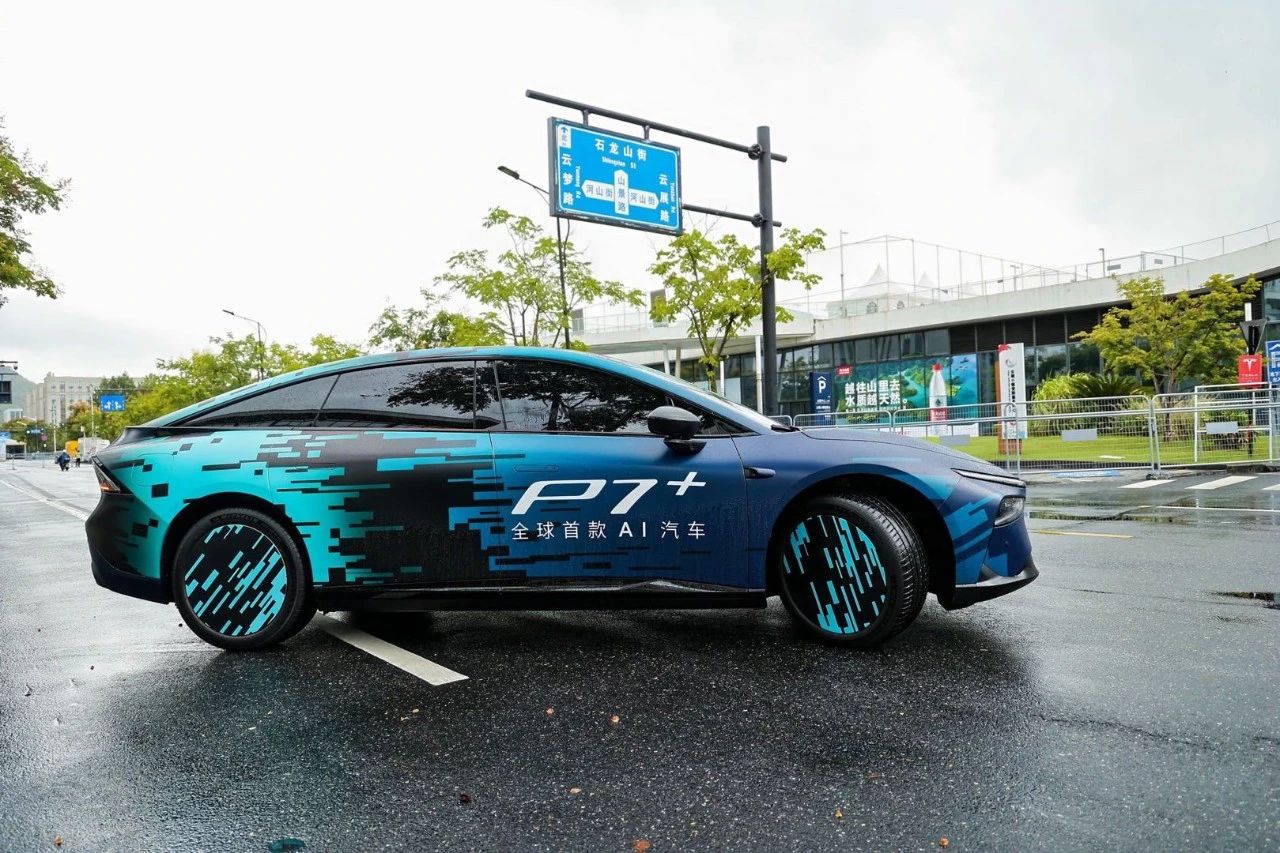
Image source: XPENG
At first glance, everyone seems to be telling the same story.
Look closer, and they're not talking about the same thing at all.
XPENG is more focused on how AI drives. End-to-end, VLA, world models — the core is still about enabling Vehicles to handle complex roads without relying solely on pre-written rules.
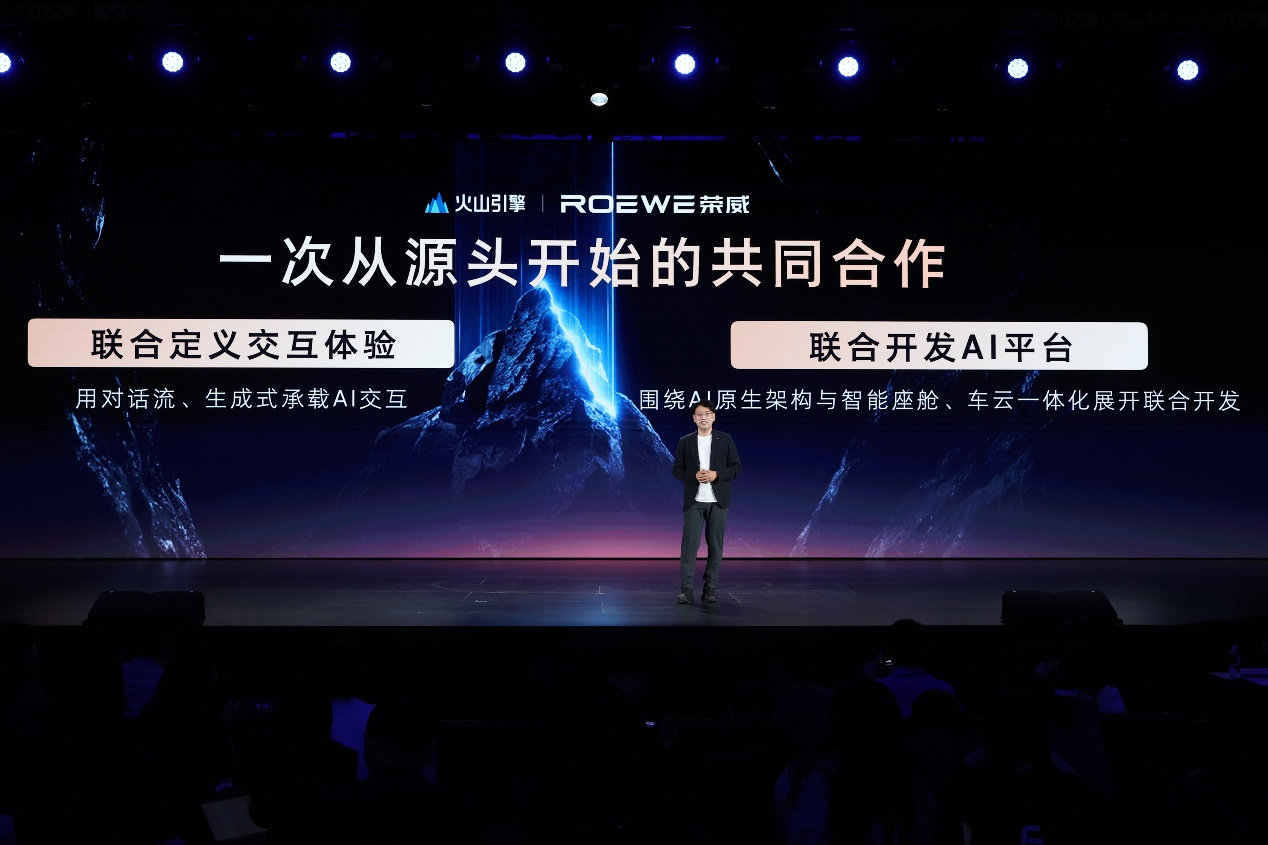
Image source: Roewe
Roewe's "AI-native" concept emphasizes whether AI can truly mobilize the entire vehicle. The Jia Yue 07 opens up a vast number of SOA service interfaces, allowing seats, lighting, audio, and even intelligent driving capabilities to be uniformly orchestrated.
Geely has taken a step further, hoping AI is no longer just a standalone model in the cabin or for driving, but connects the cabin, driving, and more vehicle domains through world behavior models and multiple intelligent agents.
At Great Wall Motor, the issue sinks even deeper into the operating system. Coffee AI OS 4 is no longer about "adding AI to an OS," but embedding AI capabilities into the system base, which then calls upon vehicle capabilities.
That's why Chen Xiaofeng, vice president of Great Wall Motor's technology center and chief scientist, would say: "Large models can be creative, but an operating system absolutely cannot have hallucinations."
FAW Group's answer is slightly different again.
Xu Baojun, chief EE architect at FAW's R&D headquarters, describes an AI Vehicle as a vehicle intelligent agent that can perceive, decide, execute, and evolve continuously. Yet, he also emphasizes the model matrix, agents, permission sandboxes, and traceable mechanisms.
If we had to compress these paths into a single sentence:
XPENG is answering how AI drives; Roewe is answering how AI calls upon a Vehicle; Geely is answering how AI connects the cabin and driving; Great Wall is answering how AI enters the Vehicle's underlying layer; FAW is trying to answer how AI ultimately forms a complete vehicle system.
This is also why there is still no standard answer for "AI Vehicles" today.
It's not that no one is giving an answer; it's that everyone is holding a different ruler.
Why has this exploded in the last two years?
Because several previously independent technology paths are finally colliding.
Central computing and SOA allow vehicle capabilities once scattered across different controllers to be called uniformly; end-to-end, VLA, and world models reduce intelligent driving's reliance on human-coded rules; large models and agents bring intent understanding, memory, task decomposition, and tool calling.
The so-called smart Vehicles of the past were more like vehicles with increasingly clever features added on.
The change happening today is that AI is starting to participate in how these capabilities are generated, combined, and evolved.
Meng Chao summarized the difference between software-defined Vehicles and AI-defined Vehicles bluntly: In the software era, capabilities were mostly pre-defined by engineers; in the AI era, some capabilities are being generated by models through data, learning, and reasoning within safety boundaries.
Great Wall Motor offered a more vivid analogy back in 2024: previously, we were "teaching machines how to drive"; in the future, it may become "teaching AI to drive."
The technical logic has certainly shifted. But technical paths haven't converged yet, and commercial competition has already begun.
"AI Vehicle" happens to be a label few automakers are willing to abandon. Whoever proposes a definition first finds it easier to turn their technical advantage into a new industry narrative.
Thus, the constant emergence of "AI Vehicle," "AI-native," "physical AI," and "super-intelligent agent."
Technology is still looking for answers, but the market is already fighting over the right to define them.
This may well be the true state of "AI Vehicles" today.
Consumers Might Not Want an "AI Vehicle" at All
The industry's enthusiasm for "AI Vehicles" doesn't mean consumers are waiting for a new vehicle category.
Users certainly need intelligence.
McKinsey's China automotive consumer survey this year shows that 69% of respondents already view high-level intelligent driving like city NOA as a standard feature, and 84% want in-Vehicle intelligent agents to actively provide services rather than just passively listen to commands.
But the other side is worth watching too.
J.D. Power's China automotive intelligent experience study indicates that while smart features are spreading rapidly, the performance index has dropped for the first time in four years, with "instability/inaccuracy" becoming one of the most prominent issues for advanced configurations.
Put these two results together, and it's telling.
Consumers want smarter Vehicles, but they are increasingly unwilling to pay for "immature intelligence."
For most ordinary users, the need is simple: navigation shouldn't take detours, voice commands should be understood the first time, parking shouldn't work one day and fail the next, and proactive services shouldn't turn into proactive harassment.
As for whether it's running VLA, a world model, or a few agents in the background, that mostly doesn't matter.
Users buy results, not tech stacks.
That's where the "AI Vehicle" label gets a bit awkward.
In the cabin, the more visible AI is, the easier it is to sell. It chats, remembers users, recommends restaurants, and understands vague phrases. Even if the occasional recommendation isn't perfect, the consequences are limited.
If it recommends Restaurant A today and Restaurant B tomorrow, most people won't develop safety anxiety over their Vehicle because of it.
But the industrial application of AI has already moved beyond the consumer's line of sight.
If you tell consumers that AI is participating in this Vehicle's R&D, testing, fault diagnosis, or even partial driving and vehicle control, their first reaction might not be "advanced," but is it reliable?
Over the past few years, generative AI has completed a unique round of "consumer education."
Everyone knows AI is smart, and everyone also knows it can make mistakes with a straight face.
This leads to a somewhat counterintuitive result: The closer AI is to the consumer, the more it needs to be felt; the closer AI is to the Vehicle's core, the more it needs to be forgotten.
Users See AI, While Automakers Are Already "Using" AI
The diffusion of AI in the auto industry has long since moved beyond a single path of "getting into the Vehicle."
Seres this year proposed building an "AI-native enterprise," bringing AI further into R&D, manufacturing, and service.

Image source: Seres
FAW Group is already using proprietary large models and AIGC for vehicle creative design.
Great Wall Motor has also deployed enterprise agents in engineering R&D.
Sonatus co-founder and CTO Fang Yu is pushing AI even further into testing, diagnostics, and after-sales.
He cited a case: by combining R&D information with vehicle test data and using AI to assist in root cause analysis, some complex issues that previously took about two weeks to investigate can be shortened to around two days.
Of course, the practices of these leading enterprises don't represent the entire auto industry being at the same stage.
Different automakers vary widely in data accumulation, software capabilities, organizational structures, and willingness to invest.
But at least one thing is becoming increasingly clear: The industry's understanding of AI is expanding from "what AI features to give consumers" to "how to use AI to build Vehicles."
One line is inside the Vehicle. Cabin, intelligent driving, agents, proactive services — all ultimately require direct consumer experience.
The other line is hidden in the background. Design, R&D, testing, production, fault diagnosis, after-sales service — users may never see most of this AI.
Both lines are indispensable. The cabin and intelligent driving determine whether consumers are willing to believe in an "AI Vehicle"; industrial AI determines whether that belief is supported by engineering capability.
The real significance of industrial AI isn't that it's "more important" than the cabin or intelligent driving.
It's that it changes something rarely discussed in the context of AI Vehicles: AI isn't just becoming a capability of the Vehicle; it's also becoming a tool for building it.
Once this line deepens, the boundaries of "AI Vehicles" will blur even further.
AI participates in product definition, design, and development, then in testing and manufacturing; after delivery, it continues to exist in the cabin, driving, diagnostics, and after-sales.
So, does a so-called "AI Vehicle" refer to a product that uses AI, or an automotive industrial system being reshaped by AI?
This may be a more worthwhile discussion than arguing over who is the "world's first AI Vehicle."
The Real Challenge: How Much Decision-Making Power to Hand Over to AI
Here, the question touches the industry's bottom line.
Fang Yu gave a simple example at the forum: "Asking for a restaurant recommendation in the cabin? It doesn't matter if the answer is different. But in vehicle diagnosis, AI must guarantee deterministic correctness."
One sentence separates two worlds.
What AI is truly good at is handling complex, open environments where rules can't be fully written out, finding patterns in massive data, and making judgments under uncertainty.
The automotive industry, however, has long pursued something else: verifiability, repeatability, and traceability.
Restaurant recommendations can have ten reasonable answers. But a Vehicle's reason for triggering a fault light can't be one thing today and another tomorrow.
If AI generates an unappealing design sketch, a designer can just delete it. If a wrong hypothesis is raised during R&D, engineers can still review it.
But once AI starts influencing fault diagnosis, driving decisions, the chassis, or vehicle execution, "let's try it out" is no longer an acceptable approach.
So, while the definition of "what counts as an AI Vehicle" is still being debated, another set of rules can't wait.
And that is safety.
What the product is called can continue to be discussed.
But once AI enters safety-related links, it must answer more specific questions.
What can be left to the model, and what must be verified by traditional rules? Which results allow probabilistic judgment, and which must meet deterministic safety conditions?
These are boundary issues.
And beyond the boundaries, there are fallback issues: If AI is wrong, can the system detect it? Who provides the fallback? And how is accountability assigned?
ISO/PAS 8800 has already begun establishing a specific framework for safety-related AI in road vehicles, and domestic standards for AI model testing, risk governance, functional safety, and data/information security are also advancing.
This is also why companies with seemingly completely different routes are starting to say similar things.
Meng Chao emphasizes safety boundaries; FAW sets permission sandboxes for agents; Great Wall demands that operating systems have no hallucinations; Fang Yu stresses that diagnostic results must be reliable.
The truly difficult question has never been whether Vehicles can use AI, but how much decision-making power the industry is willing to hand over to it.
Back to the beginning.
"What is a true AI Vehicle?" Today, of course, there are answers — they just haven't converged.
And what consumers really Vehiclee about may never be that complex: What exactly has AI made better about this Vehicle?
The auto industry still has to answer one more question: Can this "improvement" be achieved stably, reliably, and verifiably?
If those two questions can be answered, what the "AI Vehicle" is called might not really matter.
Perhaps one day, when large models, agents, AI intelligent driving, and AI-assisted R&D all become default capabilities of the automotive industry, the label "AI Vehicle" itself will slowly fade into the background.
What truly decides if AI can redefine the Vehicle isn't which press conference it appears at.
It's whether, when rules can't cover a scenario, AI can help the Vehicle make a better judgment — and ensure that judgment withstands scrutiny for safety, reliability, and verifiability.


