



Over the past century, the core definition of the automobile has remained largely unchanged: a powertrain, a control system, and a safety framework designed to move people from point A to point B. But in today's China, the automotive industry is undergoing a profound paradigm shift—cars are beginning to evolve from "transportation tools" into " Smart Homes on Wheels". The meaning of the automobile is quietly transitioning from a mobility device to a living space.
This shift is not a simple matter of "feature upgrades" or "hardware piling." It is the result of multiple forces converging: China's social structure, family needs, housing costs, mobility patterns, psychological pressures, electrification technologies, and the country's unique industrial organization capabilities.
More importantly, this is a direction that is distinctively Chinese,and powerful enough to reshape the global understanding of what a car can and should be.
1. Why Is China the First to Enter the "Mobile Home" Era?
To understand why Chinas 'smart electric vehicles have taken the path of "building cars as if they were homes," we must begin with the realities of everyday life in China.
(1) High Housing Prices and Scarce Personal Space: The Car Becomes the Most Accessible Private Space for Young People.
China's rapid urbanization, combined with persistently high housing prices, has made it difficult for many young people—even those earning ¥20,000–30,000 per month—to obtain a truly private space of their own.
Small rental units, shared apartments with little privacy, long commutes, and the relentless pace of city life have made the need for personal, undisturbed space stronger than ever.
In contrast, a car priced at ¥200,000–300,000 can immediately provide 5–6 square meters of high-quality, fully private space. There is no need to share it with anyone; it is mobile, always accessible, and can instantly become a sanctuary for solitude, entertainment, or relaxation—whether parked in a garage, on the roadside, or at a charging station.
From a cost-per-square-meter perspective, a car is an order of magnitude cheaper than urban housing.
Thus, for many young people, seeing the car as "the first room they truly own" is entirely reasonable.
(2) High-Pressure Urban Life Makes "In-Car Private Space" a Rigid Demand
Life in Chinese cities is fast-paced, information-heavy, and highly competitive. Long working hours and widespread overtime culture create an urgent need for a personal space that can shut out the world at any moment. The enclosed and controllable nature of the car makes it a natural psychological decompression zone:
a place to zone out after work, take a brief nap, listen to calming music, escape momentarily from family duties or work pressure.
The car becomes a "mobile sanctuary" where people can breathe, reset, and regain emotional balance. I recall a popular post on Zhihu titled "Why do adults want to sit alone in their cars for a while after work?"—it triggered an overwhelming wave of resonance because it spoke directly to this shared emotional need.
(3) Evolving Family Structures: Multi-Child Households and Three-Generation Travel Make the "Mobile Second Home" a Necessity
China's auto market has entered a replacement-and-upgrade era, with more than 65% of purchases coming from such demand. For family buyers, acceleration is no longer the top concern. What matters most are questions like: Is the second row comfortable enough? Can the third row accommodate elderly family members on long trips? Do children have their own entertainment space? Can passengers lie flat during long-distance travel? Can the vehicle function as a "mini home" for camping or weekend trips?
As a result, large space, high comfort, and scenario-based design have become the core forces shaping product definition. The car is no longer just a vehicle—it is evolving into a "mobile second residence" for modern Chinese families.
(4) Strict Regulations on Vehicle Modifications Drive a Unique Chinese Path: Front-Loaded "Premium Customization" as an Innovation Mechanism
Chinese consumers do have strong personalization and modification needs. However, stringent regulations, structural safety requirements, and insurance constraints make deep aftermarket modifications difficult to legalize.
Unlike in the United States or Japan, the features Chinese users desire— luxurious interior wrapping, giant screens, ambient lighting, fragrance systems, in-car refrigerators, high-power external outlets, camping water–electricity systems, rotating seats, full lie-flat seats, and even in-car shower functions— are extremely hard to implement in the aftermarket. They can only be realized by automakers through factory-installed solutions.
This has created a globally unique innovation mechanism in China: OEMs take users' "modification demands," "premium finish requirements," and "niche functional needs," and transform them into front-loaded, standardized, scalable, and OTA-upgradable product capabilities.
The result is twofold: significantly enhanced user experience, and substantially increased per-vehicle value and brand power.
2. Electrification + Intelligence: The Technologies That Make the "Mobile Home" Possible
The reason the automobile can evolve from a transportation tool into a living space is fundamentally rooted in technological progress.
(1) Electrification Drives a Structural Revolution: Space Is Liberated and Redefined
1) Flat Floor: The Fundamental Source of Spatial Freedom
Traditional ICE vehicles require a driveshaft, transmission, and central tunnel, making a truly flat floor almost impossible. EV architecture, however, is far simpler. A flat floor sitting directly above the battery enables three transformative changes: Enhanced connectivity between the first and second rows, turning the interior from a "cockpit" into a "room." Exponential growth in storage potential, including underfloor compartments and drawer-style modules. Far greater flexibility in seat layout, making rotation, sliding, and full-flat reclining possible.
The flat floor is the origin of all variable-space innovation.
2) Shrinking the Front Compartment: Structural Redundancy = Spatial Potential
Without a bulky engine, the front compartment can be minimized or reconfigured. The addition of a front trunk (Frunk) increases storage capacity, improves overall proportions, and maximizes interior space.
For many families, the Frunk is becoming a dedicated zone for children's items, emergency kits, and cleaning supplies. A good example is the ONVO L90, where 96% of users use the Frunk at least once a week—its usage frequency has surpassed the rear trunk for the first time (95% weekly usage).
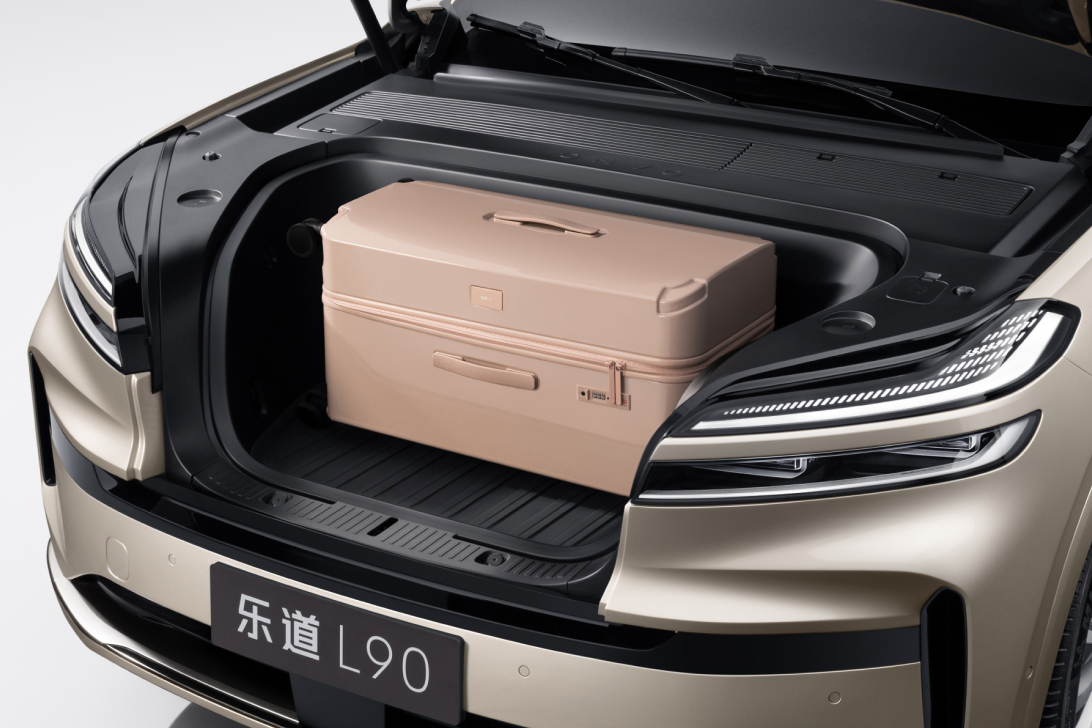
ONVO L90; photo source: ONVO
3) Longer Wheelbase: The Primary Variable of Ride Comfort
Chinese consumers are extremely sensitive to second- and third-row space, making wheelbase length a key indicator of comfort. EV platforms can easily achieve long-wheelbase layouts that traditional ICE vehicles cannot. This dramatically expands MPV and SUV interior volumes, allowing second-row legroom to become the core determinant of comfort and enabling "living-room-style" interior design.
Models such as the XPENG X9, AITO M9, and Denza D9 all position long wheelbase and expansive cabin space as central product advantages.
4) CTC / CTB (Cell-to-Chassis / Cell-to-Body): Unlocking the Floor Space Completely
BYD, Tesla, Leapmotor, and others have already mass-produced CTC or CTB technologies, integrating the battery directly into the vehicle structure rather than treating it as a standalone component. This enables three major breakthroughs: A thinner floor, A lower center of gravity, Greater structural design freedom.
From an engineering perspective, these advances substantially increase the feasibility of building a true "home on wheels."
(2) The Intelligent Cockpit Becomes the Operating System of the Mobile Family Space
The intelligent cockpit is the pivotal point where a car transforms from a "machine" into a "space."
In the past, in-car entertainment systems merely handled music and navigation. Today, the intelligent cockpit has evolved into the central controller of daily life, orchestrating emotional regulation, ambient lighting, acoustic modes, temperature and airflow, air quality, multi-screen collaboration, content consumption, and the varying needs of different family members. In essence, it has become the in-vehicle counterpart of a smart-home operating system, enabling the car to function as a programmable living space.
The vehicle is no longer just operated, it now operates the rhythm of life.
(3) The real value of intelligent driving lies not in technological showmanship, but in enhancing everyday safety and comfort.
On highways, advanced driver-assistance systems substantially reduce fatigue and long-distance travel risks. In congested urban commutes, intelligent following and smooth-control algorithms ease the driver's mental load. In complex parking environments—shopping malls, office districts, residential communities—automatic and memory parking significantly improve convenience. And in dense urban traffic with frequent signals and intricate intersections, navigation-assistance systems provide greater safety redundancy and more stable driving performance.
As the technology matures, intelligent driving is shifting from an "optional feature" to a foundational capability that users rely on across multiple travel scenarios. It has become a critical enabler for the industry's transition into the "space-experience era."
In this sense, intelligent driving is evolving from a technical highlight into a basic infrastructure for vehicles—supporting the car's transformation into a mobile living space.
(4) The Rise of In-Vehicle Home Appliances
As cars evolve into "homes on wheels," they must begin to provide the capabilities of a living space, much like a real house. This includes: cooling (refrigerators, temperature-controlled cups), heating (hot water, warm air), water purification and sterilization, showering, power supply for cooking devices, outdoor lighting, compact kitchen systems, and camping modules.
The realization of these functions relies on three underlying technological foundations:
1) Large Battery Capacity: The Energy Backbone of Mobile Living
Most EVs today carry 60–100 kWh battery packs, enabling V2L (vehicle-to-load) power output. This allows in-vehicle appliances to operate for extended periods—hot-water systems, heating modules, large-format displays, immersive audio—and gives the vehicle, for the first time, the role of a mobile energy node within a lifestyle ecosystem.
2) Mature Thermal Management: Coordinated Water, Air, and Heat-Pump Systems Enable Household-Level Capabilities
A representative example is the IM Motors' LS9, which has already offers a shower-related feature as optional equipment—made possible by the maturity of automotive heat-pump technology. Thermal management, once designed primarily for motors and batteries, is now becoming the foundation of household-grade features: Heat pumps can deliver stable hot water;Water pipelines can precisely regulate temperature and pressure;Modular drainage systems make indoor-style usage feasible.
Car manufacturers are beginning to acquire the ability to build outdoor living facilities natively into vehicles.
3) Vehicle Home-Appliance Integration Brings New Supply Chain Entrants
Major home-appliance brands such as Haier, Midea, and Ecovacs have begun entering the automotive domain with innovations in In-vehicle washing,Air purification and sterilization,Water filtration,Compact refrigerators,Onboard cooking modules (an emerging trend) etc.
These categories never existed in the traditional automotive supply chain. Going forward, they are expected to become high-growth, high-innovation sectors, forming a new incremental industry around the "mobile home" paradigm.
3. A New Trend in Chinese Luxury: From "Piling Up Features" to "Designing Space"
In the past, luxury was defined by materials and brand prestige. Today, luxury is increasingly defined by the quality of the spatial experience.
(1) The Seven Pillars of "Chinese-Style Luxury" includes:
1) Generous space
2) Extensive soft-touch wrapping (e.g., the NIO ES8 features over 50 m² of interior wrap coverage)
3) Large-scale audio systems (20–30+ speakers becoming mainstream)
4) Immersive audiovisual experiences (cinema-level in-car entertainment)
5) Strong privacy (superior quietness and light-blocking capability)
6) Atmosphere systems (lighting, fragrance, color ambiance)
7) Scenario modes (napping, soothing children, camping, movie watching, etc.)
This is not "spec-sheet stacking:"—it reflects the reality that people are genuinely living inside their cars.
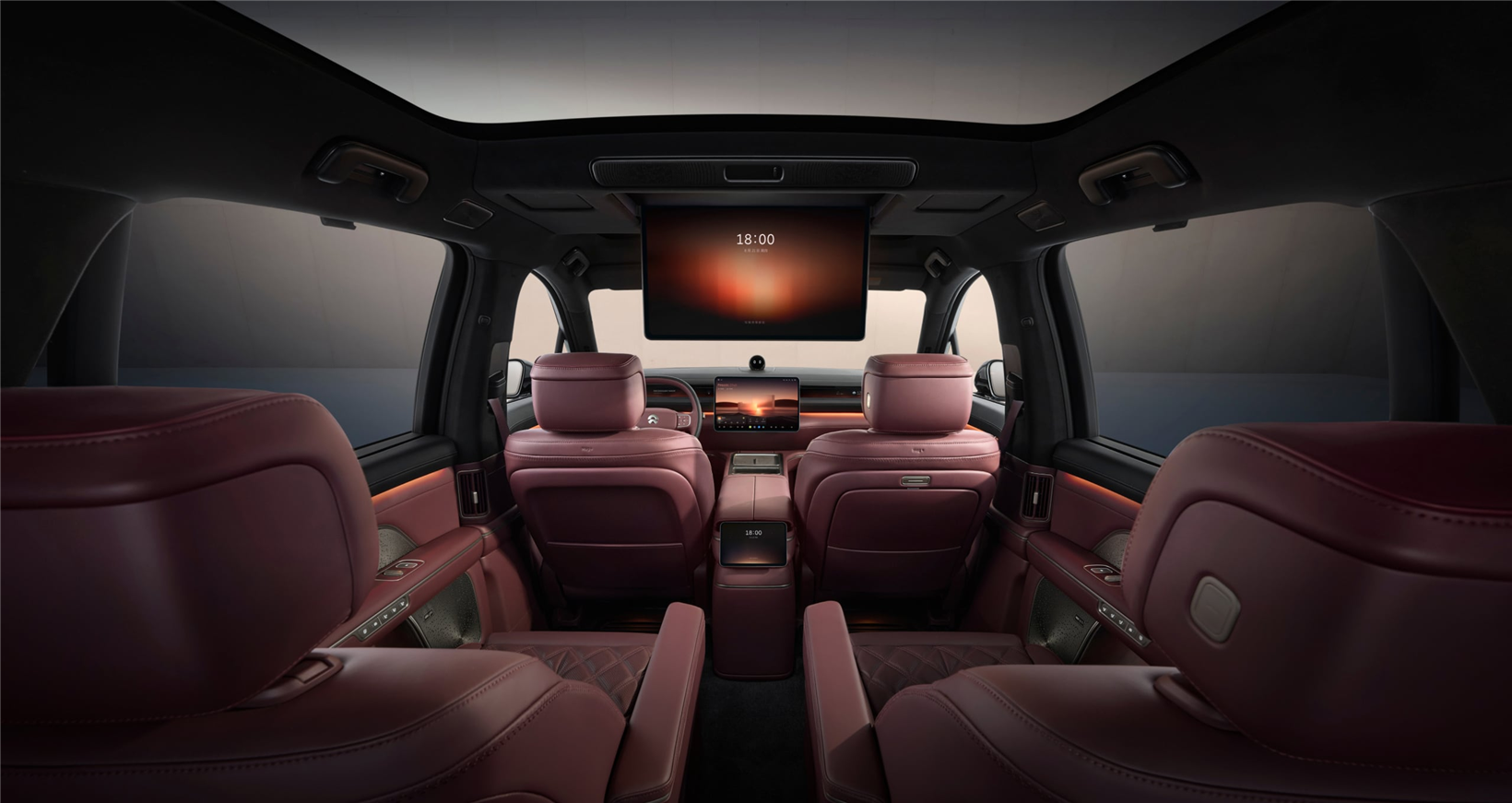
All-New NIO ES8; photo source: NIO
(2) China NEV Starups Are Converging on the Same Product Philosophy
Their approaches differ, but their destination is the same: to create a mobile space that supports the full spectrum of family life. Followings are some typical expamls:
Li Auto: family-centric engineering + immersive audio/entertainment
NIO ES8: luxury materials + superior spatial comfort
XPENG X9: innovative spatial design in the MPV segment
IM Motors: extreme expansion of factory-installed outdoor scenarios (showers, water–electricity systems for camping)
AITO: extending intelligent features into family-oriented experiences
Together, these companies are driving a profound industry shift: family-oriented scenarios have become the true main battlefield of China's automotive sector.
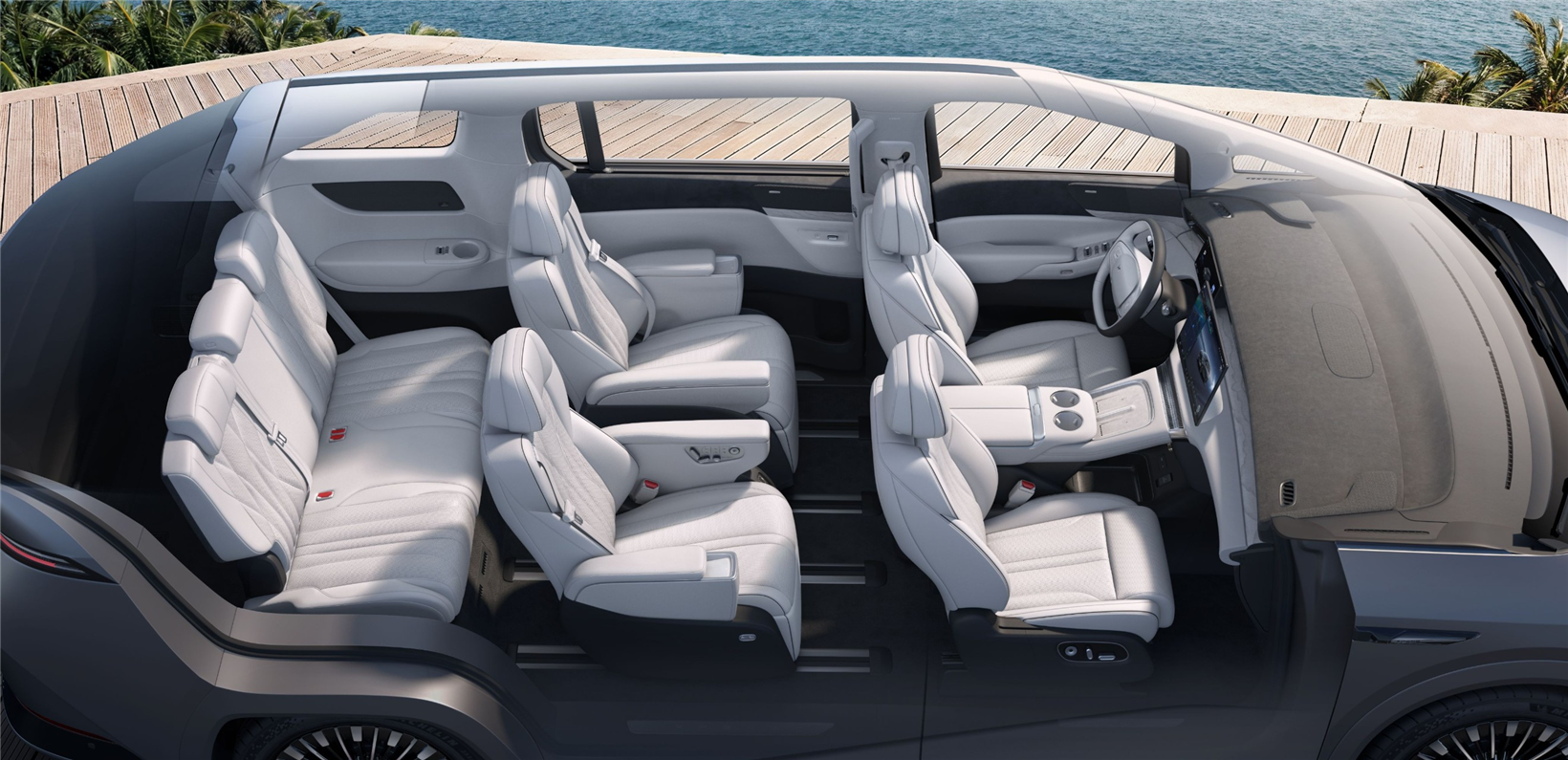
XPENG X9; photo source: XPENG
4. Case Studies: How the New Generation of Models Redefine "The Car as Home"
(1) NIO's New ES8: A "Luxury Mobile Living Space with over 50 m² soft-touch surface coverage"
With extensive soft-touch interior wrapping, furniture-grade materials, headrest audio paired with a cinematic atmosphere, and second- and third-row comfort on par with the first row, the ES8 is designed for multi-child families and three-generation travel.
In essence, it is a "luxury mobile cabin over 50 m² soft-touch surface coverage."
(2) XPENG X9: Transforming the MPV into a "Variable Space"
Featuring an expansive sliding-space architecture, rotating seats, semi–mother-and-infant modes, multi-screen interaction, and scenario programmability, the X9 functions fundamentally as a "mobile living room."
(3) IM Motors' In-Car Shower System: The Ultimate Factory-Installed Outdoor Feature
Many users have long wanted to retrofit outdoor shower systems, but the risks around water–electricity management, safety regulations, and modification legality make true aftermarket solutions nearly impossible.
IM Motors took the bold step of integrating the system at the factory level. Designed for camping, fishing, and long-distance travel, it represents the first time a Chinese automaker has embedded an outdoor lifestyle capability so natively into a production vehicle.
5. Why Is This an Industrial Path Unique to China?
Because China, the U.S., and Europe differ fundamentally in residential space, modification regulations, outdoor lifestyle patterns, family needs, organizational speed within automakers (China is faster by an order of magnitude), electrification infrastructure (China leads in charging-network density), and the ability of China's supply chain to support high-complexity, high-iteration innovation.
These factors collectively create a globally unique industrial phenomenon: Only in China is the automobile rapidly evolving into a "smart mobile home."
6. 2030: The Car Will Become the "Third Living Space" for Young People in China
In China, the structure of personal space is undergoing a profound shift:
Home is becoming increasingly expensive, crowded, and filled with responsibilities.
The workplace is fast-paced and high-pressure—a place one must be.
The car, however, is the only space where one can close the door and the world instantly becomes quiet.
For more and more people, a car is no longer just a tool. It is a mobile, safe, fully controllable private sanctuary.
Looking ahead to 2030, we can predict with confidence that a car in China will carry far more meaning than "getting from point A to point B."
It may become:
a bedroom for short naps,
a mobile office during commutes,
a harbor of relief after a long day of overtime,
a weekend living room on wheels,
an energy hub for camping trips,
a social space for gatherings,
and a place where one can retreat for emotional recovery.
As this shift unfolds, automotive competition will move from a race of technical parameters to a race of spatial experience. Whoever enables users to live better, relax better, and express themselves more freely inside the car will win the market of future.
Written by Xiaoying Zhou — CEO and Editor-in-Chief, Gasgoo International


