



Gasgoo Munich- According to data from Gasgoo Institute, BYD's passenger vehicle exports from January to March 2026 were characterized by concentrated top markets, diverse regional structures, and divergent powertrain strategies. Brazil emerged as a core growth engine with a significant scale advantage, while multiple European countries expanded in sync to provide stable support. Meanwhile, the Middle East and select emerging markets achieved structural breakthroughs driven by plug-in hybrid models. Overall, by running a dual-track strategy of "pure electric + plug-in hybrid" alongside a differentiated regional layout, BYD continues to strengthen its global market penetration, keeping export growth momentum robust.
According to the Gasgoo Institute export database, the top 10 destinations for BYD passenger vehicle exports in the first quarter of 2026 are as follows:
No. 1 Brazil: From January to March 2026, BYD exported 53,355 pure electric passenger vehicles and 36,282 plug-in hybrid passenger vehicles to Brazil, totaling 89,637 units.
No. 2 United Kingdom: From January to March 2026, BYD exported 5,120 pure electric passenger vehicles and 12,283 plug-in hybrid passenger vehicles to the UK, totaling 17,403 units.
No. 3 United Arab Emirates: From January to March 2026, BYD exported 553 pure electric passenger vehicles and 14,332 plug-in hybrid passenger vehicles to the UAE, totaling 14,885 units.
No. 4 Belgium: From January to March 2026, BYD exported 6,840 pure electric passenger vehicles and 7,693 plug-in hybrid passenger vehicles to Belgium, totaling 14,533 units.
No. 5 Australia: From January to March 2026, BYD exported 9,558 pure electric passenger vehicles and 4,419 plug-in hybrid passenger vehicles to Australia, totaling 13,977 units.
No. 6 Germany: From January to March 2026, BYD exported 6,320 pure electric passenger vehicles and 4,329 plug-in hybrid passenger vehicles to Germany, totaling 10,649 units.
No. 7 Spain: From January to March 2026, BYD exported 4,170 pure electric passenger vehicles and 4,022 plug-in hybrid passenger vehicles to Spain, totaling 8,192 units.
No. 8 Hong Kong, China: From January to March 2026, BYD exported 7,329 pure electric passenger vehicles and 21 plug-in hybrid passenger vehicles to Hong Kong, totaling 7,350 units.
No. 9 Israel: From January to March 2026, BYD exported 275 pure electric passenger vehicles and 5,668 plug-in hybrid passenger vehicles to Israel, totaling 5,943 units.
No. 10 Slovenia: From January to March 2026, BYD exported 3,673 pure electric passenger vehicles and 2,070 plug-in hybrid passenger vehicles to Slovenia, totaling 5,743 units.
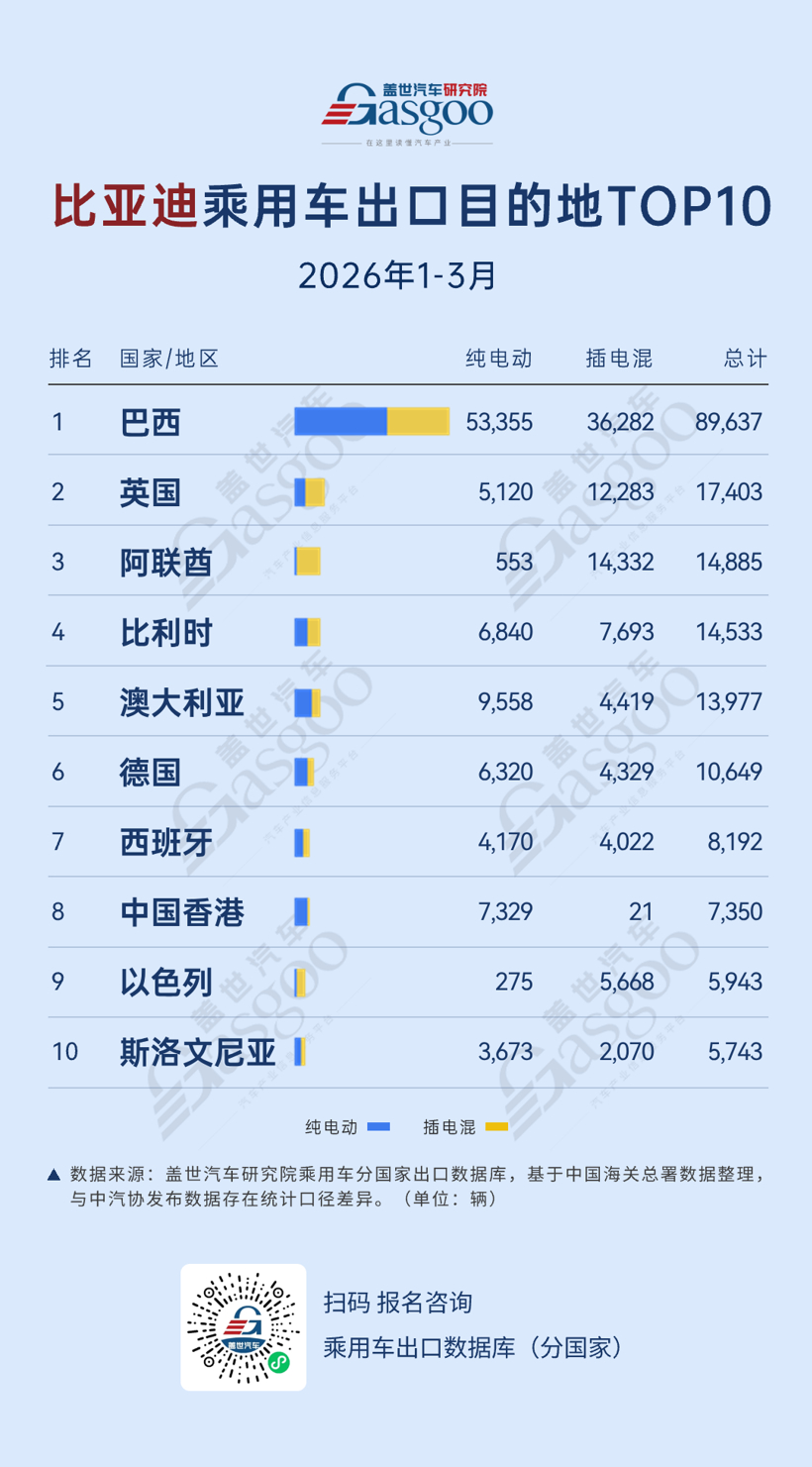
Looking at the distribution of BYD's passenger vehicle export destinations in the first quarter of 2026, Brazil stands far ahead with 89,637 units, significantly distancing itself from the runner-up and cementing its status as BYD's most critical overseas market. In terms of model mix, Brazil exhibits a classic "pure electric + plug-in hybrid synergy." While pure electrics (53,355 units) claim a higher share, plug-in hybrids (36,282 units) also boast substantial volume. This reflects strong local acceptance of multi-energy powertrains to meet both urban commuting and long-distance travel needs. This dual-path structure has become a key pillar supporting BYD's rapid volume expansion in emerging markets.
The European market, meanwhile, displays a pattern of "broad-based growth and structural balance." The UK (17,403 units), Belgium (14,533 units), Germany (10,649 units), and Spain (8,192 units) all rank high, indicating a relatively even distribution. The UK leans heavily toward plug-in hybrids (12,283 units), while Germany and Spain show near-equal splits between pure electric and plug-in hybrids. Belgium presents a relatively balanced mix, underscoring the European market's broad acceptance of both technological paths.
In the Middle East, the UAE (14,885 units) and Israel (5,943 units) are both dominated by plug-in hybrid models, significantly outpacing pure electrics. This trend is closely tied to local long-distance driving scenarios, charging infrastructure, and user demand for range stability, fully leveraging the adaptability advantages of plug-in hybrids. Oceania also delivered a standout performance. Australia (13,977 units) is primarily pure electric, reflecting the region's steadily rising acceptance of new energy vehicles.
Overall, BYD has established a global layout defined by "regional differentiation and a dual-technology track": driving scale in Latin America, achieving balanced penetration in Europe, breaking through in the Middle East with plug-in hybrids, and steadily expanding elsewhere. The precise matching of different markets with specific powertrain forms is becoming the core support for its sustained global volume growth.


