Gasgoo Munich- Data from Gasgoo Institute reveals a striking divergence in the export strategies of China’s top automakers for March 2026. BYD is anchored by Central & South America as its core growth engine, Geely is leveraging a balanced push across the Commonwealth of Independent States (CIS) and Southeast Asia, while Chery is leading the pack with a dual-core strategy targeting the EU, UK, and EFTA alongside the CIS. As these giants flex their strengths in different regions, they highlight the diverging paths of Chinese brands’ overseas expansion—and collectively signal a shift in the nation’s passenger vehicle exports from pure volume growth to structural deepening.
According to the Gasgoo Institute export database, here is the ranking of BYD's passenger vehicle export regions for March 2026:
NO.1 Central & South America: In March, BYD exported 41,037 units to this region.
NO.2 EU + UK + EFTA: In March, BYD exported 27,039 units to this region.
NO.3 Rest of Asia: In March, BYD exported 8,707 units to this region.
NO.4 Southeast Asia: In March, BYD exported 8,614 units to this region.
NO.5 Middle East: In March, BYD exported 5,745 units to this region.
NO.6 Oceania: In March, BYD exported 5,325 units to this region.
NO.7 CIS countries: In March, BYD exported 3,257 units to this region.
NO.8 Africa: In March, BYD exported 2,202 units to this region.
NO.9 Rest of Europe: In March, BYD exported 332 units to this region.
NO.10 North America: In March, BYD exported 255 units to this region.
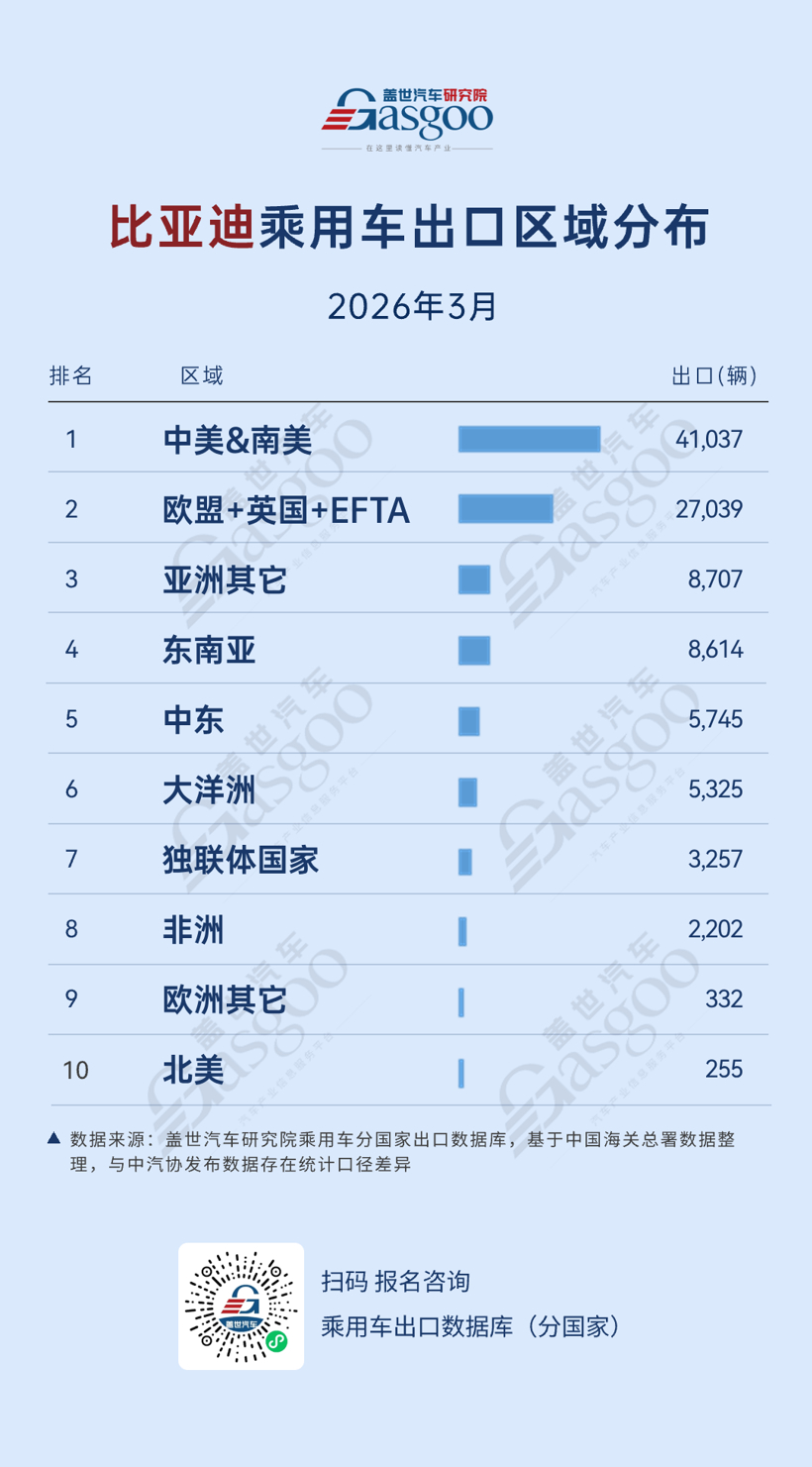
Gasgoo Institute data shows BYD’s global layout in March was characterized by high regional concentration, standout advantages in core markets, and clear differentiation among tiers. Central & South America led with 41,037 units, becoming BYD’s largest overseas market. This dominance stems from continuous improvements in channel layout and product adaptation in regions like Brazil, combined with local new energy policy dividends that have quickly generated a scale effect. The EU + UK + EFTA region followed with 27,039 units, sustaining a strong performance in mainstream European markets and underscoring the rising recognition of BYD’s new energy models in mature markets.
Export volumes for Rest of Asia and Southeast Asia were remarkably close at 8,707 and 8,614 units respectively. As geographically proximate traditional strongholds, they maintain a stable baseline volume. The Middle East and Oceania followed with 5,745 and 5,325 units, acting as steadily cultivating markets where demand and acceptance of new energy vehicles are gradually gaining traction. The CIS and Africa, with 3,257 and 2,202 units respectively, remain in the early stages of market penetration and channel establishment.
Notably, exports to Rest of Europe and North America were just 332 and 255 units. Affected by geopolitical tensions, trade environments, and policy uncertainties, BYD maintains a cautious approach to these regions. Overall, BYD’s exports are anchored by Central & South America and the EU + UK + EFTA; the former provides stable volume and disperses risk, while the latter elevates brand premium and technological image. If BYD can consolidate its advantages in these two markets and enhance growth resilience in regions like the Middle East, its lead in global electrification will only solidify.
According to the Gasgoo Institute export database, here is the ranking of Geely Holding's passenger vehicle export regions for March 2026:
NO.1 CIS countries: In March, Geely Holding exported 17,037 units to this region.
NO.2 Southeast Asia: In March, Geely Holding exported 11,353 units to this region.
NO.3 EU + UK + EFTA: In March, Geely Holding exported 10,682 units to this region.
NO.4 Central & South America: In March, Geely Holding exported 10,054 units to this region.
NO.5 Africa: In March, Geely Holding exported 7,863 units to this region.
NO.6 Rest of Asia: In March, Geely Holding exported 3,547 units to this region.
NO.7 Oceania: In March, Geely Holding exported 2,396 units to this region.
NO.8 North America: In March, Geely Holding exported 1,799 units to this region.
NO.9 Rest of Europe: In March, Geely Holding exported 188 units to this region.
NO.10 Middle East: In March, Geely Holding exported 96 units to this region.
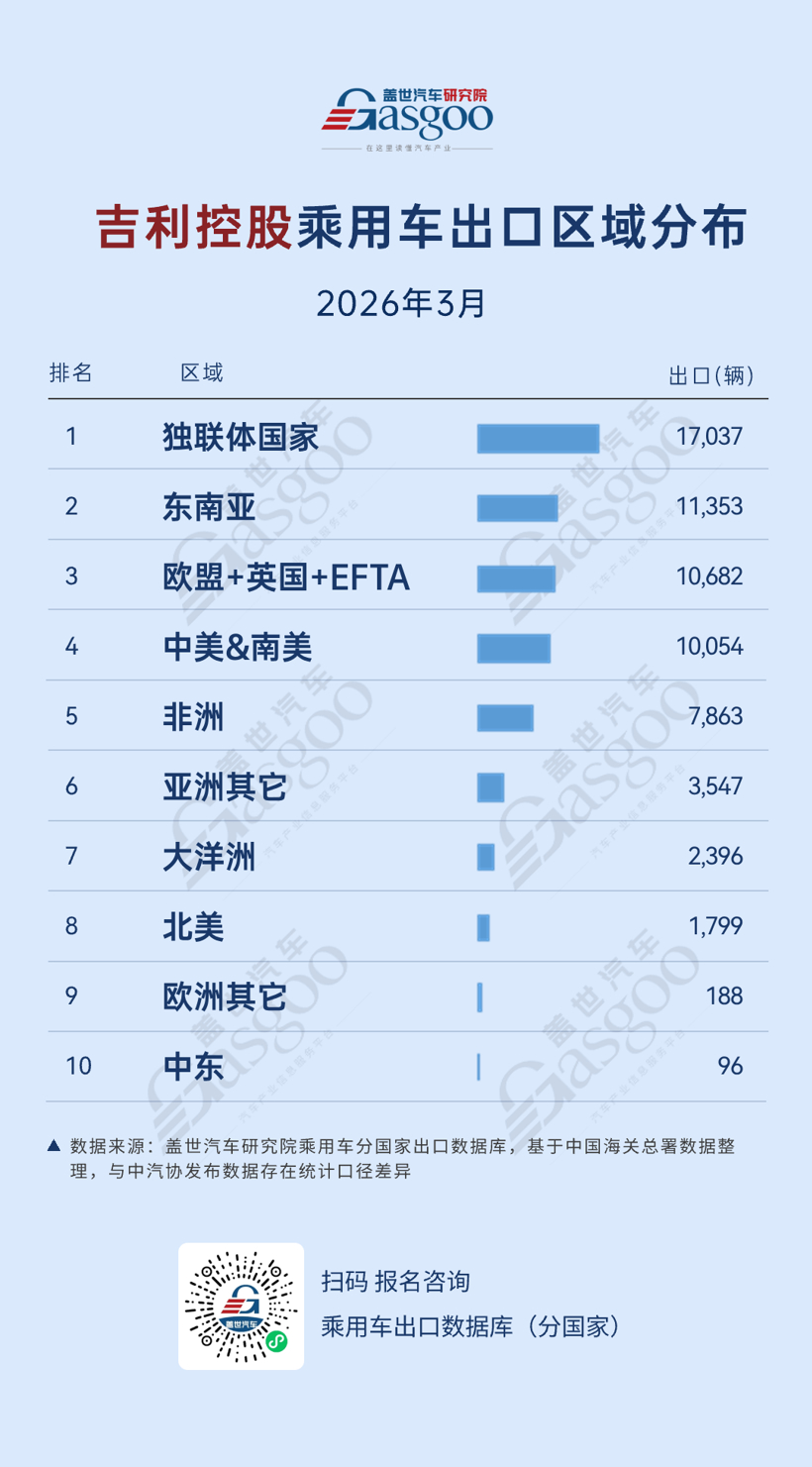
March export data reveals Geely Holding’s globalization features a CIS-led, multi-region balanced approach with steady performance in emerging markets. CIS countries ranked first with 17,037 units, remaining Geely’s core export market. This reflects the solid market barriers built through long-term product adaptation, channel construction, and localized operations in the region.
Southeast Asia, EU + UK + EFTA, and Central & South America ranked second, third, and fourth respectively, with all exceeding 10,000 units. This demonstrates stable expansion in these markets and the gradual formation of a multi-region synergistic growth pattern. Africa, Rest of Asia, Oceania, and North America form a middle tier with volumes in the thousands, creating stable secondary incremental markets. Meanwhile, Rest of Europe saw only 188 units, indicating low market penetration and significant room for development.
Notably, Geely Holding exported a mere 96 units to the Middle East in March, likely impacted by geopolitical conflicts and quarter-end demand fluctuations. Overall, Geely is advancing globalization via a strategy of "stabilizing the base in emerging markets while raising the ceiling in mature markets." If it can further strengthen differentiated product layouts across regions and improve the synergy of overseas production capacity, the stability and growth potential of its export structure will be further unleashed.
According to the Gasgoo Institute export database, here is the ranking of Chery Holding's passenger vehicle export regions for March 2026:
NO.1 EU + UK + EFTA: In March, Chery Holding exported 38,111 units to this region.
NO.2 CIS countries: In March, Chery Holding exported 34,154 units to this region.
NO.3 Central & South America: In March, Chery Holding exported 21,149 units to this region.
NO.4 Middle East: In March, Chery Holding exported 11,714 units to this region.
NO.5 Africa: In March, Chery Holding exported 10,686 units to this region.
NO.6 Southeast Asia: In March, Chery Holding exported 10,359 units to this region.
NO.7 North America: In March, Chery Holding exported 6,140 units to this region.
NO.8 Rest of Asia: In March, Chery Holding exported 3,746 units to this region.
NO.9 Oceania: In March, Chery Holding exported 3,536 units to this region.
NO.10 Rest of Europe: In March, Chery Holding exported 420 units to this region.
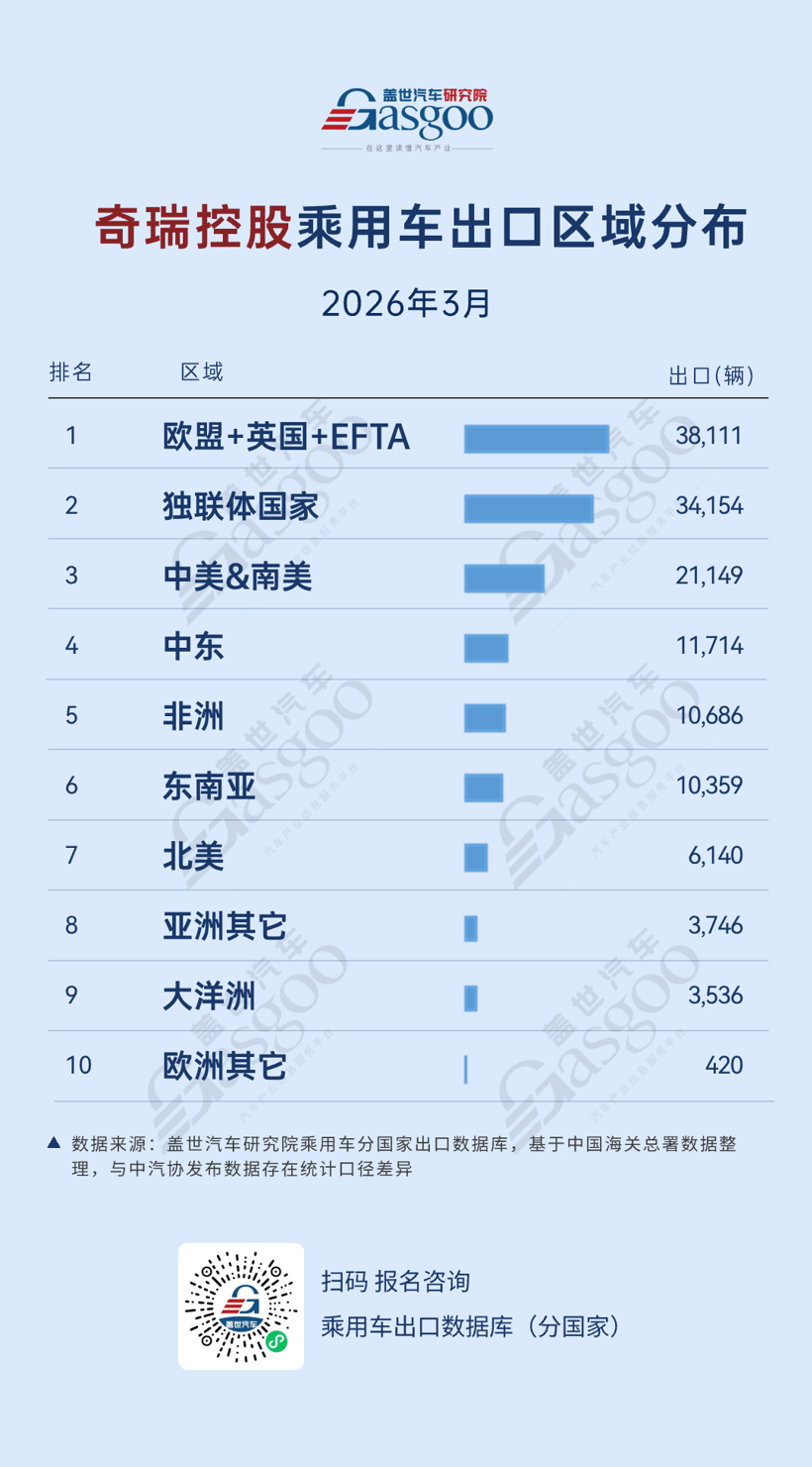
March export data shows Chery Holding’s globalization layout features a "dual-core market lead with multi-polar support," characterized by clear regional tiers and strong resilience. The EU + UK + EFTA region topped the list with 38,111 units, becoming Chery’s largest export market. This marks Chery’s product competitiveness and brand recognition in Europe as entering the first tier, with Europe gradually becoming a core engine for its export growth. CIS countries followed closely with 34,154 units, forming another massive pillar of equal magnitude. Together, these two markets account for over 70,000 units, cementing this "dual-core" structure.
Exports to Central & South America surpassed 20,000 units, while the Middle East, Africa, and Southeast Asia all exceeded 10,000 units. These four markets constitute Chery’s second growth curve. This widely distributed, multi-point export structure not only guarantees stable volume but also effectively hedges against risks from policy changes and exchange rate fluctuations in single markets, fully demonstrating the resilience of its global layout.
Notably, exports to North America, Rest of Asia, and Oceania were 6,140, 3,746, and 3,536 units respectively. While this tier’s sales scale falls short of the top two, they all show a steady development trend. Rest of Europe ranked last with 420 units, as the region is still in the early stages of channel setup and brand penetration, having not yet formed a scale effect.
Overall, Chery’s current globalization path is accelerating toward "leading with head European markets while advancing in parallel across multiple regions." If it can further deepen localized operations in each region and replicate the compliance and electrification experience gained in Europe to emerging markets, its competitiveness in the global passenger vehicle export market is poised to strengthen continuously.