



Gasgoo Munich- China's passenger vehicle market in 2026 is undergoing a profound structural adjustment.
According to the latest data released by the CPCA on May 11, April retail sales reached 1.384 million units, down 21.5% year-on-year and 16% month-on-month. While the market faces overall pressure, a historic turning point has arrived: the domestic retail penetration rate of new energy vehicles (NEVs) exceeded 60% for the first time, hitting 61.4%.
This signals that the center of gravity in China's auto market is accelerating its shift from internal combustion engine vehicles to NEVs. Meanwhile, export markets maintain high growth, and the joint venture camp continues to contract. Together, these trends paint a picture of a market defined by "total volume pressure and structural divergence."
Domestic Brands Capture Nearly 70% Share; JV Camp Shrinks Further
The divergence between domestic brands and joint ventures became even sharper in April.
Data shows domestic brand retail sales hit 970,000 units, capturing a 69.6% share of the domestic market—up 4 percentage points from last year. This means that for every ten new cars sold in China, nearly seven are from domestic brands.
In stark contrast to the domestic surge, the joint venture camp is sliding. Mainstream JV retail sales stood at just 280,000 units in April, plunging 37% year-on-year and 33% month-on-month. German brands saw their retail share slip to 13.3%, Japanese brands to 10.9%, and American brands to 4.5%. The market share of JVs, which once held half the Chinese market, is being squeezed step by step.
Cui Dongshu, secretary-general of the CPCA, stated clearly in a recent interview that the gap between domestic and JV brands will widen further this year. The core disparity lies in the speed of NEV transition, intelligent technology, and cost control. Leveraging full supply chain advantages and surging exports, domestic brands are poised to push their market share past 70%, accelerating both high-end positioning and electrification. Conversely, JVs—hampered by a shrinking ICE base and slower electrification—will likely see their share slide below 30%, with only a few top players able to stabilize their footing through localized new products.
And clearly, rising oil prices have accelerated this trend.
In a high-oil-price environment, more drivers are abandoning ICE vehicles for NEVs. According to CPCA analysis, April ICE vehicle sales fell by 365,500 units, accounting for 84% of the total retail decline. Domestic brands, with their first-mover advantage and supply chain accumulation in NEVs, have seized the initiative in this powertrain shift.
Production figures tell a similar story. passenger vehicle production reached 2.193 million units in April, down 1.8% year-on-year and 7.2% month-on-month. Specifically, domestic brand production rose 3% year-on-year and 2% month-on-month; JV production fell 14% year-on-year and 25% month-on-month; and luxury vehicle brand production dropped 10% year-on-year and 26% month-on-month. Domestic brands were the only camp to achieve year-on-year growth, while JVs and luxury vehicle brands contracted. This indicates automakers are adjusting capacity layouts based on market signals, shifting resources further toward domestic NEVs.
Wholesale data confirms this shift. Nationwide passenger vehicle wholesales hit 2.11 million units in April, down 4.0% year-on-year and 11.3% month-on-month. Driven by exports, the wholesale growth rate outpaced retail growth by 17.5 percentage points. Domestic automakers wholesaled 1.59 million units (up 3% year-on-year), while mainstream JVs wholesaled 310,000 units (down 30% year-on-year), and luxury vehicle brands wholesaled 210,000 units (down 2% year-on-year).
The luxury vehicle market is also under pressure. luxury vehicle retail sales totaled 140,000 units in April, down 16% year-on-year. Notably, as guide prices for luxury vehicle cars return to rational levels, the retail share of traditional luxury vehicle brands actually edged up 0.6 percentage points to 10.2%. This suggests that high-end consumers are relatively less sensitive to price, and the luxury vehicle market is stabilizing after a period of adjustment.
Exports provided the brightest spot in April. Passenger vehicle exports (including complete vehicles and CKD kits) reached 769,000 units, soaring 80.7% year-on-year and 11.8% month-on-month. Exports accounted for 36% of manufacturer sales in April, a sharp rise from 19% a year ago. Domestic brands exported 653,000 units (up 91%), while JVs and luxury vehicle brands exported 117,000 units (up 39%). A leading contingent comprising Chery, BYD, and Geely is gaining traction in overseas markets.
In terms of structure, NEVs have become a major force in exports. NEVs made up 52.7% of total exports in April, an 8-point increase from the same period last year. For every two Chinese cars leaving the country, one is an NEV. This export pattern is reshaping the competitive landscape of the global auto market.
NEV Penetration Tops 60%; Domestic Sales Flat, Exports Surge
The NEV sector delivered a report card in April marked by "highlights and divergence."
In the domestic market, NEV passenger vehicle retail sales reached 849,000 units, down 6.8% year-on-year and dipping slightly by 0.3% month-on-month. Although the penetration rate hit a record high of 61.4%, absolute sales did not surge. This is largely because the market is still digesting the pull-forward effect from last year's purchase tax policy adjustments, compounded by weak consumer confidence. Domestic NEV demand has entered a stable phase.
However, the export sector performed exceptionally well. NEV manufacturer exports hit 406,000 units in April, jumping 111.8% year-on-year and 18.3% month-on-month. It is clear that overseas markets are becoming a vital outlet for domestic NEV production capacity.
Regarding the breakthrough in penetration, Cui Dongshu commented: "The rise from 52% in March to 61% in April is effectively explosive growth. It's mainly because ICE vehicles are dropping too fast—as the water recedes, the rocks are revealed—causing the NEV share to rise significantly."
He further projected: "ICE demand will remain under pressure in May and June. If oil prices don't change significantly, the penetration rate will hover around 60%. Looking at last year's trend, April to November saw a gradual rise, but this leap is quite fast. It will be hard to drop back below 55%. In the coming months, it will likely hover between 58% and 65%, with 62% or 63% becoming the norm."
Specifically, the pure electric market is experiencing structural divergence. A00-class wholesale sales fell to 70,000 units, down 55% year-on-year, with their share of the BEV market dropping from 21.3% a year ago to just 9%. Meanwhile, B-segment EV wholesales climbed to 243,000 units, up 27% year-on-year, claiming a 31% share. The divergence between high-end models gaining ground and economy models under pressure is stark. Behind this split lies rising raw material costs and the withdrawal of subsidies, which have intensified cost pressures on entry-level EVs, while mid-to-high-end models—with larger profit margins—have become the priority product lines for automakers.
Plug-in hybrids showed greater resilience. Sales of narrow-definition PHEVs reached 362,000 units in April, up 13.7% year-on-year, serving as a key driver of NEV growth. Extended-range electric vehicles (EREVs) saw wholesales of 87,000 units, down 9.1% year-on-year and 9.9% month-on-month, performing relatively weakly. In terms of NEV wholesale structure, BEVs accounted for 63.3%, narrow-definition PHEVs for 29.6%, and EREVs for 7.1%.
The sales leaderboard also underscores the dominance of NEVs. In April, 15 models surpassed 20,000 wholesale units. The BYD Song led with 67,351 units, followed closely by the Model Y with 52,143 units, with the Tansuo 06, Geely Xingyuan, and Yuan UP trailing behind. Among these top 15 models, NEVs occupied the vast majority; ICE vehicles are struggling to break into the top ranks.
The export performance was even stronger. NEV passenger vehicle exports hit 406,000 units in April, surging 111.8% year-on-year and 18.3% month-on-month, accounting for 52.7% of total passenger vehicle exports and breaking the 50% mark for the first time. BYD led with 130,042 units exported in a single month, followed by Chery (57,910), Tesla China (53,522), and Geely (48,901). Notably, narrow-definition PHEVs accounted for 39.9% of NEV exports, up 7.6 percentage points from last year, showing significant growth in developing markets.
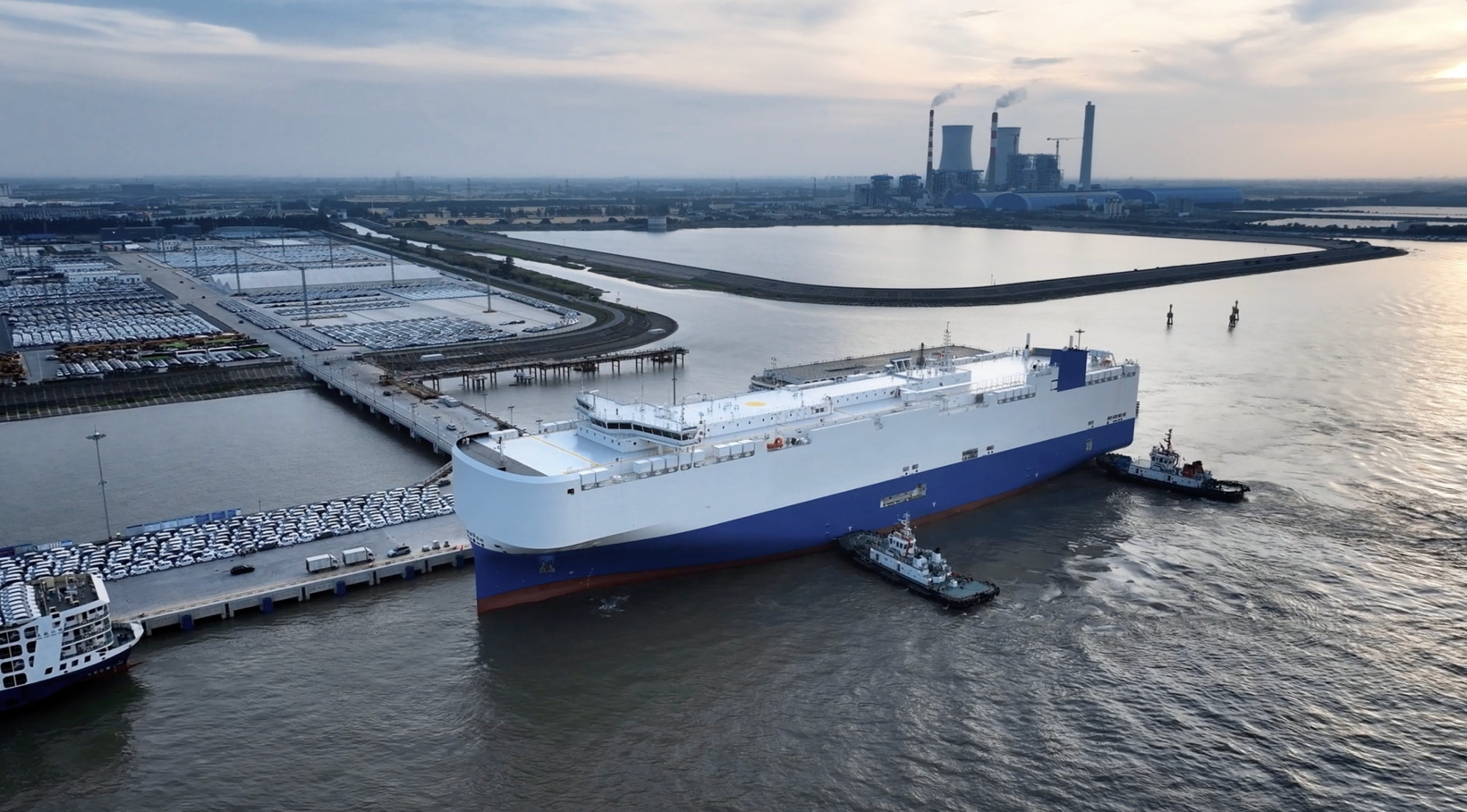
Image source: Chery
Looking at the competitive landscape, 20 manufacturers achieved wholesale sales exceeding 10,000 NEV units in April, accounting for 93% of the total NEV passenger market. BYD continued to lead with 314,100 units, followed by a second tier comprising Geely (135,600), Chery (93,000), Tesla China (79,500), and Leapmotor (71,400). On the retail side, 16 domestic brands surpassed 20,000 units, with BYD Auto on top at 182,000 units, followed by Geely Auto (95,600), Changan Auto (64,500), and Leapmotor (57,200).
The "new force" camp turned in a standout performance, capturing a 25.6% retail share—up 5.6 percentage points year-on-year. Leapmotor, Li Auto, and NIO have become key growth poles. Notably, BEV sales accounted for 81.1% of new force models, a sharp increase from 66% last year, indicating that these brands are accelerating their transition toward pure electrics. The market is concentrating at the top, further squeezing the survival space for tail-end enterprises.
The conventional hybrid market remained relatively stable. Conventional hybrid passenger vehicle wholesales totaled 72,000 units in April, up 2% year-on-year but down 30% month-on-month. GAC Toyota, FAW Toyota, and SAIC Passenger Vehicle ranked in the top three. The hybrid market, neither growing as fast as BEVs nor slumping as hard as ICE vehicles, sits in a relatively stable range.
May Outlook: MoM Recovery, YoY Pressure; Exports Remain Key Growth Driver
With April's figures settled, all eyes are on May's trajectory. Based on the CPCA's analysis, May will likely follow a pattern of "month-on-month recovery, year-on-year pressure, and exports leading the way."
On the positive side, the May Day holiday combined with various auto shows is activating purchasing demand. As the price war cools, consumer expectations for further price cuts are fading, and some wait-and-see buyers are entering the market. The CPCA predicts that auto production and sales in May will continue a slow rebound, with a "high start, stable finish" monthly trend. The dividend of new models released at the Beijing Auto Show will also inject some growth momentum.

Image source: IM Motors
In terms of working days, May this year has 19 days, matching May 2025, so the production rhythm should be relatively stable. Terminal performance suggests the momentum for month-on-month repair in May is broadly positive. Previous sales losses caused by the cooling price war and stabilizing promotion intensity are gradually being digested.
However, challenges cannot be ignored. High international oil prices are suppressing ICE demand and increasing travel costs, which in turn weakens overall purchasing power. Geopolitical tensions add significant uncertainty to the market by keeping oil prices elevated. Meanwhile, cautious income expectations, tighter auto financing policies, and higher credit thresholds suggest a slow pace for domestic consumption recovery. Despite having 19 working days, achieving year-on-year growth in May will be no easy feat.
Exports remain the most certain growth engine currently. Leveraging mature NEV industrial advantages, leading automakers are accelerating expansion into Latin America, Europe, and other markets, using overseas gains to offset domestic pressure. From January to March 2026, China's auto exports reached 2.34 million units, up 53% year-on-year. By destination, Russia, Brazil, Mexico, the UK, and Belgium were the top five markets. Brazil saw the largest increase, adding 121,500 units from January to March compared to the same period last year; Russia added 93,700 units, and the UK added 59,900 units. Exports of Chinese NEVs to the Middle East and developed markets are showing a trend of high-quality development.
Conclusion
April's passenger vehicle market was a mix of chill and heat. In terms of volume, the 1.384 million retail scale reflects the chill on the demand side; structurally, however, the domestic share nearing 70%, NEV penetration topping 60%, and exports surging over 80% reveal the heat on the industrial side.
The divergence between total volume and structure is a hallmark of a market in transition. The void left by fading ICE vehicles is being filled by NEVs and exports; the share surrendered by JVs is being absorbed by the domestic ecosystem. The process won't happen overnight, but the direction is clear.
For the remainder of 2026, the market still faces many uncertainties: oil price trends, consumer confidence, policy timing... But one thing is certain: China's auto industry is shifting from a phase of "scale expansion" to one of "structural reshaping." For every participant in this game, adapting to this divergence is far more urgent than waiting for a total volume recovery.


