



What were the biggest headlines in the global auto industry this week?
FORVIA Sells Interiors Business for €1.82 Billion
Auto parts supplier FORVIA announced on April 27 that Apollo Funds has agreed to acquire its interiors business in a deal valued at €1.82 billion.
The deal marks a key milestone in FORVIA’s IGNITE strategy, unveiled on February 24 at its Capital Markets Day. Under this plan, the group is shifting focus to high-value, technology-driven core operations while shoring up its financial structure. Once the interiors division is spun off, FORVIA expects to slash its net debt by at least €1 billion.
Closing is expected by the end of the year, pending consultations with employee representatives and regulatory approvals.
The interiors unit is a global leader, generating roughly €4.8 billion in consolidated revenue in 2025—about 18% of the group’s total. Its footprint spans 19 countries with 59 production bases and eight R&D centers, employing over 31,000 people. As controlling shareholder, Apollo plans to leverage its expertise and operational model to drive the unit’s transformation and long-term growth.
Gasgoo Take: Offloading low-margin operations to shore up cash flow is a survival tactic for traditional Tier 1 suppliers—and a way to create room for financial maneuvering.
Q1 Auto Industry Profit Falls 18% YoY; Margin Slips to 3.2%
Citing data from industry analyst Cui Dongshu, China’s auto output fell 6% year-on-year to 7.15 million units in the first quarter of 2026. Over the same period, industry revenue edged down 0.2% to roughly 2.41 trillion yuan, while total costs climbed 0.7% to 2.14 trillion yuan.

Image Credit: Cui Dongshu
Squeezed by falling revenue and rising costs, total industry profit for the quarter dropped 18% to 78.4 billion yuan, dragging the profit margin down to 3.2%. Even though March’s margin rebounded to 3.7%—up from 2.9% in the first two months—it remains near historic lows.
The auto sector’s profitability lags far behind the broader downstream industrial average, which sat at roughly 6% in Q1 compared to the industry’s 3.2%. Meanwhile, upstream miners are enjoying high profits: the non-ferrous metals sector saw a 39.1% jump, while oil margins climbed to 32.9%, passing cost pressures down the chain. Soaring lithium carbonate prices and elevated commodity costs have only intensified the burden on mid- and downstream manufacturers.
Looking at per-vehicle metrics, revenue climbed 5.4% to 337,000 yuan in Q1, though costs rose faster—up 6.3% to 299,000 yuan. Taxes per vehicle increased 3.9% to 27,000 yuan, while gross profit per vehicle slumped 13.2% to just 11,000 yuan.
Gasgoo Take: Rising revenue but falling profits, margins squeezed from both sides—these bleak numbers confirm the auto industry has moved beyond mere price wars into a brutal game of survival where only the fittest remain.
Chip Costs Force Another Automaker to Hike Prices
On April 30, Changan NEVO announced a price adjustment via its official channels.
Citing a sharp rise in global automotive chip costs, the company said it will raise the official guide price by 3,000 yuan for the NEVO Q07 Tianshu Intelligent LiDAR Edition starting May 7. The increase affects three trims: the 215 LiDAR Honor, Flagship, and Flagship PLUS, which will now cost 159,800 yuan, 169,800 yuan, and 179,800 yuan, respectively.
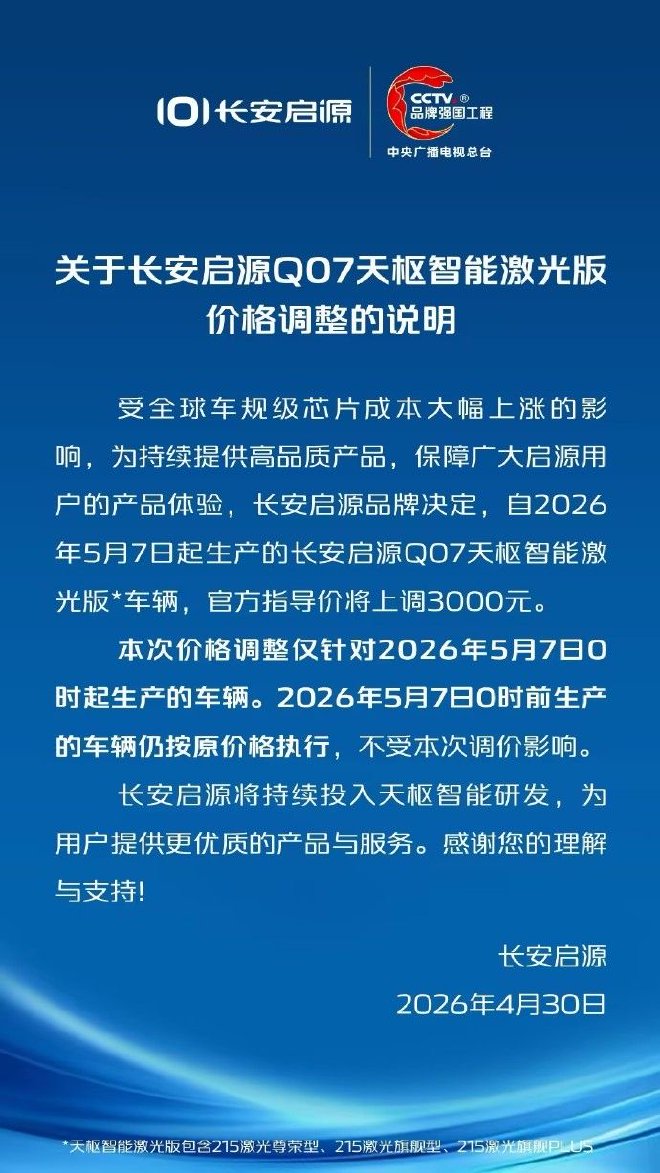
Image Credit: Changan NEVO
There’s a catch: vehicles produced before May 7 will still be sold at the original price. In the short term, that could spur consumers to visit showrooms during the May Day holiday.
Just two nights earlier, on April 28, BYD issued a similar notice. The price of the optional "God's Eye B" assisted driving LiDAR package for select models under its Dynasty, Ocean, and Fangchengbao series will increase from 9,900 yuan to 12,000 yuan—a hike of 2,100 yuan—effective May 1.
BYD also pointed to supply chain pressures, specifically a surge in global memory hardware costs.
Gasgoo Take: Moving from "fierce competition" to "reluctantly passing on costs," these price hikes by top automakers are a sign of necessity—but they could also mark the turning point that finally breaks this unsustainable price war.
JAC Motors Plans Investment in Yinwang Intelligent Technology
On April 30, JAC Motors announced plans to invest in Yinwang Intelligent Technology, though the exact amount, structure, and price will depend on the final agreement signed by both parties.
The announcement stated that JAC has begun negotiations with Yinwang and its shareholders to join the investment, aiming to jointly support Yinwang’s goal of becoming a world leader in intelligent driving systems and components while serving as an open platform for the auto industry.
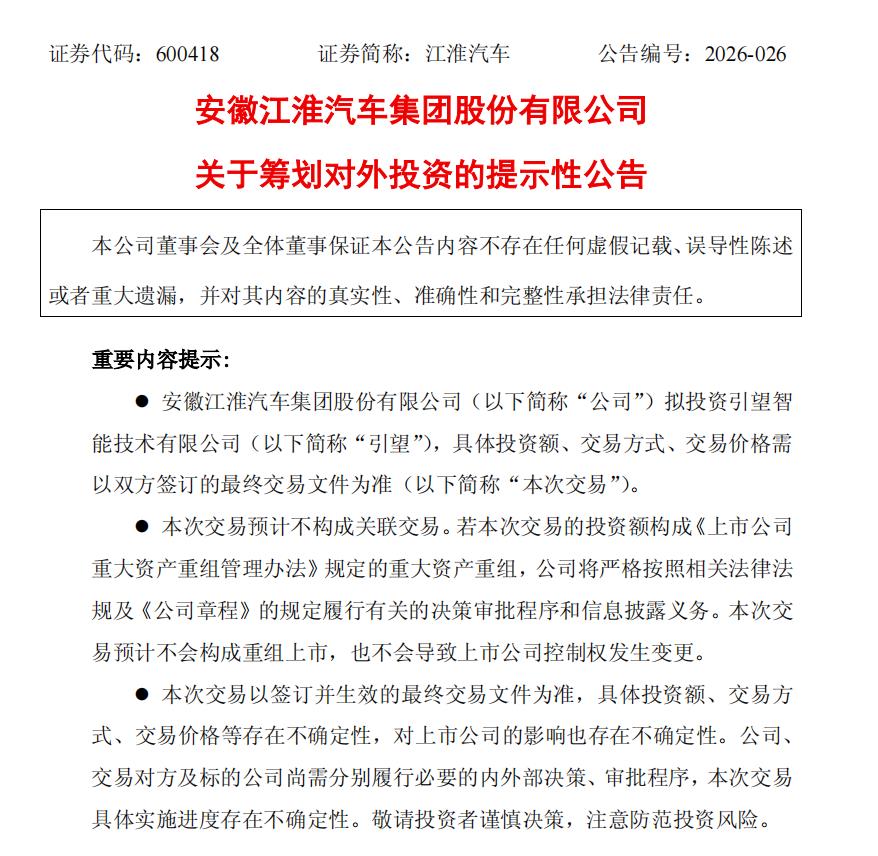
Image Credit: JAC Motors Announcement
If the deal goes through, Yinwang will become an associate company of JAC Motors, though the scope of consolidated financial statements will not change. The transaction is not expected to constitute a related-party deal.
According to the filing, no investment agreement has been signed yet; specifics will be finalized in the closing documents.
As of now, Yinwang’s major shareholders are Huawei Technologies with an 80% stake, Seres Automobile with 10%, and Avatr Technology (Chongqing) with 10%.
JAC Group’s partnership with Huawei dates back to a comprehensive framework agreement signed in December 2019. In December 2023, the two sides signed a deal to collaborate under the HarmonyOS Mobility (HIMA) model to build ultra-luxury smart electric vehicles.
Their first jointly developed model, the million-yuan-class luxury sedan Zunjie S800, launched in May 2025. By the end of March 2026, cumulative deliveries had surpassed 16,000 units, making it the top-selling ultra-luxury sedan in China for seven consecutive months.
On April 26, JAC Group and Huawei signed a Joint Innovation Cooperation Agreement in Beijing, taking their strategic partnership to a deeper level. Focusing on joint R&D, supply chain integration, and brand building, the deal aims to accelerate the Zunjie brand’s rise as a leader in China’s ultra-luxury smart car market.
Gasgoo Take: Paying to enter Huawei’s ecosystem isn’t just about buying technology—it’s about securing an entry ticket for Zunjie to compete in the million-yuan luxury arena.
Report: SAIC’s MG Picks Spain for European EV Plant
SAIC Motor’s MG brand plans to build an electric vehicle plant in Spain, a move that would help the Chinese automaker mitigate the impact of EU tariffs, according to people familiar with the matter.
The decision isn’t final yet, they said, with key details like investment scale, capacity, and production timing still under discussion and subject to change. Choosing Spain would mean dropping Hungary, which had been a backup option.
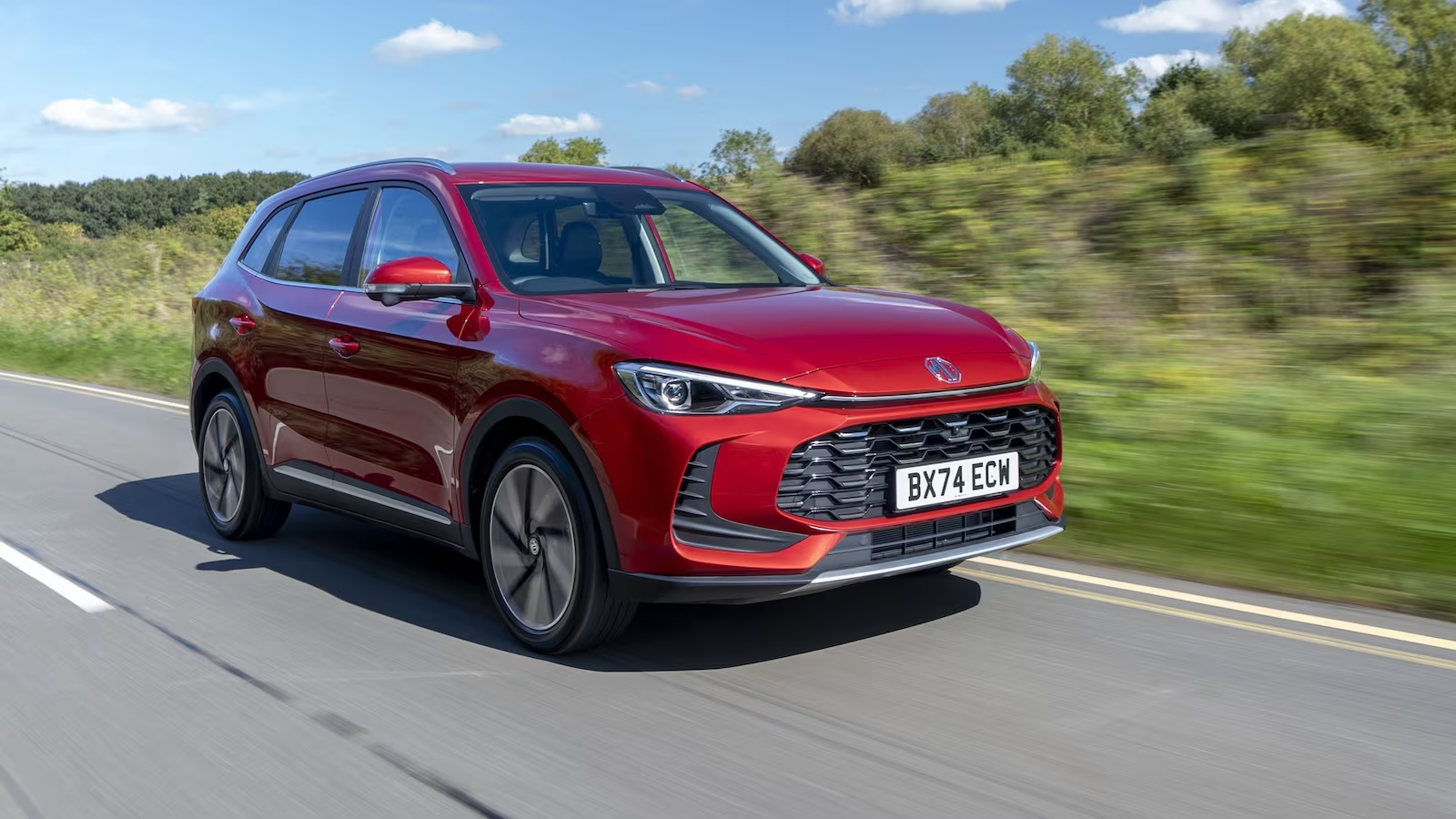
Image Credit: MG
Hungary has recently attracted significant EV and battery investment, including projects from BYD, thanks to its improving supply chain, logistics network, and infrastructure advantages connected to the Belt and Road Initiative.
Spain, meanwhile, is actively positioning itself as an EV investment hub, using policy incentives and its established automotive infrastructure to attract businesses. Regions like Zaragoza—a key Stellantis production base—offer mature industrial support, a skilled workforce, and logistical advantages.
SAIC and MG declined to comment on the report.
Gasgoo Take: By choosing Spain over Hungary, SAIC MG is making a calculated move against EU tariff barriers—a clear sign that local production has become a necessary compromise for Chinese automakers trying to crack the European market.
Minieye and neueHCT Establish Joint Venture
On April 27, Minieye and neueHCT announced plans to form a joint venture, integrating technology, capital, and market resources to focus on mobile robotics. The partnership aims to build a product system covering "indoor-park-city-open road" scenarios. Using autonomous logistics vehicles as a strategic pivot, the JV will expand into multi-scenario delivery applications, creating a full-chain solution spanning R&D, mass production, and global delivery.
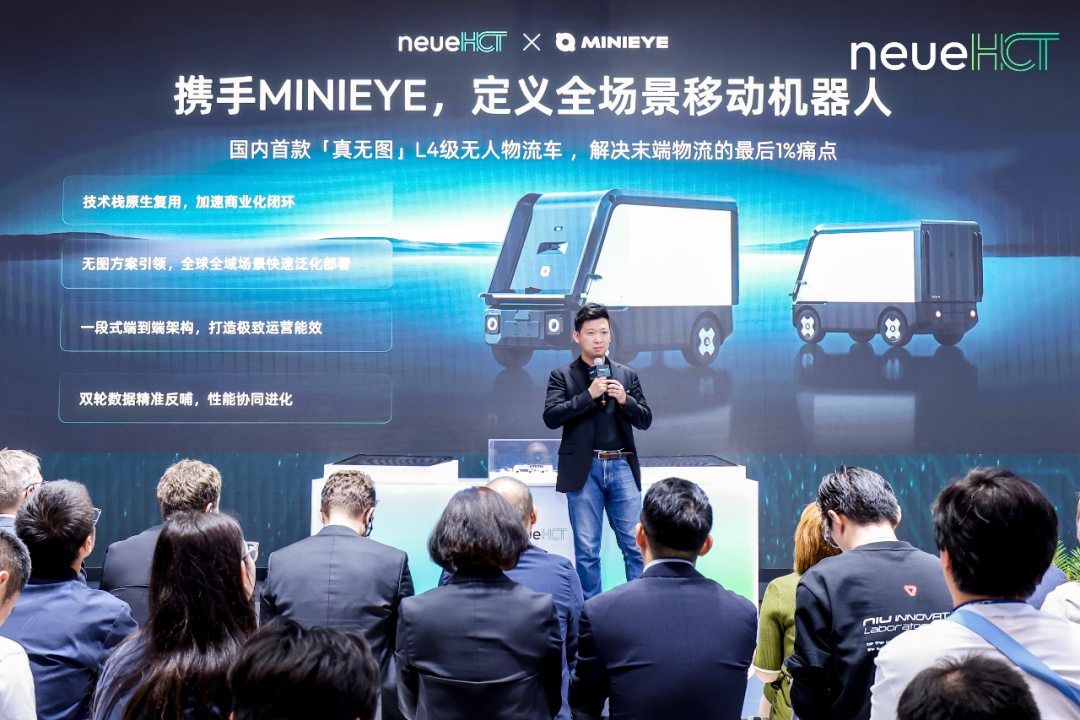
Image Credit: neueHCT
During the 2026 Beijing Auto Show, Minieye unveiled the T5 Pro, China’s first "true map-free" L4 autonomous logistics vehicle. A product of this partnership, the T5 Pro is designed for "out-of-the-box usability, hour-level deployment, and full-scenario adaptability." It achieves breakthroughs in performance, cost, and cross-regional deployment by eliminating reliance on high-definition maps. The vehicle handles complex urban environments and shortens delivery cycles, enabling plug-and-play operation anywhere and accelerating the path to large-scale commercial use.
Looking ahead, the partnership will deepen along two tracks. In the L2 and L2+ automotive front-loading market, they will leverage their R&D and mass-production experience to create integrated ADAS+DMS solutions, offering cost-effective, reliable cabin-driving fusion systems for passenger vehicles. In the L4 autonomous logistics sector, they will explore technical innovations to accelerate deployment in specific scenarios and overseas markets, using data from L2 applications to train and develop L4 algorithms.
Gasgoo Take: Using mass-market L2 data to fund the L4 dream is perhaps the most pragmatic "indirect path" to survival for autonomous driving companies right now.


