



"Is this the robots' Gala?" As Cai Ming shared a laugh with a robot "grandson" capable of pouting and pulling off backflips, and as dozens of machines took the stage—performing horse stances and drunken boxing alongside martial artists, or dancing to the beat of "Smart Manufacturing Future"—countless viewers found themselves asking the same question.
From Cai Ming and Guo Da's 1996 sketch "Robot Humor," which romanticized future tech, to 2026, where she reprised the role of a "first-generation robot" three decades later—this time acting opposite a real embodied AI agent. Those thirty years mark not just a span of Cai Ming's career, but a vivid transformation of China's robotics sector from theoretical concept to a flourishing industry.
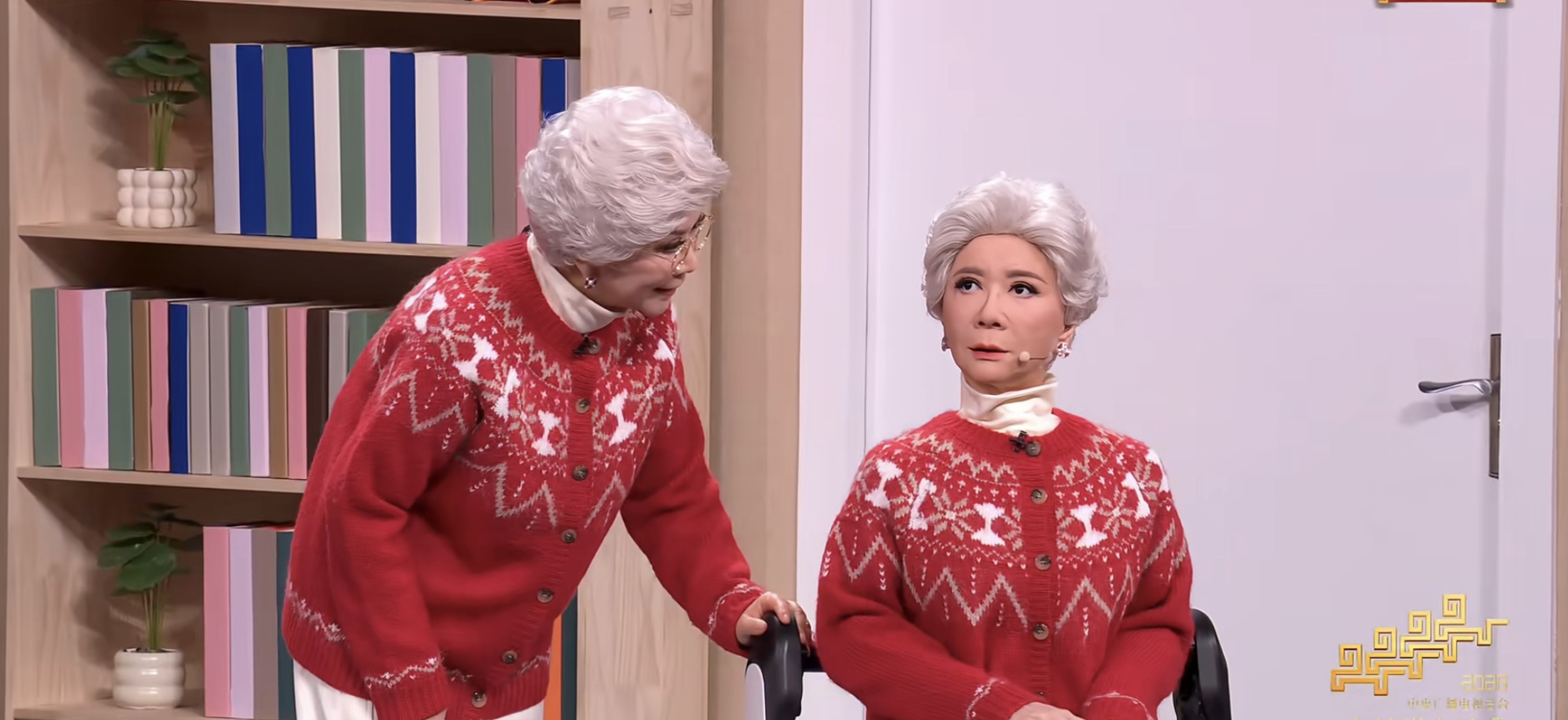
Image source: Spring Festival Gala screenshot
One online comment struck a chord with many: "It's hard to believe that just a year ago, these things were wobbling around spinning handkerchiefs. Now they're practicing martial arts, acting in skits, singing, and dancing—it's like they've evolved at double speed."
More notably, the robots gracing the stage this year weren't a solo act. Four companies—Unitree Robotics, MagicLab, Galbot, and Noetix Robotics—made their debut as a group. This wasn't just a tech showcase; it was a collective manifesto for an entire industry.
A 'Four-Way Battle' on the Gala Stage
As spotlights illuminated the stage, four robotics firms stepped into the view of hundreds of millions of viewers, each with its own flair.
Unitree Robotics made its third Gala appearance, bringing its G1 and H1 humanoids to perform "WuBOT" with martial artists from the Henan Tagou Wushu School. They executed horse stances, somersaults, sweeping legs, and side aerials with fluid precision. Wielding long staffs and nunchucks, performing aerial flips and drunken boxing—they made it look effortless. Compared to the robotic ox "Benben" in 2021 and last year's "YangBOT," this performance carried a more composed, commanding air—the aura of true martial arts masters.
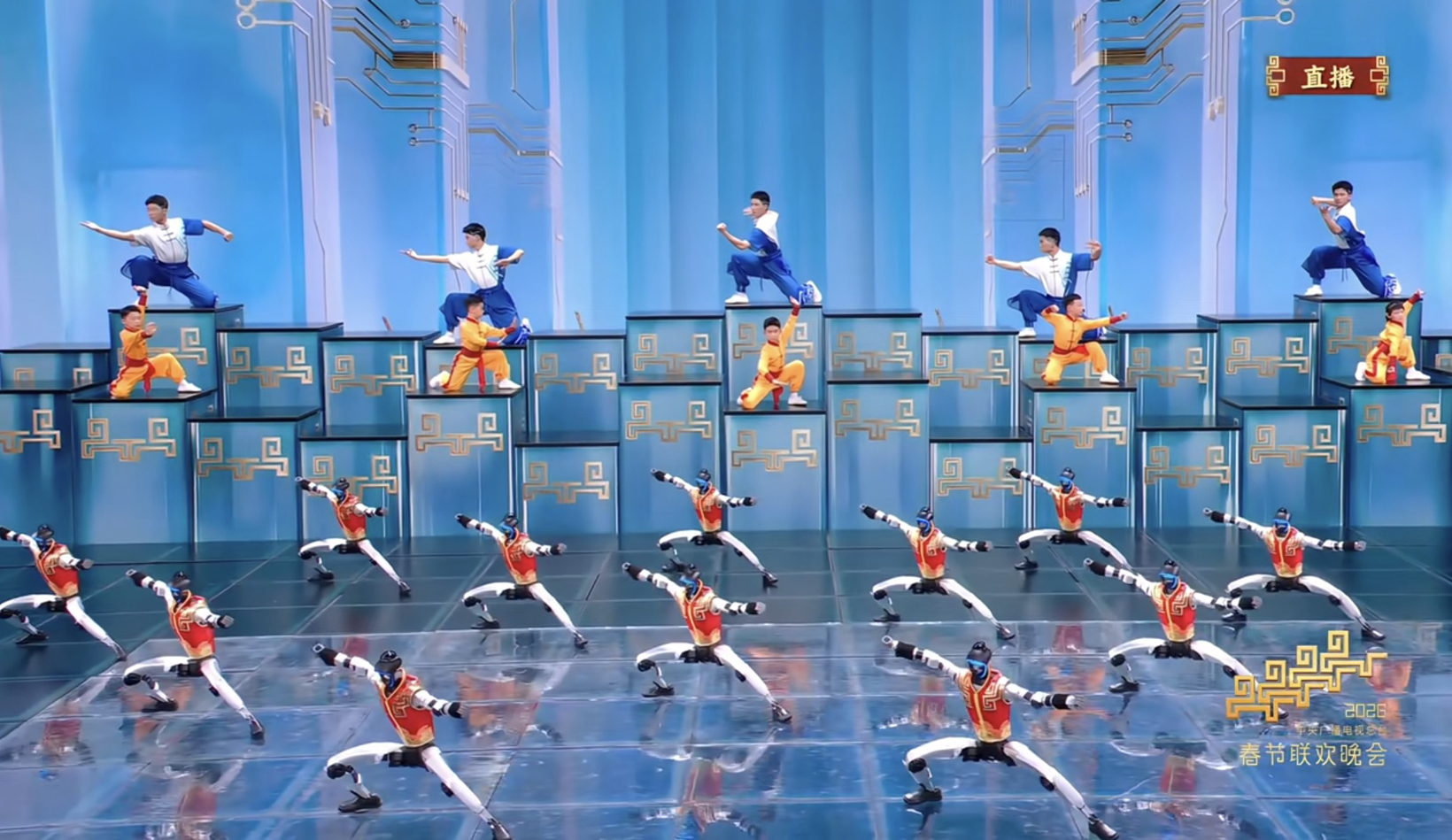
Image source: Spring Festival Gala screenshot
Unitree wasn't the only player this year. Over 200 humanoid robots took the stage, with domestic firms like Noetix Robotics, MagicLab, and Galbot joining the fray—a veritable "parade of Chinese embodied intelligence."
The skit "Grandma's Favorite," featuring Cai Ming and a robot from Noetix Robotics, won over audiences with its warm narrative and lifelike performance. The robot didn't just do housework; it acted coquettishly, told jokes, and pulled off high-difficulty moves like backflips. The "robot grandma" appearing at the end was startlingly realistic.
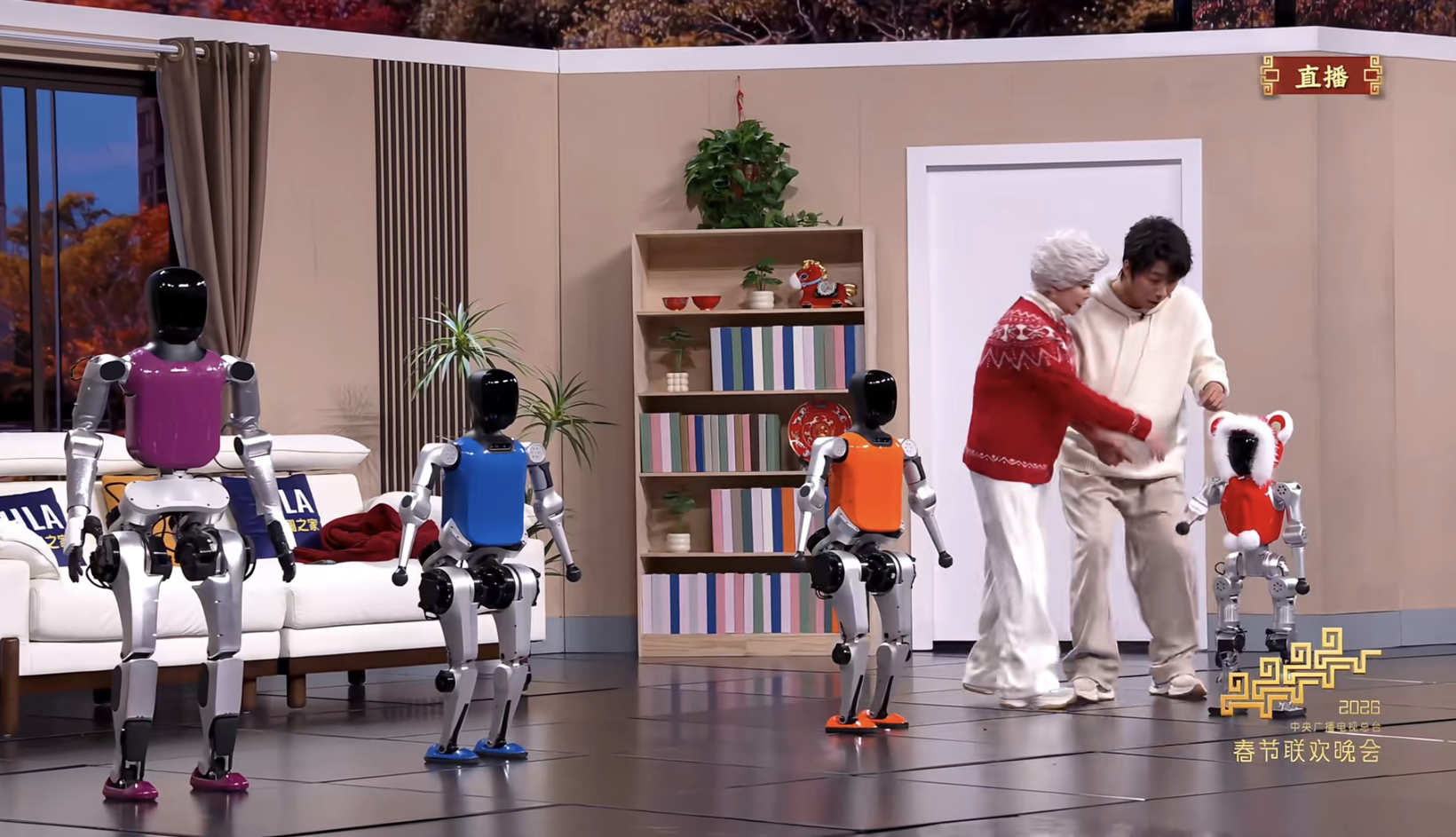
Image source: Spring Festival Gala screenshot
This marked Cai Ming's third robot-themed Gala. Thirty years ago, her "robot wife" was a whimsical fantasy of future tech. Today, robots with human-level interaction capabilities are quietly stepping into daily life. Noetix Robotics' breakthrough in anthropomorphic expression serves as a vivid snapshot of the rapid rise in China's service robotics sector.
MagicLab participated in the song "Smart Manufacturing Future," showcasing the diverse layout of Chinese intelligent manufacturing. Its high-dynamic bipedal humanoid, the Magicbot Z1, has previously pulled off stunts like 360-degree Thomas flares and one-handed handstands, demonstrating powerful athletic capabilities.
Galbot also made its debut, highlighting autonomous decision-making in complex scenarios. What the audience saw wasn't repetitive pre-programmed motion, but intelligent agents capable of perceiving their environment and reacting in real time.
Securing a Gala slot came at a steep price: collaboration rights reportedly cost between 60 million and 100 million yuan. For unprofitable startups, that's equivalent to a year's comprehensive R&D costs. Why take such a gamble?
The answer lies in Unitree Robotics' success at the 2025 Gala. Last year, "YangBOT" became a phenomenon, driving a surge in orders that helped the company close a Series C round in the first half of the year, pushing its valuation to 12 billion yuan. "The Gala brings hundreds of millions of impressions—a tangible visibility that amplifies brand and capital appeal," said Zhang Yi, CEO of iiMedia Research. That exposure often stimulates valuations, fundraising, and even IPO expectations.
Yet, some chose a different path. Zhiyuan Robotics, a leader in shipments, footed the bill for its own "Wonderful Night of Robots"—the world's first dedicated robot gala. Over 200 robots performed across 12 acts, even joining actor Huang Xiaoming for a magic trick.
On one side, a 100-million-yuan entry fee for a four-way battle; on the other, a zero-cost solo production. Two starkly different routes, both reflecting the competitive anxiety of robotics firms in the "year of commercialization."
Robots Step Out of the Spotlight
The Gala performance pushed humanoid robots into the mainstream. But a more critical question remains: when the lights dim and the music stops, what can these robots actually do?
This Spring Festival, the answer is becoming clear—they aren't just performers; they are workers.
Over the past year, the state backed Beijing and Shanghai in building innovation centers for embodied intelligence and humanoid robotics, pushing the development of open-source platforms like "Tiangong."
In the market landscape, Chinese firms are taking the lead globally. According to Omdia, Zhiyuan Robotics held 39% of the global market share in 2025, with Unitree at 32%. Unitree responded that its actual humanoid shipments exceeded 5,500 units, with over 6,500 units rolling off production lines—making it one of the world's highest-volume manufacturers.
More importantly, robots are moving from labs to real-world scenarios.
On the industrial front, UBTECH's Walker S2 has begun mass delivery, covering key sectors like auto manufacturing, smart production, and logistics. The company plans to scale annual capacity to 5,000 units by 2026 and 10,000 by 2027. Recently, Walker S2 collaborated with mobile robots to automate SPS loading for unmanned logistics vehicles, building a multi-agent smart manufacturing system.
In commercial services, Galbot's robots are "on the job" at top-tier factories like CATL. The company has deployed 100 fully autonomous "Galaxy Capsule" convenience stores across over 20 cities and built the world's first retail warehouse operated continuously by humanoids for over a year, working eight hours daily. AI² Robotics' "Zhi Cube" robots are operating stably for eight hours a day in stores across Shenzhen and Beijing, making hundreds of cups of coffee and ice cream daily with zero errors, serving tens of thousands of people.
In the consumer market, Noetix Robotics launched the "Xiao Bumi," a humanoid robot priced in the ten-thousand-yuan range, aiming to push humanoids into the mass market.
Morgan Stanley has raised its 2026 sales forecast for Chinese humanoids to 28,000 units—a 133% jump year-on-year, far surpassing its earlier prediction of 14,000. The bank expects China's market to enter "exponential growth," reaching 262,000 units by 2030 and potentially 2.6 million by 2035. Falling costs are the key driver: raw material costs are projected to drop 16% in 2026, with robot prices potentially falling from $50,000 in 2024 to $21,000 by 2050.
Yet beneath the glitzy stage, how hot is the industry really? Many listed companies labeled as "concept stocks" admit that related businesses are mostly in market exploration, sampling, or small-batch stages, contributing little to current earnings. Industry data supports this caution. The Robot Report notes that while the humanoid sector saw 463 funding rounds in 2025 and valuations tripled, actual shipments rose just 17%. Goldman Sachs surveyed nine Chinese supply-chain firms: suppliers planned annual capacity of 100,000 to 1 million units, but none confirmed large-scale orders. Moreover, education and research institutions account for 75% of total orders.
"Compared to dancing, robots should enter human society—ideally starting in elderly and childcare fields to genuinely help reduce pressure," an industry insider said bluntly. In his view, if it stays at the level of performance, the hype won't last.
Conclusion
The 2026 Gala has ended, but the robots' performance lingers. From Cai Ming's 30-year reunion with the "first-generation robot" to the four-way corporate showdown, and the machines quietly taking jobs nationwide—China's humanoid robotics industry is experiencing an unprecedented boom.
This Gala battle brought positive attention. Whether squeezing onto the CCTV stage or hosting their own galas, these firms brought robot technology to the masses, shattering stereotypes and cultivating potential users.
But clarity is needed: the industry's core strength lies not in minutes of stage stunts, but in technical depth, product quality, and real-world deployment. As one insider put it: "Robots making it to the Gala means they've moved from lab prototypes to an engineering stage of stable, scalable operation. But what decides their future isn't whether they can perform, but whether they can enter real scenarios and homes."
The 2026 marketing war was essentially a rehearsal for the "right to survive." A 100-million-yuan Gala ticket buys exposure, but can that convert to orders? A self-funded gala saves costs, but can those savings be redirected into real tech breakthroughs? There is no right or wrong here—only success or failure.
Walking off the stage, they are running into our lives. And as the Gala's spotlight fades, the true test by the market has only just begun.


