



Gasgoo Munich- As the automotive industry enters the "Software-Defined Vehicle" (SDV) era, vehicle hardware systems are growing increasingly complex while iteration cycles accelerate. With software functions expanding rapidly, development efficiency and quality assurance have emerged as the industry's core challenges. Given the frequent updates to underlying software, increasingly complex system architectures, and stricter requirements for information and functional safety in connected environments, traditional development models are struggling to keep pace with industrial demands.
Against this backdrop, artificial intelligence (AI) is becoming a critical driver for automotive software development. By deeply integrating into requirements analysis, configuration design, and automated testing, the industry is exploring intelligent, full-process development methods designed to boost efficiency, cut costs, and ensure quality.
At the 7th Software-Defined Vehicle Forum, Zhang Long, Chief Technology Officer of Wuhan Kotei Informatics Co., Ltd. (Kotei Info), shared the company's progress in AI-driven automotive software development. As software complexity grows exponentially, boosting efficiency while maintaining quality has become a universal challenge. To address this pain point, Kotei Info has implemented full-process intelligent practices by fusing AI technology with automotive software development. The company has achieved phased results in key areas like AUTOSAR, offering replicable, actionable insights for the industry.
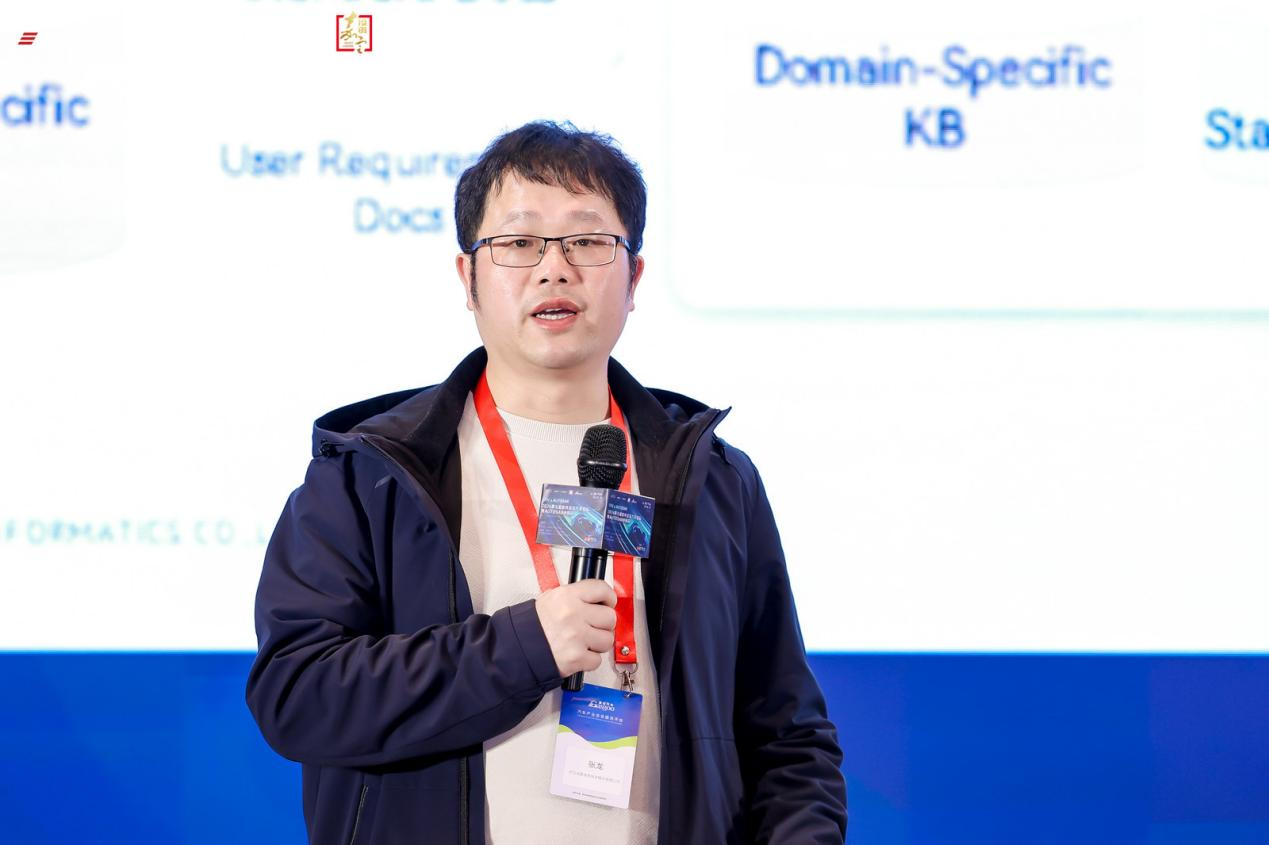
Zhang Long | CTO of Kotei Info
From Manual Experience to Intelligent Development: How AI Tools Break the Deadlock
Within the SDV framework, diversifying hardware and complex software upgrades have raised the bar for information and functional safety, placing higher demands on engineering capabilities and intelligent toolchains. In actual development and mass production, simple issues are easily caught via bench or simulation testing. However, as system complexity grows, timing-related issues become difficult to troubleshoot manually due to the sheer number of possibilities. Kotei Info focuses its AI efforts on these intractable problems, leveraging computing power and analytical capabilities to explore a path toward intelligent transformation. Given that hardware diversity drives frequent changes to underlying software—impacting upper-layer architectures and interfaces—the company targets high-barrier, repetitive tasks in customization. Drawing on its technical reserves, Kotei Info has developed the AUTOSAR Expert Agent.
In automotive software development, tasks like chip replacement, adapting to new models, and meeting OEM customization needs typically require senior engineers—a scarce resource. By mapping the technical experience and industry knowledge of these experts into a knowledge graph, the AUTOSAR Expert Agent enables mid-level engineers to handle complex adaptation tasks. Early in the project, the goal was set to boost development efficiency fivefold and shorten development cycles by 20%.
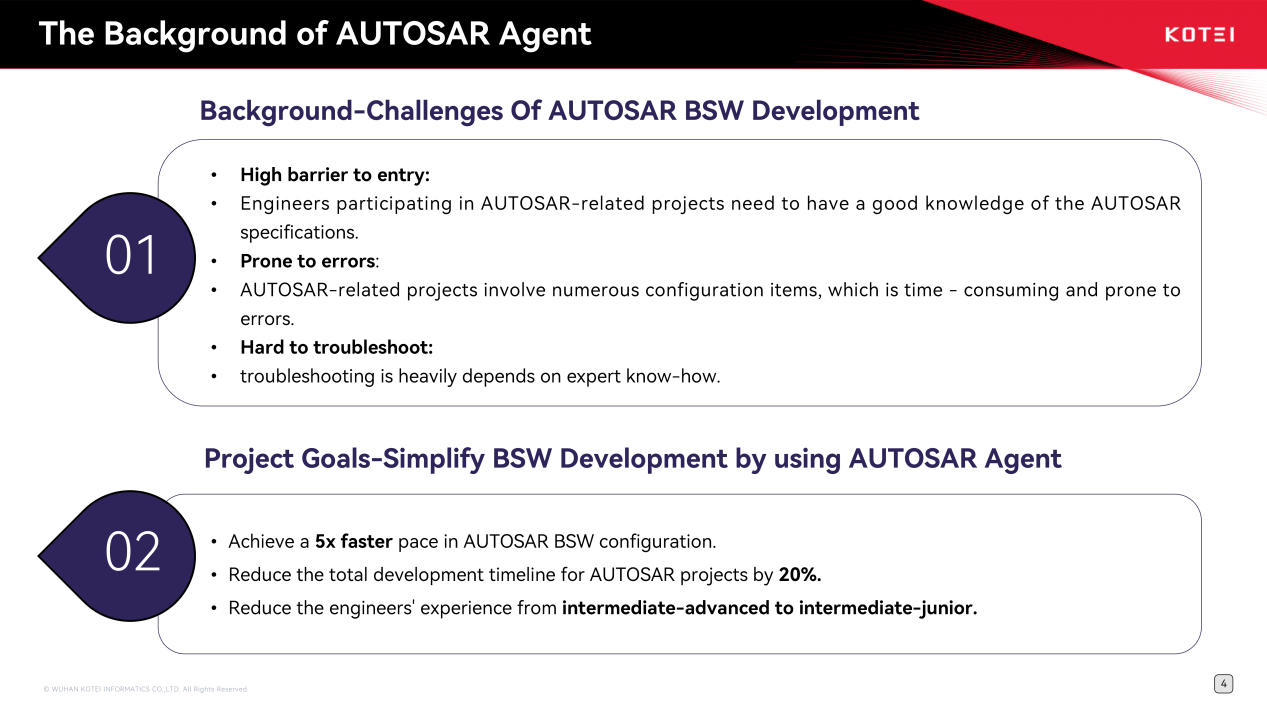
Image source: Speaker materials
With clear development goals and application scenarios in place, Kotei Info refined the Agent's technical foundation and knowledge system to ensure efficient execution in complex development tasks.
Built on a general large language model (LLM) foundation, the AUTOSAR Expert Agent addresses a common gap: generic models lack specialized AUTOSAR knowledge. Kotei Info systematically mapped its accumulated AUTOSAR data, hardware specs, and communication network details into a structured graph, significantly reducing LLM hallucinations. Leveraging this knowledge graph, the Agent classifies and parses requirements with precision, efficiently handling both structured data and unstructured logic. In practice, once development requirements are imported, the Agent automatically manages the entire process—from analysis and configuration design to automated testing—ultimately generating project deliverables and intelligently empowering the software development workflow.
According to Zhang Long, the AUTOSAR Expert Agent operates through a standardized, intelligent workflow divided into five key steps:
First, requirement extraction and analysis. The Agent comprehensively identifies structured and unstructured development requirements to extract core user needs.
Second, requirement preprocessing. Various requirements are converted into a unified model the Agent can recognize, transforming unstructured inputs into structured data.
Third, requirement verification and correction. Using AI, the Agent automatically detects and fixes incoherent, inconsistent, or contradictory content to ensure requirement accuracy.
Fourth, task planning and execution. The Agent uses the knowledge graph to define objectives and generate exclusive workflows. An autonomous planning engine coordinates and executes each stage, ultimately compiling the results into project deliverables.
Fifth, feedback optimization and iteration. If deviations, omissions, or errors occur, the process can be paused to feed new information to the Agent. It automatically identifies and resolves the issue before resuming autonomous planning and execution. Additionally, the Agent features a professional Q&A function, acting as a personal assistant for engineers by providing precise answers and advice on highly technical issues.
AUTOSAR Expert Agent: Application Progress and Practical Exploration
With a robust knowledge graph and standardized processes in place, Kotei Info deployed the AUTOSAR Expert Agent into actual development and mass production projects to validate its performance in real-world scenarios.
To ensure quality, the Agent supports the synchronized generation and adaptation of both physical test benches and virtual test environments, driving interconnection between the two for full-process automated testing. In a pilot with a client on a mass-production zone controller's BSW configuration, the Agent was adapted to both EB and Vector protocol stacks. The trial validated core functions—including intelligent requirements analysis, automated configuration, test execution, and expert Q&A—delivering significant results.
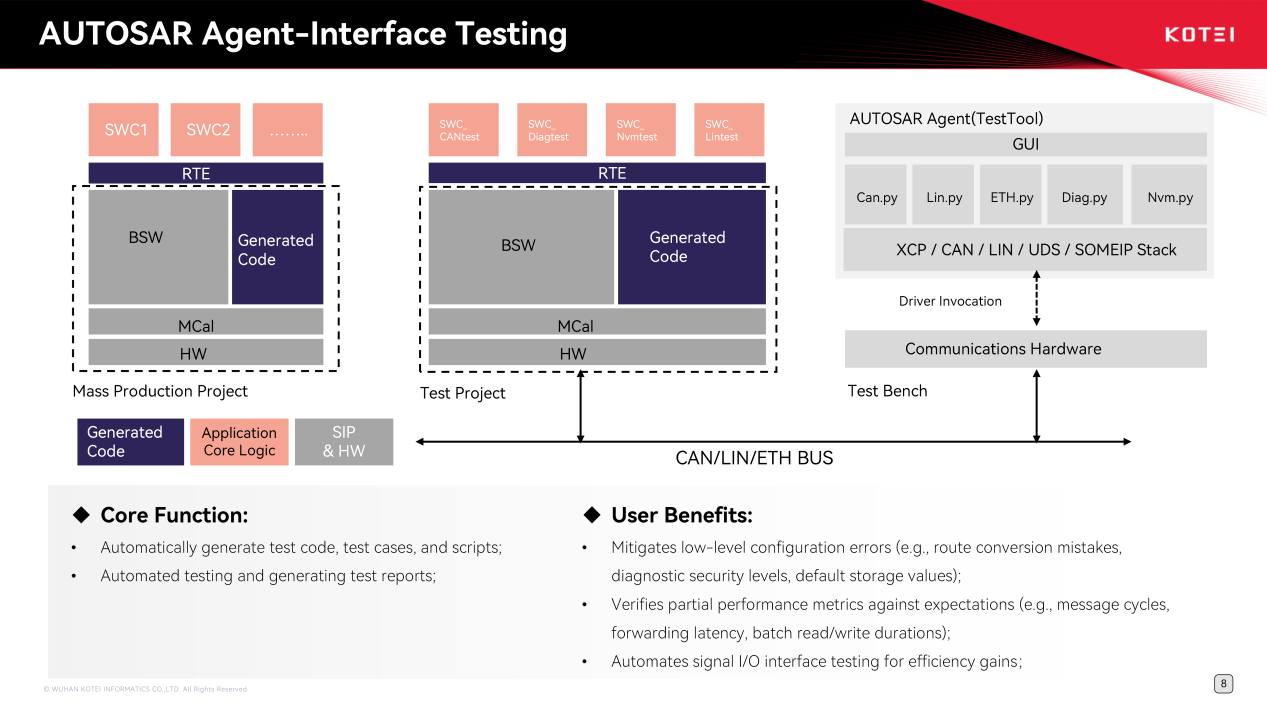
Image source: Speaker materials
In application, the Agent excelled at requirements conversion, achieving near 100% accuracy when translating unstructured inputs into structured data—a testament to the knowledge graph's precision. Regarding speed, the Agent answers queries within 3 seconds and delivers full outputs in under a minute, drastically cutting down team communication and decision-making time. In automated testing, the Agent autonomously handles most test identification and issue resolution. For lingering complex problems, it escalates them to engineers for manual intervention, optimizing the balance between human and machine collaboration.
The impact on workload and efficiency is clear. For example, configuring a new MCU project—once a month-long job for 20 to 30 engineers—can now be completed with roughly half the manpower and time. This substantial efficiency gain not only reduces labor costs but also makes the team more agile in responding to demands across multiple models, chips, and OEMs.
The successful deployment of the AUTOSAR Expert Agent is underpinned by Kotei Info's proprietary Agent technology platform. Featuring a universal Agent framework, LLM foundation, toolchains, and a planning memory system, the platform provides robust support for developing various specialized Agents. This creates a reusable, scalable technical base, securing the long-term future of AI-driven software development.
From Fixed Workflows to Autonomous Planning: Accelerating the Evolution of the Development System
As the AUTOSAR Expert Agent sees wider project use, Kotei Info is eyeing the next technological breakthrough: moving from standardized workflows to more intelligent autonomous planning.
Currently, the first-stage Agent uses AI to link standardized manual workflows, enabling automated execution while allowing for manual verification of interim results. To meet diverse customer, model, and chip requirements, the company has initiated a second phase of R&D. The goal is AI autonomous planning, where the Agent automatically identifies requirements and designs workflows based on project specifics, supporting both parallel and sequential task optimization. Once implemented, this phase is expected to boost software development efficiency by more than 50%.
Following the autonomous planning phase, the company aims to achieve full-process end-to-end automation. This would enable AI to handle the entire chain from requirement input to final output, with human intervention reserved only for critical checkpoints, fully accelerating the intelligent evolution of automotive software development.
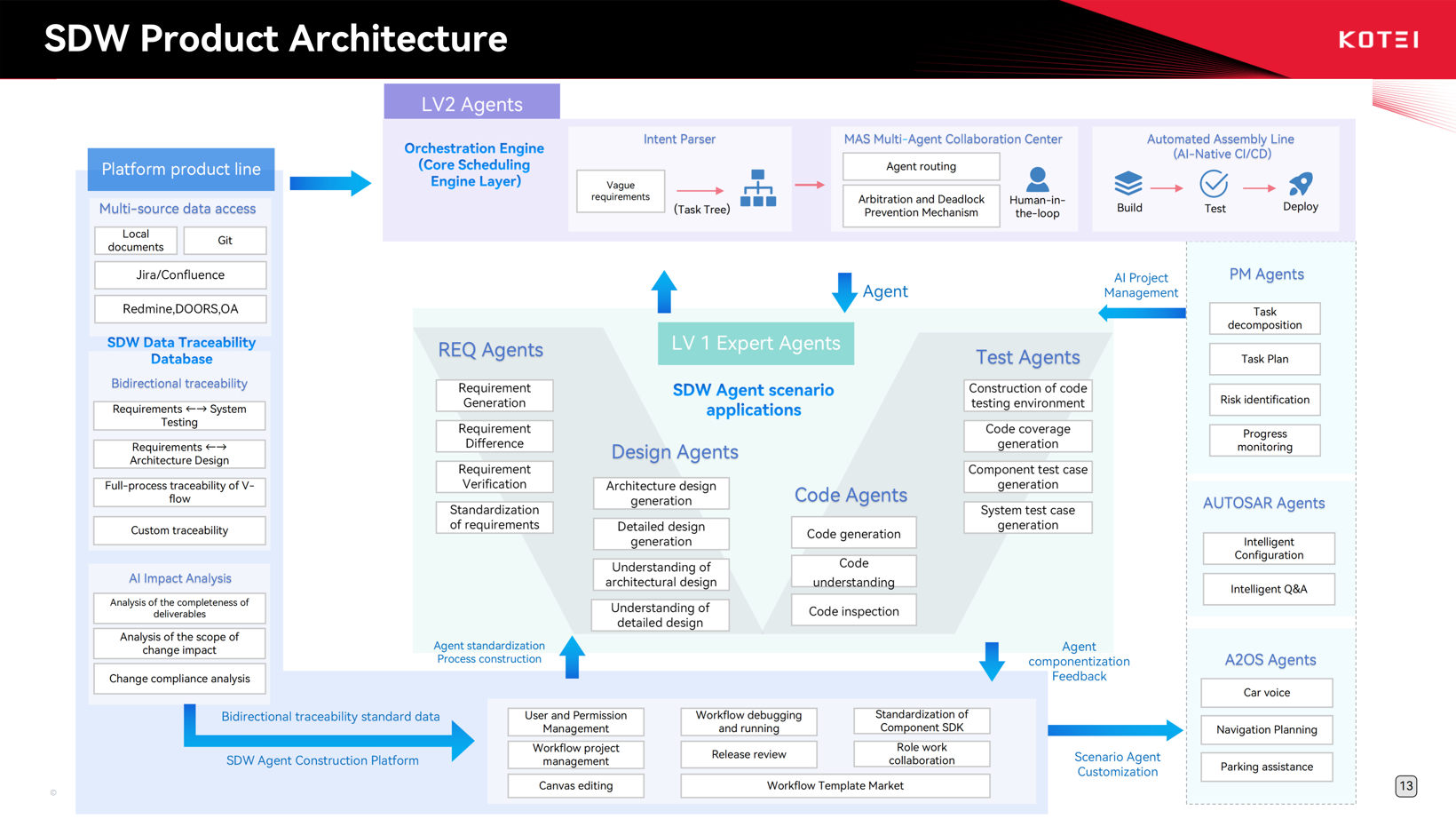
Image source: Speaker materials
Kotei Info has constructed a comprehensive technical platform and product matrix for its AI-driven software development system. The foundation is a proprietary LLM adapter capable of seamless integration with general models like Qianwen and ChatGPT, incorporating general toolchains and memory systems. Above this, the company classifies Agents into two tiers. The first tier consists of Expert Agents, which focus on specialized development scenarios. Leveraging knowledge graphs and standardized processes, they provide AI support for requirements analysis, code generation, automated testing, and project management, and are already in use across multiple projects. The second tier is the Autonomous Planning Agent. Designed to intelligently identify tasks based on specific client and project needs, this agent assembles bespoke Expert Agents to drive execution, enabling personalized, full-process intelligent development. This technology is currently advancing steadily.
Looking ahead, Kotei Info plans to refine its autonomous planning and end-to-end automation capabilities. The goal is to elevate AI from a supportive role to a core driver in automotive software development, achieving full-chain intelligent processing from input to delivery. This vision aims to sustain industry-wide efficiency gains and push automotive software development toward higher levels of intelligence and innovation.


