



The new year typically brings a "slow season" to the power battery market, but according to the latest January 2026 data from the China Automotive Power Battery Industry Innovation Alliance (hereinafter referred to as the "Alliance"), the first "monthly report" of the year reveals structural signals distinct from the past, hidden within the usual sequential decline. While total production and sales slipped month-on-month, year-on-year growth remains impressive. More crucially, installation volumes, exports, and the performance of different technology routes are collectively charting a new path for the evolving market landscape.
January's "Off-Season" Isn't Off: Structural Divergence Amid a Shift in Gears
Alliance data shows that in January 2026, combined output of power and energy storage batteries in China hit 168 GWh—a 16.7% sequential drop but a staggering 55.9% surge year-on-year. Sales totaled 148.8 GWh, down 25.4% from the prior month yet up 85.1% annually. Most notably, power battery installations—the industry's key metric—reached 42 GWh. Despite a 57.2% sequential plunge driven by the Lunar New Year holiday, this still represents an 8.4% year-on-year increase.
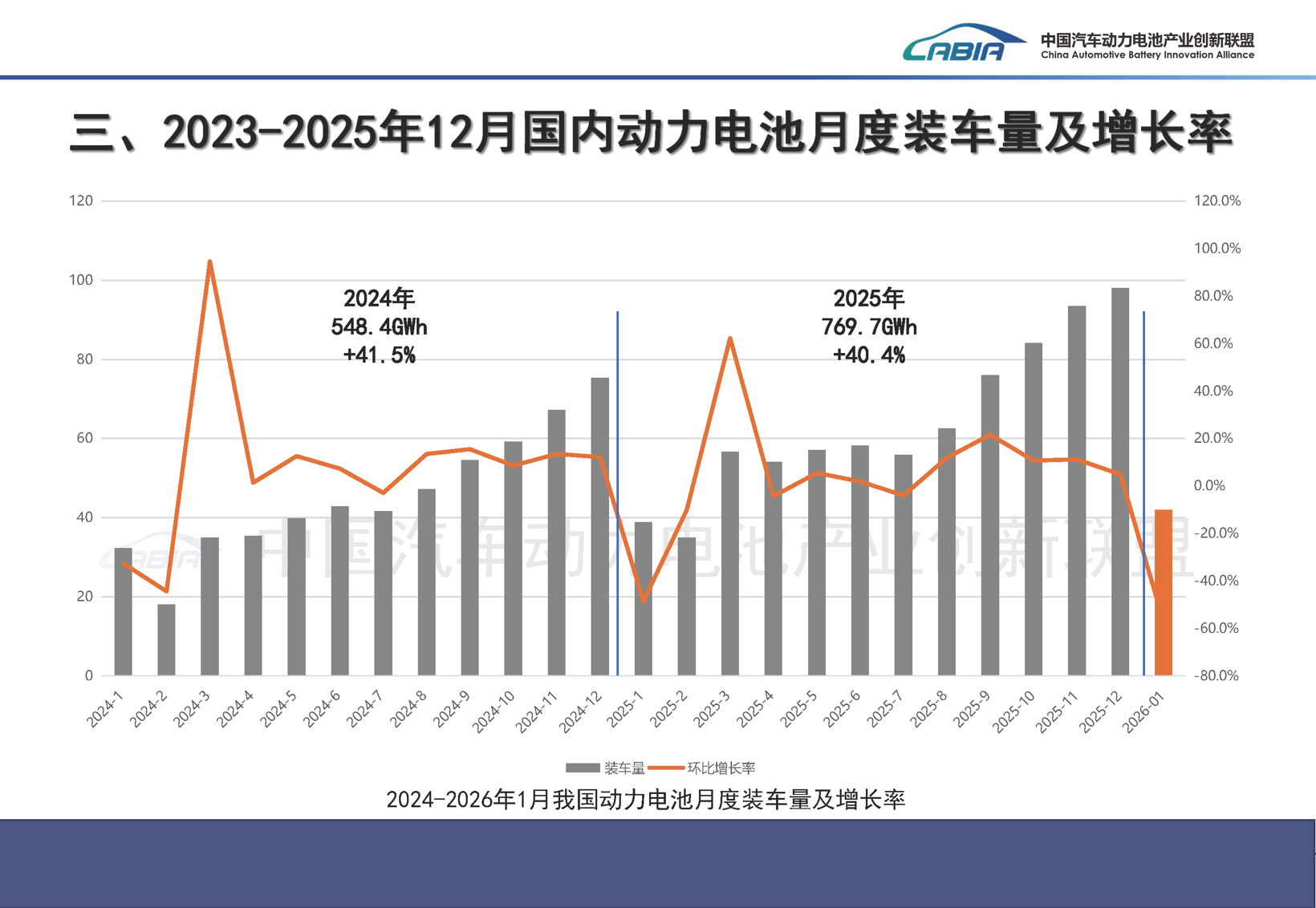
Image source: Alliance (same below)
This "monthly report" exposes several defining characteristics of the industry's development, visible in the gap between sequential and annual figures.
First, the momentum behind annual growth remains robust. The double-digit percentage gains in both production and sales indicate the sector is still in an expansionary phase, with end-market demand for new energy vehicles providing solid support for the upstream supply chain. Power battery sales alone hit 102.7 GWh in January, accounting for 69% of total sales and jumping 63.2% year-on-year—further cementing their status as the core engine of industrial growth.
Second, the sharp sequential decline aligns with seasonal patterns. January is typically a period of production adjustment for automakers, naturally dampening procurement demand. However, the 57.2% drop in installations also reflects a supply chain actively managing inventory and production rhythms following the year-end push—a rational market correction.
Of greater concern are the structural shifts. Lithium iron phosphate (LFP) battery installations reached 32.7 GWh, claiming 77.7% of the total. Despite a 59.1% sequential slide, they rose 8.1% annually, further solidifying market dominance. In contrast, ternary lithium batteries managed 9.4 GWh, or 22.3% of the total. While their 9.6% annual growth roughly matches LFP's, their market share continues to face compression.
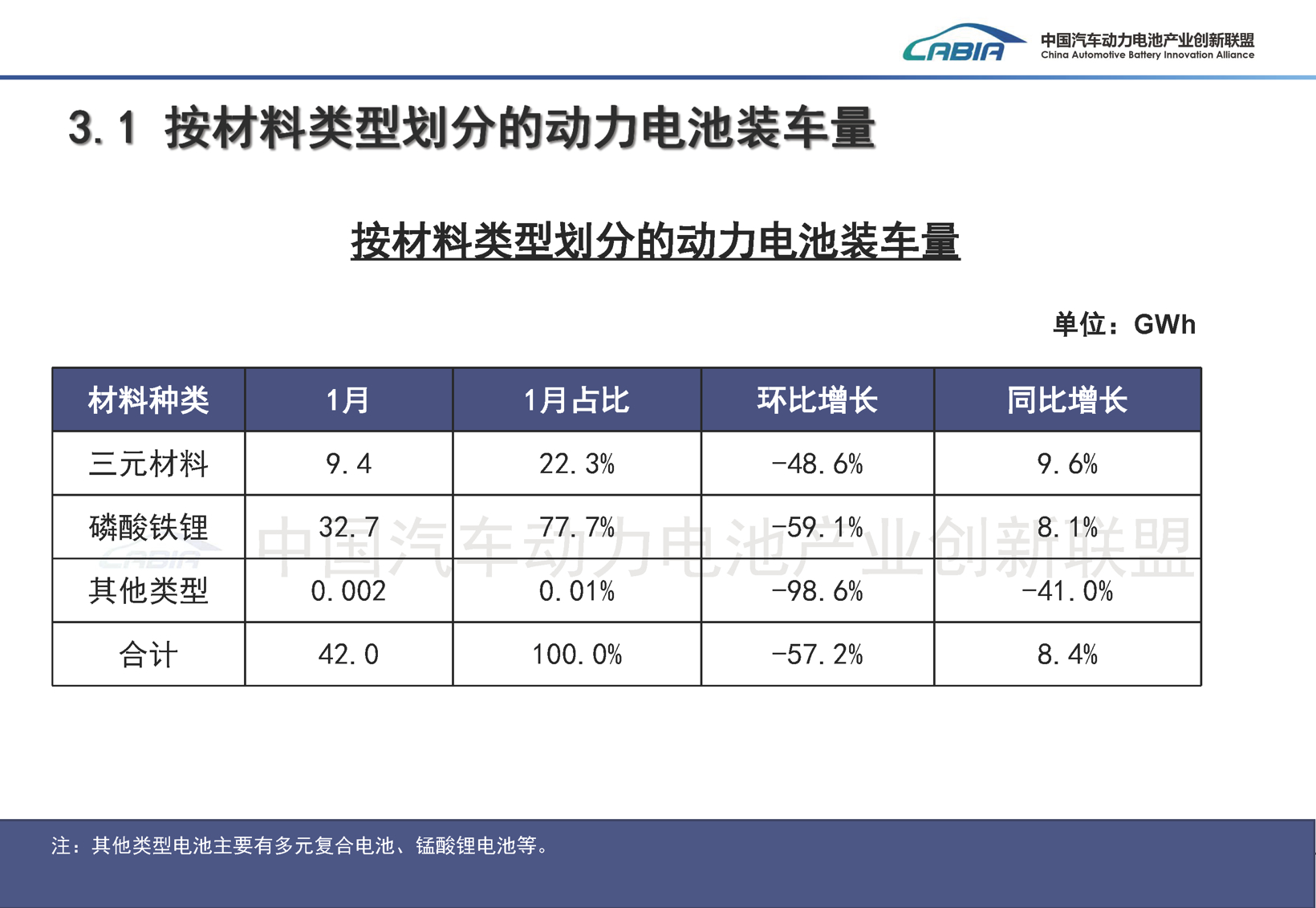
This ebb and flow between technology routes reflects a pragmatic market choice balancing cost, safety, and performance. For the vast majority of models prioritizing value, LFP has become the default. This signals the way forward for battery companies: how to consolidate the LFP base while breaking through in the high-end ternary market and next-generation technologies like solid-state batteries.
The "Two Kings" Remain Unshakable, While the Second Tier Seeks to Rewrite the Competitive Landscape
When discussing market structure, the dominance of CATL and BYD—the "Two Kings"—remains the unavoidable theme. Far from being weakened, this duopoly appears even more entrenched during the off-season, according to the Alliance's latest installation data for January.
In January, 33 power battery companies achieved installations in China's domestic market, three fewer than last year, signaling ongoing resource consolidation. The dominance of the leaders is staggering: CATL topped the list with 20.91 GWh installed, commanding a 49.79% market share—up 3.14 percentage points sequentially. BYD followed in second with 7.32 GWh, securing a 17.43% share.
Together, these two giants installed 28.23 GWh, accounting for a massive 67.2% of the total. This means that out of every three new energy vehicles hitting the road, more than two are powered by batteries from either the "Ning King" or the "Di King." Although their combined share dipped slightly by 2.8 percentage points compared to last year, their absolute dominance in a traditional slow month like January remains undisputed.
Under the shadow of these giants, the battle for the second tier is heating up. Gotion High-tech took third place with 2.55 GWh installed and a 6.06% share; CALB ranked fourth with 2.22 GWh and a 5.28% share; EVE Energy followed closely with 2.07 GWh, holding 4.92%.
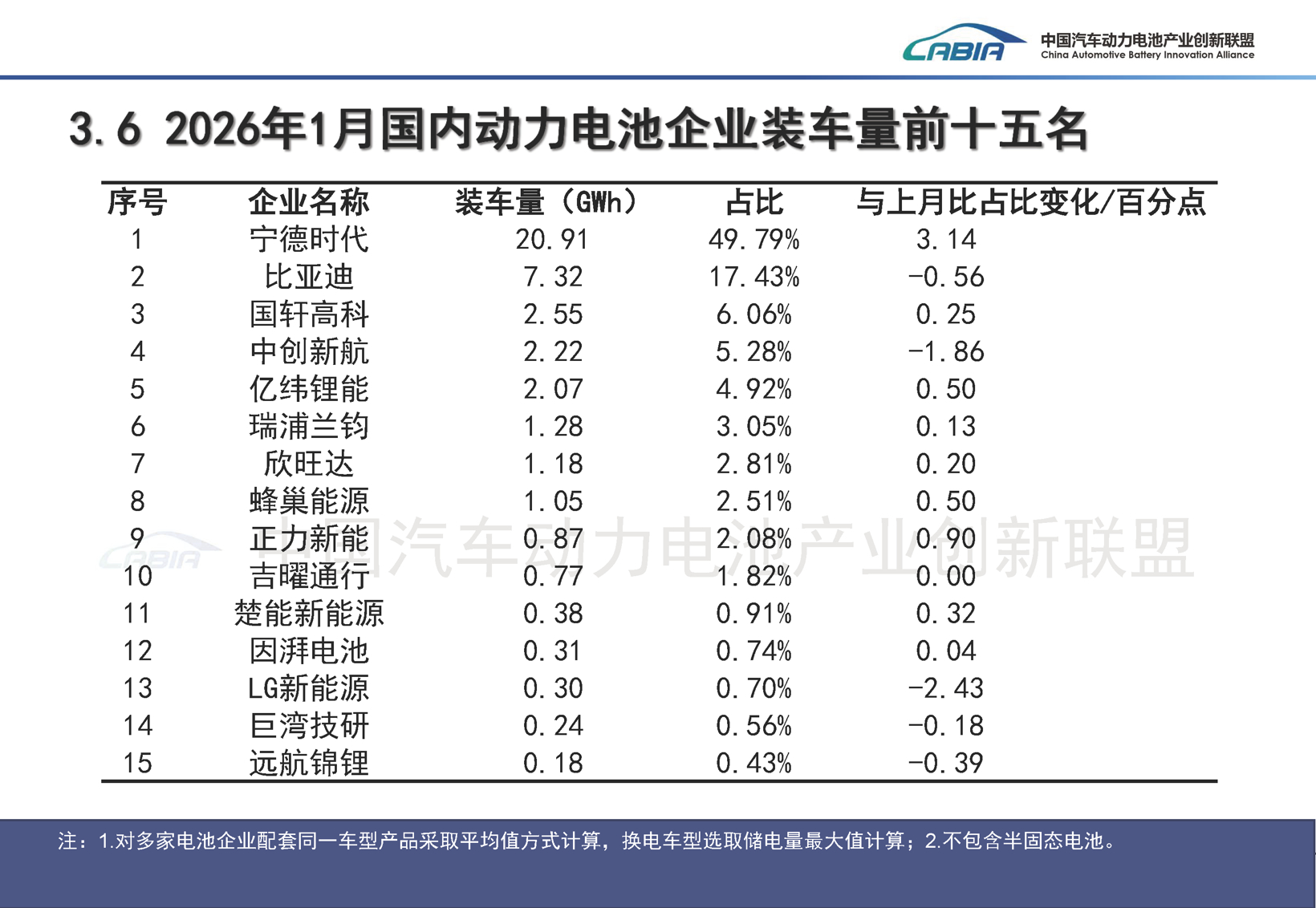
Concentration data reveals that the top five companies accounted for 35.1 GWh of installations, or 83.4% of the total. The top ten reached 40.2 GWh, capturing 95.7% of the market. This indicates high resource concentration in the power battery sector. However, the top ten's share slipped 1.1 percentage points year-on-year—a subtle shift suggesting the market isn't fully sealed, leaving a sliver of opportunity for second-tier players and new entrants.
Competition is particularly fierce among ranks 6 to 15. Rept Batteries, Sunwoda, and SVOLT took the 6th through 8th spots, all with installations above 1 GWh and separated by razor-thin margins. Notably, ZENERGY BATTERY TECHNOLOGIES installed 0.87 GWh for a 2.08% share; with a 0.9 percentage point sequential increase, it emerged as one of the month's fastest-growing companies, displaying strong upward momentum.
Emerging players like CORNEX NEW ENERGY and IBT also cracked the top 15, signaling the rise of new forces. Conversely, foreign giant LG Energy Solution saw its installations slump to just 0.30 GWh in January, sliding to 13th place. Its market share fell 2.43 percentage points sequentially, further squeezing its survival space in the Chinese market.
The January power battery market acts like a prism, reflecting both the natural correction following rapid industry growth and the deep structural shifts in technology and competition.
As the new energy vehicle market transitions fully from "policy-driven" to "market-driven" growth, the demand for power batteries has shifted from "good enough" to "excellent." Whether it's the "Two Kings" deepening their moats, the second tier seeking differentiation through innovation and customer partnerships, or emerging technologies like solid-state and sodium-ion batteries waiting in the wings, 2026 promises to be a marathon defined by technical depth, cost control, and globalization speed. The January data is merely the opening chapter worth savoring in this long run.


