



Gasgoo Munich- The auto components sector saw a major development on February 26. Bethel Automotive Safety Systems announced plans to acquire a 50.9727% stake in Yubei Steering System (Xinxiang) Co., Ltd. for no more than 1.1214 billion yuan, a move that would secure controlling interest.
This alliance between two heavyweights marks a landmark move for Chinese auto parts firms. Facing the heat of global competition, they are actively pursuing horizontal integration to accelerate their growth and scale.
Deal Moves Forward: Bethel Automotive Safety Systems Aims to Seize Control of Yubei Steering
According to the filing, Bethel Automotive Safety Systems intends to sign share transfer agreements with several shareholders of Yubei Steering. The plan involves purchasing a total of 50.9727% of shares. Sellers include institutions such as Junhong Industrial Co., Ltd., Ningbo Fengyuan Equity Investment Partnership (Limited Partnership), Hefei Huaxin Yunxiang Automotive Electronics Investment Partnership (Limited Partnership), and Hefei Industrial Investment High-Growth No. 1 Equity Investment Partnership (Limited Partnership).
Upon completion, Bethel Automotive Safety Systems will become Yubei Steering's controlling shareholder. Yuan Yongbin will emerge as the de facto controller, and the target company will be consolidated into Bethel Automotive Safety Systems's financial statements.
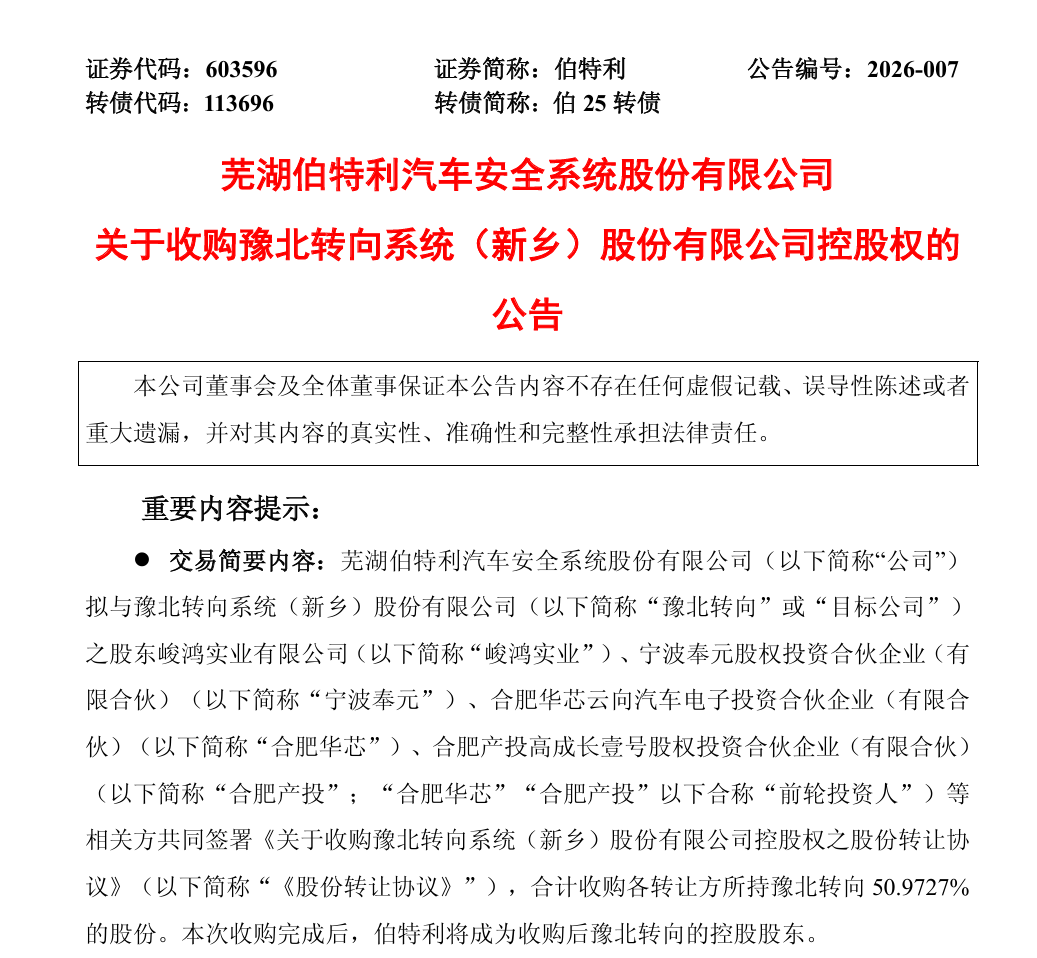
Image Source: Screenshot of Bethel Automotive Safety Systems announcement
Regarding valuation, the parties agreed that Yubei Steering will be valued at no more than 2.2 billion yuan, putting the transaction price at no more than 1.1214 billion yuan. To safeguard the quality of the acquisition, the sellers have made commitments: Yubei Steering's net assets attributable to shareholders will not fall below 930 million yuan by the end of 2025, and R&D expenses will account for at least 3% of revenue. This ensures asset quality and sustained investment in innovation.
In terms of business credentials, Yubei Steering is a top-tier domestic supplier of automotive steering systems with over five decades of manufacturing heritage. Its portfolio covers electric power steering, hydraulic power steering, and core steering components. The company serves mainstream domestic automakers and emerging EV players, holding a leading market share in commercial vehicle steering and electric steering segments.
Bethel Automotive Safety Systems, for its part, is a globally recognized player in chassis systems and body components. With proprietary intellectual property and mass-production capabilities in mechanical braking, electronic braking, intelligent driving, and lightweighting, it stands as one of the few domestic braking system leaders capable of going toe-to-toe with international Tier 1 suppliers.
It should be noted that the acquisition still requires approval from antitrust regulators and other government bodies. Audits and assessments related to the deal are currently underway. Furthermore, the final transaction price has not yet been fixed; it will be determined later through a supplemental agreement based on the target company's 2025 audit results, pricing terms in the share transfer agreement, and reference valuations.
Bethel Automotive Safety Systems acknowledged that the acquisition carries some uncertainty. The company pledged to announce developments promptly after the supplemental agreement is signed and to maintain timely disclosure as the transaction progresses.
Horizontal Integration: Chinese Parts Firms Fight to Break Through
On the day the announcement dropped, Bethel Automotive Safety Systems Chairman Yuan Yongbin took to WeChat Moments to publicly articulate the industry backdrop and strategic intent behind the deal. "China is the world's largest auto producer, with output three times that of the second-place U.S.," he wrote. "Yet, among the top 20 global auto parts companies, there is only one Chinese firm. Chinese enterprises must scale up and strengthen through horizontal integration to boost competitiveness."
These remarks highlight both the scale advantage of China's auto industry and the glaring weakness in the global competitiveness of its components sector. This is the key to understanding the rationale behind the current acquisition.
China's auto industry is currently shifting from sheer expansion to quality competition. As vehicle exports accelerate and intelligent technology penetrates deeper, component suppliers face higher demands: stronger integration capabilities, broader product lines, greater economies of scale, and more stable global delivery. For years, domestic parts firms have grappled with fragmented niches, small individual scale, insufficient R&D spending, and weak bargaining power. Against international giants like Bosch, ZF, and Continental, they have struggled to mount a systematic defense. Horizontal integration, plugging gaps, and scaling up have become the inevitable choice for local leaders.
The merger of Bethel Automotive Safety Systems and Yubei Steering first brings a high degree of product line complementarity. Bethel Automotive Safety Systems's strength lies in braking, while Yubei excels in steering; both belong to the core safety systems of the chassis, offering strong synergy. Post-merger, Bethel Automotive Safety Systems can rapidly form an integrated "braking + steering" solution, upgrading from a single-component supplier to a chassis safety system supplier. This significantly boosts the value it offers to OEMs and strengthens customer stickiness.
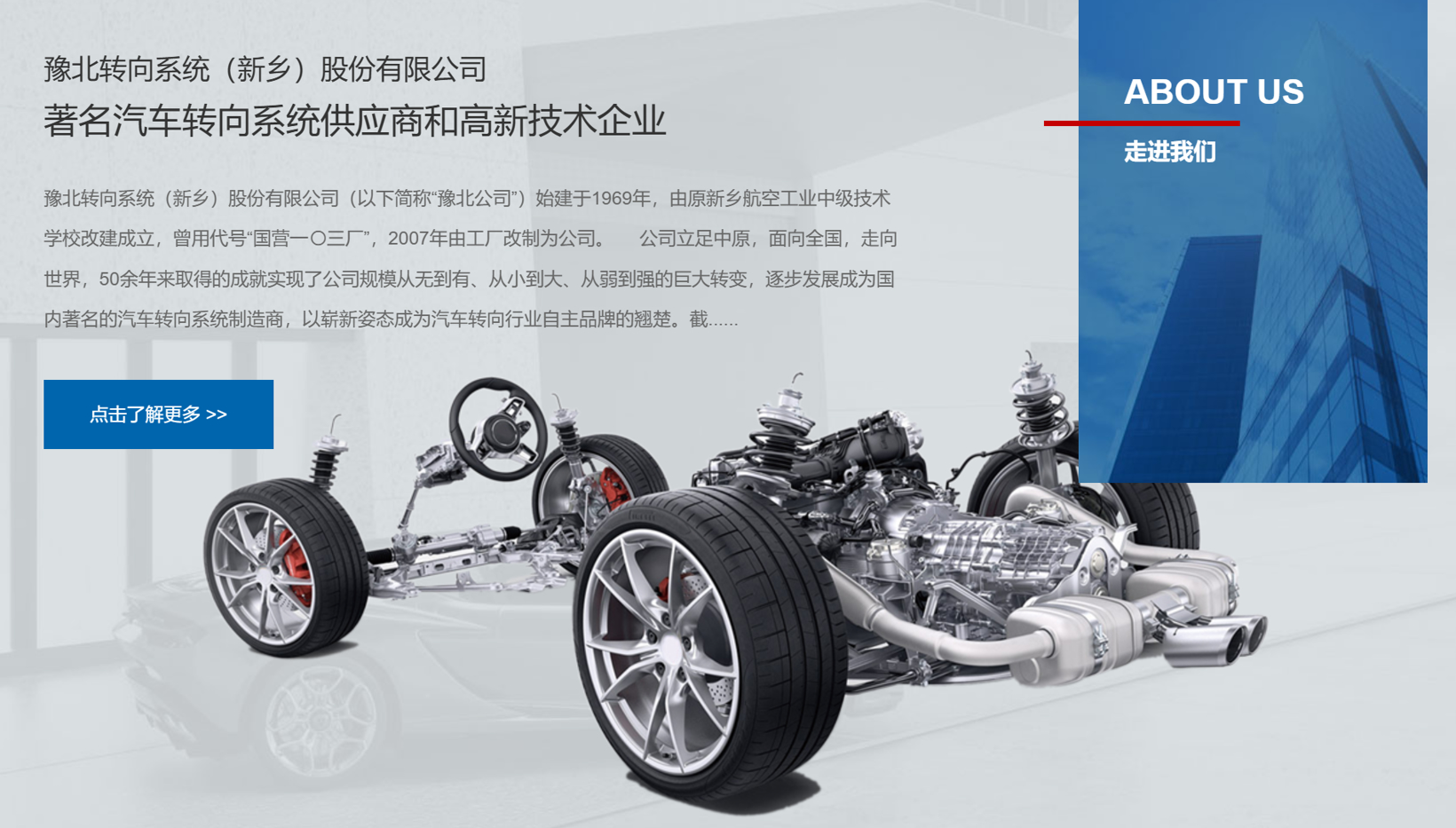
Image Source: Screenshot of Yubei Steering website
Second comes the amplification of market and customer synergies. Yubei Steering has deep roots in commercial vehicles, domestic passenger cars, and emerging EV brands, leading the market in electric steering products. Bethel Automotive Safety Systems, meanwhile, has a solid layout in new energy passenger vehicles, high-end models, and overseas markets. Integrating their customer resources allows for cross-selling and one-stop supply, significantly boosting order volume and delivery efficiency while lowering overall supply chain costs.
Even more critical is the integration and upgrade of R&D and technology. Steering and braking are the core execution layers for steer-by-wire chassis and intelligent driving; their data interconnectivity and algorithmic synergy are key to deploying high-level autonomous driving. Yubei Steering possesses in-house EPS core ECU development capabilities, while Bethel Automotive Safety Systems has deep accumulation in wire-control braking and electronic control algorithms. Together, they can advance the integration and domain-control development of steer-by-wire chassis, narrowing the gap with top-tier international technology and building core defenses for the smart electric era.
"This collaboration will rapidly expand our product categories and specifications, enhance our R&D and service capabilities, and create win-win outcomes with our customers," Yuan stated.
Analysts at Kaiyuan Securities also noted that if the acquisition is completed, it will help refine Bethel Automotive Safety Systems's layout in the "big chassis" sector. The firm is better positioned to seize the era's opportunity as steering systems evolve from traditional to steer-by-wire. It also strengthens development capabilities for key components like ball screws and motor control, likely generating strong synergies across customers, products, and the supply chain.
This acquisition is clearly more than a simple equity consolidation; it is an active breakout by Chinese domestic parts firms facing global competition. Only through horizontal integration—scaling up, deepening technology, and offering complete solutions—can they secure a more advantageous position in the restructuring of the global supply chain, transforming China from a major automotive power into a strong one.
In the long run, this acquisition will propel Bethel Automotive Safety Systems to new heights in revenue and profit, consolidating its position in the domestic market while laying the groundwork for future global expansion and platform-based development. For the industry as a whole, it signals that China's auto components sector is entering an accelerated phase of consolidation. More niche leaders are set to concentrate through mergers and acquisitions, giving rise to large auto parts groups with genuine global competitiveness.


